
RaeRae Reacts · One Piece Episode 92
Hero and Ballerina
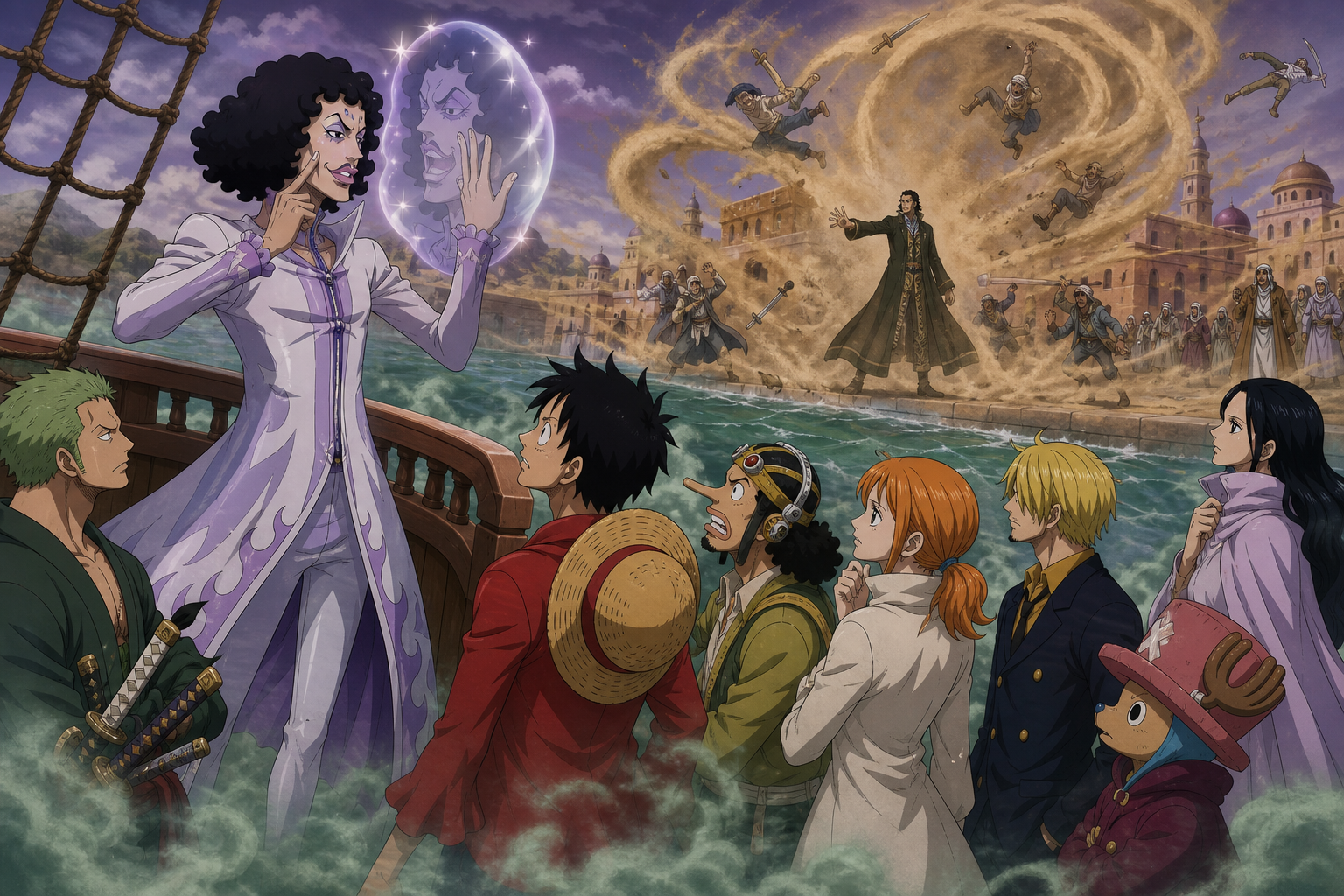
One Piece Episode 92 contrasts Crocodile's public hero performance with Bon Clay's shipboard demonstration of the identity-copying Clone-Clone Fruit.
Quick reaction
One Piece Episode 92 introduces two performances that look entertaining until the consequences settle in. Crocodile saves Nanohana from pirates and receives the gratitude of people who believe their Warlord protects them. Bon Clay dances aboard the Going Merry, copies faces, and turns identity into a party trick. Both men control what other people see. Only the audience understands how dangerous that control can become.
Crocodile’s rescue is real for the residents facing immediate violence. That truth makes his deception stronger, not weaker. He can protect a city today while engineering the national crisis that will make his protection politically necessary tomorrow. Public gratitude becomes part of the weapon because good evidence exists inside the lie.
RaeRae’s bottom line: the Straw Hats do the decent thing by rescuing a stranger from poisonous vapor. They are not foolish for helping Bon Clay. The danger begins when his Clone-Clone Fruit records faces through touch and everybody treats the demonstration as harmless entertainment. Alabasta is already at war with appearances.
Crocodile performs heroism where the largest audience can see him
Nanohana residents watch Crocodile defeat pirates threatening their city. His Warlord title appears to function exactly as promised: the government tolerates a powerful pirate because he uses that power against other criminals. People cheer because somebody dangerous has made them safer in the immediate moment.
The rescue deserves recognition as an event without turning into proof of character. A person can stop one attack and still create another crisis elsewhere. Crocodile understands that visible protection buys trust faster than private policy. Every public victory makes later accusations against him sound less believable.
He also controls the scale of the spectacle. Sand overwhelms the attackers, marks the battlefield, and reminds witnesses that his power belongs to the landscape around them. The message is simple: when danger comes, Crocodile can command the desert better than the kingdom can.
The Warlord system rewards the appearance of public service
Crocodile’s government status creates conflicting incentives. The state wants his strength directed against pirates, while he benefits from crime serious enough to justify his presence. A system that measures visible victories without examining manufactured threats gives him room to produce the need for his own authority.
Cobra’s gratitude carries political weight because a king publicly thanking Crocodile helps legitimize him. Refusing gratitude after a rescue could look cruel or paranoid. Offering gratitude without independent investigation allows the Warlord to convert one intervention into broader moral credibility.
Alabasta needs records of attacks, patterns in pirate arrival, property damage, witness accounts, and connections between repeated crises. The question is not whether Crocodile saved people in Nanohana. The question is who benefits when the same country keeps needing him to perform salvation.
Sand becomes a weapon, a signature, and a warning
Crocodile’s ability strips moisture, controls sand, and changes the physical space around his targets. Residents may see decisive protection. Anyone close to the attack also faces debris, eye injury, breathing problems, dehydration, structural damage, and panic caused by a force that moves through the whole street.
Evacuation should happen before celebration. Children, older residents, animals, injured people, and anyone with breathing conditions need clean air and shelter. Medical teams should assess dehydration and dust exposure even when the defeated pirates appear to be the only casualties.
Evidence matters after the sand settles. Weapon marks, unusual residue, routes used by the attackers, and testimony about timing may reveal whether the confrontation was spontaneous. Cleaning the scene for a heroic public image could erase the details needed to understand a pattern.
Nanohana’s recovery should include the people whose shops, homes, or work routes became part of the attack. A public ceremony for Crocodile cannot replace repair payments, medical follow-up, and honest accounting. Hero stories often center the strongest person in the street while the residents who absorb the damage disappear from the record.
The Going Merry enters a Hot Spot before anyone understands the hazard
At sea, the crew enters a region covered by strange green vapor. The visual change announces danger, but curiosity and forward momentum keep the ship moving. Unknown vapor should trigger distance, covered skin, protected breathing, reduced flame, and a lookout for changing wind before anybody reaches into the water.
The Straw Hats find a stranger and pull him aboard. Rescue is the right choice when someone may drown or suffer exposure. Help does not purchase trust, access, or disclosure from either side. The crew can provide air, water, warmth, and basic assessment while protecting navigation details and Vivi’s identity.
Chopper should evaluate breathing, skin contact, confusion, and possible poisoning. The crew also needs to watch themselves for delayed symptoms. An apparently cheerful survivor does not prove that the vapor was harmless or that exposure ended once the ship left the colored area.
Bon Clay turns rescue into performance without losing his agency
Bon Clay wakes with theatrical energy and quickly fills the deck through dance, humor, and confidence. His flamboyance is part of his expression, not evidence that he is dishonest. The warning signs come from access, unexplained ability, and the strategic value of what he demonstrates.
The crew can enjoy his performance without treating him as a joke whose boundaries never matter. He is a rescued traveler, an unknown combatant, and a person with his own mission. Hospitality should include clear limits around private cabins, maps, supplies, bodies, and information.
That distinction protects Bon Clay as well. Automatic suspicion based on gender presentation or theatrical behavior would be prejudice, not security. Good security focuses on actions available to any stranger: what he touches, what he asks, where he moves, and what information he collects.
The Clone-Clone Fruit makes physical contact a security decision
Bon Clay demonstrates that touching a face allows him to copy that person’s appearance. The reveal lands as comedy because the crew watches familiar faces move through his body. The same power can bypass guards, issue false orders, enter medical spaces, fracture relationships, and frame an innocent person.
Consent matters before demonstration. Nobody should have to surrender biometric access because the group finds transformation entertaining. The crew needs to know whether the ability records a face permanently, whether copied voices and bodies include physical traits, and what action returns Bon Clay to himself.
Once a face has been copied, deletion cannot be assumed. The affected person deserves an honest record of what happened and a plan for future authentication. A copied face creates continuing risk after the friendly encounter ends.
Appearance can no longer serve as proof of identity
The demonstration changes every future reunion, command, and emergency. Seeing Nami, Zoro, Sanji, Chopper, Usopp, Vivi, or Luffy will not be enough. The crew needs private challenge-and-response methods based on information Bon Clay did not hear and behavior he cannot reproduce from appearance alone.
Behavior checks must avoid stereotypes. A woman acting assertive is not automatically fake. A man expressing fear is not automatically fake. Authentication should rely on agreed phrases, recent private events, assigned objects, and reciprocal questions rather than narrow expectations about how each crewmate should perform personality.
Medical trust requires special protection. A copied Chopper could give harmful instructions. A copied Nami could redirect the ship. A copied Vivi could order royal supporters into a trap. Roles with high consequence need a second confirmation channel before the crew obeys an unusual command.
Bon Clay’s copied faces endanger the originals
An impersonator can commit violence, make promises, steal property, or appear in front of witnesses while wearing somebody else’s face. The original may later confront anger or punishment without knowing what the copy did. Every person copied aboard the Merry now carries reputational risk.
The crew should document whose faces Bon Clay recorded, the date, the context, and the limits he described. That record should remain protected because a public list could help enemies design impersonation attacks. Vivi’s inclusion would be especially dangerous in a kingdom already divided over royal intent.
Emotional trust can become a weapon as quickly as official authority. A familiar face can request privacy, touch, money, access, or forgiveness. The safest rule is not permanent suspicion. The safest rule is verification when a request carries unusual consequence.
Verification also needs privacy. Challenge phrases shouted across the deck can be learned by the same observer the system is meant to stop. Each crewmate should hold more than one method, rotate compromised signals, and confirm the person asking as carefully as the person answering.
Vivi recognizes the threat after hospitality has already done its work
The audience understands that Bon Clay belongs to Baroque Works before the crew fully connects the identity. That delay creates dread without making their rescue wrong. Decent people should not stop saving strangers because one rescued person may become an enemy later.
Vivi’s eventual recognition changes the meaning of the demonstration. Baroque Works now has an agent capable of copying the princess, the king, or people trusted by either side. Crocodile can manufacture orders and evidence with more than rumors. He can place familiar faces inside the machinery of civil war.
The crew needs to respond without pretending Bon Clay’s earlier friendliness was necessarily fake. People can share genuine warmth while serving opposing organizations. Emotional complexity does not reduce the operational danger. Both truths can remain visible.
They also need to protect him from automatic retaliation before confirming what he knows and intends. Recognition identifies his affiliation, not every private motive or future choice. Restraint, distance from critical systems, and direct questions provide more information than panic. Security becomes stronger when the crew separates verified capability from assumptions about character.
The production team balances two kinds of theater
Junki Takegami’s script places Crocodile’s controlled public heroism beside Bon Clay’s joyful shipboard performance. One man wants a city to trust the protector he presents. The other displays identity as movement and play. The episode links them through the gap between surface and strategic consequence.
Yuji Endo’s direction lets both sequences entertain before revealing the trap beneath each spectacle. Crocodile receives cheers after violence. Bon Clay receives laughter after transformation. Viewers feel the appeal that makes both men effective rather than watching obvious villains announce deception.
Noboru Koizumi’s animation direction makes copied bodies readable while preserving Bon Clay’s expressive continuity. Fumihiro Uchikawa’s art separates Nanohana’s dry sand from the Hot Spot’s green vapor, giving each danger its own atmosphere without abandoning the larger Alabasta palette.
What Episode 92 changes
Crocodile becomes Alabasta’s celebrated hero in public, establishing the reputation Vivi must overcome. Defeating him will require more than exposing criminal behavior to the audience. Citizens need evidence strong enough to compete with rescues they personally witnessed.
Bon Clay gains the faces of people aboard the Going Merry, turning visual identity into an unreliable system. The crew now needs authentication procedures before reaching a country where false royal orders could accelerate war.
Vivi faces a more dangerous form of manipulation than expected. Crocodile can control public narratives through heroism while an agent can control private trust through copied faces. Alabasta’s crisis depends on people believing what they see, and both tools attack that belief from different directions.
Episode details
Japanese title: Arabasuta no Eiyuu to Senjou no Bareriina
English title: Alabasta’s Hero and the Ballerina on the Ship
Japanese broadcast: December 9, 2001
Saga: Alabasta
Script: Junki Takegami
Episode direction: Yuji Endo
Animation direction: Noboru Koizumi
Art: Fumihiro Uchikawa
The official One Piece episode guide supplies the title, broadcast record, and production credits. RaeRae’s analysis connects Crocodile’s public rescue, the Warlord incentive, sand exposure, the Hot Spot, Bon Clay’s rescue, face copying, and Vivi’s recognition to the episode’s wider argument about performance and trust.
Final verdict
Episode 92 makes deception effective by giving every performance a truthful surface. Crocodile really saves people from pirates. Bon Clay really brings joy to the deck. The problem lies in what each man can do with the trust earned through those moments.
The Straw Hats should not regret helping Bon Clay. Their humanity remains worth protecting. They should regret treating copied faces as consequence-free entertainment when Vivi is traveling into a political crisis built on manufactured evidence.
RaeRae rating: 9.2/10. Evacuate before cheering Crocodile, investigate repeated crises, rescue strangers without surrendering the map, ask before copying a face, and build authentication before Alabasta turns somebody familiar into a weapon.