
RaeRae Reacts · One Piece Episode 86
Hiriluk's Blossoms
One Piece Episode 86 follows Chopper's dangerous search for Amiudake as Hiriluk completes his blossom research and entrusts Chopper's medical education to Kureha.
Quick reaction
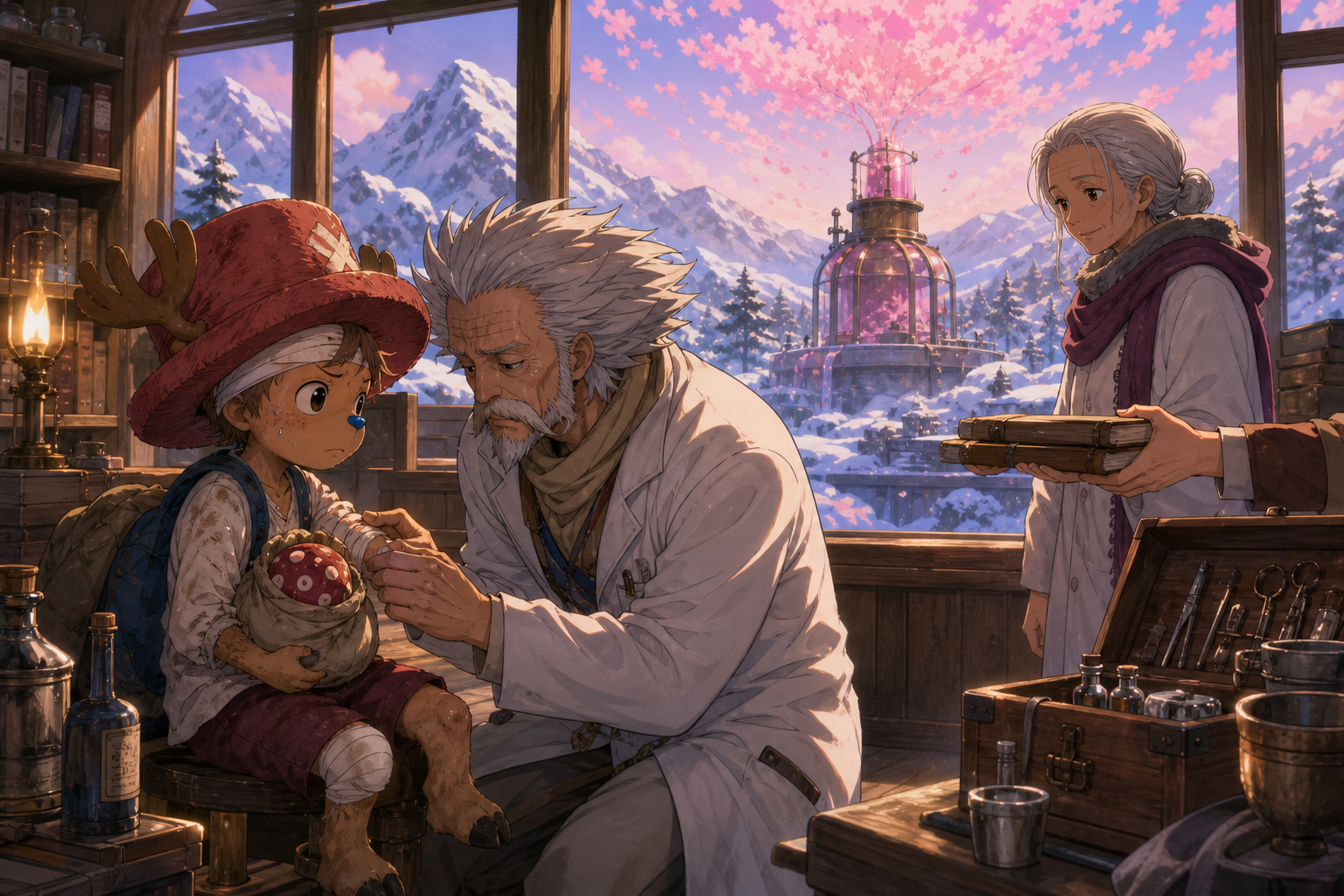
One Piece Episode 86 breaks Chopper’s heart with the cruelest possible collision between love and incomplete knowledge. Hiriluk receives a terminal prognosis and hides the countdown. Chopper discovers enough to understand that his father figure is dying, mistakes a skull beside a mushroom for a symbol of cure, and nearly destroys his own body bringing home poison.
Hiriluk drinks the soup because he understands the love inside Chopper’s mistake and knows his own death is already close. That choice is emotionally devastating. The choice also leaves a child believing his medicine mattered in a way that will require careful truth later. Love can protect somebody for one night while creating confusion that follows for years.
RaeRae’s bottom line: Hiriluk’s inherited will should give Chopper purpose, not lifelong obligation or blame. Kureha needs to teach the science, name the mistakes, preserve the access principle, and help him understand that one poisonous mushroom did not cause a terminal illness.
A terminal prognosis demands planning, not secrecy disguised as protection
Hiriluk learns that he has roughly ten days left. The countdown affects pain control, unfinished research, Chopper’s care, property, patient records, hazardous materials, and who needs to know. Ten days is not merely an emotional deadline.
Advance planning protects choice. Hiriluk should identify a medical decision-maker, document symptoms and preferences, arrange custody of his work, and decide how Chopper will receive the truth. Kureha is the obvious partner because she understands both medicine and the child who depends on him.
Secrecy may spare Chopper one immediate shock, but silence leaves him interpreting symptoms alone. A young trainee can sense decline without having language for the cause. Partial information often produces more fear, not less.
Chopper learns enough to panic without receiving enough to grieve safely
Chopper realizes Hiriluk is dying and responds by searching for a universal medicine. His decision comes from love, medical aspiration, and the belief that failure to find a cure equals failure to save the person who accepted him.
Children and trainees need direct, age-appropriate information about terminal illness. Someone should explain what doctors know, what remains uncertain, what comfort care can do, and why one learner is not responsible for reversing death.
Grief support also needs practical structure: a trusted adult, safe tasks, permission to ask the same question repeatedly, and protection from dangerous solo rescue attempts. Chopper’s urgency should have alerted Hiriluk or Kureha that he understood more than they intended.
The skull illustration turns visual shorthand into medical catastrophe
Chopper finds an image of a mushroom marked with a skull and interprets the symbol through Hiriluk’s pirate flag. To him, the skull represents conviction, possibility, and the doctor who taught him that no disease should be beyond hope.
In medical and field guides, symbols need legends. A skull commonly warns of poison. Assuming every reader shares that meaning is dangerous, especially when the learner has a different cultural and emotional association.
Kureha’s future teaching should require names, identifying features, habitat, preparation, dosage, contraindications, and independent confirmation. An illustration alone cannot support ingestion, especially when look-alike species may exist.
Chopper’s mountain search should never have become a solo test of love
He travels through dangerous terrain, severe cold, wildlife, and injury to retrieve the mushroom. Every wound becomes proof of devotion in his mind. The episode makes that devotion moving without making the method safe.
No one should forage alone in unknown winter terrain. A route plan, partner, weather check, return deadline, first-aid supplies, and species reference would reduce risk. Wildlife should be avoided rather than treated as obstacles standing between love and success.
When Chopper returns wounded, the response should begin with care, not praise. Rewarding self-endangerment teaches him that medical worth requires sacrificing his body. His effort can be honored while adults state clearly that survival matters too.
The mushroom requires independent identification before becoming medicine
Chopper believes the Amiudake will cure Hiriluk, but belief and effort do not establish pharmacology. The specimen needs confirmation by somebody with botanical and toxicological knowledge before preparation.
Identification should consider cap, gills, stem, smell, habitat, season, look-alikes, and contamination. Cooking may change some compounds while leaving others dangerous. A soup format does not make an unknown organism safe.
Kureha should test or reject the substance and explain the result without humiliating Chopper. Correcting dangerous knowledge works best when the learner remains willing to bring future uncertainty forward rather than hiding another experiment.
Hiriluk drinks the soup through love, consent, and incomplete disclosure
Hiriluk understands that Chopper risked everything to bring what he believes is a cure. Drinking the soup protects the child’s hope during their final time together. Hiriluk also knows his terminal condition limits what poison can take from his future.
Consent requires accurate information, and Chopper cannot provide information he does not have. Hiriluk’s choice is his own, but the emotional exchange should not become evidence that the treatment worked or that devotion makes dangerous medicine acceptable.
Immediate poison care should still follow: identify the species, estimate amount and timing, preserve a sample, monitor symptoms, and contact Kureha. Terminal illness does not remove the right to comfort or the value of preventing a more painful death.
Chopper cannot become responsible for the outcome
Hiriluk was already dying before the soup. Chopper needs that fact stated plainly and repeatedly after the death. Otherwise, a child doctor may build his entire career around the belief that one error killed the person he loved.
Accountability can exist without blame. Chopper made a dangerous identification and needs education. Hiriluk chose to ingest the soup while withholding key information. The adults around them failed to build a safer disclosure and supervision plan.
Bereavement care should allow anger, guilt, relief, confusion, and memories that do not fit a heroic story. Chopper deserves a relationship with Hiriluk’s legacy that includes love and mistakes together.
Hiriluk’s blossom research succeeds as a symbol, not a clinical cure
Hiriluk spent thirty years trying to recreate the pink blossom sight that changed his own will to live. His work aims at a country’s spirit through color, scale, and shared experience rather than through a drug that treats one diagnosis.
Beauty is not proof of safety. The powder, launch system, dispersal, residues, and environmental effects need testing and reproducible records. A symbolic ritual should never be marketed as medical treatment without evidence.
The distinction preserves the dream instead of diminishing the dream. Art, wonder, and collective hope can support health while remaining different from antibiotics, surgery, nutrition, or public clinics. Drum needs both imagination and medicine.
Residents should hear that distinction clearly before the display becomes public. Someone facing serious illness must not abandon proven care because the mountains look transformed. Kureha can honor Hiriluk while stating that emotional renewal and clinical treatment answer different needs.
Thirty years of research deserves records another person can reproduce
Hiriluk entrusts notebooks and materials to Kureha. Custody should include an inventory, dates, formulas, trial results, failed attempts, safety notes, and clear separation between tested facts and speculation.
Kureha should not have to reverse-engineer sentiment from scattered pages while caring for Chopper and a country. Reproducible work allows her to verify the blossom safely and prevent hazardous materials from becoming folklore.
The records also preserve authorship without turning Hiriluk into an infallible scientist. Future readers should see the labor, the breakthroughs, and the errors. Honest preservation respects him more than polished mythology.
Hazardous compounds and launch components need controlled storage until review is complete. Labels should identify contents, risks, dates, and responsible custodians. A grieving admirer finding an unlabeled powder should not be able to repeat the experiment from enthusiasm alone.
Kureha inherits Chopper’s education without inheriting ownership
Hiriluk asks Kureha to teach Chopper. The request recognizes her expertise and the trust between them, but Chopper is not a research notebook transferred with the estate. Kureha still needs his consent and must build a relationship he can question.
His education needs anatomy, diagnosis, pharmacology, toxicology, sanitation, field medicine, records, consent, and supervised practice. The mushroom disaster should become a case study in identification and disclosure rather than a secret everybody avoids.
Kureha should preserve Hiriluk’s principle that medical care cannot belong only to elites while correcting unsafe methods. Inherited will becomes useful when the next person carries the purpose and improves the practice.
Inherited will should offer direction without becoming a debt
Chopper can choose to become a doctor who treats diseases others call impossible. He should not believe that changing the whole country or completing every abandoned project is the price of loving Hiriluk.
Kureha needs to name which responsibilities are hers, which belong to Drum’s institutions, and which Chopper may accept later. Adults protect grieving children by refusing to hand them every unfinished task.
Luffy’s future invitation should also wait for enough grief processing to make choice meaningful. Adventure can offer belonging, but adventure should not become an escape adults arrange before Chopper understands what he is leaving.
Nami and Sanji hear a legacy relevant to the voyage ahead
Nami and Sanji learn why Chopper practices medicine and why Hiriluk’s flag matters. They should receive the story without turning Chopper’s most painful history into crew entertainment or a recruitment argument.
The Going Merry will need storage for medical texts, safe mushroom samples, controlled medicines, clean instruments, and continued study. A ship that wants Chopper’s skill must support the education behind that skill.
Poison and mushroom exposure protocols will matter at sea: preserve samples, record time and amount, avoid induced vomiting unless directed, and keep the patient under observation. Hiriluk’s story should change practice, not merely produce tears.
The production team lets objects carry love and error together
Michiru Shimada’s script links the prognosis, book illustration, mushroom, soup, research notebooks, and blossom apparatus through incomplete knowledge. Every object means something different to the person holding the object.
The chain works because no single villain causes the tragedy. Time is short, adults delay disclosure, a child reads a symbol through love, and medical hope outruns verification. The episode asks viewers to feel the devotion while noticing the safeguards that could have changed the outcome.
Konosuke Uda’s direction allows the emotional truth and medical danger to coexist without flattening either one. Chopper’s return is courageous and alarming. Hiriluk’s acceptance is loving and ethically complicated.
Eisaku Inoue’s animation direction makes Chopper’s physical cost visible. Kunihiro Senda’s art transforms winter color through the promise of pink, giving Hiriluk’s idea a visual future beyond his body.
What Episode 86 changes
Chopper’s commitment to medicine becomes inseparable from the loss of Hiriluk and the Amiudake mistake. His future expertise grows from love, guilt risk, and the need for better knowledge.
Hiriluk completes the blossom research and entrusts the work to Kureha. The dream now has a custodian capable of testing, documenting, and safely realizing the symbolic display.
Kureha accepts responsibility for Chopper’s medical education, creating the path from isolated apprentice to the doctor the Straw Hats will meet. Inherited will passes through correction rather than simple imitation.
Episode details
Japanese title: Hiriluk no Sakura to Uketsugareyuku Ishi!
English title: Hiriluk’s Cherry Blossoms and Inherited Will
Japanese broadcast: November 4, 2001
Saga: Alabasta
Script: Michiru Shimada
Episode direction: Konosuke Uda
Animation direction: Eisaku Inoue
Art: Kunihiro Senda
The official One Piece episode guide supplies the title, broadcast record, and production credits. RaeRae’s analysis connects Hiriluk’s prognosis, Chopper’s dangerous forage, the Amiudake soup, consent and blame, blossom research, Kureha’s custody, and inherited medical purpose to the episode’s wider argument about love and incomplete knowledge.
Final verdict
Episode 86 hurts because nobody’s love is fake. Chopper wants to cure Hiriluk. Hiriluk wants to protect Chopper’s hope. Kureha agrees to carry the work forward. The tragedy grows from truths withheld, symbols misunderstood, and a child taking adult responsibility onto a wounded body.
The right legacy is not repeating every choice Hiriluk made. The right legacy is making care more accessible, knowledge more accurate, and hope less dependent on one person destroying himself to prove devotion.
RaeRae rating: 9.7/10. Tell Chopper the prognosis, identify the mushroom, treat the poison, preserve the research honestly, and let inherited will become education rather than debt. Love deserves better information.