
RaeRae Reacts · One Piece Episode 85
Hiriluk's Dream
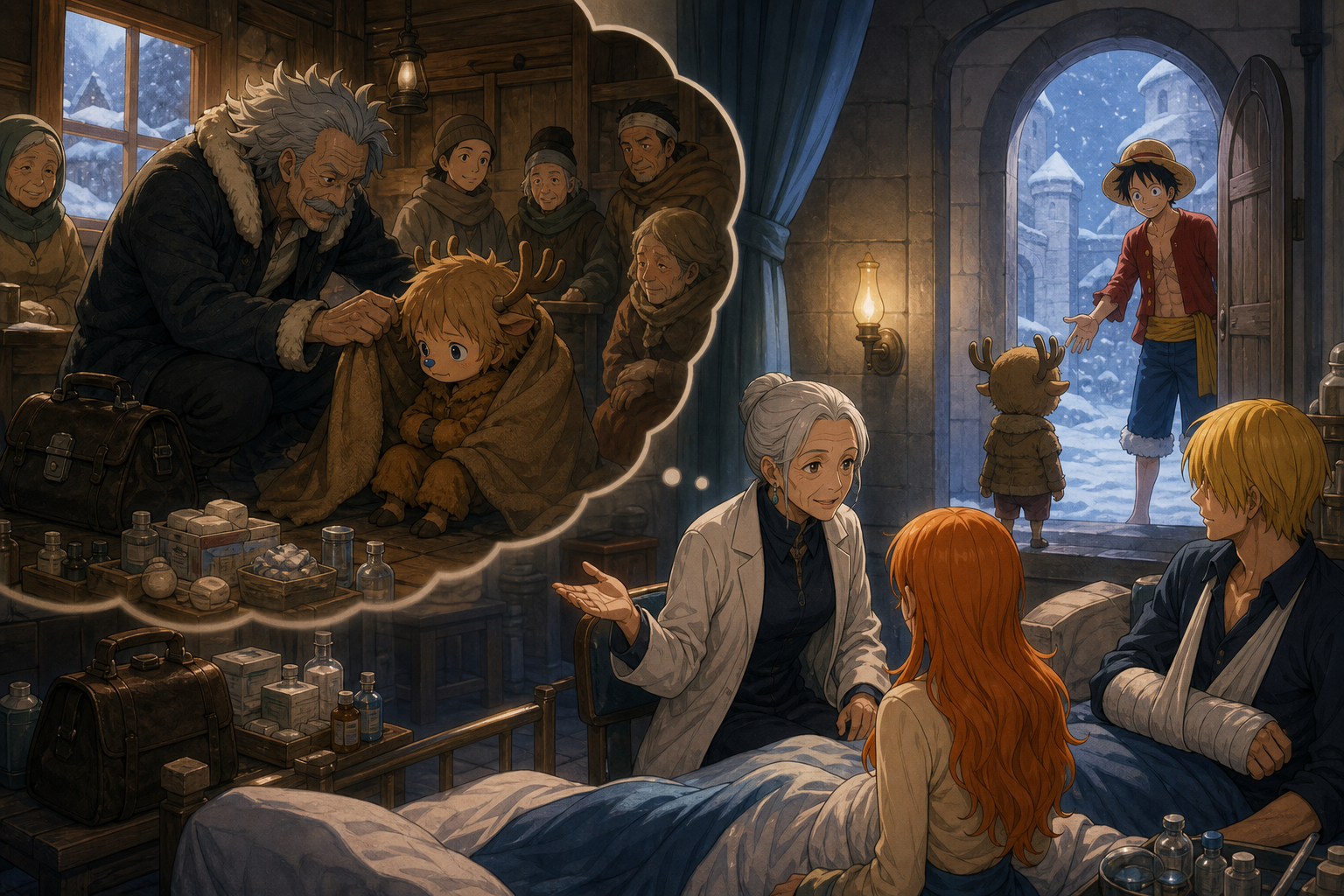
One Piece Episode 85 tells how Hiriluk welcomed Chopper and treated patients during Wapol's doctor hunt while Luffy begins asking Chopper to join the crew.
Quick reaction
One Piece Episode 85 gives Chopper two men who see him differently and still refuse to let him answer easily. Hiriluk looks at an injured outcast and names possibility. Luffy looks at a doctor, fighter, reindeer, and frightened stranger and decides he wants that whole person aboard. Neither moment works if acceptance becomes ownership.
Kureha tells the story while Nami and Sanji remain patients, which keeps Hiriluk’s legacy inside the medical system he challenged. He treated people for free during Wapol’s doctor hunt, but compassion did not automatically make his remedies safe. Drum needed access and competence. Wapol weaponized the absence of both.
RaeRae’s bottom line: Hiriluk deserves love, accountability, and historical honesty in the same paragraph. He gave Chopper a name and a future. He also practiced beyond his skill and sometimes harmed the people he meant to help. Chopper’s dream becomes stronger when he inherits the access principle and corrects the medicine.
Luffy changes the invitation when claiming Chopper fails
Luffy’s first instinct sounds like possession: he wants the strange, impressive doctor on his ship and treats refusal as a temporary obstacle. Chopper has already been hunted, rejected, and handled as something other people define. Recruitment cannot repeat that pattern with kinder intentions.
A real invitation explains the voyage, risks, duties, living conditions, crew expectations, and Chopper’s ability to say no. The Straw Hats travel into combat, government pursuit, harsh climates, and uncertain resupply. Adventure deserves an honest description.
Luffy begins changing when he sees more than novelty. He recognizes courage, grief, medical work, and the attachment to Hiriluk’s flag. Wanting Chopper becomes meaningful when the desire includes respect for what Chopper wants.
No answer is still an answer that needs space
Chopper runs, avoids, and struggles to answer directly. Silence can reflect fear, confusion, or a need for time. The crew should not treat hesitation as hidden consent waiting for enough pursuit.
They should leave one clear route for Chopper to return when he is ready. Repeated shouting, blocking doors, or surrounding him would turn enthusiasm into pressure and confirm the fear that other people decide what happens to his body.
The earlier chase needs repair first. Chopper deserves an apology for being cornered and assurance that nobody will drag him onto the Going Merry. Safety makes conversation possible.
He can request conditions: time to speak with Kureha, medical storage, research space, contact with Drum, freedom to refuse combat, and a clear role in patient decisions. Negotiating needs does not weaken belonging.
Chopper’s medical work is not automatically available to the crew
The Straw Hats need a doctor badly, but need does not create entitlement. Chopper already treated Nami because a patient required care and Kureha directed the clinic. That act does not bind his future labor to the ship.
Joining should never become repayment for food, protection, or friendship. A crew relationship must include what Chopper receives: safety, travel, supplies, help, companionship, and room to continue learning.
If he joins, medical authority needs clear boundaries. Chopper must be able to stop unsafe activity, protect confidentiality, rest outside emergencies, and admit when a condition exceeds his knowledge.
Hiriluk treated people for free during a manufactured medical famine
Wapol gathered the kingdom’s trained doctors under royal control, turning illness into leverage. Residents who needed care had to depend on access shaped by political favor, distance, and obedience.
Hiriluk’s free treatment resisted that monopoly. He went where excluded patients lived and insisted that poor people deserved a doctor. The principle was radical because the government had made ordinary medical access dangerous.
Medical exclusion is political violence. Untreated infection, injury, childbirth, chronic illness, and preventable death become tools of rule when one leader controls every clinician. Wapol’s policy harmed bodies even when no soldier entered a home.
Compassion and competence remain separate duties
Hiriluk wanted to help, but intention could not guarantee diagnosis, dosage, sanitation, or treatment safety. A patient may refuse a volunteer doctor whose methods are unproven, even when no other care is nearby.
Practicing beyond competence creates harm that poverty does not make acceptable. Hiriluk needed supervision, feedback, records, and referral routes. Evidence should guide remedies before hope turns a patient into an experiment.
The fair assessment does not call him useless. He identified a moral failure in Drum and tried to fill the gap. His mistake was treating moral urgency as a substitute for clinical preparation.
Community members could have helped him build safer practice if Wapol had not criminalized independent care. People can track symptoms, prepare clean spaces, identify transport routes, and report outcomes without pretending to be physicians. Public health grows through organized knowledge rather than one heroic person running between homes alone.
Wapol’s doctor hunt created the conditions for unsafe alternatives
When a government removes trustworthy care, desperate people turn toward whoever remains. Hiriluk’s patients carried the risk of his imperfect practice because Wapol denied them safer choices.
That context explains the demand without absolving every outcome. Hiriluk remains responsible for what he administered. Wapol bears broader responsibility for engineering scarcity and criminalizing independent medical work.
Doctors serving under coercion also need protection and scrutiny. Some members of the Isshi-20 may have complied to survive or preserve limited access. Individual records and testimony matter more than treating all twenty as one moral character.
Chopper arrives as an outcast expecting harm
Chopper has been rejected by reindeer and humans, shot, chased, and taught that his transformed body produces fear. Approaching Hiriluk requires a risk he has little evidence will end safely.
Hiriluk responds with acceptance, warmth, food, a name, and a place. Those actions give Chopper a relationship that is not based on hiding. The emotional rescue is real even when Hiriluk’s medical practice remains flawed.
Acceptance should not become dependency that prevents questions. Chopper needs permission to disagree, learn elsewhere, and outgrow his mentor. Love becomes durable when growth is not treated as betrayal.
Hiriluk also needs to recognize the power imbalance between an adult caregiver and an isolated child. Chopper may accept unsafe instructions because losing the relationship feels worse than the risk. A good mentor makes disagreement survivable before asking a student to trust.
Hiriluk names possibility without proving every dream clinically
Hiriluk teaches that the world is larger than Drum and that conditions called impossible may change. For Chopper, that language opens a future beyond hiding and gives medicine an ethical direction toward people others abandon.
Symbolic cures cannot replace clinical care. Hope may improve motivation, connection, and willingness to continue, but hope does not kill bacteria, set a fracture, or identify poison by itself.
Chopper learns through the contradiction. He can preserve Hiriluk’s refusal to abandon patients while building the technical skill his mentor lacked. Inherited will should improve practice rather than freeze every method in reverence.
Kureha’s account needs love and accountability together
Kureha tells Nami and Sanji about Hiriluk because his story explains Chopper’s medicine, fear, and attachment to the flag. She should not turn the mentor into a saint whose errors disappear after death.
Naming the mistakes protects Chopper from copying them. Naming the generosity protects him from believing every failure erased the care he received. Bereavement becomes healthier when memory can hold contradiction.
Hiriluk’s patients also deserve a record. Their outcomes, complaints, gratitude, and harm belong inside the history, not only the perspective of people closest to the doctor.
Nami and Sanji hear the story while still receiving care
Nami listens as a patient whose survival depended on Kureha and Chopper. The story should not pressure her into praising every medical risk or turning gratitude toward Chopper into support for immediate recruitment.
Sanji is recovering from a fracture and may connect strongly with feeding, protection, and chosen family. He still needs to respect Chopper’s decision and his own treatment limits.
Kureha should pause the account when patient care requires attention. Storytelling can support connection, but medicine remains the reason they occupy the room.
A medical handoff requires Chopper’s consent and real infrastructure
Kureha can prepare equipment, records, textbooks, medicine, and supply lists if Chopper chooses the voyage. Preparation should not become a decision made around him.
The Going Merry needs a clean examination area, secure medicine storage, controlled temperature where possible, fresh water, sharps handling, and privacy. Wanting a doctor without changing the ship would ask Chopper to improvise every standard of care.
A supply inventory should identify what Drum can provide, what must be replenished at the next port, and which items need special handling. Continued education requires room for notes, specimens, and reference books.
Patient confidentiality must become crew policy
A small ship makes privacy difficult because everybody hears doors, conversations, and movement. The crew needs a rule that diagnoses, fears, histories, and treatment details belong to the patient unless safety requires disclosure.
Luffy’s status as captain does not grant automatic access to every medical detail. Chopper can share functional limits and emergency information without repeating private conversations.
The same protection belongs to Chopper. His body, transformations, history, and medical research should not become stories crewmates tell strangers for entertainment.
Privacy rules need an emergency exception narrow enough to prevent gossip. If a condition threatens the ship or requires another person’s help, Chopper should share only the information necessary for action. The patient should hear what was disclosed as soon as circumstances allow.
Drum needs community medicine after Wapol
Defeating Wapol will not rebuild clinics or restore trust automatically. The Isshi-20 and Kureha need training routes, distributed supplies, transparent triage, patient records, and care beyond the castle.
Wapol must never regain control of clinicians through a key, title, or remaining loyalist. Medicines and facilities should transfer into accountable public custody with more than one person controlling access.
Dalton’s emergency shows the stakes. A country capable of saving one leader must build the same urgency for residents whose names never reach the castle.
Mobile teams may be necessary for distant winter settlements where travel itself can worsen illness. Public medicine must account for geography, storms, food access, and transport rather than measuring fairness only by whether one central clinic technically accepts everyone.
The production team complicates the mentor without weakening the bond
Michiru Shimada’s script lets Hiriluk be generous, reckless, funny, brave, and dangerous without forcing viewers to choose one label. Chopper’s love remains understandable because the relationship changed his life.
Yoshihiro Ueda’s direction makes memory intimate through rooms, blankets, medicine, and tentative approach rather than distant legend. Chopper’s trust grows through small acts.
Noboru Koizumi’s animation direction gives care imperfect hands. Tomoko Yoshida’s art contrasts public scarcity with the refuge Hiriluk builds, showing why one unsafe doctor could still represent freedom under Wapol.
What Episode 85 changes
Luffy’s interest in Chopper begins shifting from pursuit toward invitation, but Chopper has not consented. The possibility of joining now rests on understanding his history and choices.
Hiriluk becomes the person who accepted Chopper and resisted Wapol’s medical monopoly while practicing with dangerous limitations. His contradictions shape the doctor Chopper wants to become.
Kureha’s role expands from current physician to keeper of a difficult legacy. She must teach Chopper enough to preserve access, correct unsafe practice, and choose a future beyond Drum.
Episode details
Japanese title: Hamidashimono no Yume! Yabu Isha Hiriluk!
English title: Dream of the Outcasts! Quack Doctor Hiriluk
Japanese broadcast: October 28, 2001
Saga: Alabasta
Script: Michiru Shimada
Episode direction: Yoshihiro Ueda
Animation direction: Noboru Koizumi
Art: Tomoko Yoshida
The official One Piece episode guide supplies the title, broadcast record, and production credits. RaeRae’s analysis connects Luffy’s changing invitation, Hiriluk’s free care and unsafe practice, Wapol’s doctor monopoly, Chopper’s acceptance, Kureha’s account, and shipboard medical infrastructure to the episode’s wider argument about belonging and competence.
Final verdict
Episode 85 makes Hiriluk worth remembering because the story leaves room for the harm beside the love. He could not become the doctor Drum needed through compassion alone. He still became the person Chopper needed to imagine a life.
Chopper’s future should not repay that gift through imitation. His future should carry the refusal to abandon people and add the knowledge, consent, records, and accountability that Hiriluk lacked.
RaeRae rating: 9.4/10. Ask Chopper instead of claiming him, repair the chase, build a real clinic aboard the Merry, restore public medicine, and remember Hiriluk honestly. Love survives the truth.