
Naruto and the Old Soldier
A northern-border patrol teaches Naruto that Kosuke’s genin rank records almost nothing about the wisdom, skill, and courage of his fifty-year career.
Bottom line
Naruto Shippuden Episode 190, "Naruto and the Old Soldier," begins during the Leaf's recovery from Pain's assault. Kosuke Maruboshi looks toward the Hokage Monument and remembers an earlier crisis, when Konoha was rebuilding after Orochimaru's invasion.
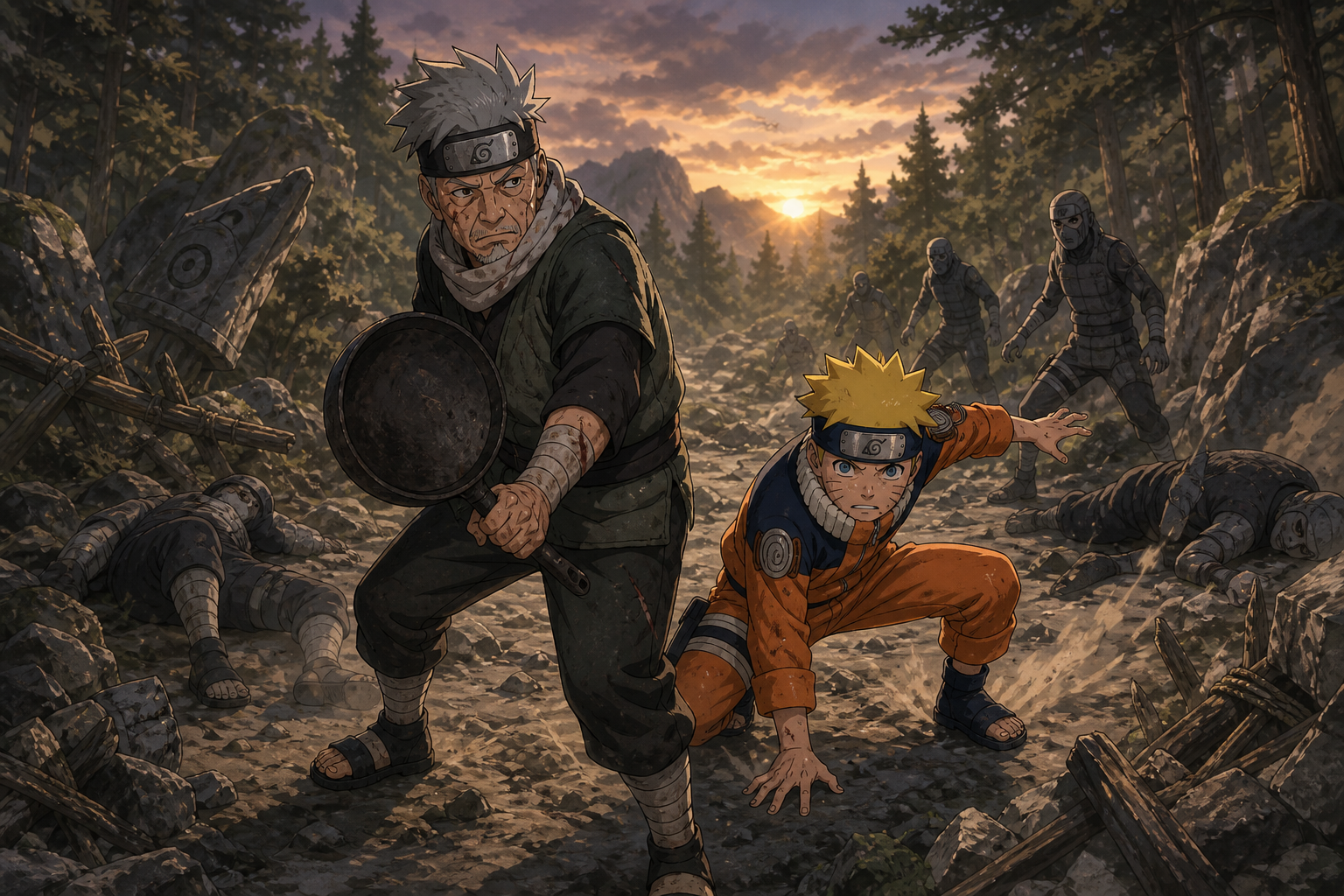
Young Naruto joins a northern-border patrol led by Hayama Shirakumo. The team also includes trap specialist Tekuno Kanden and Kosuke, an elderly man who has remained a genin for more than fifty years. Naruto assumes Kosuke is baggage until the old shinobi reads the terrain, finds supplies, prepares their camp, and casually mentions serving alongside some of the village's greatest ninja.
Rock ninja exploit Konoha's weakened position and cross the border. Hayama and Tekuno stay behind in sequence to delay the larger force while Kosuke orders Naruto to carry a warning home. Kosuke then turns alone to face the pursuers.
Naruto refuses to let him die and returns. The old genin reveals the skill hidden beneath his rank, using the Leaf-Style Willow and his iron cooking pan alongside techniques learned across a lifetime. Together, Kosuke and Naruto defeat the attackers. In the present, Kosuke recognizes that Naruto has become the kind of protector he saw forming on that patrol.
Episode 190 rejects the idea that rank, age, or spectacle can summarize a shinobi's value. Kosuke's fifty years as a genin contain survival, service, mentorship, and knowledge that no promotion badge can measure. Naruto enters the patrol seeing an elderly burden and leaves having fought beside a living archive of Konoha.
Naruto mistakes rank for worth
Naruto knows better than most people that a label can be unfair. He has spent his childhood being judged as a troublemaker and a container before anyone considers his choices. Even so, he looks at Kosuke's age and genin rank and assumes the man cannot contribute.
That contradiction is believable. People who suffer one kind of prejudice do not automatically become immune to every other shortcut. Naruto wants teammates whose strength is obvious because he measures safety through visible power.
Kosuke corrects him without delivering a lecture. He finds mushrooms while reading signs Naruto misses, knows the border better than the younger team, and understands how to make a defensible camp. Competence appears in tasks Naruto initially treats as chores.
The correction works because Kosuke never performs insecurity. He does not list famous teachers to win an argument or demand deference based on age. He lets careful work reveal the gap between Naruto's assumption and reality. Respect grows from attention rather than status.
Fifty years as a genin is not fifty years of failure
The title “Eternal Genin” sounds like an insult until Kosuke explains the life underneath the title. He served with the Second Hokage, learned from the Third, and crossed paths with Jiraiya and Sakumo. Other shinobi advanced, became famous, or died while Kosuke continued taking missions.
His rank stayed still. His experience did not.
The shinobi system likes clean ladders: genin, chunin, jonin, Kage. Kosuke proves that a person's actual knowledge can grow far beyond the badge attached to a uniform. He is not secretly resentful that younger teammates surpassed him. He carries their lessons and remembers them with gratitude.
There is dignity in choosing useful work after prestige stops being the measure. Kosuke cooks, scouts, and watches the border because those things still protect people.
Longevity changes what expertise means. Kosuke has watched tactics, leaders, and crises pass across generations. His value lies not only in accumulated techniques but in recognizing patterns before younger shinobi understand that a pattern exists. The border mission needs exactly that patient memory.
Border patrol shows the work between famous battles
Naruto enters the mission expecting an easy walk. Hayama understands that a damaged village looks like an invitation. Konoha's enemies do not need to defeat its strongest shinobi at full power; they can wait until the walls are broken and the defenders are exhausted.
That makes the patrol politically important even if nothing happens. Its visible presence tells neighboring forces that Konoha still monitors its territory. The team is performing deterrence, the kind of quiet work that succeeds when the feared attack never arrives.
The episode gives ordinary shinobi labor its due. Traps, campsites, tracks, routes, and messenger decisions matter as much as signature jutsu once an invasion begins.
Reconstruction creates vulnerability beyond broken buildings. Enemies watch exhaustion, staffing gaps, and divided attention. A patrol may look uneventful beside the battle that damaged Konoha, yet maintaining the border is part of keeping that disaster from multiplying. Kosuke understands recovery as vigilance plus care.
Hayama and Tekuno turn retreat into a relay
When the Rock force appears, the team does not pretend four people can win one glorious stand. Hayama stays behind so the others can move. Tekuno later takes the next delaying position. Kosuke sends Naruto onward and becomes the third link.
Each person converts time into distance for the teammate carrying the warning. Their plan only works if someone accepts leaving a comrade behind, which is exactly the choice Naruto struggles to make.
From a command perspective, Naruto should obey. The village needs information more than Kosuke needs companionship. From Naruto's perspective, a mission that requires accepting an old man's death has become intolerable. The episode lets both truths exist.
The relay structure gives every delay meaning. Hayama, Tekuno, and Kosuke are not competing for the noblest sacrifice. Each person inherits time purchased by the previous stand and passes that time forward. Naruto's return disrupts the expected final link by asking whether warning the village and saving Kosuke must remain mutually exclusive.
Kosuke's secrecy is humility, not helplessness
Kosuke does not announce his history when Naruto dismisses him. He allows the younger ninja to underestimate him because recognition is not why he joined the patrol. Only when the team needs his strength does he reveal what decades of survival built.
His fighting style feels like a biography. The Leaf-Style Willow carries the Second Hokage's era. His sword skill and battlefield judgment reflect teachers and teammates whose names outgrew his own. The iron pan links combat to the practical care Naruto already saw at camp.
Nothing about Kosuke's power feels newly invented for applause. His ability has been present in the way he moves through the landscape. The battle simply makes his skill impossible for Naruto to miss.
The reveal also avoids treating age as a disguise that must be discarded. Kosuke does not become valuable only when he fights like a younger man. His patience, fieldcraft, cooking, and memory remain part of the same competence. Combat confirms the whole person rather than replacing him with a surprise warrior.
Naruto returns because orders cannot erase a person
Naruto turning back is tactically dangerous. The choice is also completely consistent. He has heard “complete the mission” used to justify abandonment before, and he refuses to let efficiency make Kosuke disposable.
The important difference is that Naruto does not return merely to protest. He returns ready to fight and helps create a survivable outcome. His loyalty becomes useful because Kosuke can work with Naruto's support rather than spending his last strength alone.
Naruto's choice does not prove orders never matter. His choice proves command decisions still involve human beings. A shinobi can understand the mission's stakes and search for an answer that does not require surrendering someone too early.
Kosuke's acceptance of help matters too. He could waste time defending pride or insist that Naruto preserve the original plan. Instead, decades of teamwork let him adapt quickly. Naruto's refusal becomes effective because the older shinobi recognizes a new resource and folds that resource into the fight.
The iron pan is the perfect Kosuke weapon
There is something wonderful about an elderly ninja walking into battle with a cooking pan. The image sounds like a gag until Kosuke uses the pan with complete seriousness. The object represents the kind of service Naruto undervalued: feeding teammates, maintaining camp, and making sure younger people can keep moving.
Kosuke does not divide care from combat. The same hands prepare dinner and stop an attack. The pan becomes a shield, a blunt weapon, and evidence that practical tools have value beyond the category assigned to them.
That is Kosuke's whole story in miniature. Genin does not mean unskilled. Old does not mean finished. Cook does not mean noncombatant. The label tells less than the life.
The Will of Fire belongs to ordinary shinobi too
Kosuke has watched celebrated people carry Konoha's ideals across generations, but he does not treat the Will of Fire as property of Hokage and legends. He embodies the principle through persistence. He stays available, passes on what he learned, and protects the next person in the relay.
Naruto's return helps Kosuke recognize that the principle continues in someone younger. The old soldier does not need Naruto to copy his techniques. He needs proof that the village will still produce people who see comrades as more than mission resources.
In the present, looking at Naruto after Pain confirms what Kosuke glimpsed on the border. The impulsive genin who came back for one teammate grew into the shinobi who returned for an entire village.
Kosuke carries history without becoming trapped by history
Names such as Tobirama, Hiruzen, Jiraiya, and Sakumo could turn Kosuke into a walking collection of cameos. The episode instead uses those connections to show continuity. He absorbed lessons from remarkable shinobi and carried those lessons into assignments that history books may never record.
Kosuke does not measure his life by whether his name grew as famous as theirs. He measures usefulness through the people fed, routes protected, and knowledge passed forward. That perspective gives his memories warmth rather than bitterness.
Naruto meets someone who proves that legacy can be practical. A technique survives because Kosuke uses the technique at the border. A village ideal survives because he remains willing to protect younger comrades. History stays alive through application.
The episode separates recognition from worth
Kosuke deserves recognition, but recognition is not what creates his worth. He was already skilled before Naruto noticed. He was already carrying Konoha's history before the audience received the list of famous connections. The episode asks viewers to correct their perception rather than waiting for Kosuke to become different.
That idea reaches beyond rank. Reconstruction depends on people whose work may never become a headline: patrol teams, cooks, scouts, messengers, trap specialists, and veterans who know which quiet warning signs matter. Their contribution remains real even when nobody builds a monument.
Naruto's lesson is therefore not merely “this old man is secretly powerful.” The deeper correction is that visible combat power was never the only evidence he should have valued.
The present-day frame completes Kosuke's judgment
After Pain's assault, Kosuke looks at a village saved by the same young shinobi who once disobeyed an order to return for him. The border memory gives that public victory a private history. Naruto's refusal to discard one person was already shaping the protector he would become.
Kosuke can recognize growth because he saw the imperfect beginning. Young Naruto judged rank too quickly, resisted command, and created tactical risk. He also learned, returned prepared to contribute, and placed another person's life inside his definition of success.
The older soldier's perspective prevents the present celebration from feeling isolated. Naruto did not become Konoha's protector in a single battle. The role accumulated across choices, including small missions remembered by people whose names the crowd may never chant.
Naruto repeats the hierarchy that once misjudged him
He knows labels can erase a person, yet Kosuke’s genin rank and age become enough evidence for dismissal. Pain does not automatically teach somebody every form of empathy.
The episode lets Naruto be wrong without making him cruel. He wants visible strength because danger has taught him to fear teammates he may have to protect.
Kosuke corrects the assumption through ordinary competence
He gathers food, reads terrain, prepares camp, and notices conditions Naruto overlooks. None looks like a dramatic rebuttal. Together, they expose how much survival happens before combat begins.
Kosuke does not audition for respect. He performs the work because the patrol needs it, allowing Naruto’s attention to mature at its own pace.
Institutional rank records recognition, not total capacity
Fifty years at genin says something about Kosuke’s formal path. It cannot summarize teachers, missions, grief, fieldcraft, or the people who returned because he knew what to do.
The badge is real information and incomplete information. Naruto grows when he stops asking one symbol to carry an entire life.
The border reveals reconstruction as strategic exposure
Broken buildings are visible. Staffing gaps, exhausted defenders, disrupted supplies, and opportunistic neighbors are less visible and equally dangerous.
Patrol work protects recovery from becoming invitation. Success may look like nothing happening, which is why the people performing it disappear so easily from heroic narratives.
The relay of sacrifice turns time into a shared resource
Hayama delays the enemy, Tekuno inherits the remaining distance, and Kosuke prepares to become the final barrier. Each person spends danger so the warning can move closer to Konoha.
The structure is disciplined and brutal. Naruto’s refusal asks whether the relay can be revised before the last teammate becomes an accepted loss.
Returning works because Naruto brings more than protest
He does not come back merely to announce that nobody should die. He enters the fight as a resource Kosuke can use, changing the arithmetic behind the original order.
Loyalty becomes responsible when it helps produce another viable plan instead of denying every constraint surrounding the danger.
The pan refuses to separate care from defense
Kosuke cooks with it, carries it, and turns it against attackers. The object keeps every part of his service visible inside the fight.
Feeding a patrol and shielding a comrade belong to the same protective life. Glamour is irrelevant to whether the tool answers the need.
Kosuke’s longevity becomes generosity instead of contempt
He could use five decades to belittle every younger ninja. Instead, he feeds Naruto, lets the boy misjudge him, accepts help, and passes forward techniques and standards without demanding worship.
Experience becomes legacy only when somebody else is allowed to receive it. Kosuke keeps the door open.
RaeRae's reaction to Naruto and the Old Soldier
Kosuke had me the moment the mushroom gathering turned out to be scouting, meal planning, and proof that he had already read the ground better than Naruto. He never argues for respect. He keeps being useful until Naruto's assumptions become embarrassing on their own.
I love the iron pan fight because the scene refuses the idea that dignity requires looking glamorous. Kosuke brings everything he is into battle: the cook, the scout, the student of famous teachers, and the genin who survived long enough to become an archive with a sword.
Naruto turning back is reckless, yes. The decision is also the seed of the hero Kosuke sees after Pain. Naruto cannot build a philosophy around protecting bonds and then abandon the person directly behind him because the order is efficient.
The episode's quiet triumph is that Kosuke does not need a promotion at the end. His worth was never waiting for the village to change the symbol on his vest. Naruto changes instead. He learns that a rank records what an institution recognized, not everything a person knows, survived, or still has to give.
The detail that stays with me is Kosuke continuing to serve without converting experience into contempt for younger shinobi. He could treat Naruto as an ignorant child and guard every hard-earned lesson. Instead, he feeds him, corrects him through example, accepts his help, and lets one more generation inherit what fifty years taught.
The present proves Naruto’s choice was part of a pattern
After Pain, Kosuke sees the boy who returned for one elderly teammate become the shinobi who returned for a village. The scale changes. The refusal to define success through acceptable abandonment does not.
That private memory gives public heroism roots. Naruto became a protector through repeated decisions long before a crowd finally named him one.
Kosuke also proves that survival is not passive. Each year he remained available created another chance to protect someone, remember a lesson, and carry knowledge past the death of its first teacher. Longevity becomes active service, not merely the absence of defeat. That quiet persistence deserves its own monument in Konoha.
RaeRae’s final word on Naruto and the Old Soldier
Kosuke never begs Naruto to respect him. He gathers dinner, reads the border, builds a safe camp, and lets competence make the argument while Naruto slowly realizes the old genin is running circles around him.
The iron pan is perfect. It carries food, defense, practicality, and absolutely no concern for looking legendary. Kosuke’s whole life is inside that object.
Naruto returning is reckless because the warning matters. It is also the beginning of the protector Kosuke recognizes after Pain. Naruto cannot preach that people are more than tools and then accept a teammate’s death without testing another answer.
I appreciate that Kosuke accepts the help. Pride does not trap him inside the sacrifice he already offered. He sees Naruto as new information and adjusts like somebody who has survived by learning.
No promotion is required at the end. Kosuke’s value existed before Naruto noticed and remains larger than the rank beside his name. The person who changes is the young shinobi finally learning how much history can stand quietly beside him.
RaeRae’s call
Kosuke’s rank stayed still while his life kept growing. The old soldier feeds, scouts, teaches, and fights with the same steady purpose, forcing Naruto to see the person no badge could summarize.