
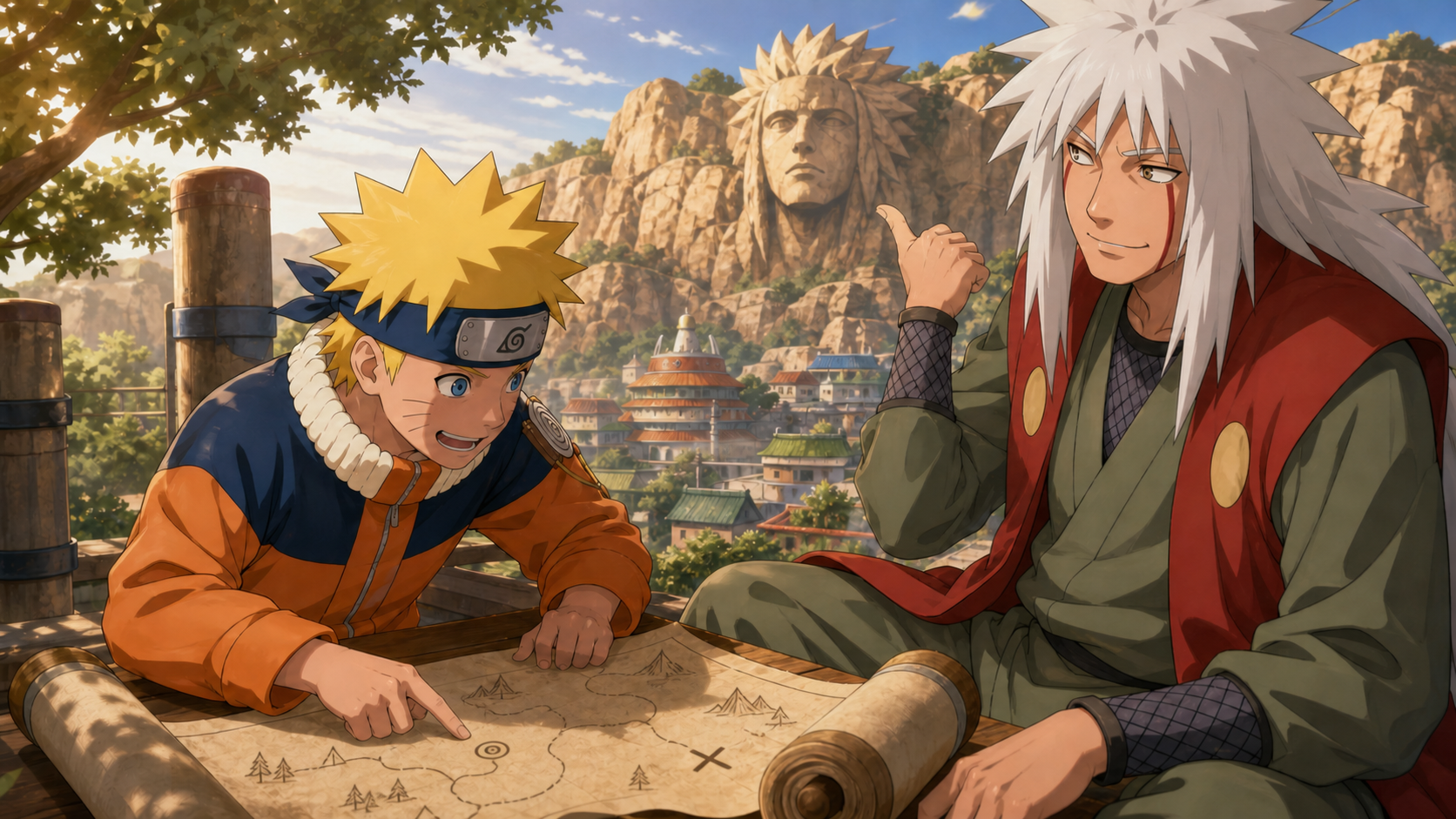
Big Adventure! The Quest for the Fourth Hokage’s Legacy, Part 1
A pre-Chunin-Exam treasure hunt turns Naruto’s fascination with the Fourth Hokage into a playful test of observation, teamwork, and what a legacy can actually mean.
What happens in Naruto Shippuden Episode 170?
Naruto Shippuden Episode 170, "Big Adventure! The Quest for the Fourth Hokage's Legacy, Part 1," steps back to the days before the Chunin Exam finals. Naruto is training for his match with Neji when he overhears Jiraiya mention a secret left behind by the Fourth Hokage. The words "Fourth Hokage's legacy" are enough to redirect every ounce of Naruto's attention.
The supposed legacy is tied to a village challenge and a record that no young ninja has broken. Naruto immediately imagines a hidden technique worthy of the hero whose face watches over the Leaf. Sakura and Sasuke are pulled into the search, while the other rookie teams become competitors.
What begins as a treasure hunt quickly becomes a sequence of traps, clues, and tests. Naruto races ahead because the idea of inheriting something from the Fourth Hokage feels irresistible, even though he does not yet know the personal reason that name matters to him.
A deliberate return to younger Team 7
Coming directly after Naruto's confrontation with Nagato, this flashback is a sharp tonal change. The village is whole. Jiraiya is alive. Team 7 can bicker over a mission without the weight of betrayal or war sitting between them.
That placement can feel strange if the episode is treated as the next event in the Pain story. It works better as a pause that lets us look at how much Naruto has changed. The boy chasing a legendary prize is not yet the person trusted to decide Nagato's fate. He is impatient, loud, and certain that the fastest route must be the right one.
The comedy does not erase the previous arc. It shows us an earlier version of the relationships that made Naruto's later choices possible.
The phrase "Fourth Hokage's legacy" hooks Naruto immediately
Naruto has always been drawn to the Fourth Hokage as an image of recognition. The Hokage is the person everyone sees, respects, and remembers. Before Naruto knows Minato is his father, the title represents the opposite of his own childhood invisibility.
That is why Jiraiya barely needs to explain the challenge. Naruto supplies the fantasy himself. He imagines a secret technique, a heroic inheritance, and a shortcut toward proving that he belongs in the same conversation as the village's greatest ninja.
There is dramatic irony in watching him chase his father's legacy without knowing it is his father's. The real inheritance is already inside his life: his name, his appearance, the seal, the Rasengan he will learn, and the faith Minato placed in him. Naruto is looking for an object because no adult has told him the truth.
Jiraiya knows exactly how to motivate him
Jiraiya's teaching style is rarely tidy. He provokes curiosity, lets Naruto run into the consequences of his assumptions, and trusts that experience will make the lesson memorable. Mentioning the Fourth Hokage within Naruto's hearing is not subtle, but subtlety would be wasted here.
The challenge gives Naruto a reason to practice observation, endurance, coordination, and restraint without announcing those skills as homework. Jiraiya understands that Naruto will work harder to beat a story than to complete a worksheet.
There is also tenderness beneath the teasing. Jiraiya knows more about Naruto's connection to Minato than Naruto does. Every reference carries information he cannot reveal yet. He can still let the boy feel close to that legacy through training and adventure.
Team 7's old rhythm is the real treasure
Young Team 7 works because its members want different things from the same situation. Naruto wants the glory of finding the legacy. Sakura wants the team to think before triggering every trap. Sasuke treats the challenge seriously but refuses to indulge Naruto's dramatic assumptions.
Their friction produces coordination almost by accident. Naruto pushes them forward. Sakura reads the practical details he skips. Sasuke notices patterns and threats. None of them would describe the others as essential, yet the course is built to punish anyone who tries to behave as a complete team alone.
Seeing this rhythm again is bittersweet. These small arguments belong to a time when their separation was still preventable. The episode lets us enjoy their chemistry without pretending we do not know where it leads.
The rookie teams turn training into a contest
The presence of the other Chunin Exam rookies expands the search beyond Team 7. A private rumor becomes a village-wide competition, and every team approaches it according to its strengths.
Shikamaru looks for the structure behind the challenge. Kiba treats it like a race. Neji and the Byakugan introduce a level of precision Naruto cannot match by charging ahead. Choji, Ino, Hinata, Shino, and their teammates make the course feel like a snapshot of the generation before its members carried adult responsibilities.
The competition also exposes Naruto's habit of measuring himself against everyone at once. He is training to face Neji, but he reacts to every rival as if losing one step will prove he does not deserve the final prize.
A legacy should be more than a powerful technique
Naruto assumes the Fourth Hokage's legacy must be a jutsu because power is the easiest inheritance to recognize. The story keeps complicating that idea. A record can measure speed, but it cannot explain why the course exists. A scroll can hold instructions, but it cannot transfer judgment.
Minato's actual legacy is scattered across people and choices. Jiraiya carries his memory. Kakashi carries his teaching. The village carries the result of his sacrifice. Naruto carries both his hope and the cost of the seal.
This two-part adventure uses a lighter story to ask a serious question: if Naruto finds the thing he is chasing, will he understand what it was meant to teach him?
Naruto's impatience is funny because it is familiar
The traps work on Naruto because they offer him exactly what he wants: an obvious direction and the promise that the goal is just ahead. He rarely pauses to ask who placed the clue or what behavior the course is testing.
Sakura's frustration and Sasuke's dry reactions give the comedy its timing, but Naruto is not simply the joke. His momentum keeps the team from becoming too cautious. The problem is not that he acts. It is that he treats action as proof that he understands.
That distinction follows Naruto into adulthood. His greatest growth does not come from losing his impulsiveness. It comes from learning when to let another person's story interrupt it.
The placement is emotional whiplash on purpose or not
Naruto just stood inside Nagato’s chamber carrying the moral weight of an entire war cycle. Now we are back before the Chunin Exam finals, chasing clues with children who still believe tomorrow will resemble today. That shift is jarring.
I am not going to pretend the transition is elegant. It interrupts one of the series’ most intense conversations. The flashback still offers something valuable: a preserved pocket of Team 7 before grief divided every ordinary interaction.
The intact village changes the air immediately
Konoha has streets, rooftops, shops, and familiar training spaces. Nobody is searching rubble for survivors. The Fourth Hokage Monument is background rather than the face of a father Naruto met inside a failing seal.
That normalcy feels almost luxurious after Pain’s assault. The village was never harmless to Naruto, but it was physically whole, and the children could make mistakes without every error becoming a question of national survival.
Jiraiya is alive enough to be annoying
He teases, withholds information, and knows exactly which phrase will make Naruto abandon every other thought. Seeing him behave like an imperfect teacher instead of a martyr is part of the episode’s emotional appeal.
Grief tends to polish dead mentors until their rough edges disappear. This story gives Jiraiya back his mischief. Naruto misses a person, not a flawless monument.
Minato’s name offers Naruto borrowed recognition
Before learning the truth, Naruto sees the Fourth Hokage as the village’s most visible hero. Everyone knows his face. Everyone respects his sacrifice. Chasing that legacy feels like chasing a route from isolation toward undeniable worth.
Naruto assumes possessing something Minato left behind will make the connection public. The painful joke is that the connection is already biological, political, and sealed into his body, while adults keep him ignorant.
The secrecy around Naruto creates unnecessary dramatic irony
Jiraiya knows Minato was Naruto’s father. Kakashi knows. Hiruzen knew. Naruto does not. Watching him fantasize about a stranger’s inheritance is funny only until we remember how many adults chose silence.
Security concerns explain part of that choice. They do not erase what secrecy cost Naruto. Information that could have grounded his identity became another resource controlled by other people.
Naruto assumes legacy means a secret jutsu
Power is the inheritance he understands. A technique can be demonstrated, mastered, and used to force recognition from people who would otherwise look away. Emotional history is messier and cannot be won through training repetitions.
The treasure-hunt premise plays with that expectation. Every clue seems capable of leading to a scroll because Naruto wants greatness to be portable.
Jiraiya turns curiosity into disguised training
A lecture about observation would lose Naruto in minutes. A legendary challenge tied to the Fourth Hokage keeps him moving through every trap. Jiraiya builds motivation before explaining the lesson.
That method is manipulative in a gentle, teacherly way. He knows Naruto will practice longer for a story than for an assignment and designs experience around the student actually standing before him.
The record converts admiration into competition
Naruto does not only want to find Minato’s legacy. He wants to beat the Fourth Hokage’s record. Admiration becomes a measurable contest because numbers feel easier than living up to an idea.
A fast completion can prove skill. It cannot prove Naruto understands why the course exists. The challenge keeps putting comprehension in front of speed.
Sakura keeps clues attached to reality
Naruto sees symbols and immediately supplies heroic meanings. Sakura asks what the marks indicate, how the route works, and which obvious danger Naruto is about to trigger. Her practicality prevents momentum from becoming pure chaos.
She is not merely the person yelling at him. She translates excitement into a plan and expects both boys to contribute.
Sasuke competes without leaving the team behind
This younger Sasuke still wants to win and still reacts to Naruto as a rival, but competition remains inside Team 7. He can be irritated, impressed, and useful without treating every bond as an obstacle to revenge.
Knowing what comes later makes the ordinary cooperation ache. There was a version of this group where tomorrow still held another shared mission.
Naruto supplies movement when analysis stalls
His impatience triggers traps, but endless caution would not complete the course either. Naruto’s willingness to act produces information the team can use. The flaw lies in refusing to pause after the information arrives.
Team 7 works when Sakura’s analysis, Sasuke’s perception, and Naruto’s momentum correct one another. No member contains the full answer alone.
The rookie teams reveal different definitions of winning
Kiba treats the hunt like a race. Shikamaru searches for the underlying trick. Neji relies on precision. Hinata watches carefully. Every team carries habits developed through its teacher and clan.
The challenge becomes a snapshot of a generation before war assigns heavier stakes to the same strengths. Competition is still allowed to be formative rather than fatal.
Hinata gets to exist near Naruto without crisis
After “Confessions,” seeing younger Hinata around him changes the texture of every quiet glance. Naruto does not understand what she feels, and she does not need to risk death to occupy the scene.
Her presence reminds us that affection was built through ordinary observation long before the crater demanded extraordinary courage.
A treasure map rewards interpretation
The symbol-only clues frustrate Naruto because they refuse to announce one obvious route. The map requires context, memory, and cooperation. It cannot be conquered by running harder in the first direction that looks promising.
That design mirrors legacy itself. Symbols survive, but another generation must interpret what they ask people to do.
The traps make arrogance expensive without making failure permanent
Wrong assumptions produce embarrassment, delay, and physical comedy. They do not destroy the village or cost a teammate’s life. This is the kind of safe failure young shinobi need before missions weaponize every mistake.
Training works when learners can discover limits and try again. Jiraiya’s course creates consequences small enough to teach.
Part 1 keeps the imagined prize larger than the lesson
Naruto is still chasing an object, secret, or technique capable of proving his connection to greatness. The episode lets that fantasy drive the adventure before revealing what the challenge measures.
The delay is useful. A lesson announced at the beginning would become another slogan Naruto repeats without testing.
RaeRae's reaction
The jump from Nagato's chamber to a Chunin Exam treasure hunt gave me emotional whiplash, but I understand the appeal. After so much death and destruction, seeing Jiraiya alive and young Team 7 together feels like opening a window in a room that became too heavy.
The dramatic irony around Minato is doing most of the work for me. Naruto lights up at the idea of the Fourth Hokage's legacy without knowing he met that man as his father one episode earlier in the present-day timeline. The prize he imagines is smaller than the truth waiting for him.
I also missed this version of Team 7. Sasuke's competitiveness is still something the group can use. Sakura can scold both boys and expect them to be there tomorrow. Naruto can be reckless without the mistake becoming a national emergency.
Part 1 does not deliver the meaning of the challenge yet. It builds the course and lets Naruto sprint into it with all his usual certainty. The fun is knowing the Fourth Hokage's real legacy will never fit neatly inside a scroll, no matter how badly Naruto wants the answer to be something he can grab.
The real nostalgia is permission to be unfinished
Young Naruto can charge into the wrong passage, argue with Sasuke, and misunderstand Jiraiya without carrying the moral future of the shinobi world. The episode remembers a time when growth had room to be messy.
That permission is the treasure I feel most strongly after Pain’s assault.
RaeRae’s final word on the Fourth Hokage’s Legacy, Part 1
This is a rough place to interrupt Nagato’s story, and I will not lie about that. The tonal pivot feels like somebody changed channels during the conversation I most wanted to hear.
Once I accept the flashback, young Team 7 gets me. Naruto races toward an idea, Sakura keeps the idea attached to facts, and Sasuke pretends he is above the chaos while competing just as hard.
The Minato irony does the deeper work. Naruto thinks he needs to discover a secret object connecting him to the Fourth Hokage. The adults around him know his entire life is already shaped by Minato and still let him chase shadows.
Part 1 works as a playful argument against shortcuts. A legacy is not a scroll someone hands over. It is a problem the next generation must understand well enough to carry differently.
The episode remembers what Team 7 could have become
Naruto, Sakura, and Sasuke are not harmonious. They interrupt, compete, complain, and pull the group toward different answers. That friction is exactly why the team has possibility. Nobody must erase a personality to cooperate. They need enough trust to let another person’s strength correct the mistake each one is most likely to make.
The later tragedy is not that this version of Team 7 was secretly fake. The teamwork is real. So are Sasuke’s wounds, Naruto’s hunger for recognition, and Sakura’s effort to hold a changing group together. The treasure hunt catches them before those pressures become stronger than the routines connecting them.
Jiraiya’s role looks lighter here, but the episode still exposes his complicated place in Naruto’s life. He knows the father Naruto is chasing as a legend. He knows why the boy resembles Minato and why the idea of a hidden inheritance has such power. Rather than tell the truth, he offers an adventure shaped around it.
There may be security reasons for silence, but silence remains a choice with consequences. Naruto is forced to construct identity from monuments, rumors, and whatever adults accidentally reveal. His eagerness is not simple hero worship. It is a child reaching toward a family history everyone else can see.
The course cannot repair that deprivation. It can give Naruto experience with a better form of inheritance. Jiraiya leaves a challenge that requires observation, teammates, persistence, and judgment. Those are capacities Naruto can own rather than facts controlled by somebody else.
That is why the filler premise earns more attention than its placement suggests. Beneath the jokes sits a question the Pain arc just made urgent: what does one generation leave the next? A weapon, a burden, a record, a method, or enough trust for young people to create an answer that does not repeat the old disaster?
The legacy Naruto needs is not proof that he can outrun Minato. It is permission to learn with people beside him, fail without losing their respect, and discover that inheritance becomes meaningful only when the receiver chooses how to carry it. Part one leaves that answer hidden behind the next clue, which is exactly where young Naruto keeps running toward.
RaeRae’s call
Naruto chases Minato’s legacy as though greatness must be hidden inside a scroll. The treasure hunt keeps answering with teamwork, interpretation, and the truth that running first is not the same as understanding.