
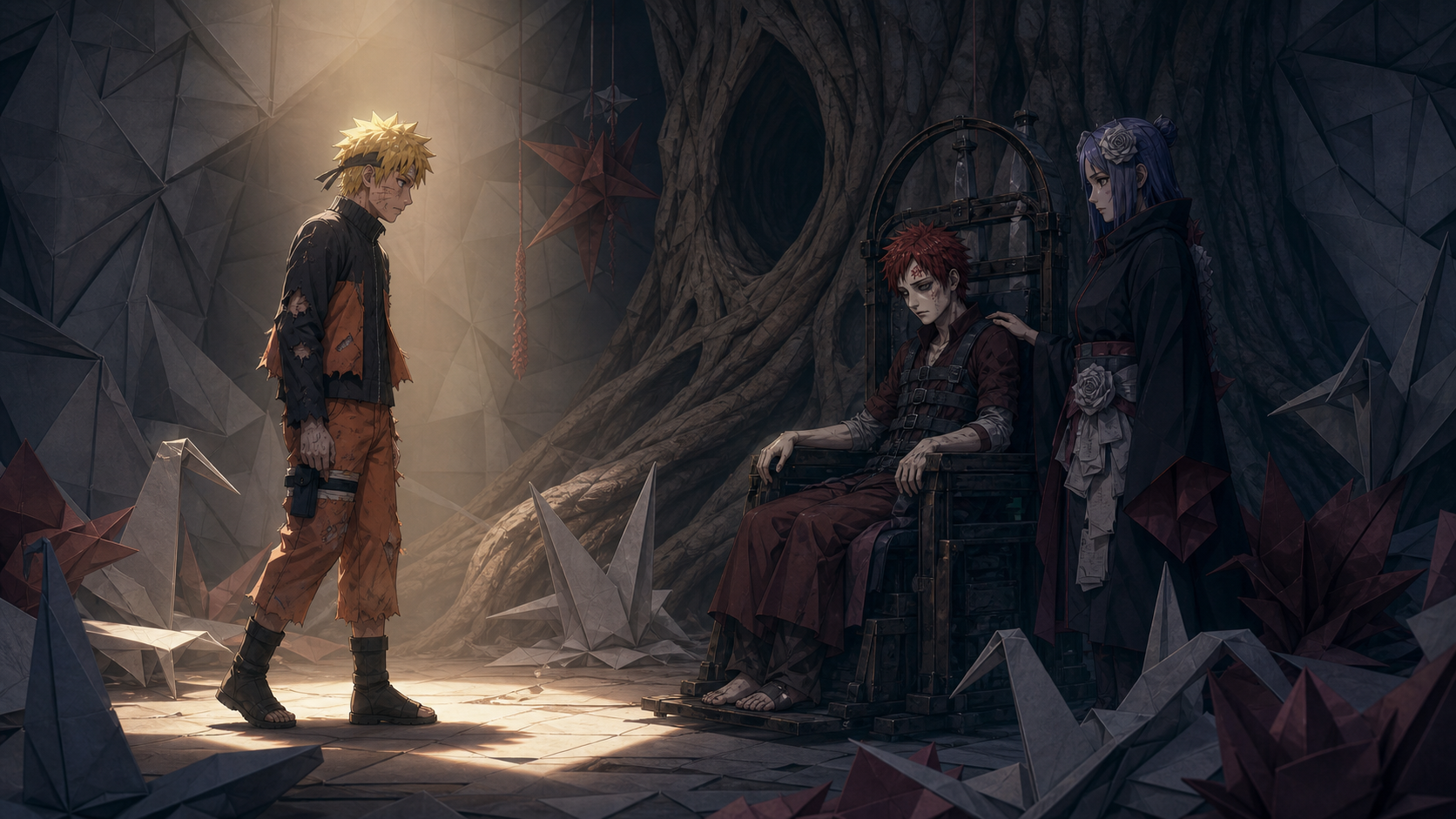
The Two Students
Naruto defeats the last Pain body, then refuses to mistake victory over a weapon for an answer from the wounded student controlling it.
What happens in Naruto Shippuden Episode 169?
Naruto Shippuden Episode 169, "The Two Students," ends the physical battle with Tendo Pain and begins the confrontation the arc has been building toward. Naruto returns from his meeting with Minato in control of himself. He uses the last of his Sage Mode, turns Pain's five-second interval against him, and drives a Rasengan into the final body.
The crater does not become a victory stage. Naruto takes one of Pain's black receivers, uses it to trace the chakra controlling the bodies, and follows that connection to Nagato. Inoichi, Shikaku, Katsuyu, and the surviving Leaf shinobi understand the danger. Naruto asks them to let him go alone.
Inside the paper-covered tree, Konan stands beside a frail Nagato. Naruto enters carrying grief, anger, and the memory of Jiraiya. All three were shaped by the same teacher. Only one of them still believes his promise can survive what happened.
Defeating Tendo Pain is not the ending
Naruto's final exchange with Tendo is satisfying because it is intelligent rather than enormous. Pain has used force on a scale that reshaped the village. Naruto wins the opening by paying attention. He knows Shinra Tensei needs time between uses, and he creates the one moment he needs.
That tactical finish restores Naruto's agency after the Nine-Tails transformation. The victory belongs to the person who trained, listened, adapted, and returned. Minato repaired the seal, but Naruto chooses how to use the chance he was given.
The episode refuses to confuse defeating a weapon with resolving the person holding it. Tendo collapses, yet Nagato is still alive. Naruto could treat that distance as permission to celebrate. Instead, he follows the chakra signal toward the human source.
Naruto asks the village to trust his judgment
Naruto's decision to approach Nagato alone is dangerous, but it is not childish bravado. A crowd of Leaf shinobi entering that chamber would turn the meeting into an execution or another battle. Naruto understands that his anger is already difficult to contain. Adding everyone else's grief would make listening almost impossible.
The village has spent much of Naruto's life deciding what he can handle. Here, he tells its leaders what he needs. Shikaku recognizes something in Naruto's request and supports him. That support matters because trust is no longer abstract praise offered after a victory. It means allowing Naruto to choose a path the adults cannot control.
Katsuyu accompanies him as a witness and source of information, but the confrontation remains Naruto's responsibility. He is not asking to be protected from the truth. He is asking for room to hear it before judgment becomes irreversible.
Two students carrying one teacher's hope
The title identifies Naruto and Nagato by their shared relationship to Jiraiya. That framing strips away the simple hero-villain distance. They learned from the same man. They heard the same dream about peace. They were both trusted to carry it forward.
Their different conclusions are not the result of one student listening and the other ignoring him. Nagato believed Jiraiya too. His faith was broken by repeated loss and by a political world that used smaller nations as battlefields. Naruto still believes because bonds kept reaching him before despair could become his only language.
That difference makes their meeting painful. Naruto is not looking at a stranger who hates everything Jiraiya represented. He is looking at a possible future for anyone who keeps being asked to endure without relief.
Konan is more than a guard at the door
Konan's position beside Nagato tells us where her loyalty rests, but it does not make her thoughtless. She watches Naruto enter after he has defeated every Pain body and survived Planetary Devastation. She has every reason to attack first.
Instead, the scene holds. Konan protects Nagato, yet she also allows the conversation to begin. Her presence reminds us that Nagato's choices did not develop alone. The original Akatsuki was built from shared hope among children who wanted their country to stop being crushed between larger powers.
Konan has lost Yahiko too. She knows the story Naruto has come to hear because she lived it. The paper chamber looks like a fortress, but her silence creates the narrow opening through which testimony can pass.
Naruto arrives angry enough to kill
The episode does not sanitize Naruto's response. He tells Nagato that he cannot forgive him. Jiraiya is dead. Kakashi appears dead. The village is rubble. Hinata fell in front of him. Naruto's body still carries the consequences of nearly releasing the Nine-Tails.
Listening is not presented as emotional purity. Naruto has to grip the black receiver and endure Nagato's chakra while holding back the urge to attack. He is attempting something harder than pretending he is calm. He is remaining present while anger has a legitimate claim on him.
That distinction is essential. Forgiveness demanded before truth is another kind of violence. Naruto does not offer it. He asks Nagato to tell him what happened and why he chose this path.
Pain's philosophy finally has a face
The six bodies made Pain look like a god who could exist above ordinary consequence. Nagato's real body destroys that illusion. He is emaciated, physically bound to machinery, and exhausted by the techniques he has used. His power has not liberated him from suffering. It has reorganized his entire life around it.
Seeing Nagato does not absolve him. It makes responsibility more specific. The village was not erased by an untouchable force of nature. A wounded person made choices, found systems that amplified them, and sent corpses to carry those choices into the world.
Naruto has to hold both truths together: Nagato has suffered terribly, and Nagato has caused terrible suffering. If he drops either truth, he cannot answer Pain's argument honestly.
Jiraiya remains inside the conversation
Jiraiya is absent from the chamber, but everything between Naruto and Nagato passes through him. His first book, his dream, his failures, and his belief in both students shape what they can say to one another.
Naruto is carrying Jiraiya's faith at the moment when it feels least practical. Nagato is carrying the evidence he believes disproves it. Their meeting is not a debate about a slogan. It is an argument over whether their teacher's hope can survive the world that killed him.
The cruelest detail is that Jiraiya would have wanted this conversation. Naruto reaches Nagato by doing what his teacher tried to do: entering another person's pain without surrendering his own moral judgment.
Naruto returns from the seal with his mind back
The six-tailed form answered Pain through instinct and destruction. Naruto returns carrying grief, Minato’s warning, and the ability to decide what happens next. That restoration of judgment matters more than the raw chakra he lost.
He does not wake calm or magically healed. He wakes capable of placing anger beside information. The difference is agency, not emotional perfection.
The last exchange rewards attention instead of escalation
Deva Path has the grander technique, controls distance, and already built a moon around Kurama. Naruto wins by tracking the five-second gap after Shinra Tensei and arranging one precise opening.
The finish returns the battle to shinobi choices. Clones, timing, deception, and a Rasengan matter more than producing an even larger crater.
Throwing clones turns repulsion into arithmetic
Pain can repel an incoming attack, but the ability must reset. Naruto fills the interval with bodies and momentum, using shadow clones as a sequence rather than one crowd. Each clone extends the next attempt toward the target.
The technique that once signaled undisciplined excess now expresses exact timing. Naruto has not abandoned his oldest tool. He finally understands how many different jobs it can perform.
The Rasengan belongs to a line of teachers
Minato created it. Jiraiya taught it. Naruto carried it through failure, variations, and battles neither man could fight for him. Driving the final Rasengan into Tendo places both legacies inside Naruto’s own decision.
That lineage does not make the victory inherited. A technique becomes Naruto’s through the way he studies Pain and earns the opening.
Tendo falls without giving Naruto an answer
The body collapses, but it cannot explain Jiraiya’s murder, Amegakure’s suffering, or why Nagato chose terror as peace. Destroying the final Path ends immediate violence and leaves the central question untouched.
Naruto recognizes the difference. He refuses the easy emotional ending where defeating a weapon automatically defeats the worldview guiding it.
The receiver becomes a thread back to the human source
Naruto uses Pain’s black receiver to feel the chakra being transmitted from Nagato. The object designed to impose remote control becomes a route toward accountability.
That reversal is beautifully specific. Naruto does not follow a rumor or convenient map. He traces the system through the mechanism that made six dead bodies appear divine.
Finding Nagato means choosing proximity to pain
The farther Naruto travels from the crater, the less useful a simple hero-versus-villain story becomes. He is going to meet the person whose body and history were hidden behind Pain’s performance.
Proximity does not require forgiveness. It removes the comfort of judging only an icon. Naruto wants the truth from the person who made the choices.
The Leaf shinobi have every reason to demand revenge
Their home is destroyed. Friends and relatives appear dead. Nagato’s bodies attacked civilians, healers, teachers, and children. Following Naruto into the chamber with weapons drawn would feel emotionally justified.
That is precisely why a crowd cannot create the conversation Naruto needs. Collective grief can become another force that decides the ending before testimony begins.
Shikaku gives Naruto something Konoha rarely offered
He gives trust without taking control. Naruto asks to confront Nagato alone, and Shikaku recognizes that the request comes from judgment earned through everything he just witnessed.
This is acknowledgment with consequences. Praising Naruto after victory is easy. Allowing him to choose a path adults consider dangerous proves they see more than a useful weapon.
Katsuyu remains a witness and a connection
Naruto does not enter the hidden chamber completely isolated. Katsuyu carries information, medical awareness, and a living connection to Tsunade and the village. Her presence keeps the confrontation from becoming an unrecorded private myth.
She supports without crowding Naruto’s agency. That balance is exactly what the village has struggled to give him.
The paper tree hides vulnerability behind impossible architecture
Konan’s paper creates a fortress that looks organic from outside and constructed within. It protects Nagato’s body while the Paths project power elsewhere.
The chamber visually exposes the trick behind godhood. A fragile human body sits inside layers of distance, machinery, and devotion designed to make his decisions appear untouchable.
Nagato’s body records the price Pain concealed
The Six Paths moved like tireless corpses. Nagato is emaciated, pierced by receivers, and attached to equipment that sustains his remote control. His suffering is not a metaphor. It has reorganized his body.
Seeing that cost creates context without absolution. A wounded person can remain responsible for wounds deliberately inflicted on others.
Konan stands with Nagato and still allows speech
She has watched Naruto defeat every Path and approach the person she protects most. Attacking immediately would be understandable. Instead, the moment holds long enough for words.
Konan’s restraint matters because she also carries Yahiko’s death and Amegakure’s history. She is not neutral. She chooses not to close the last available door before Nagato speaks.
Naruto says he cannot forgive him
This line protects the conversation from cheap sainthood. Naruto is furious. Jiraiya is dead, Konoha is rubble, and Hinata was nearly killed in front of him. Listening does not require pretending those facts have become acceptable.
Forgiveness demanded before truth would only silence the injured person again. Naruto begins with an honest boundary and stays.
The receiver forces Naruto to feel Nagato’s chakra
Contact exposes Naruto to the pressure and hostility running through Pain’s system. He grips the rod while fighting the urge to retaliate, turning restraint into an active physical choice.
This is harder than performing serenity from a safe distance. Naruto remains present while his body carries a direct reminder of the person who hurt everyone he loves.
Two students inherited one unfinished assignment
Jiraiya believed people could understand each other and trusted students to continue searching for peace. Nagato and Naruto both heard that hope. Their difference lies in what repeated loss persuaded them to do with it.
The title refuses to let either man escape the shared lineage. Naruto is not confronting someone untouched by Jiraiya’s love. He is confronting a student who decided the lesson could not survive reality.
RaeRae's reaction
I love that Naruto's smartest victory in the battle is followed by a choice not to treat victory as enough. The Rasengan lands. Tendo Pain falls. That could have been the applause moment. Naruto keeps moving because he knows the body he defeated cannot answer him.
His request to go alone scared me, but it also showed how much the village's relationship with him has changed. Shikaku does not reduce Naruto to a weapon or a child. He recognizes that Naruto has earned the right to decide how this confrontation happens.
The scene inside the tree is uncomfortable in the best way. Naruto is not serene. Konan is not welcoming. Nagato is not immediately sympathetic. Everybody enters with reasons to distrust the others, and still the first decisive act is a question.
That question does not undo anything. It creates a pause where another killing might have been. After an arc obsessed with the way pain reproduces itself, a pause is not small. It is the first proof that Naruto may be able to interrupt the cycle without pretending it never wounded him.
Understanding is not the same as surrendering judgment
Naruto wants Nagato’s story because killing without knowing would repeat the habit this arc condemns. He can hear how suffering shaped Nagato and still condemn what Nagato chose to do.
Holding both truths requires more moral strength than flattening one person into monster or victim.
RaeRae’s final word on The Two Students
I love that the last Pain body falls before the real climax begins. The story refuses to pretend a Rasengan can answer why children from small nations keep becoming weapons in wars designed elsewhere.
Naruto’s decision to go alone is dangerous, but he is not chasing private glory. He is protecting a narrow pause from everyone, including himself, who has earned a reason to kill Nagato before listening.
Nagato’s ruined body does not erase Konoha’s crater. Konoha’s crater does not erase what larger nations did to Amegakure. The chamber forces those histories into the same space without allowing either to cancel the other.
Jiraiya failed to solve peace and kept believing somebody might. One student decided pain should rule the world through fear. The other arrives angry enough to kill and asks a question first. That pause is the first real interruption of the cycle Pain insisted was automatic.
The difference between revenge and accountability begins here
Revenge would let Naruto use Nagato’s suffering as permission to answer with suffering of his own. Accountability requires seeing the person, naming the harm, hearing the history, and then deciding what action protects others without pretending the damage never happened. The second path is slower and emotionally crueler because it denies Naruto the temporary clarity of simple hatred.
Naruto does not know whether he can walk that path when he enters. That uncertainty keeps the scene human. He is not a saint arriving with forgiveness prepared. He is a grieving student testing whether Jiraiya’s hope can survive contact with the person who murdered Jiraiya.
Nagato’s body complicates the encounter without settling it. Pain presented himself as consequence made divine, remote from ordinary vulnerability. The man behind that image is starving, scarred, and dependent on machinery. Compassion can recognize those facts. Justice must also remember the bodies in Konoha. Any answer that requires forgetting either side will reproduce the blindness that created the conflict.
Konan’s presence sharpens that balance. She knows Nagato before the title Pain and remembers the dream shared with Yahiko. To Naruto, those memories are not yet evidence. To Konan, they are the reason the person in front of her cannot be reduced to the massacre he ordered. The conversation needs her witness even when her loyalty makes neutrality impossible.
Shikaku’s trust also deserves credit. Adults have repeatedly praised Naruto while withholding authority. This time, a senior strategist recognizes that the person closest to the emotional center may understand what the situation requires. He does not demand that Naruto perform certainty first.
That choice carries risk, and trust without risk is usually just approval after the fact. Naruto could be attacked, manipulated, or overwhelmed. Shikaku still lets him go because treating Naruto as capable means allowing decisions the village cannot guarantee or control.
The episode ends before Nagato’s history unfolds, which is exactly right. Listening cannot be compressed into one heroic gesture. Naruto has created the conditions for testimony. Now he has to remain present long enough for another student’s broken version of Jiraiya’s dream to become more than an enemy slogan.
Naruto has not forgiven Nagato and has not promised that listening will save anyone. He has done something smaller and rarer. He has refused to let Pain’s last act decide Naruto’s first act in return. That pause protects the possibility of a different ending without pretending anybody’s grief is already resolved. Jiraiya’s dream survives here as a question both students must finally answer with their lives.
RaeRae’s call
Naruto defeats Tendo with timing, then rejects the easy ending. He follows the receiver to Nagato because a fallen weapon cannot explain why Jiraiya’s two students carried the same hope toward opposite answers.