
Confessions
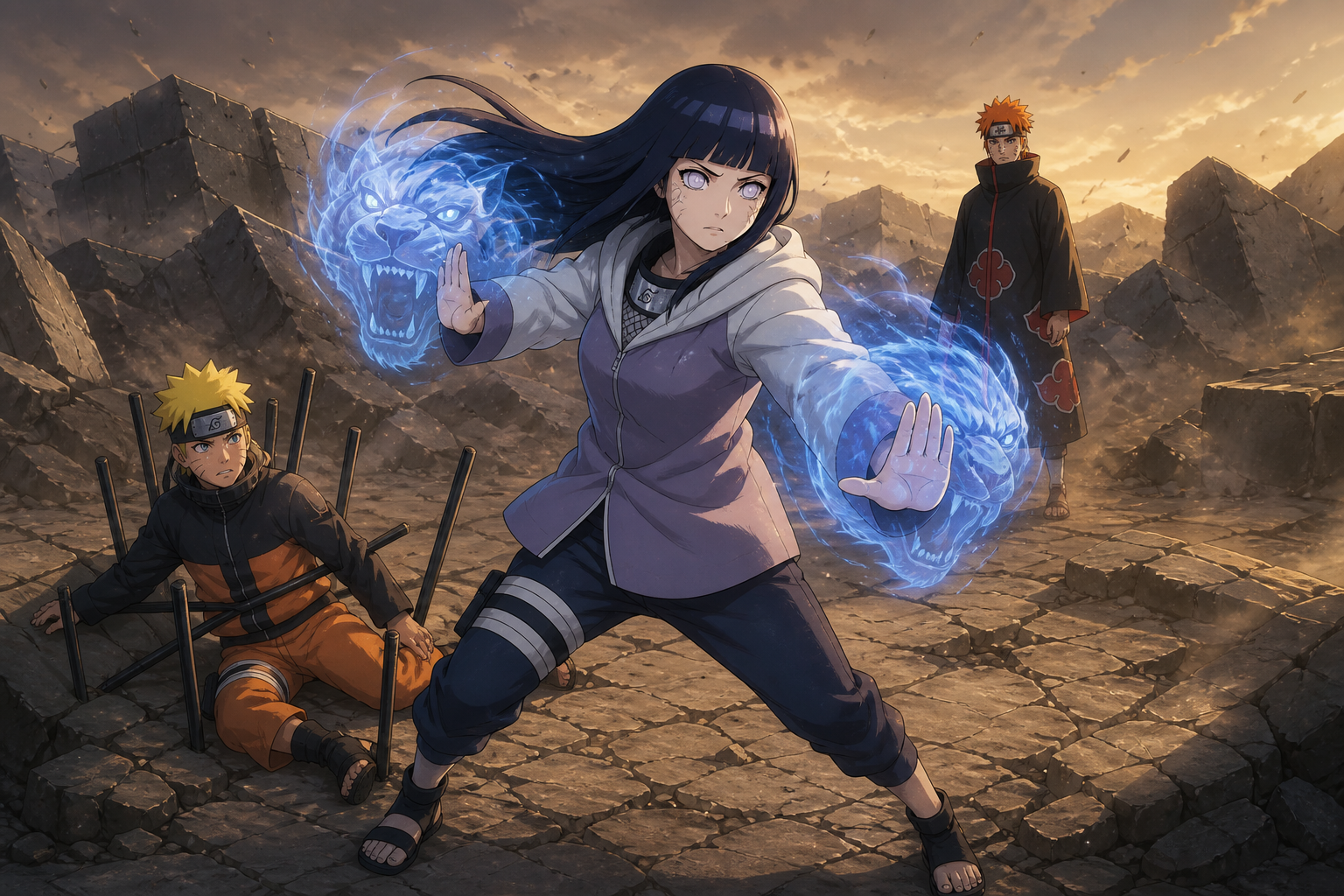
Hinata claims her own choice, speaks what Naruto’s persistence has meant to her, and restores human presence inside Pain’s attempt to reduce him to a captive power.
What happens
Naruto is restrained by Tendo Pain after Fukasaku and Shima are taken out of the fight. Pain uses Naruto's helpless position to explain a vision of peace built through overwhelming fear and repeated suffering.
Hinata has followed the battle with her Byakugan. Despite knowing the gap in power, she enters the crater and stands between Naruto and Pain.
Naruto tells her to run. Hinata refuses, explains that she is acting by her own choice, and finally speaks the feelings she has carried for years. She fights to free him even though she knows the attempt may cost her life.
Hinata enters by choice
The scene matters because Hinata explicitly claims ownership of her decision. She does not describe herself as ordered, confused, or unaware of the danger.
Naruto wants her to leave because he understands the likely outcome. Her refusal is not a failure to hear him.
It is an assertion that caring for him does not erase her right to decide what risks she will accept.
The Byakugan makes danger clearer
Hinata has observed the battlefield through the Byakugan. She can see Naruto's chakra, the restraint points, and the terrifying power standing over him.
Her courage therefore does not depend on ignorance. She enters with unusually precise knowledge of how little advantage she possesses.
That clarity makes the choice heavier. She is not imagining herself invulnerable; she is deciding that Naruto should not face the moment completely alone.
Naruto's warning is also care
Naruto's demand that Hinata run can sound like rejection if separated from the situation. In context, it is immediate concern for her life.
He is restrained and cannot protect her. Watching her approach forces him to experience another person's danger without the agency to intervene.
Both characters act from care, but care points them in opposite directions: Naruto wants distance to preserve her, while Hinata wants proximity to stand with him.
Confession is larger than romance
Hinata tells Naruto that his persistence changed how she understood herself. He became proof that failure did not have to become identity.
Her love is real, but the confession also names influence, gratitude, admiration, and the self she worked to become.
Speaking those feelings now is not a request for an answer. It is a refusal to let fear keep defining what remains unsaid.
Naruto was seen before the village saw him
For years, Naruto wanted acknowledgment from people who looked through him or saw only the Nine-Tails. Hinata noticed the effort hidden beneath the mistakes.
She saw him fail, feel embarrassed, and continue anyway. Her attention was not dependent on the prestige he later earned.
That history makes her presence different from the village's sudden hope in the new Sage hero. She stands beside the person whose struggle she recognized long before his power became convenient.
Hinata's courage has a history
This moment does not transform a timid character into a brave one without preparation. Hinata has repeatedly acted while afraid.
Her confrontation with Neji during the Chunin Exams established that courage could mean refusing an identity someone else declared permanent.
The confidence she carries into the crater was built through many smaller choices, each one making the next refusal possible.
Gentle Fist meets impossible distance
Hinata's Gentle Fist style is precise and close-range. Pain controls distance through attraction and repulsion, making approach extremely difficult.
The matchup is unfavorable by design. Technique alone cannot erase the difference in battlefield control.
Hinata still uses what she knows to target the restraints and create even a small chance for Naruto to move.
Twin Lion Fists visualize commitment
The chakra lions around Hinata's hands make her resolve visible. Their force is focused, shaped, and held close to the body.
That visual language contrasts with Pain's wide, impersonal control over the crater. Hinata's power remains connected to one person and one immediate purpose.
She is not trying to dominate the landscape. She is trying to reach Naruto.
The rescue attempt respects Naruto's personhood
Pain speaks about Naruto as a jinchuriki and a tool required for his plan. Hinata addresses Naruto directly as someone whose life matters to her.
That difference is the moral center of the scene. One figure restrains a body to extract its power; the other risks her body to restore the person's agency.
Hinata's intervention cannot be measured only by whether she defeats Pain. It changes what Naruto experiences inside the capture.
Sacrifice needs honest boundaries
The scene is emotionally powerful, but the danger should not be romanticized into a rule that love must prove itself through self-destruction.
Hinata acts inside an extraordinary crisis where ordinary routes of help have collapsed. Her decision belongs to that context.
What makes it meaningful is not that she values her life less. It is that she understands its value and still claims the authority to place it beside Naruto's.
Pain tries to turn love into evidence
Pain wants Naruto to accept that attachment inevitably produces loss, and loss inevitably produces hatred. Hinata's intervention gives him an immediate way to test that claim.
By harming someone Naruto loves, Pain expects to demonstrate that moral restraint is temporary under sufficient pressure.
This is not dialogue in good faith. It turns a person into an instrument inside an argument about another person's soul.
Naruto's helplessness becomes emotional danger
Naruto has endured physical pain throughout the fight, but restraint makes the threat to Hinata especially destabilizing. He cannot place his body between her and the attack.
The situation activates grief already accumulated through Jiraiya's death and Konoha's destruction. Hinata's fall is not an isolated stimulus.
It lands on a reserve of loss Naruto has been holding through discipline, pushing that discipline toward collapse.
The confession creates a responsibility to remember
Hinata speaks without knowing whether she will survive or whether Naruto can answer. Her words enter the story as testimony rather than transaction.
Naruto now carries knowledge of how deeply his persistence affected another person. That knowledge cannot undo the danger, but it changes the meaning of his own history.
The lonely child who wondered whether anyone saw him learns that someone built part of her courage by watching him refuse surrender.
Hinata walks into a fight she has already measured
The Byakugan removes every comforting excuse. Hinata can see Naruto’s chakra disrupted by the receivers, the dead Paths around him, and the remaining body controlling the crater. She knows this is not a contest she should win on paper.
That knowledge is why her entrance matters. Courage is not pretending Pain looks manageable. Courage is seeing the scale accurately and deciding that accuracy does not get the final word about whether Naruto stands alone.
No order sends Hinata into the crater
Hinata says plainly that she is acting of her own free will. That line protects the scene from becoming another Hyuga duty imposed on her body. Her clan spent years defining worth through hierarchy, talent, and obedience. Here, she names the reason and owns the decision.
Naruto tells her to run, and she hears him. Refusing does not mean she misunderstood his fear. It means his desire to protect her cannot cancel her agency any more than Pain’s rods can cancel his.
Naruto’s panic is not contempt for her strength
He knows what Pain just did to the village, the toads, and everyone who reached this battlefield before Hinata. He is pinned and cannot intercept the next strike. Of course he wants her gone.
The scene becomes painful because both people are trying to protect the other with opposite choices. Naruto reaches for distance. Hinata reaches for presence. Neither impulse is petty, and neither can guarantee safety.
Hinata confesses without demanding payment
She does not attach a question to her love. There is no request for Naruto to answer before she helps him, no promise he must make if they survive, and no claim that years of private feeling create a debt.
The confession is testimony. Naruto’s persistence changed how Hinata understood failure and herself. She tells him because silence has controlled enough of her life, not because the battlefield is a romantic bargaining table.
She loved the work before Konoha loved the result
The village now sees a Sage hero capable of challenging Pain. Hinata remembers the loud child who failed publicly, embarrassed himself, and returned to try again. Her attention was never dependent on rank, applause, or a dramatic entrance.
That history matters. Everybody wants Naruto once his strength becomes useful. Hinata saw value while his striving still looked inconvenient and ridiculous to the people around him.
The Chunin Exams live inside this choice
Naruto once shouted encouragement while Neji tried to convince Hinata that weakness was her permanent nature. She stood again, not because fear vanished, but because somebody believed her future could exceed the verdict handed down by family.
Now Naruto is the one immobilized beneath another man’s certainty. Hinata returns the gift. She cannot promise victory, but she can refuse the claim that his current position defines the ending.
Twin Lion Fists belong to Hinata’s own growth
The chakra lions are focused extensions of Gentle Fist, shaped around the hands that once trembled under scrutiny. Their beauty should not distract from the discipline required to form and maintain them.
Hinata did not spend the time between arcs waiting to become somebody’s love interest. She trained. The technique makes that unseen labor visible at the exact moment she chooses what her strength is for.
Gentle Fist tries to restore movement, not win applause
Hinata targets the receivers and the control holding Naruto down. Her objective is specific: create an opening, return his body to him, and interrupt extraction. She is not posing as Pain’s equal.
That practical aim protects the scene from empty sacrifice. Hinata has a plan appropriate to her skill set, even when the power gap makes execution nearly impossible. Bravery and strategy can coexist without guaranteeing success.
Pain turns her into an exhibit in his argument
Nagato believes attachment inevitably produces loss and loss inevitably produces hatred. Hinata’s arrival gives him a person he can hurt directly in front of Naruto, then point to Naruto’s reaction as proof that the cycle cannot be escaped.
This is cruelty dressed as instruction. Pain is not neutrally testing a theory. He manufactures trauma, removes alternatives, and declares the emotional response evidence that his worldview was correct all along.
Hinata is not disposable proof of Naruto’s feelings
The story centers Naruto’s reaction, but Hinata’s personhood must remain visible. Her life does not become meaningful only because losing it might unlock his rage. She arrives with history, technique, fear, choice, and a reason she articulates herself.
Pain wants to reduce her to leverage. Good reading should refuse to help him. The scene hurts because Hinata matters before Naruto sees her fall.
Love does not make the violence romantic
There is nothing romantic about Pain driving a receiver through Hinata’s body. Her confession gives the assault emotional context, but it does not beautify what he does or establish self-destruction as the proper price of affection.
Hinata values her life. That is why choosing to risk it carries weight. A fandom reading that treats death as the necessary proof of love misses the agency she fought to claim.
Naruto is forced to watch another loss
Jiraiya is dead. Kakashi appears dead. Konoha has been flattened. Naruto arrived holding that grief inside the balance Sage Mode demanded. Hinata’s fall strikes the exact point where discipline has become exhaustion.
Pain calls the reaction predictable because he ignores accumulation. Naruto is not responding to one isolated injury. He is being made to witness another beloved person harmed while his body is pinned and his choices are deliberately removed.
Kurama enters through a wound Pain creates
The seal responds as Naruto’s anger floods the space where Sage discipline had held. Pain wants the Nine-Tails and simultaneously provokes the emotional conditions that loosen its cage. That confidence borders on arrogance.
Nagato believes he understands suffering well enough to control its outcome. Kurama is the reminder that weaponized trauma can release forces even the person inflicting it does not truly command.
The confession gives Naruto evidence against isolation
Naruto’s childhood taught him that nobody saw the person behind the village’s fear. Hinata tells him she watched, learned, and changed because of his refusal to quit. Her words revise a memory he thought belonged only to loneliness.
Pain can insist that connection creates vulnerability. Hinata proves connection also carries recognition across years. The same bond that makes loss hurt helped her survive earlier versions of herself.
Neji’s old certainty has already lost
Neji once described Hinata as someone fundamentally unable to change. The woman facing Pain is frightened, outmatched, and still moving through a choice entirely her own. She does not need to defeat a godlike opponent to invalidate the cage Neji described.
Her victory happened when inherited judgment stopped authoring her decisions. Pain can overpower her body. He cannot make that old verdict true again.
RaeRae reaction
“Confessions” works for me because Hinata's speech is not framed as a demand for romance. She does not enter the crater to make Naruto promise anything. She enters because she has decided that the person who helped her believe change was possible should not be abandoned when he cannot move.
I also value Naruto's warning. He is not dismissing her strength; he is terrified that she will be hurt while he is unable to help. Their disagreement comes from mutual care, which makes it painful rather than petty.
Hinata's Byakugan is an important detail. She sees the battlefield clearly. Her courage is not built from misunderstanding the odds, and her confession is not an impulsive fantasy that victory will make everything simple.
The episode lets her speak as the author of her own choice. Pain may treat her as a tool for proving his theory about hatred, but Hinata enters for a different reason: to restore human presence inside a scene designed to reduce Naruto to the Nine-Tails. She may not free him physically, yet she refuses to let captivity decide that he is alone or unseen.
The scene belongs to two kinds of recognition
Hinata recognizes Naruto as a person when Pain names only a jinchuriki. Naruto finally hears that his messy persistence became a lifeline for someone watching from the edge of his story. Neither recognition requires perfection.
That is the part fandom should protect. The confession is not valuable because Hinata becomes flawless or because Naruto immediately returns every feeling in the correct language. It is valuable because truth enters a space built around control.
RaeRae’s final word on Confessions
Hinata has never needed the story to pretend she is not afraid. Fear is part of the point. She sees Pain clearly, sees the rods inside Naruto, and walks forward without inventing a fantasy where her love makes her unbeatable.
I love that she claims the decision before she names the feeling. Her choice belongs to her. Naruto inspired her, but he does not own the courage she built from that inspiration.
Pain tries to use her as a demonstration. Hurt the person Naruto loves, release his hatred, and call the result proof. That is not wisdom. That is an abuser arranging the room so only his preferred answer appears available.
Hinata cannot free Naruto before Pain strikes her down. She still changes the captivity. Naruto is no longer pinned beneath the lie that he is unseen, and Pain is about to discover that provoking a weapon is much easier than controlling what comes through the broken seal.
Why the moment stays complicated after the confession
Naruto does not have space to process what Hinata tells him. He is restrained, Pain is standing over them, and every second carries immediate mortal danger. Expecting a clean romantic response here would treat crisis like a stage waiting for the correct couple dialogue. Hinata does not ask that of him, and neither should we.
Her words still matter beyond the emergency. They establish that Naruto’s influence traveled farther than he knew and that Hinata’s quiet observation contained an active relationship to his choices. She did not simply admire him from a distance. She used what she saw to challenge the limits assigned to her, then brought that changed self back to protect him.
The scene also refuses a comfortable definition of protection. Naruto wants Hinata safe outside the crater. Hinata wants Naruto to retain even one ally inside it. Both positions are loving, and the collision hurts because no available choice can protect both people. Pain created those conditions. Blaming either victim for failing to discover a painless answer gives his violence too much cover.
What comes next should not erase the choice she made before Naruto transformed. Kurama’s rage may dominate the battlefield, but Hinata’s decision remains human-sized and complete. She saw somebody she loved being reduced to an object, named her own agency, and stepped between that person and the man claiming suffering made resistance meaningless. She lost the exchange. She did not lose the argument.
Hinata’s courage does not need Pain’s defeat to become real. It lives in the distance she crosses after seeing exactly what waits below. Naruto once gave her permission to imagine change when nobody else would. She returns that faith when his body cannot move, making sure the worst moment of his life contains one voice that calls him Naruto instead of Nine-Tails again.
RaeRae’s call
Hinata does not confess to collect an answer. She claims her own choice, stands beside the person who taught her that failure was not identity, and refuses to let Pain define Naruto as a beast waiting to be extracted.