
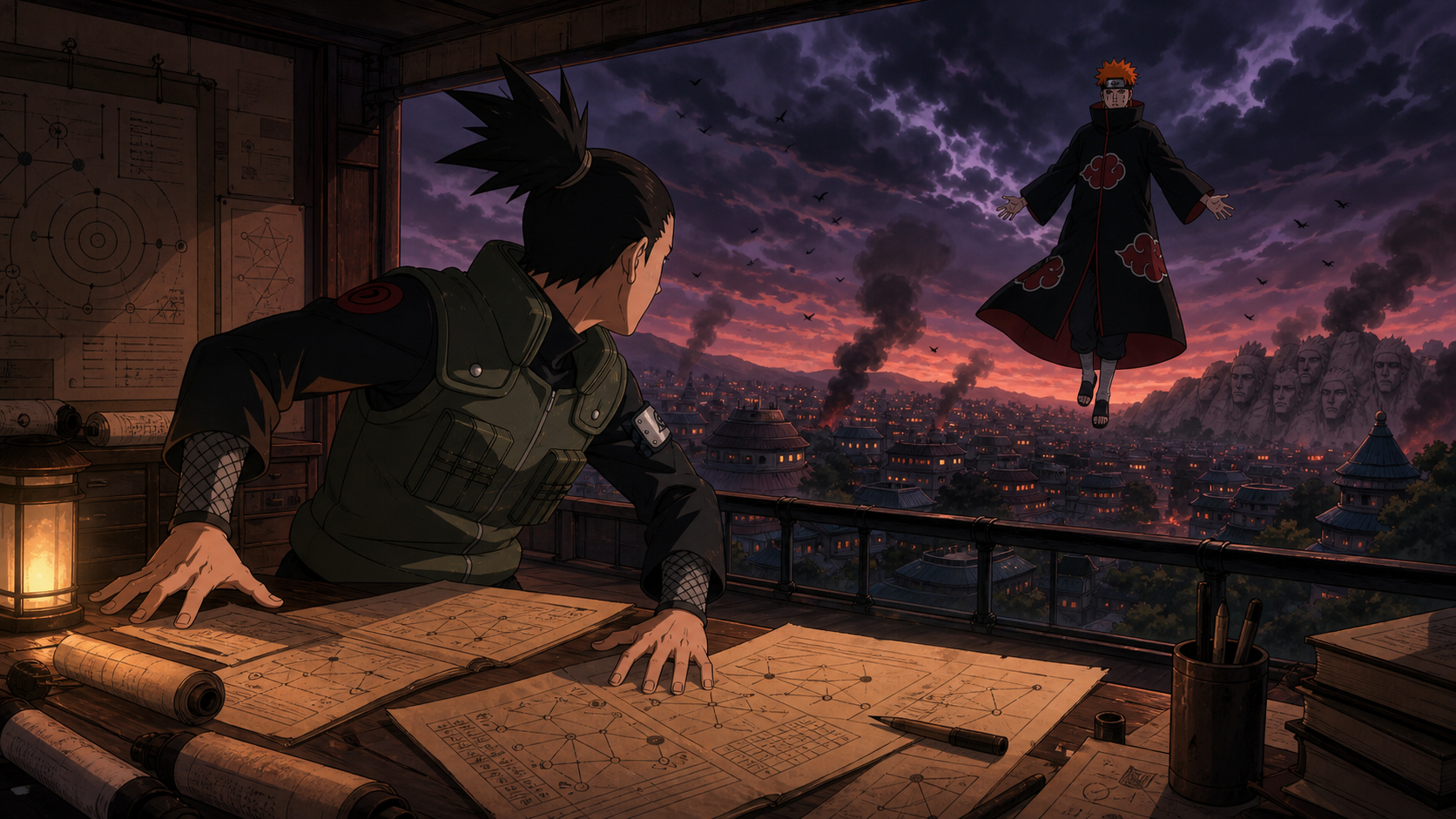
Assault on the Leaf Village!
Pain attacks before Jiraiya’s evidence is fully understood, forcing Konoha to convert partial knowledge into defense while Naruto remains away.
What happens
Shikamaru and the Leaf intelligence teams continue waiting for Jiraiya's information to be analyzed. Every clue matters because Pain's bodies, abilities, and shared identity remain only partly understood.
Before the village can finish that work, disaster arrives. Pain launches an assault on Konoha, turning the site of investigation into the battlefield itself.
The timing is cruel and strategic. The village has evidence but not certainty, defenders but not complete preparation, and Naruto, the person training specifically to face this threat, is still far away at Mount Myoboku.
The attack weaponizes unfinished knowledge
Konoha is not ignorant when Pain arrives. Its analysts have Jiraiya's code, battlefield testimony, and material evidence.
The danger lies in the gap between information and understanding. The village knows enough to fear Pain but not enough to predict every body or counter the system connecting them.
Pain attacks inside that gap. Uncertainty becomes a tactical advantage because defenders must learn while surviving.
Analysis and emergency collide
The intelligence room represents patience, comparison, and disciplined doubt. An assault demands speed, triage, and immediate decisions.
When the alarm interrupts the analysis, neither form of work becomes irrelevant. The analysts' incomplete findings may save lives, while defenders create new observations the analysts need.
The episode collapses the distance between research and consequence. A diagram on a table is suddenly connected to a body moving through the street below.
Pain chooses the village as a source of answers
The assault is not random destruction. Pain wants Naruto and treats Konoha as the network most likely to know where he is.
That purpose makes every civilian, shinobi, archive, and communication route vulnerable. The village's relationship with Naruto becomes something the enemy tries to interrogate by force.
Pain's method turns community into leverage. He assumes bonds can be exploited more easily than they can protect.
Naruto’s absence changes every calculation
Naruto is away because the village recognized that he needed Sage training. That decision may eventually provide the strength required to stop Pain.
In the present, however, his absence leaves others facing an enemy who specifically came for him. Protection and vulnerability are produced by the same choice.
The episode resists an easy judgment. Calling Naruto back too early could waste Jiraiya's final opening. Keeping him away asks the village to endure the assault without its target and hoped-for defender.
Shikamaru faces a problem that will not wait
Shikamaru's strength is creating a model of the battlefield before committing resources. Pain denies him the time needed for a complete model.
This does not make strategy useless. It changes strategy into a live process where every encounter updates the plan.
Shikamaru must tolerate uncertainty without surrendering precision. The village cannot wait for perfect knowledge, but it also cannot afford panic disguised as action.
Jiraiya’s investigation enters its second life
Jiraiya gathered intelligence in the Hidden Rain knowing he might not return. The assault proves why preserving that knowledge mattered.
His observations now move through analysts, messengers, defenders, and commanders. They become a distributed defense against an enemy built from distributed bodies.
Pain killed the investigator but could not stop the investigation from reaching Konoha. Every defender who acts on Jiraiya's clues extends his resistance.
A village is more than its strongest fighter
Naruto's growth has made him central to Konoha's hopes, but the assault begins by showing the work of people still inside the walls.
Analysts, sensory ninja, patrols, medics, commanders, and ordinary defenders all become part of the response. The village cannot be reduced to waiting for one hero.
That collective effort matters even if Naruto ultimately becomes decisive. A savior can only arrive because a community preserved lives, information, and time long enough for arrival to matter.
Pain attacks systems as well as bodies
An invasion disrupts communication, movement, command, medical response, and the ability to distinguish reliable information from rumor.
Pain's multiple bodies are suited to that disruption. They can create simultaneous crises and force Konoha to divide attention.
The assault therefore tests the village as an organization. Individual courage matters, but coordination determines whether courage accumulates into defense or disappears in isolated fights.
The title’s exclamation mark changes the arc’s rhythm
Recent episodes have moved through grief, decryption, and training. “Assault on the Leaf Village!” announces a sudden change in tempo.
The exclamation is not celebration. It is an alarm. The private work of understanding Jiraiya's legacy now meets public catastrophe.
The transition feels brutal because preparation was meaningful but unfinished. The story refuses to wait until every character feels ready.
The village protects Naruto by refusing Pain’s premise
Pain approaches Konoha as a container holding information about Naruto. The village's resistance insists that its people are not simply obstacles between him and a target.
Every defender who protects a neighbor contradicts the logic that suffering can reduce a community to compliance.
Konoha has serious institutional failures, many of which shaped Pain and Naruto alike. Yet the relationships within it can still produce a defense grounded in mutual obligation rather than fear.
The Animal Path enters by turning surveillance against the village
Konoha’s barrier system is designed to identify intruders crossing the perimeter. Pain answers by having one body enter and summon the others from inside. The defense detects the first breach but cannot prevent a distributed force from appearing beyond the expected boundary.
The tactic is clever because Pain studies systems rather than merely overpowering walls. He asks what the village expects an invasion to look like, then arrives in another shape.
Six bodies let one attacker create institutional overload
Each Path can attack a different function at the same time. Interrogation, destruction, summoning, intelligence gathering, and defense unfold across separate streets.
Konoha must decide whether reports describe several enemies or one coordinated system. That confusion costs time, spreads responders thin, and makes every local encounter feel disconnected from the larger plan.
Konan’s paper technique makes information gathering intimate
Paper can disperse, enter spaces, restrain people, and create copies that blur the boundary between scout and attacker. Her power fits an invasion built around locating one person inside a dense community.
Konan is not decorative support for Pain. She participates in the search while carrying her own history with Jiraiya and the Hidden Rain. Konoha sees an enemy before understanding the student standing inside that enemy role.
Ibiki’s interrogation system meets an opponent who feels no ordinary fear
Konoha relies on pressure, pain, and controlled uncertainty to extract information. Pain’s bodies complicate those tools because the visible body may not be the person who values survival.
An interrogation method built around individual self-preservation struggles against a network where damaged bodies can be replaced and information remains elsewhere.
The village’s strongest defense is communication
No single squad can observe every Path. A shinobi who survives one encounter needs a route to report abilities before another team repeats the same mistake.
Messengers, sensory units, radio links, summons, and command decisions become as important as attacks. Shared knowledge can turn six confusing battles into one understandable system.
Partial intelligence changes who survives the first contact
Jiraiya’s message does not explain every ability, yet defenders know the bodies are connected and the visible figures may not include the real controller. That warning can stop them from treating one defeated body as final victory.
Incomplete evidence saves lives when leaders communicate the uncertainty clearly instead of hiding it until analysts feel completely certain.
Tsunade has to protect Naruto without sacrificing everyone around him
Pain demands Naruto’s location because Akatsuki wants the Nine-Tails. Sending Naruto back would concentrate the danger on the intended target. Keeping him away shifts the cost onto the village under attack.
There is no painless command. Tsunade must preserve Naruto’s training while organizing a defense that treats every resident as more than acceptable collateral.
Pain understands Konoha’s attachment to Naruto better than the old village did
Years earlier, many residents treated Naruto as a burden or threat. Pain attacks on the assumption that the village now values him enough to protect his location.
That change is real, but the enemy turns belonging into leverage. Community creates vulnerability precisely because people have become unwilling to hand Naruto over.
The invasion exposes the danger of centralizing essential knowledge
Analysts, archives, command offices, hospitals, and communications hubs become targets because destroying one location can erase specialized capacity.
A resilient village needs duplicated records, trained backups, dispersed medical supplies, and succession plans. Heroic defense cannot compensate for every single point of institutional failure.
Civilians experience the attack before they understand the reason
Most residents do not know Pain’s history, Jiraiya’s code, or Naruto’s exact location. They encounter shattered streets, alarms, summons, and bodies.
Their ignorance does not make their suffering secondary. Leaders owe civilians clear routes, shelters, triage, and honest information during an assault caused by decisions far above ordinary daily life.
The Hidden Rain conflict reaches the people who never saw the Rain
Konoha’s wars helped shape the conditions Nagato survived, yet many current residents had no personal role in those decisions. Pain brings historical consequence to a generation that inherited the village without inheriting a complete account.
That does not make indiscriminate attack justice. The history explains the rage while the civilian cost exposes the moral failure of distributing blame across everybody inside a border.
Naruto’s absence prevents the arc from becoming one hero’s entrance immediately
The village has to reveal its own strengths, weaknesses, habits, and relationships before Naruto returns. Medics protect patients. squads exchange information. Teachers defend students. Analysts continue working.
These actions establish what Naruto will be fighting for. Konoha becomes people performing care under pressure rather than scenery waiting for the protagonist.
Pain’s shared vision punishes familiar team tactics
Attacking one body from a blind angle fails when another body can see the approach. Separate figures function as one surveillance network.
Konoha must break lines of sight, isolate Paths, share ability reports, and resist the instinct to read each face as an independent opponent. Coordination must answer coordination.
The first explosions are also questions
Pain destroys and interrogates because force is his search method. Every damaged building and threatened person asks whether somebody will reveal Naruto’s location.
The method treats suffering as a communication tool. Refusal therefore becomes both protection and a rejection of the premise that pain grants authority over another person’s whereabouts.
The village’s moral record remains complicated during defense
Konoha has harmed neighboring lands, hidden truths, exploited children, and failed Naruto. None of those facts grants Pain ownership of civilians or permission to repeat the same logic of collective punishment.
Defending the village can coexist with judging the village. Love does not require historical innocence, and criticism does not require accepting massacre.
RaeRae reaction
The timing is vicious. Konoha is literally studying how Pain works when Pain turns the village into the next data set.
I like that this beginning does not make the analysis pointless just because the attack arrives first. Partial knowledge is still knowledge, and the defenders will need every fragment Jiraiya managed to send home.
Naruto's absence creates exactly the tension it should. He is where he needs to be for the future and missing from where everyone needs him now.
“Assault on the Leaf Village!” converts all the quiet work of the previous episodes into an emergency without erasing it. Grief produced a code, the code produced questions, and training is producing a new Naruto. Pain attacks before any of those processes are complete. The village's task is to keep incomplete hope alive under immediate pressure.
The assault turns every profession into part of defense
Medics preserve bodies, analysts preserve meaning, messengers preserve coordination, and frontline shinobi preserve time. No single role can replace the others.
The episode begins showing a village as an interdependent organism. Damage spreads when one function collapses, but protection also spreads when people trust the work outside their own specialty.
Pain arrives with certainty while Konoha survives through revision
He believes suffering will reveal truth and compel obedience. Konoha holds fragments, tests reports, and changes plans as new abilities appear.
Certainty looks powerful during the first strike. Revision offers the better chance of adapting to a system nobody fully understands.
The alarm interrupts grief without ending grief
Jiraiya’s death remains present inside the code, Fukasaku’s testimony, Naruto’s absence, and Pain’s identity. The village has no time to finish mourning before defending itself.
Emergency forces grief into action, but action does not erase the people responders have lost. Every task carries memory into the streets.
RaeRae’s final word on Assault on the Leaf Village
Pain attacks at the worst possible moment because he understands the value of unfinished preparation. Konoha has enough evidence to recognize the system and not enough evidence to control the first response. Every defender has to learn while the danger is already moving.
The six bodies are built for overload. One searches, one summons, one destroys, and shared vision connects the work. Konoha’s only credible answer is another network: analysts, medics, sensory teams, fighters, messengers, and civilians protecting information together.
Naruto’s absence hurts because the village finally chooses to protect the boy many residents once feared. That belonging gives Pain leverage, yet handing Naruto over would prove the belonging was conditional after all.
The assault is not a moral correction for Konoha’s history. Pain takes real grievances and uses them to justify collective punishment. The village deserves accountability. The people in the streets still deserve protection from a man who has confused making others suffer with making them understand.
Tsunade’s refusal protects more than Naruto’s location
Pain expects leadership to calculate one life against the village and surrender the target under enough pressure. Tsunade refuses that arithmetic. Naruto is not inventory Konoha can transfer to an attacker because defense has become expensive.
The refusal also protects every future bond inside the village. If belonging ends when an enemy demands sacrifice, nobody can trust that community under pressure.
The barrier team succeeds even though the invasion succeeds
Detecting the first intruder does not stop the summoned Paths, but detection still gives Konoha a starting time, entry point, and method. A defense can produce valuable information without producing total prevention.
Calling the barrier useless would ignore how Pain deliberately worked around the system. The correct response is to study the workaround, improve interior detection, and preserve what functioned.
Emergency planning must assume the enemy studied the plan
Konoha’s defenses are old enough to be observed through travel, spies, former residents, and previous wars. Pain arrives with knowledge of the village’s expectations. Static procedure therefore becomes predictable.
Resilience requires drills for unexpected interior breaches, redundant command routes, and teams authorized to adapt when the official invasion model no longer matches the street.
Every Path turns a human body into specialized equipment
The visual horror goes beyond matching eyes and black receivers. Nagato has converted corpses into functions inside a remote system. Individual histories disappear behind labels based on ability.
That treatment mirrors the weaponization Pain condemns in shinobi villages. His grievance against systems that consume human lives leads him to build another system from human remains.
The assault tests whether Konoha learned anything from Naruto’s childhood
The village once isolated one child because adults feared the force sealed inside him. Now the same child is absent, and residents must decide whether he belongs to them when protecting him brings danger.
Refusing Pain’s demand is meaningful only if the refusal grows from seeing Naruto as a person. Protecting the Nine-Tails as military property would repeat the old harm under nobler language.
The defenders buy more than minutes
Every delayed Path gives analysts time to compare abilities, medics time to move patients, civilians time to reach shelter, and messengers time to carry warnings. Survival accumulates through small intervals.
A later hero may receive the visible victory, but arrival depends on people who turned seconds into routes, reports, and living bodies.
Pain wants one answer while the village produces many refusals
He asks where Naruto is. Defenders answer through resistance, silence, evacuation, misdirection, analysis, and protection. No central speech creates that response.
The scattered refusals show community functioning without perfect coordination. People make local moral choices that add up to a larger boundary: Naruto will not be purchased with somebody else’s terror.
That boundary does not make Konoha innocent. The village still owes the Hidden Rain an honest historical account and Naruto an honest account of his own childhood. Defense becomes morally credible when protection and accountability can exist together. Pain offers only a false choice between forgetting harm and repeating harm. Konoha’s people deserve a third path where the past is named, present civilians are protected, and future peace does not require another generation of bodies to prove that suffering happened. The first minutes of the invasion also expose why Naruto needed to train away from home. Keeping him in Konoha might have placed the target inside the destruction before he possessed the perception or control required to answer six bodies. Sending him away created another cost because everyone else now holds the line. Leadership has to choose which risk leaves the community with a future. Tsunade chooses time for Naruto and trusts Konoha to remain a village That trust is not romantic. Buildings fall, defenders bleed, and information arrives late. Still, the response proves the village contains more than one source of courage. Naruto will return to people who were fighting for one another, not to scenery waiting for his rescue. Their resistance gives his entrance meaning and gives him a community accountable to the lives spent protecting his chance.
RaeRae’s call
Pain exploits incomplete intelligence and Konoha’s bond with Naruto. The village survives only if every defender turns one local observation into knowledge the whole community can use.