
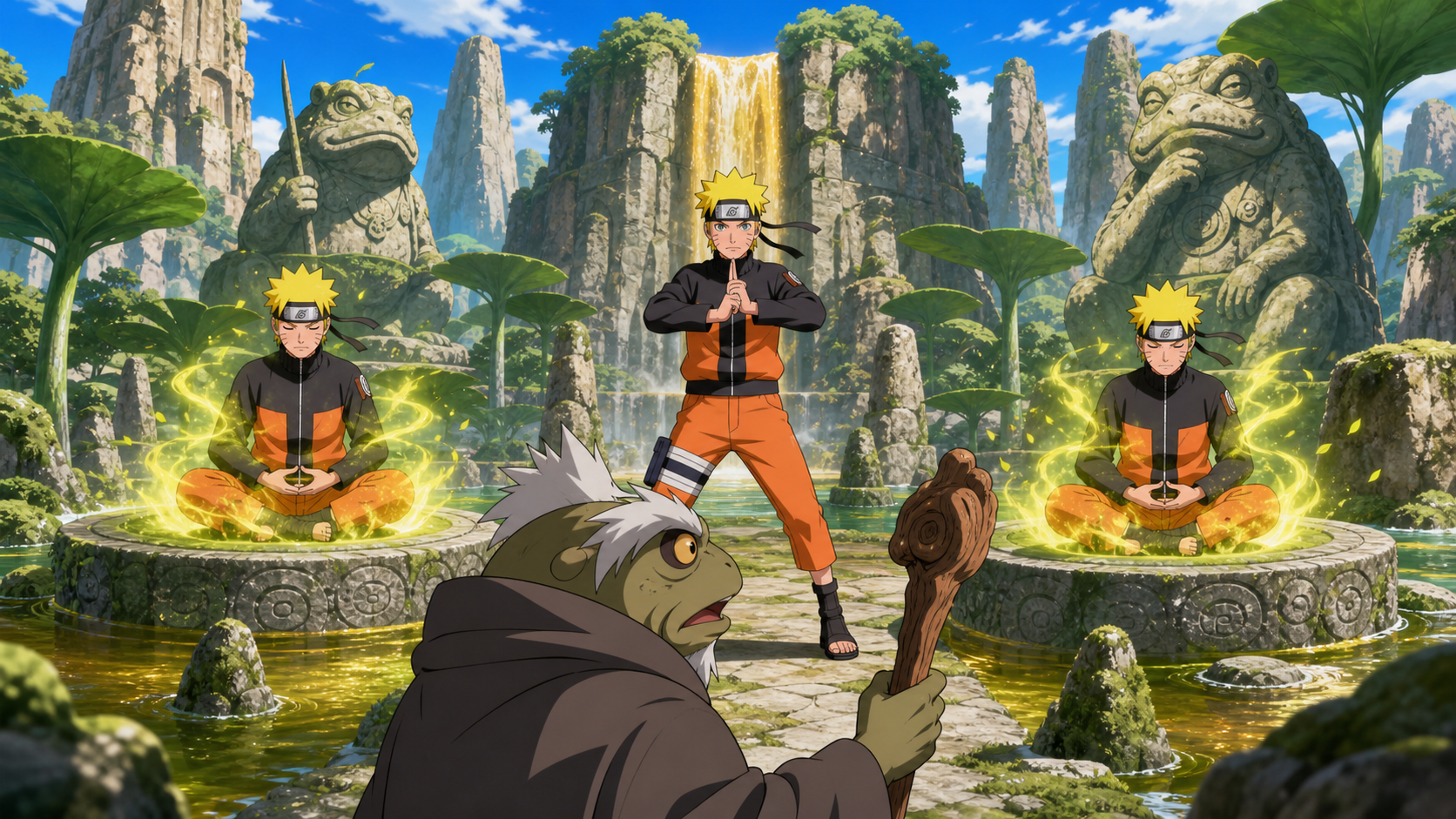
Surpassing the Master
Slow Sage progress pushes Naruto to adapt shadow-clone learning, honoring Jiraiya by changing the method instead of remaining inside it.
What happens
Naruto continues Sage training at Mount Myoboku, but his progress remains painfully slow. Gathering nature energy requires stillness and exact balance, two conditions that resist his usual habit of solving difficulty through movement and repetition.
Fukasaku loses patience with the pace and suggests moving on to the next phase. Naruto, however, begins applying the training logic he developed for the Rasenshuriken: shadow clones can divide the work and return their accumulated experience to the original.
The method does not make Sage Jutsu easy. It turns Naruto's most familiar technique into a tool for learning an unfamiliar kind of attention.
Slow progress is still progress
Fukasaku's frustration does not mean Naruto has learned nothing. The slowness reveals how demanding the balance truly is.
Naruto has to notice an energy outside himself, draw it inward, and keep it proportional to physical and spiritual chakra. Each failure contains information about where the balance collapsed.
The episode refuses the fantasy that determination always produces visible results quickly. Sometimes persistence first appears as a better understanding of failure.
Fukasaku’s impatience creates a useful interruption
Fukasaku is an experienced teacher, but even he has expectations about how training should proceed. When Naruto does not meet them, moving on seems practical.
That interruption forces both teacher and student to reconsider the method rather than only repeat it. The problem may not be Naruto's capacity. It may be the pace available to one body.
Good teaching is not endless patience without adjustment. It is knowing when frustration signals the need for a different structure.
Shadow clones become a learning network
Naruto's clones are usually associated with numbers in combat. Their deeper advantage is shared experience.
Each clone can attempt the same concentration problem, and when the clones disperse, the original receives what they learned. Naruto effectively creates parallel practice without abandoning the stillness each attempt requires.
The innovation is powerful because it does not violate the lesson. Naruto is not forcing nature energy through motion. He is multiplying the number of quiet observers.
Naruto adapts rather than imitates Jiraiya
Jiraiya trained at Mount Myoboku and developed an imperfect Sage transformation. Naruto honors that path, but honoring a master does not require copying his exact method.
Naruto brings a technique Jiraiya did not use this way and redesigns the training around his own strengths. The student surpasses the master by understanding the lesson well enough to change the process.
This is inheritance at its healthiest. Jiraiya's knowledge becomes a foundation, not a ceiling.
Innovation comes from an earlier struggle
Naruto's clone-learning method was developed during the difficult creation of the wind-style Rasenshuriken. That previous breakthrough becomes infrastructure for the next one.
Skills do not remain isolated inside the challenge that produced them. A method learned for chakra transformation can later accelerate sensory discipline.
Naruto's growth feels cumulative because the story lets old training change new training. He is not restarting from zero at Mount Myoboku.
Surpassing is not erasure
The title could sound like Naruto's achievement makes Jiraiya smaller. The episode supports the opposite reading.
A teacher's success includes creating a student capable of going farther. Naruto's potential does not cancel Jiraiya's work; it proves how much that work made possible.
Jiraiya's limitations also become knowledge Naruto can inherit. Knowing that his master struggled with Sage balance helps Naruto recognize the importance of finding a method suited to his own chakra and mind.
Multiplication creates new risks
Shadow clones accelerate experience, but they also multiply fatigue and mental strain when their knowledge returns.
Sage training already carries the danger of absorbing nature energy incorrectly. Increasing the number of attempts increases the information Naruto must integrate.
The method therefore depends on discipline, not only cleverness. Naruto has found leverage, but he still has to manage it without turning efficiency into recklessness.
Naruto’s defining trait becomes precision
Naruto's refusal to quit has always mattered. This episode shows a more mature version of that trait.
He does not merely insist on repeating the same failure longer than anyone else. He studies what the failure demands and reorganizes his resources.
Persistence becomes intelligent when it can change form. Naruto remains stubborn, but the stubbornness now serves observation and design.
The master can be surpassed because teaching is shared
Naruto's Sage training is not only between him and Jiraiya's memory. Fukasaku provides instruction, Mount Myoboku provides the energy, and Naruto's earlier teachers made his clone method possible.
The phrase “surpassing the master” therefore describes a collective achievement carried through one student. Naruto advances because many relationships converge in his practice.
That truth fits Jiraiya's legacy. His greatest strength was never solitary perfection. It was the number of people whose futures he helped set in motion.
The next phase arrives before comfort
Fukasaku's suggestion to move on means Naruto cannot wait until the first challenge feels effortless. Real preparation often proceeds with imperfect mastery.
Pain is moving, and the village's investigation is incomplete. Training has urgency without permission to become careless.
Naruto must carry what he has learned into the next task, trusting that continued practice and clone experience will deepen the balance alongside new demands.
Naruto turns a supposed weakness into the scale of the solution
He has always produced too many clones, spent too much chakra, and attacked a problem with embarrassing volume. Those habits began as compensation for isolation and uneven instruction. Experience has taught him when numbers create information instead of noise.
The Sage breakthrough does not deny his old self. Naruto takes the technique most associated with youthful excess and gives every copy a quiet, exact job.
Fukasaku learns from Naruto while remaining the teacher
Authority does not collapse because a student invents something the instructor did not anticipate. Fukasaku recognizes the logic, adjusts the training, and continues supervising the danger.
That response makes him a stronger teacher. He protects the core principle of Sage balance while allowing Naruto to redesign the route toward mastery.
The clone method respects the time pressure without lying about time
Pain will not wait for Naruto to complete years of contemplative practice. Parallel learning compresses experience, but each clone still has to sit, sense, fail, and correct.
The method earns speed through multiplied labor. Naruto does not receive instant mastery because the plot needs him. He pays for accelerated learning with chakra, fatigue, concentration, and the risk of overwhelming feedback.
Experience transfer makes every clone’s failure valuable
A clone that loses balance has not wasted the attempt. The original receives the sensation and can compare that mistake with every other version. Failure becomes a shared dataset.
This is one of Naruto’s smartest uses of ninjutsu because the technique expands reflection rather than avoiding reflection. He learns faster by preserving mistakes long enough to study them.
Surpassing Jiraiya begins with accepting Jiraiya’s unfinished work
Naruto does not arrive at Mount Myoboku with a complete manual. Fukasaku carries teaching. Jiraiya’s imperfect Sage form carries evidence. The mountain carries the tradition.
Naruto adds his own method to an inheritance full of gaps. Surpassing becomes possible because he does not waste energy pretending the gaps are disrespectful to notice.
The student can improve the method without judging the master’s worth
Jiraiya’s inability to reach perfect balance did not make him a failed shinobi or teacher. Bodies, chakra reserves, learning histories, and available techniques differ.
Naruto’s result belongs to another combination of strengths. Comparison becomes useful when comparison reveals possibility, not when comparison turns grief into a ranking contest.
Fukasaku’s praise carries the weight of direct memory
He trained Jiraiya and now watches Naruto find a route Jiraiya never completed. His recognition connects the two students across time.
The praise matters because Fukasaku knows the difficulty and knows the master. He is not flattering Naruto into confidence. He is naming a technical breakthrough he can verify.
The training creates a problem for real combat
Nature energy requires stillness, and Pain will not politely pause while Naruto sits on a stone. Mastering the gathering process is only half the problem.
Naruto must eventually find a way to enter battle with Sage chakra available or replenish the power without exposing himself. The clone method hints at an answer while creating new logistical limits.
Parallel concentration requires centralized judgment
Many clones can gather experience, but one Naruto must decide which lessons to keep and how to act. More information can improve judgment only if he can integrate competing sensations without panic.
The exercise trains mental organization alongside chakra balance. Naruto is learning to receive several versions of himself and remain one responsible decision-maker.
The episode makes innovation relational
Yamato and Kakashi helped Naruto discover clone-based learning during wind training. Fukasaku teaches nature energy. Jiraiya created the emotional and technical path toward Mount Myoboku.
Naruto’s idea is genuinely his, yet the idea grows from earlier instruction. Originality does not require pretending no one helped.
Hard work changes meaning when the student designs the work
Naruto has never lacked willingness to suffer through repetition. The mature change is his ability to ask whether repetition is producing the right information.
He reorganizes the exercise instead of simply demanding more endurance from one body. Effort becomes purposeful, measurable, and responsive to results.
The Rasenshuriken lesson returns without repeating the same story
The earlier training established that clones can return experience. Episode 156 does not present that rule as a brand-new miracle. Naruto remembers and transfers the method.
Continuity makes intelligence visible. A character looks smarter when previous learning changes later behavior instead of disappearing after one arc.
Nature energy remains bigger than Naruto’s workaround
Clones increase attempts, but they cannot alter the required proportion. Every copy still has to respect physical energy, spiritual energy, and the world outside the body.
The workaround serves the natural law rather than overruling the law. That boundary keeps Sage Mode from becoming another power Naruto can obtain through stubbornness alone.
Progress gives grief a structure without erasing grief
Naruto can see a path toward the strength needed against Pain. The breakthrough creates hope and also reminds him why the training became urgent.
Jiraiya remains present in every comparison. Growth and mourning continue together, sometimes making the same success feel proud and painful at once.
Surpassing the master is a responsibility, not a trophy
If Naruto reaches a level Jiraiya could not, greater power creates greater obligation. He must use the ability with judgment, protect people who cannot match him, and pursue the peace question Jiraiya left unresolved.
The title should increase pressure on Naruto’s ethics rather than inflate his ego.
RaeRae reaction
I love this use of shadow clones because it feels like Naruto thinking with his own history. He does not suddenly become a different kind of student to satisfy Sage training. He translates Sage training into a structure he understands.
The clever part is that the clones do not let him avoid stillness. They let him practice stillness in parallel. That distinction keeps the breakthrough from feeling like a shortcut around the lesson.
Fukasaku's impatience is useful too. Teachers are allowed to misread pace, and students are allowed to reveal a method the teacher did not anticipate.
“Surpassing the Master” is not about defeating Jiraiya's memory. Naruto surpasses him by carrying Jiraiya's path forward with techniques and relationships gathered from the rest of his life. The achievement honors the master because it proves the student was never meant to remain inside the master's exact outline.
The clone system also reveals Naruto’s limits honestly
Accelerated experience can exhaust him. Maintaining clones consumes chakra. Nature energy must remain balanced. Combat will restrict how many copies can safely gather power elsewhere.
A strong technique becomes more interesting when the audience understands the conditions. Strategy grows from the limit instead of arriving as a surprise whenever the plot needs tension.
Fukasaku gives Naruto permission to be different from Jiraiya
The training does not demand identical posture, pace, appearance, or method. Fukasaku wants Naruto to master the principle and survive the process.
That flexibility protects mentorship from becoming imitation. Naruto can love Jiraiya without treating difference as betrayal.
The episode rewards Naruto for thinking before moving
His solution arrives because he studies why the pace is failing and remembers another learning structure. The breakthrough begins in thought, then changes action.
That order proves the first challenge worked. Stillness has already created a more reflective version of Naruto’s stubbornness.
RaeRae’s final word on Surpassing the Master
Naruto does not surpass Jiraiya by loving him less or by proving the old man trained incorrectly. He surpasses one technical limit because Jiraiya, Fukasaku, Kakashi, Yamato, Mount Myoboku, and Naruto’s own past work all meet inside the same idea.
The shadow clones are perfect because they do not cheat the stillness requirement. Every Naruto has to sit down and listen. He simply creates more listeners, then carries their experience back into one body.
Fukasaku’s willingness to adjust deserves attention too. A weaker teacher would protect authority by rejecting the student’s innovation. Fukasaku protects the student and the principle, then allows the method to change.
Surpassing becomes an act of inheritance. Naruto takes what Jiraiya reached, accepts what Jiraiya could not finish, and adds a solution shaped by every lesson that came afterward. The path grows because the student was never supposed to remain a copy.
The breakthrough depends on Naruto remembering his own education
Many action series treat training arcs as separate rooms. A hero learns one technique, closes the door, and receives another lesson that has no relationship to the first. Naruto does something better here. The wind-style training remains active knowledge.
He remembers not only the Rasenshuriken result but the learning mechanism that produced the result. That transfer shows real development. Education becomes durable when a student can recognize where an old method fits a new problem.
Clones make concentration social without adding another person
Each copy experiences frustration, adjustment, and small success independently before returning to the original. Naruto receives a crowd of perspectives that all belong to him but do not arrive from the same moment.
The structure suits someone who grew up alone and first used clones to create visible presence around himself. A technique born from loneliness now teaches cooperation inside his own mind.
Fukasaku must supervise the system instead of only the individual
One student becoming a toad can be corrected with the staff. Several clones gathering nature energy create more thresholds to watch and more returned experience to manage. The new method changes the teacher’s job.
Fukasaku accepts that added work because faster progress remains worth pursuing under approaching danger. Adaptation runs both ways. The student redesigns practice, and the teacher redesigns safety around the practice.
Efficiency is not automatically wisdom
Naruto’s method accelerates training, but speed can become seductive. More clones are not always better. Each copy consumes chakra, produces fatigue, and increases the information returning to one brain.
He needs a number that improves learning without destroying judgment. Sage balance therefore extends beyond the three energy sources. Naruto must balance time, risk, attention, and the limits of his own technique.
Jiraiya’s incompleteness becomes a gift
A flawless master can leave a student with reverence and no room to contribute. Jiraiya leaves knowledge, mistakes, unfinished research, and a peace problem with no final answer. Naruto has to participate.
That incompleteness is painful because death prevents later conversation. The same incompleteness grants the student authority to test, revise, and extend. Naruto is not disrespecting a sacred system when he changes the route. He is doing the work Jiraiya can no longer do.
The title carries affection underneath competition
Naruto loves competition, and surpassing can sound like winning. This episode places the word inside mourning. Jiraiya is not present to lose, object, or celebrate. Fukasaku becomes the witness who can understand both achievement and absence.
The emotional victory therefore remains complicated. Naruto wants to become strong enough to face Pain, which means every improvement grows beside the fact that Pain killed the person whose level he is passing.
Mastery should widen Naruto’s choices in the coming fight
Raw strength offers one response: hit harder until the visible body falls. Sage perception, balance, and stored nature energy create options. Naruto can sense, plan, conserve, and distinguish threats across a distributed battlefield.
Those choices matter because Pain’s system punishes impulse. The battle will require timing, information, and the ability to stop before anger decides the entire moral outcome.
Episode 156 earns its hopeful title because Naruto does not receive greatness as compensation for grief. He studies. He fails. He notices a structural problem. He remembers earlier work and proposes a solution that preserves the dangerous lesson instead of avoiding the lesson. Fukasaku listens, tests the idea, and continues teaching. That sequence makes surpassing feel like shared success. Jiraiya’s shadow remains present, but Naruto is no longer trying to fit inside its exact shape. He carries the path forward with his own footprints, his own technique, and a responsibility to make greater power answer to the peace Jiraiya never stopped seeking. The strongest proof of growth is not Fukasaku’s comparison. Naruto now treats difficulty as a problem he can examine instead of an insult he must overpower. He identifies the bottleneck, recalls a tested learning tool, predicts how the tool could help, and accepts the additional risk that comes with using the tool. That thinking will matter against Pain as much as expanded chakra. Six coordinated bodies demand a fighter who can change plans without losing purpose. Naruto is learning that flexibility does not weaken conviction. Flexibility gives conviction a better chance to survive contact with a complicated world and its human consequences.
RaeRae’s call
Naruto honors Jiraiya by changing the method. Shadow clones multiply stillness, preserve failure as experience, and let the student carry an inherited path beyond its old limit.