
RaeRae Reacts · One Piece Episode 58
Zoro vs. Eric in the Ruins
One Piece Episode 58 turns a false destination into heritage evidence that redirects Ryu home while Zoro conducts a bounded delay against Eric.
Episode information
Japanese title: Haikyo no Kettou! Kinpaku no Zoro tai Eric! (1 Jikan SP Zenpen)
English title: Duel in the Ruins! Tense Zoro vs. Eric!
Japanese broadcast: February 21, 2001
Saga: East Blue
Script: Junki Takegami
Episode direction: Munehisa Sakai
Animation direction: Naoyoshi Yamamuro
Art: Tomoko Yoshida
The storm passage leads to a ruined island
Episode 58 brings the crew through the mirror wall and severe weather to a remote place that appears to match the Lost Island story. The crew finds is architecture without a living dragon colony.
The discovery is not meaningless because the island fails to satisfy the original expectation. Ruins can preserve migration, settlement, art, and environmental history.
A false destination is still useful evidence
The crew tested Ryu’s recalled landmark and reached a real site. The result supports part of the memory while challenging the conclusion that this location is the Dragon’s Nest.
Responsible investigation updates the hypothesis instead of forcing the landscape to fit the desired answer.
Ryu should not be blamed for incomplete recall. Age, fatigue, time, changed coastlines, submerged land, repeated migration, and trauma can alter memory. He communicated what he could through Apis.
Adults chose the route and remain responsible for verification.
The crew needs a landing assessment. Before unloading an elderly dragon, inspect surf, slope, ruins stability, weather, fresh water, escape routes, and signs of other visitors. The mirror passage may make return difficult.
Ryu should remain aboard or in a protected staging area until the route is safe.
Ruins are not an empty campsite. Stone walls, paintings, tools, foundations, burials, and deposits may belong to Warship Island ancestors. Camping, cooking, or dragging the cart across them can destroy context.
The crew should use already disturbed ground and remove all waste.
Archaeological context matters. An object’s exact location, depth, orientation, and relationship to nearby material often holds more information than the object alone. Picking up souvenirs destroys that evidence.
No crewmate should pocket artifacts for decoration or sale.
The summit ruins contain a ceiling painting
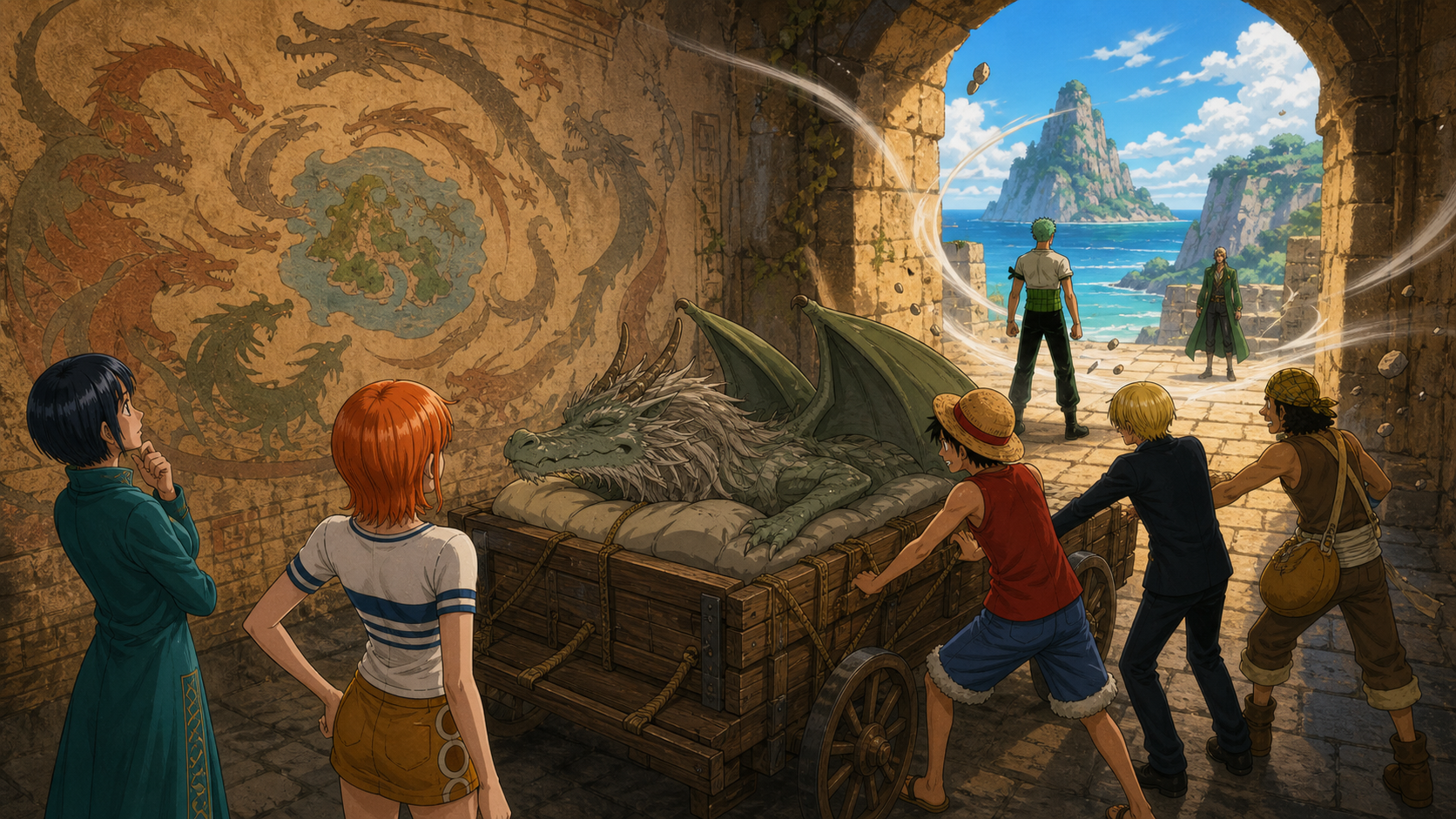
The mural shows dragons in relation to an island form. Its composition gives Ryu and the crew a new way to interpret the migration story.
Visual evidence requires careful observation before anyone touches, traces, or copies the mural.
Protect the painting from bodies and equipment. Cart wheels, ropes, hands, smoke, moisture, lamps, and food can damage pigment and plaster. Establish a boundary and keep Ryu’s transport away from fragile surfaces.
Use indirect light and noncontact notes where possible.
A ceiling image is not automatically a map. Artists may encode cosmology, memory, ceremony, season, direction, or symbolism rather than literal coordinates. Island shapes can be stylized.
The crew should compare the image with Warship Island geography, Bokuden’s account, Ryu’s response, and natural landmarks.
Ryu remembers the nest is at Warship Island
The painting triggers a revised understanding: the destination may have been where the journey began. That reversal feels surprising because the crew treated distance as evidence of hidden truth.
New evidence can responsibly overturn a long detour.
Returning home can be the discovery. Communities often preserve traces of deep history in familiar landscapes that outsiders overlook. Warship Island’s name, shape, relief, and oral tradition may contain more than residents realized.
The answer does not become outsider property because pirates helped connect clues.
Apis should hear the revision without blame. She advocated for Ryu and translated under pressure. The adults should explain that the first route produced important evidence and that changing course is responsible.
No one should suggest her ability failed because memory evolved.
Nami needs a return route that avoids the tail. If Eric followed through the mirror passage, turning directly toward Warship Island can lead him to the nest. The shortest route may be the least safe.
Counter-surveillance and habitat protection should shape departure timing.
Zoro senses hostile intent
His awareness alerts the crew before Eric fully attacks. Early detection is valuable because the transport group needs time to move.
A sensed threat should trigger confirmation, cover, and role assignment rather than immediate uncontrolled combat.
Eric reveals the purpose of his pursuit
He intends to seize Ryu and use the dragon to reach valuable remains. His conduct confirms that the conservation threat is active rather than hypothetical.
Information about Warship Island must now be treated as compromised.
Zoro positions himself as a delay
Standing between Eric and the cart creates a bounded tactical objective: prevent pursuit long enough for Luffy, Nami, Sanji, Usopp, Apis, and Ryu to withdraw.
He does not need to settle pride, prove superiority, or capture Eric to complete the role.
A delaying action needs a clock. Zoro should know the route, expected loading time, recall signal, fallback point, and maximum acceptable injury. Without those, “buy time” can become fighting until collapse.
Communication makes sacrifice a strategy rather than a vague expectation.
Eric’s wind attacks threaten heritage
Cutting gusts can damage mural surfaces, columns, roofs, artifacts, and the path supporting the cart. Fighting inside the ruins risks irreversible loss.
Zoro should draw Eric toward open, already disturbed ground if possible.
The mural needs emergency documentation
Before leaving, take quick noncontact sketches or images from safe angles, note colors and orientation, and mark the site’s location in a restricted record. Do not delay evacuation for perfect documentation.
Warship Island descendants should receive the record first.
Ryu’s cart must move before combat escalates
The dragon cannot shelter quickly from cutting air or collapsing stone. The transport team should clear the structure, secure wheels, and choose a route shielded by terrain.
Stopping to watch Zoro would endanger the passenger and waste his delay.
Apis may resist leaving Zoro. A child can feel guilty when someone stays behind to protect her and Ryu. Adults should explain the plan, keep her moving, and avoid making her responsible for his decision.
She can help by reassuring Ryu and preserving the information they found.
Luffy needs to accept divided leadership. He may want to remain and fight Eric. As captain, his role may be more valuable controlling the cart, protecting Apis, and ensuring the route closes behind them.
Trusting Zoro with a bounded task is not abandonment.
Nami controls movement through the ruins. She should choose slopes, turns, surface conditions, and timing. Archaeological sensitivity and cart stability both matter.
The fastest line across a fragile floor may create collapse or destroy evidence.
Sanji can protect the cart flank. He can move debris, stabilize wheels, watch for wind effects, and shield people from secondary hazards. Close combat should remain a last response.
His role is passenger safety, not competing with Zoro’s stand.
Usopp should carry the evidence record. His observation and drawing skills can preserve the mural’s layout while remaining mobile. The notes should avoid public coordinates and be stored in a waterproof container.
If forced to choose, people and Ryu come before the record.
Eric can be delayed without being killed. Disarmament, terrain separation, damaged footing away from the mural, rope obstacles, or forcing him to defend against his own gust rebound may create time.
The goal is to end pursuit capacity temporarily, not impose punishment.
Zoro’s new swords face an environmental test
Sandai Kitetsu and Yubashiri now operate amid abrasive dust, salt, rain residue, and stone. Drawing them risks edge damage and loss if wind shifts grip.
Maintenance after the encounter is essential even if no blade visibly chips.
Wind can redirect a sword’s danger. Strong lateral force affects balance, clothing, scabbards, debris, and attack path. Zoro needs stable footing and space clear of the transport team.
Technique should adapt rather than assume still-air conditions.
Eric’s range should not dictate the whole encounter. Cover, angles, walls, elevation, and timing can reduce a ranged advantage. Zoro can force him to reposition without chasing through every ruin chamber.
Contain the pursuit corridor instead of defending the entire island.
The team must verify Zoro’s withdrawal
Once the cart reaches the ship or safe route, send the agreed signal and maintain a pickup window. Do not leave without a head count unless remaining would guarantee more loss.
A second rescue team should not reenter blindly.
The mirror wall may close or shift. Weather and reflective conditions could change, so return through the same passage is uncertain. Nami needs alternate bearings and enough supplies for delay.
Urgency to beat Eric cannot override crossing safety.
Warship Island must be warned carefully
If the nest is there, ordinary communication could expose the habitat. Use a trusted signal or indirect contact rather than broadcasting coordinates.
Bokuden and local leaders should decide how much to tell residents and how to respond to Nelson.
The nest may be hidden in plain sight. Submergence, seasonal emergence, migration, or geology could explain why residents know the legend without seeing a permanent colony. The mural offers a hypothesis, not final proof.
The crew should arrive ready to observe rather than excavate.
Do not search Warship Island destructively. Digging, blasting, draining, or clearing habitat could harm dragons, heritage, and residents. Low-impact surveys and Ryu’s guidance should come first.
The absence of immediate evidence is not permission to escalate methods.
Nelson’s force makes timing critical
Returning to an occupied island with Ryu and a tail creates converging danger. The crew may need to separate pursuers, create a safe landing, and coordinate with residents before approaching the nest.
The mission is no longer a simple homecoming.
The first island deserves later stewardship. Learning that the island is not the nest does not make the ruins disposable. Warship Island descendants may want to document, protect, or interpret the site.
The Straw Hats should preserve location notes securely for community handoff, not public adventure stories.
Junki Takegami makes correction the breakthrough
Takegami’s script lets the crew be wrong about the destination, then uses the wrong site to reveal the correct relationship. Progress comes through revision.
Eric’s arrival ensures there is no leisurely academic resolution.
Munehisa Sakai separates evidence from pursuit. Sakai’s direction gives the mural enough quiet focus before hostile intent enters the ruins. The crew’s attention shifts from interpretation to evacuation in a clear sequence.
Zoro becomes the hinge between those phases.
Naoyoshi Yamamuro makes the standoff directional. The animation direction positions Zoro between Eric and the exit rather than at the center of an arena. Every movement relates to whether the cart can leave.
Wind affects dust and loose stone before wind reaches people.
Tomoko Yoshida gives the ruins cultural weight. Weathered pigment, carved stone, open sea, collapsed walls, and the surviving ceiling image make the site feel inherited rather than abandoned.
Damage would mean losing knowledge, not just scenery.
RaeRae’s real-time reaction
The island being wrong is not a waste. The ceiling painting gives Ryu the relationship he could not retrieve from memory alone. That is what evidence is supposed to do: change the route.
Zoro staying behind works if everyone understands the stand as a timed delay. I do not need a pride duel inside the only surviving archive.
The moment that lands. Ryu looks at the dragons circling the painted island and remembers Warship Island differently. Home stops being the place they left and becomes the place they failed to fully see.
The discovery is powerful because the evidence corrects rather than confirms.
What the transport team should do next. Move Ryu out of the ruins, secure the cart, preserve restricted mural notes, reach the Merry, prepare a safe lift, and signal Zoro. Reassess the mirror passage and tail before sailing.
Tell Ryu and Apis that returning home now carries active pursuit risk and check consent again.
What Zoro should do next. Hold the exit, move combat away from fragile surfaces, monitor time, disengage at the signal, and avoid injury that prevents boarding. He should not pursue Eric after the transport route is clear.
Report Eric’s capabilities and any words revealing Nelson’s plan.
Bottom line
Episode 58 makes a mistaken destination productive. The ruined island is not the Dragon’s Nest, but its ceiling painting helps Ryu remember that the true relationship points back to Warship Island. Eric arrives to seize him, and Zoro turns the ruins into a bounded delaying action while the cart escapes.
RaeRae rating: 9.2/10. Revision is not failure. The mural matters as heritage evidence, Ryu’s memory deserves patience, and Zoro succeeds only if the confrontation protects the evacuation and leaves the archive standing.