
RaeRae Reacts · One Piece Episode 47
The Return of Captain Buggy
Buggy’s presumed death creates a succession crisis where a duel crowns Richie and weak governance leaves the crew exposed
Episode information
Japanese title: O-Machikane! Aa Fukkatsu no Buggy Senchou!
English title: You’ve Been Waiting! The Return of Captain Buggy!
Japanese broadcast: November 8, 2000
Saga: East Blue
Script: Junki Takegami
Episode direction: Hidehiko Kadota
Animation direction: Kazuo Takigawa
Art: Miyuki Sato
The Buggy Pirates escape without Buggy
Episode 47 follows the crew driven from Orange Town while their captain remains missing. They recover separated body parts they can identify and take the Big Top away from immediate danger, but they lack reliable proof about Buggy’s condition or location.
The crisis exposes how little succession planning existed beneath the crew’s theatrical confidence.
Recovery of the parts is both rescue and custody. Buggy’s Devil Fruit makes his body pieces living parts of a person rather than ordinary property. Crew members handling them have a duty to preserve, identify, secure, and return them safely.
Displaying, trading, discarding, or using them for comedy without care would violate that custodial responsibility.
The crew assumes Buggy is dead
Distance, defeat, and missing information become a conclusion before anyone verifies the scene. In dangerous conditions, presuming death can help a group move forward, but that presumption also risks abandoning a survivor.
A proper search plan needs last known location, elapsed time, witnesses, environmental hazards, and a clear point at which rescue becomes impossible.
A funeral creates closure without certainty
The crew performs a memorial on the Kumate Tribe’s island. Ritual can hold grief and stabilize a group after sudden loss, even when remains are unavailable.
The problem is not mourning. The problem is using the ritual as proof that no further verification or search duty exists.
The funeral also becomes a political transition
Once Buggy is declared gone, the captain’s position becomes available. Grief and ambition occupy the same space, revealing that the crew lacks a trusted process for choosing temporary command.
A crisis succession should first preserve safety and continuity. Personal promotion can wait.
Mohji sees proximity as qualification. As chief of staff and animal trainer, Mohji has operational experience and a recognizable position near Buggy. He may reasonably believe that rank supports a claim.
Proximity to the former captain does not automatically prove navigation, judgment, logistics, conflict management, or consent from the crew.
Cabaji sees competence as qualification. Cabaji’s acrobatics, combat ability, and officer status give him another basis for leadership. He can point to individual skill and confidence under pressure.
Technical talent in one domain does not establish the ability to govern a ship or protect people with competing needs.
The duel is a poor selection mechanism
Mohji and Cabaji fight to determine who becomes captain. The contest measures which exhausted officer can defeat the other after a crisis, not who can lead responsibly.
The duel also injures or depletes the two people most likely to coordinate recovery if another threat arrives.
Combat rewards the wrong evidence. A captain needs to plan routes, ration supplies, manage repairs, hear dissent, assign watches, avoid unnecessary conflict, and accept accountability. A duel demonstrates almost none of those capacities.
The crew confuses dominance with governance because Buggy modeled authority through spectacle and fear.
The crew should have appointed an interim council. A navigator, quartermaster, combat lead, medic, lookout, and representative chosen by ordinary members could divide urgent decisions. Time-limited authority would reduce the stakes of uncertainty.
Distributed leadership is especially useful while the captain’s status remains unresolved.
Richie becomes captain by accident
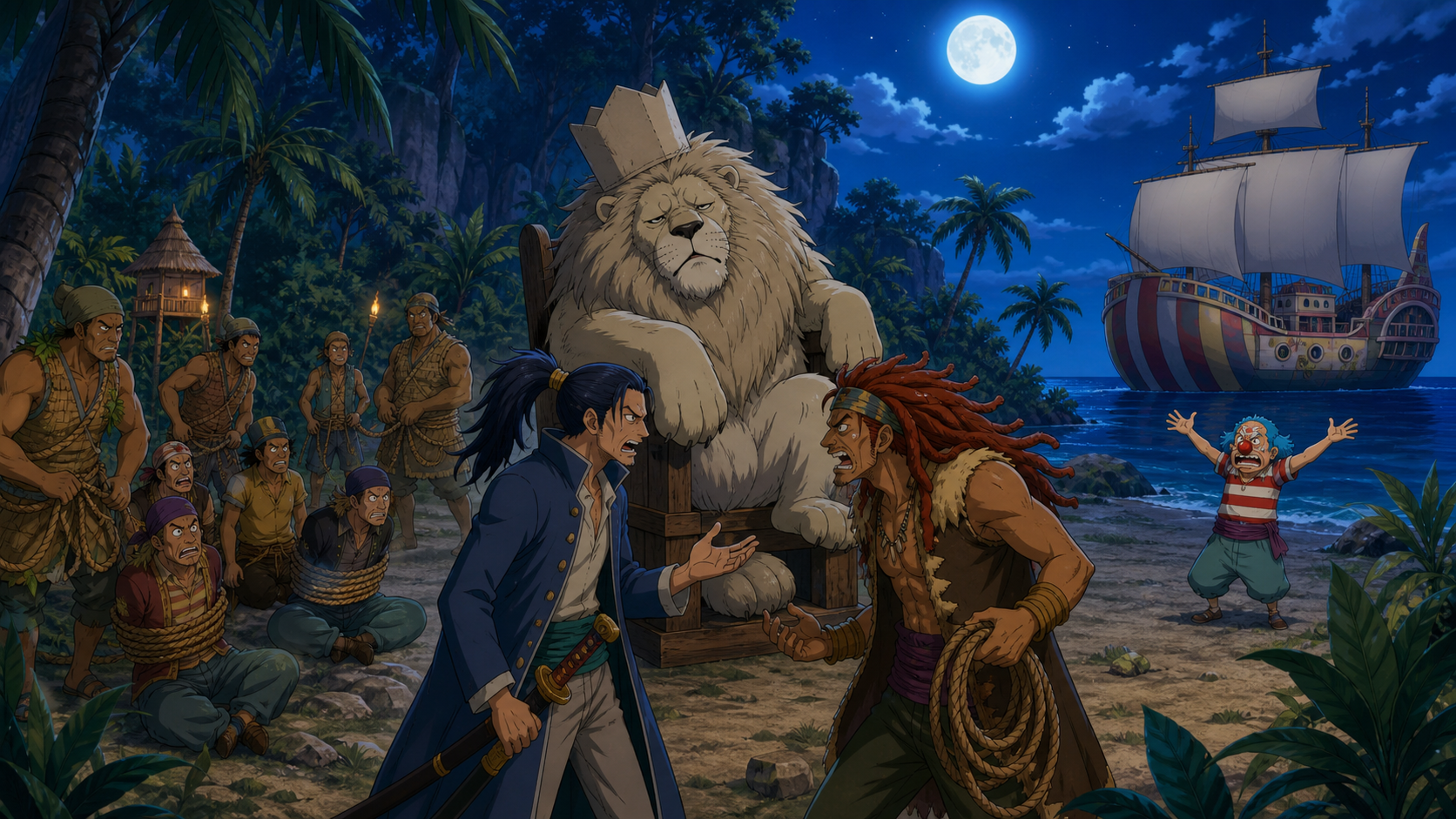
The lion strikes while half-asleep and appears to defeat both competitors. The crew interprets the result through the duel’s own rule and places Richie in command.
The absurd outcome is logically consistent with a bad process. If one blow defines leadership, an accidental blow must count.
Richie cannot consent to the office
Richie is an animal companion, not a person who has agreed to command a pirate ship. A ceremonial crown and chair do not create informed responsibility.
The crew projects authority onto him because they want the contest to produce a definite answer.
Animal welfare matters inside the joke
Richie should not be forced into crowds, conflict, unfamiliar food, or punishment for decisions he cannot make. Mohji remains responsible for his care even while pursuing rank.
Using an animal as a symbol of command cannot transfer human accountability.
The accidental captain reveals the crew’s dependency. Members wait for a central figure to tell them what the result means. They do not trust their own capacity to form a process.
Buggy’s style produced obedience without durable governance. His absence therefore creates both emotional and procedural collapse.
The Kumate Tribe has its own territory
The pirates conduct a funeral, argument, duel, and leadership ceremony on an inhabited island. They behave as though temporary presence grants control over the space.
Local residents have legitimate reasons to monitor a large armed group that arrives without permission.
Local defense is not automatic villainy. The tribe’s decision to capture the pirates may arise from perceived threat, prior experience, or protection of resources. The episode’s comic framing should not erase territorial context.
Capture still needs proportionate treatment, safe restraint, and a path to communicate intent.
The pirates are vulnerable because command consumed attention. Mohji and Cabaji focus on one another while lookouts, perimeter security, diplomacy, and departure readiness receive less attention. Richie provides no corrective leadership.
The tribe exploits a gap created by internal competition rather than overwhelming a coordinated defense.
Leadership conflict becomes a safety hazard
A disagreement that could have been handled through discussion exposes every crew member to detention. The people with the least power bear consequences for officers’ ambition.
Responsible candidates should be judged partly by whether their methods protect others from unnecessary risk.
Restraint should remain humane. Tied prisoners need circulation checks, water, shade, sanitation, and protection from animals or weather. Restraints should prevent escape without causing injury.
The tribe can secure its island while preserving basic care.
The crew needs a spokesperson. Once captured, several pirates shouting threats will confirm local fear. One calm representative should explain the ship’s condition, the funeral, the leadership dispute, and their intention to depart.
Communication will not guarantee release, but a clear statement creates a record beyond assumption.
Buggy’s return complicates every prior decision
When a presumed-dead leader reappears, relief does not automatically restore the exact old hierarchy. The crew has experienced failure, attempted succession, and detention during his absence.
They deserve a review of what happened and whether returning to prior command serves their safety.
Rescue does not erase the need for consent. If Buggy helps free the crew, gratitude may be genuine. Rescue should not become a debt that prevents members from questioning his next revenge plan.
Authority based on “I saved you” remains coercive when disagreement carries retaliation.
Buggy also owes the crew an account. He should explain his survival, the condition of his body, his encounter with Gaimon, his travel route, and any new alliance or threat. Operational information cannot remain captain-only drama.
The crew needs facts to make informed decisions about departure.
The missing parts need a careful reunion. Reattaching magical body parts should still involve identification, privacy, clean handling, and observation for problems. The reunion is bodily care, not merely a visual restoration of status.
Buggy should direct what happens to his body wherever possible.
Physical restoration is not institutional restoration
Becoming full-sized again returns mobility and power. Physical restoration does not solve the crew’s weak succession system, poor threat awareness, or tendency to confuse spectacle with competence.
If nothing changes, the next separation will produce the same chaos.
Mohji and Cabaji need accountability for the duel. Both officers diverted attention from crew safety and accepted a process that injured them without testing leadership. The review should identify impact rather than focus only on who started the fight.
Repair could include shared watches, emergency planning, and relinquishing unilateral claims while a better process is created.
Richie needs to return to being Richie. The crew should remove the crown without shaming or punishing the lion. He did not seek command and cannot be blamed for their projection.
Mohji should assess stress, food, rest, and any injuries after the capture.
The Kumate Tribe needs a safe resolution. Escape or rescue should avoid treating local residents as targets for revenge. The pirates entered their territory and created a visible threat before capture.
A negotiated departure, restitution for damaged property, and commitment not to return would reduce future conflict.
Buggy’s reunion can reinforce the worst lesson. If the crew interprets his return as proof that only the original captain can save them, dependency deepens. Buggy may enjoy the worship and avoid discussing how his earlier decisions led to Orange Town.
Relief should open a governance conversation, not close one.
Alvida’s alliance raises new questions
Buggy’s path brings him into contact with another pirate who also wants Luffy. Shared retaliation can create fast cooperation, but common enemies do not establish trust.
Each leader should disclose goals, limits, resources, command expectations, and what happens when interests diverge.
Revenge coalitions can endanger both crews. Combining forces increases capability while multiplying communication problems and civilian exposure. Members who did not choose the personal grudge may be pulled into escalating risk.
An alliance needs crew consent and an exit process rather than two captains trading followers as assets.
The Straw Hats remain absent but influential. Luffy never appears in the island succession crisis, yet Buggy’s defeat shapes every decision. Antagonism organizes people far beyond the hero’s awareness.
The broader world keeps moving because consequences travel through memory, injury, status, and rumor.
The episode examines charisma after disappearance
Buggy built an identity large enough that the crew cannot imagine itself without a substitute captain. They reproduce his hierarchy even while believing him dead.
That is a durable form of influence, but not a healthy one.
Junki Takegami makes process failure funny. Takegami’s script builds each outcome from the crew’s chosen rule. A duel leads to an accidental winner, an animal becomes captain, and distraction leads to capture.
The comedy does not require random behavior. The sequence exposes flawed assumptions through logical consequences.
Hidehiko Kadota stages competing centers of attention. Kadota’s direction lets the funeral, duel, lion, tribe, and returning Buggy successively claim the frame. The crew repeatedly follows the loudest focal point.
Viewers can see threats at the edge before characters redirect their attention.
Kazuo Takigawa keeps the ensemble readable. The animation direction distinguishes Mohji’s animal-handler physicality, Cabaji’s controlled movement, Richie’s sleepy force, and the crew’s group reactions. The succession crisis stays clear despite many participants.
Buggy’s magical scale remains expressive and non-gory when he returns.
Miyuki Sato grounds the island as inhabited space. The art gives the tribe a settlement, terrain, watch points, and relationship to the shore. The pirates are not fighting over an empty backdrop.
That specificity makes local intervention understandable even when the capture is played for comedy.
RaeRae’s real-time reaction
Mohji and Cabaji deciding that a duel will reveal the best captain is already a mess, but honoring Richie’s accidental hit makes the logic collapse perfectly. If your process can crown a sleepy lion, the lion is not the problem.
Buggy returning will feel triumphant to the crew, but I need one person to ask why nobody had an emergency plan that did not involve fighting beside a funeral.
The moment that lands
Richie sits in the captain’s chair while the actual crew becomes easier to capture. The image summarizes the difference between a symbol of authority and functioning leadership.
Everyone can see a captain; no one is managing safety.
What the Buggy Pirates should change. Create an emergency chain of command with time limits, divided roles, search obligations, medical authority, and a crew vote for longer transitions. Record where critical supplies and body parts are secured.
Ban leadership duels during active emergencies. Require lookouts, local contact, route assessment, and crew consent before entering alliances or revenge campaigns.
What Buggy should do after returning. Thank the crew for preserving his parts, assess injuries, learn how the capture happened, and disclose the terms of any alliance. Do not punish people for believing available evidence or attempting continuity.
Ask whether members still consent to his command. Physical return provides an opportunity to rebuild legitimacy through conduct rather than demand legitimacy through spectacle.
Bottom line
Episode 47 turns Buggy’s absence into a governance test his crew fails in increasingly logical ways. Unverified death leads to a funeral, ambition leads to a duel, a bad rule crowns Richie, and leadership distraction leaves everyone vulnerable to capture on an inhabited island.
RaeRae rating: 8.9/10. Buggy’s return may restore the captain’s body and title, but the return cannot repair the system beneath him by itself. The funniest outcome is also the clearest warning: authority needs more than whoever lands the last hit.