
RaeRae Reacts · One Piece Episode 46
Little Buggy’s Big Adventure
Little Buggy’s survival journey reaches Gaimon’s protected island through mistaken identity, conservation boundaries, and a cautious truce
Episode information
Japanese title: Mugiwara wo Oe! Chiisana Buggy no Daibouken
English title: Chase Straw Hat! Little Buggy’s Big Adventure
Japanese broadcast: November 1, 2000
Saga: East Blue
Script: Junki Takegami
Episode direction: Munehisa Sakai
Animation direction: Kenji Yokoyama
Art: Tomoko Yoshida
Episode 46 follows the opponent after defeat
The story leaves the Straw Hats and returns to Buggy after Orange Town. Luffy launched him away, while Nami retained many magically separated body parts. The former captain now has only a small central form and none of the crew infrastructure that supported his authority.
The shift does not ask viewers to forget what Buggy did. The episode asks what his conduct looks like when power, followers, weapons, and spectacle are removed.
Buggy’s body remains magical and whole
His reduced form is a consequence of the Chop-Chop Fruit, not a realistic amputation. The episode plays with scale and mobility without treating bodily difference as gore.
That distinction matters because comedy should come from Buggy’s pride colliding with circumstance, not from injury itself.
Nami’s retention of the parts affects survival
Taking the separated pieces helped neutralize a dangerous opponent during the Orange Town conflict. After the immediate battle, their absence leaves Buggy exposed to environmental threats.
The earlier choice can be tactically understandable and still create a duty to think about humane containment. Defeat does not erase a person’s basic safety interests.
Buggy wakes on an isolated island
He has no reliable shelter, transport, crew contact, or clear route to recover the missing parts. The environment turns ordinary fish, birds, distance, and weather into serious threats.
His situation reveals how much his captain persona depended on collective resources rather than individual invulnerability.
Revenge becomes his organizing goal
Buggy responds to vulnerability by focusing on Luffy. Retaliation gives frustration a target and lets him avoid examining decisions that led to defeat.
A goal can provide momentum while making recovery less rational. Every choice becomes useful only when the choice serves revenge, even when food, navigation, and safety deserve priority.
Responsibility remains broader than the final blow. Luffy defeated Buggy, but Buggy terrorized Orange Town, endangered residents, and escalated the fight with destructive force. His current hardship does not transform the entire history into unprovoked victimization.
Accountability and humane treatment can coexist. He can be protected from needless harm without being absolved.
The raft is an emergency solution
Buggy builds a small craft from available material and enters open water. The action shows practical improvisation beneath his theatrical personality.
The raft lacks the stability, provisions, signaling, navigation, and weather protection needed for a safe voyage. Determination does not change those engineering limits.
Going to sea is not automatically courage. Leaving isolation may be necessary, but departure without a survival plan can transfer one emergency into a larger one. Buggy treats motion as progress because staying still feels humiliating.
A safer approach would inventory resources, improve buoyancy, collect water, identify currents, and wait for conditions that increase the chance of rescue.
Fish become dangerous at Buggy’s scale
Animals that would normally be food or background now approach as predators. The scale reversal makes the sea newly legible from a vulnerable perspective.
The fish are not villains. They respond within their habitat, while Buggy entered without protection.
Birds turn open sky into another threat. A small moving figure on a raft can look like prey or nest material. Buggy has little cover and limited ability to resist being lifted or displaced.
Environmental risk arrives from above and below, proving that open visibility is not the same as safety.
Survival comedy still needs consequence. The sequence is funny because Buggy’s enormous ego now occupies a tiny practical position. The jokes work best when the danger remains temporary and non-gory.
Repeated near misses should lead to better shelter, route planning, and caution rather than an assumption that luck will continue indefinitely.
The Island of Rare Animals has existing guardianship
Buggy reaches a place viewers know through Gaimon and its unusual creatures. The island is not vacant terrain available to the next visitor.
Animals, habitat, and a long-term human guardian create a community with boundaries that newcomers must respect.
Gaimon initially suspects poaching
A stranger arriving by raft near rare animals can reasonably trigger concern. Gaimon has limited information and a responsibility to prevent exploitation.
The suspicion should prompt observation, warning, and proportionate defense, not unlimited punishment based on appearance alone.
Conservation enforcement needs verification. Rare species attract people interested in capture, sale, display, or trophies. Early intervention is sensible because harm can be irreversible.
Gaimon still needs to distinguish active hunting from accidental arrival. Protective purpose does not remove the need for evidence.
Buggy’s pirate identity complicates the encounter. Learning that Buggy is a pirate does not prove he came to poach. The disclosure explains why Gaimon remains cautious, especially after his earlier experience with treasure seekers.
Labels provide context, not a complete account of immediate intent.
Buggy has a chance to state what he needs. He needs food, water, shelter, information, and a route back to his crew or missing body parts. A clear request would give Gaimon something concrete to evaluate.
Threats and boasting make assistance harder because they ask the guardian to ignore risk without receiving useful information.
Gaimon and Buggy recognize shared isolation
Both live in bodies that constrain ordinary movement, and both have spent time separated from crews or former plans. That overlap does not make their histories identical.
The overlap creates enough common ground for curiosity to interrupt conflict.
Recognition works because neither character has to pretend that isolation produced the same ethics. Gaimon protects a habitat and has learned the cost of letting treasure define a life. Buggy still treats revenge as the route back to dignity. Their conversation can reduce immediate hostility without flattening that difference. A useful truce names the shared need for food, shelter, information, and safe departure while leaving room to refuse any future plan that threatens the island or its residents.
Shared drinks create a temporary truce
Sitting together changes the encounter from target and defender to two people exchanging stories. Hospitality can reduce uncertainty when both parties retain the ability to set limits.
Alcohol should not substitute for consent, safety assessment, or sober planning. The meaningful part is conversation, not intoxication.
A truce does not require trust without boundaries. Gaimon can provide food and shelter while keeping Buggy away from vulnerable nests, animals, and stored resources. Buggy can accept help without receiving unrestricted access to the island.
Clear boundaries protect the relationship from a false choice between hostility and total confidence.
Gaimon should not become Buggy’s revenge supplier. Understanding humiliation does not obligate the guardian to provide weapons, intelligence, transport, or support for retaliation against Luffy.
Hospitality ends where assistance would foreseeably enable new harm.
Buggy can separate recovery from revenge. Finding his crew and restoring bodily autonomy are legitimate priorities. Attacking Luffy is a separate decision with consequences for bystanders and future conflict.
Combining them into one mission makes every rescue resource part of an escalation plan.
The animals remain outside the bargain
Neither Gaimon nor Buggy should use rare creatures as mounts, bait, food, trade goods, or gifts without considering welfare and habitat impact.
Their truce concerns the two visitors to the conversation. The agreement does not create ownership over other lives on the island.
Unusual animals should not become spectacle. Buggy’s circus background makes performance and novelty especially relevant. The island’s creatures could be profitable if displayed, which raises a clear conservation risk.
Gaimon should avoid sharing location details beyond what is necessary for Buggy’s departure.
Location privacy protects the habitat. If Buggy returns to his crew with a precise route, others may follow for treasure or animals. A safe departure path can be provided without a complete map of sensitive areas.
Environmental information deserves the same care as personal information when disclosure creates predictable harm.
Morning departure needs more than enthusiasm. Before Buggy leaves, the raft should be checked for leaks, balance, lashings, drinking water, food, shade, and a signaling method. Weather and current direction matter.
A kind farewell without practical preparation would reproduce the same danger that brought him ashore.
Gaimon needs a plan if Buggy refuses limits. Hospitality may not change Buggy’s priorities. If he threatens animals or tries to take resources by force, Gaimon needs distance, cover, warning signals, and nonlethal ways to stop access.
Preparation is compatible with hope that the truce holds.
Buggy’s crew is an unresolved responsibility. He may want to reunite because they provide loyalty and power. As captain, he should also ask whether they survived, were captured, or need assistance after Orange Town.
Leadership cannot be reduced to recovering followers for a revenge campaign.
His missing parts are also an evidence problem. The body pieces may be held, moved, or discovered by people who do not understand the Devil Fruit. Mishandling could expose Buggy or others to risk.
Recovery should prioritize secure identification and reunification, not public spectacle.
The episode gives an antagonist interior continuity
Buggy does not disappear when the heroes sail away. He experiences consequences, improvises, forms a new relationship, and continues choosing what kind of person he will be.
This continuity makes East Blue feel inhabited rather than organized solely around Luffy’s current location.
Sympathy does not require moral reversal. Viewers can laugh with Buggy, recognize fear, and want him to survive without recasting Orange Town as justified. Emotional range is not acquittal.
The episode becomes stronger when compassion and memory remain together.
Gaimon models cautious hospitality
He protects the island, challenges the stranger, updates his assessment, and makes room for conversation. None of those steps requires pretending uncertainty has vanished.
Caution can soften through evidence without becoming negligence.
Junki Takegami converts a cover story into character study. Takegami’s script connects short survival incidents into a clear arc: isolation, revenge, environmental vulnerability, mistaken conflict, conversation, and renewed departure.
The episode feels episodic without becoming random because every event tests Buggy’s reduced power.
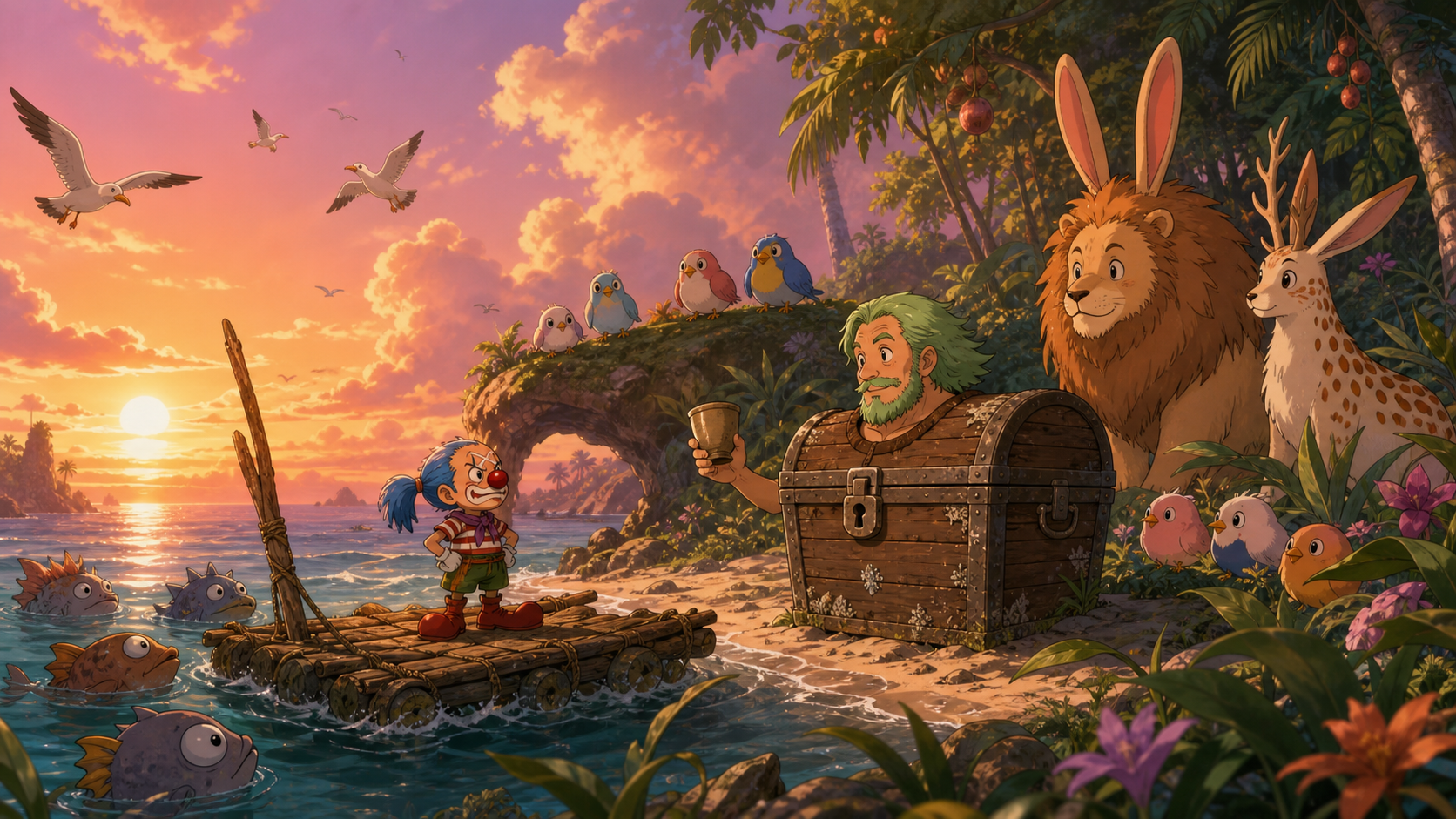
Munehisa Sakai uses scale for comic tension. Sakai’s direction repeatedly places little Buggy against fish, birds, ocean, raft, chest, and rare animals. The compositions make ordinary environments enormous.
The visual joke also communicates why planning matters more now than bluster.
Kenji Yokoyama keeps magical anatomy non-gory. The animation direction treats Buggy’s compact form as expressive and physically coherent. Movement, posture, and facial performance preserve personality without realistic injury imagery.
That choice lets the episode explore vulnerability while remaining playful.
Tomoko Yoshida makes the island feel protected. The art distinguishes habitat zones, shoreline, foliage, unusual species, and Gaimon’s lived space. The setting does not look like an empty treasure level waiting for extraction.
The environment’s specificity supports the conservation stakes.
RaeRae’s real-time reaction
Little Buggy trying to command fish and birds with the same energy he used on a whole pirate crew is exactly the consequence his ego needed. I want him safe, but I also want him to learn one survival lesson before launching the next revenge speech.
Gaimon sharing a drink after confirming Buggy is not there to poach feels generous without being foolish. He can understand the stranger and still protect every animal behind him.
The moment that lands
Buggy and Gaimon stop treating one another as categories long enough to talk. Pirate and guardian become two isolated people with bodies and plans that did not unfold as expected.
The connection is real even if their values and future choices remain different.
What Buggy should do next. Separate immediate survival, body recovery, crew welfare, and revenge into distinct decisions. Repair the raft, secure water and food, record direction, and seek a safe contact point before entering open sea.
When he finds his crew, assess injuries and consent before announcing another attack. Followers are not spare parts for restoring a captain’s status.
What Gaimon should do next. Document the encounter, check animals and habitat after Buggy leaves, avoid sharing sensitive location information, and improve a nonviolent warning system for future arrivals.
Hospitality can include a prepared supply bundle that reduces pressure to exploit island resources during departure.
Bottom line
Episode 46 gives Buggy a comic survival story without erasing Orange Town. Reduced magical scale turns fish, birds, a raft, and an unfamiliar island into serious challenges. Gaimon’s initial poaching concern protects a real habitat, while conversation creates a bounded truce between two isolated people.
RaeRae rating: 8.8/10. Buggy survives because improvisation and hospitality interrupt his revenge loop. The next measure of growth is whether he uses that second chance to recover responsibly or only to rebuild the power that failed him.