
Disappearance
Sasuke becomes the missing center of two search teams, and the crater reveals both his escape and who carried its cost.
What happens
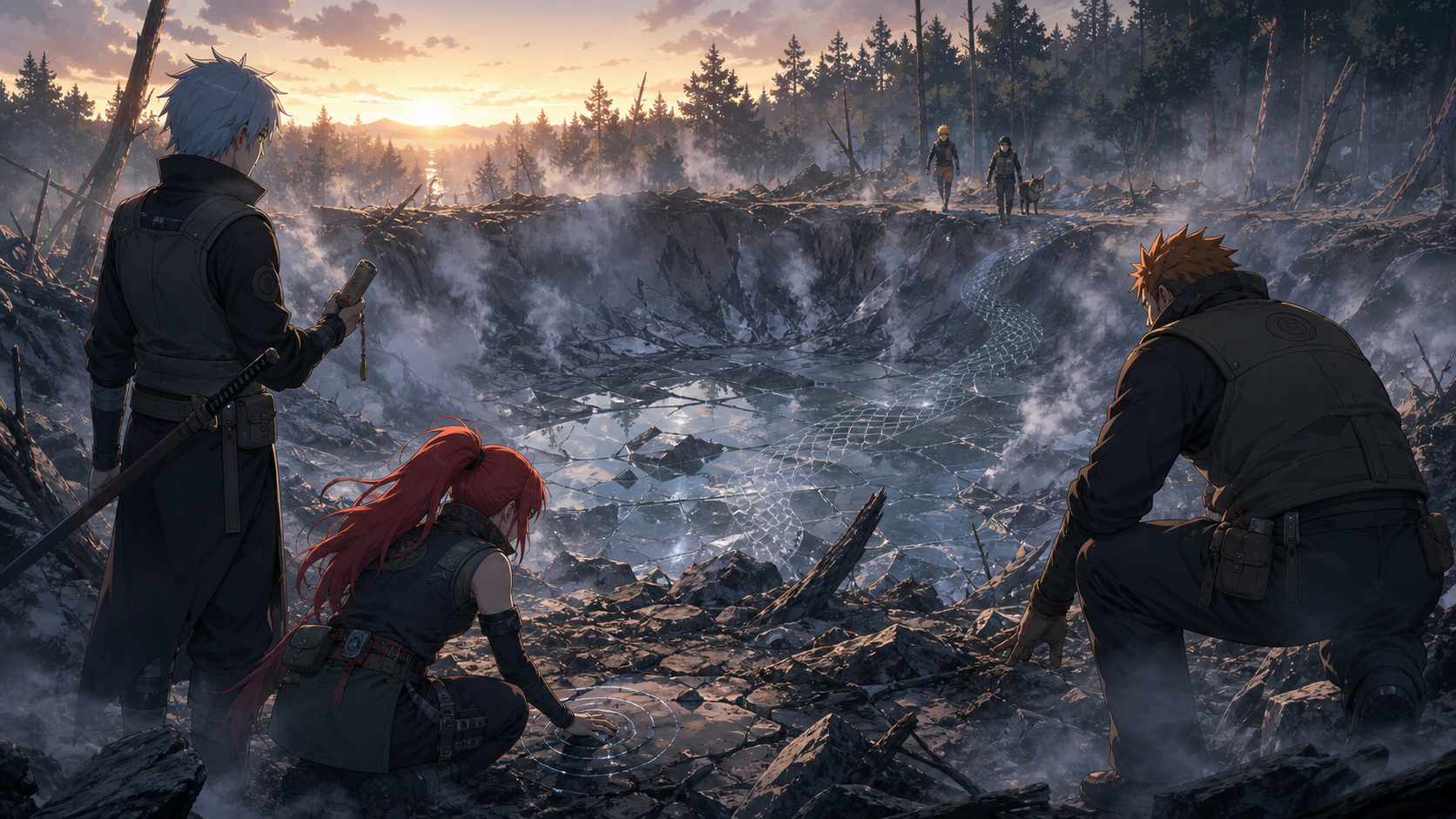
Deidara's final explosion leaves a crater large enough to be noticed by every search team in the region. Sasuke's chakra seems to vanish with it, sending Karin, Suigetsu, and Jugo racing toward the blast site.
Hebi finds devastation and uncertainty rather than a body. Suigetsu uses the summoning contract to call Manda, revealing the route Sasuke used to escape. The giant snake is mortally wounded and furious that Sasuke controlled him as a shield.
Sasuke emerges alive but badly depleted. His teammates recover him and withdraw before Konoha can close the distance. Their response shows how quickly this newly formed group has learned to coordinate around his objective.
Naruto's search party also reaches the crater. Kiba detects Sasuke's scent, but the trail and the scale of the destruction make pursuit difficult. Once again, Naruto is close enough to see the consequences of Sasuke's choices without being close enough to speak to him.
Absence becomes evidence
The episode makes disappearance feel active. Sasuke is not on screen for much of the opening, yet every character is defined by how they respond to the space he leaves behind.
Karin senses the loss first because chakra is her map. Suigetsu turns to the summoning contract because he thinks in tools and contingencies. Jugo moves with direct concern. Their different skills converge on the same question: did the person who assembled them survive?
Konoha reads the crater differently. The explosion is evidence of a battle they missed and a warning that Sasuke is moving through enemies powerful enough to erase a landscape.
Nobody has a complete account. The ruined ground, fading scent, disrupted chakra, and wounded summon become fragments each group interprets through its relationship to Sasuke.
Hebi acts like a team
Sasuke originally recruited Karin, Suigetsu, and Jugo because their abilities were useful. That transactional beginning makes their reaction here revealing.
They do not simply wait for their leader to reappear. They share information, move toward danger, and use the resources available to recover him. Their concern may not look identical, but the behavior is collective.
Karin's urgency is easy to reduce to romantic attachment, yet her sensing is operationally essential. She knows when Sasuke's chakra changes and gives the group its earliest warning. Suigetsu's knowledge of the summoning route turns uncertainty into a rescue. Jugo's steadiness holds the response together.
I wish the series lingered more often on this version of Hebi. They are messy, self-interested, and capable of functioning without being copies of Team 7.
Manda's anger matters
Manda confirms that Sasuke survived, but his condition refuses to let the escape read as a clean triumph. Sasuke imposed genjutsu, summoned him into an explosion, and used his body to absorb the cost.
Manda is violent and predatory, yet exploitation does not become harmless because the victim is unpleasant. His final anger names what the previous episode's clever reveal could obscure.
This is part of Sasuke's current moral landscape. He can solve almost impossible tactical problems because he is willing to treat relationships as systems of leverage. Hebi may be developing real loyalty around him, but he has not necessarily learned to honor it.
The contradiction creates tension. His teammates rush to save him while the summon he sacrificed dies cursing him. Both outcomes come from Sasuke's ability to bind others to his purpose.
Naruto arrives after the choice
Naruto keeps reaching places where Sasuke has just made another consequential decision. He finds traces, witnesses, damage, and abandoned routes, but rarely gets the conversation he wants.
The crater visualizes that distance. Naruto can see the size of the danger and Kiba can confirm Sasuke was there. Neither fact tells them what Sasuke chose, why he chose it, or whether intervention would be welcome.
Naruto's persistence remains loving, but the mission is also becoming a chase shaped by assumptions. He believes finding Sasuke will create an opportunity to restore him. Sasuke believes reaching Itachi requires avoiding exactly that interruption.
They are moving through the same geography with opposite definitions of rescue.
RaeRae reaction
I like aftermath episodes when they treat survival as more than a reset button. “Disappearance” lets the blast change the emotional map. Deidara is gone, Manda pays for Sasuke's escape, Hebi becomes more cohesive, and Konoha gains another trail that still does not produce contact.
The tension is quieter than the duel, but it is not empty. Every pause asks who Sasuke belongs to, who believes they understand him, and whose body or loyalty will be spent on the road to Itachi.
Suigetsu's summoning solution is especially satisfying because it turns an established object into narrative evidence. The scroll is not a miracle introduced after the fact. It connects the team's practical preparation to the cost of Sasuke's decision.
Sasuke has not disappeared from the story. He has become the missing center around which two teams reveal themselves. That makes the title less about a mystery and more about the force an absent person can exert.
The crater makes Sasuke’s absence physical
My bottom line is that Episode 125 understands aftermath as evidence. The crater is not empty scenery after a spectacular fight. It contains the size of Deidara’s last decision, the trace of Sasuke’s escape, Manda’s fatal injury, and the point where two search parties nearly become witnesses to each other.
Sasuke is absent, yet everybody responds to a different version of him. Hebi fears its leader died. Naruto fears his friend disappeared again. Manda knows the person who used his body. One missing man creates several truths around the same ruined ground.
Karin experiences disappearance before anybody sees it
Her sensory ability makes loss immediate. Sasuke’s chakra does not simply move beyond ordinary sight. It vanishes from the map she relies on. That turns professional information into personal terror without making her competence disappear.
Karin can be emotionally attached and technically essential at the same time. The story too often treats those qualities as competitors. Here her concern is the reason Hebi moves quickly, and her skill tells them the emergency exists.
Suigetsu turns preparation into rescue
The summoning scroll matters because it was established before the explosion. Suigetsu does not invent a solution after the fact. He recognizes that Sasuke may have used a snake summon and activates the remaining route back.
That is good team writing. An object carried for practical reasons becomes the link between battlefield strategy and recovery. Sasuke escapes the blast, but Suigetsu completes the escape.
Jugo’s concern is quieter and no less real
Jugo joined because Sasuke carried Kimimaro’s connection and could restrain his transformations. His loyalty is not loud, romantic, or playful. He moves because the person who offered him a path outside confinement may be gone.
The quiet response should not be mistaken for emotional emptiness. Jugo has lived with the fear that closeness will end in somebody’s death. A crater where Sasuke’s chakra vanished presses directly on that history.
Hebi becomes a team while Sasuke cannot command it
The strongest proof of cohesion arrives when the leader is missing. Karin provides the warning, Suigetsu finds the mechanism, and Jugo supports the recovery. They coordinate without waiting for Sasuke to assign every step.
That does not erase their different motives. It shows a team can form through repeated shared action before its members agree on one purpose. Their bond is becoming something Sasuke did not fully design.
Manda gets the final testimony about the escape
Sasuke’s survival reveal could have ended as a celebration of speed and intelligence. Manda’s anger refuses that clean frame. He names the coercion from inside the body that absorbed the explosion.
A summon is not a disposable technique. Manda can speak, choose, bargain, threaten, and suffer. Genjutsu removed his ability to refuse, which makes the tactic ethically legible even if he was dangerous.
Being cruel does not make Manda available for sacrifice
Manda demanded human offerings and treated summoners with contempt. None of that grants Sasuke ownership over his death. Ethics that apply only to sympathetic victims are preferences, not principles.
The emergency explains why Sasuke reached for the fastest survival route. It does not require the audience to rename coercion as loyalty. Manda did not save him. Sasuke used him.
Sasuke repeats a logic once used against him
Orochimaru treated Sasuke’s body as a future container. In the blast, Sasuke treats Manda’s body as a container for damage. The situations are not identical, but the instrumental logic echoes.
Surviving control does not automatically teach somebody how to reject control. Sasuke learned how power operates, and under pressure he uses that knowledge before asking what it reproduces.
Recovery does not mean restoration
Hebi retrieves Sasuke alive, exhausted, and still committed to Itachi. The team solves the immediate crisis without changing the purpose that created it. He survives to continue the same road.
That distinction matters throughout Naruto’s pursuit too. Getting a person back into reach is not the same as restoring trust, safety, or a future. Bodies can be recovered while the underlying wound remains untouched.
Naruto arrives close enough to measure the danger
The crater tells Naruto that Sasuke is fighting people capable of changing the landscape. Kiba’s nose confirms the scent. Neither clue produces the conversation Naruto wants.
This pattern keeps punishing him with proximity. He receives proof that Sasuke lived and moved, then watches the trail close again. Love becomes a sequence of almosts.
Kiba’s scent work has limits the episode respects
Scent can identify presence and direction, but explosions, disturbed earth, weather, crowds, and summoning complicate the trail. Kiba is not failing because he cannot turn one trace into a guaranteed destination.
Tracking is skilled interpretation under changing conditions. The episode gives his expertise value without making it omniscient.
The two groups interpret the same scene through different claims
Hebi sees the place where its leader nearly died and must be recovered. Konoha sees the place where its missing teammate passed beyond reach. Manda sees the place where his agency was stolen.
No interpretation is complete, but some include costs the others would prefer not to see. A full account of Sasuke requires holding all three.
Naruto still believes arrival can produce consent
His persistence comes from refusing to abandon a bond. That refusal has saved people who believed they were beyond care. Sasuke’s situation also requires Naruto to hear a choice he may dislike.
A retrieval squad can create contact. It cannot guarantee reconciliation. If Konoha wants Sasuke home, the village owes him truth about more than his route.
Sasuke’s teammates carry the consequences of his secrecy
They did not know his exact escape plan. Karin experiences his chakra disappearing, and all three approach a catastrophic blast without certainty. Tactical secrecy protects information from enemies while transferring fear to allies.
Leadership requires deciding which secrets are necessary and which merely preserve control. Sasuke is skilled at the first question and avoids the second.
Deidara disappears differently from Sasuke
Deidara turns his body into the blast and tries to make disappearance his permanent artistic signature. Sasuke vanishes through summoning and returns alive. One disappearance demands remembrance. The other protects continuation.
The crater holds both outcomes, which is why absence feels crowded rather than empty.
Tobi’s disappearance should make viewers suspicious
The apparent fool also vanishes inside the explosion, yet the masked man’s limits have never been reliable. His performance trained characters to assume incompetence and viewers to treat survival as unlikely.
When a story about sight repeatedly stages false conclusions, an unseen body is not proof. Tobi understands that better than anybody present.
The episode lets debris carry narrative memory
Broken ground, fading chakra, scent, a summon, and the scroll all preserve pieces of the previous battle. Characters reconstruct an event they did not witness through material consequences.
That is stronger than resetting the landscape after spectacle. Destruction becomes part of what the next episode has to know.
There is something especially revealing about who gets to panic. Karin reacts first because she can feel the absence directly. Suigetsu turns anxiety into a practical test. Jugo stays oriented toward the group. Sasuke, once recovered, does not have to witness the minutes when everyone believed he might be dead. Leaders can underestimate the emotional cost of secrecy because teammates experience the uncertainty while the leader experiences only the plan.
That gap deserves attention. Sasuke may believe the successful escape proves his calculation was sufficient. Hebi members know success arrived after terror, improvisation, and a dying summon. A team cannot build durable trust if only the outcome counts. Process tells people whether their lives and knowledge mattered inside the decision.
Karin’s sensing also complicates privacy. She can notice changes in Sasuke that he does not volunteer, which gives her access without necessarily giving her understanding. Chakra is intimate information, but it is not a complete emotional language. Feeling him weaken cannot tell her why he chose Manda, what he feared in the last second, or whether he regrets the cost.
Suigetsu’s response is practical because practicality is one of his ways of caring. He checks the contract, summons Manda, and finds the missing route. The series often packages him as sarcasm and appetite, but this moment shows a person who can keep thinking while the group’s center appears dead. Humor does not cancel reliability.
Jugo has another reason to fear disappearance. Kimimaro’s death already tied loyalty to sudden loss. Sasuke represents both connection to that memory and a living restraint against transformations Jugo cannot always control. Losing Sasuke could mean grief, danger to others, and a return to confinement. His concern is personal without needing a romantic label.
Konoha’s arrival brings institutional weight into a scene Hebi experienced as a rescue. Naruto and Kiba see evidence of a missing-nin confrontation. If they had arrived minutes earlier, would they have helped recover Sasuke or tried to detain the people helping him? The answer is not obvious, and that uncertainty explains why Hebi cannot assume Konoha’s concern is safe.
Naruto wants to protect Sasuke from Akatsuki and from revenge, but protection becomes complicated when the protected person rejects the rescuer’s authority. Naruto does not need to abandon him. He does need a vision of care that can survive disagreement. Otherwise persistence keeps sliding toward capture with a kinder emotional explanation.
The crater makes scale visible while hiding sequence. Konoha can see that something catastrophic happened, but not that Sasuke tested lightning against clay, used genjutsu, summoned Manda, and depended on Suigetsu. Material evidence always needs interpretation. A huge result can make observers invent a simpler story than the one bodies actually lived.
Manda’s body resists simplification because it supplies an accusation. He is not just wreckage indicating a summoning occurred. He identifies Sasuke as the person who removed his choice. That testimony should follow Sasuke into our understanding of the victory even though it does not slow the pursuit plot for long.
I also notice that Deidara’s death produces almost no shared mourning at the site. Hebi had reason to view him as an attacker. Konoha did not witness his final decision. Tobi is absent. The person who wanted an unforgettable ending leaves a landscape everyone immediately searches for somebody else. Spectacle cannot force the meaning its maker intended.
That irony completes Deidara’s tragedy. His largest work becomes evidence in Sasuke’s story. Search teams read the crater to find an Uchiha. Manda’s death becomes the moral center. Even the blast cannot secure the exclusive attention Deidara demanded. Art enters other people’s lives, and the audience decides what remains.
For me, disappearance is therefore about control over narrative as much as physical absence. Sasuke controls Deidara’s perception, then loses control of what Hebi and Konoha infer from his vanished chakra. Deidara controls the detonation, then cannot control how survivors interpret the crater. Manda loses control of his body and uses his last words to restore the truth of what happened.
The episode does not pause long enough for every consequence, so the editorial has to. Sasuke is alive. That matters. Hebi found him. That matters. Manda died because his agency was overridden. That matters too. Holding those facts together is not refusing to enjoy the escape. It is refusing the idea that cleverness launders cost.
I leave the crater impressed by Hebi more than reassured about Sasuke. The team can improvise, share labor, and recover one of its own. Its leader can still treat another thinking being as emergency material. Their loyalty is growing faster than his accountability, and that imbalance will matter whenever the next impossible choice arrives. Survival keeps mission alive, but it does not settle its ethics.
RaeRae’s final word on disappearance
I love aftermath when it refuses to behave like cleanup. Episode 125 makes everybody read what the duel left behind. Karin reads chakra. Kiba reads scent. Suigetsu reads the summoning contract. Manda supplies testimony nobody can romanticize.
Hebi earns the right to be called a team here. They act when Sasuke cannot direct them, combine different skills, and carry him away before Konoha arrives. Their cohesion is real even if the mission remains centered on his revenge.
Naruto’s pain is real too, but the crater cannot tell him what Sasuke wants. It only proves that the road is lethal. Reaching the next trace will not replace the harder conversation about why Sasuke keeps choosing distance.
The title belongs to more than one person. Deidara disappears into the artwork he wanted remembered. Tobi disappears behind another false conclusion. Sasuke disappears from two sensory maps and returns through somebody else’s dying body. What vanishes shapes the episode, but what remains tells the truth.
RaeRae’s call
Sasuke’s absence turns the crater into testimony. Hebi proves it can act as a team, while Manda’s final anger keeps a brilliant escape from becoming an innocent one.