
RaeRae Reacts · One Piece Episode 37
The Betrayed Promise
Arlong and Nezumi’s collusion is exposed when Nami’s eight years of savings are confiscated and Luffy finally rises to act
Episode information
Japanese title: Luffy Tatsu! Uragirareta Yakusoku no Ketsumatsu!
English title: Luffy Rises! The End of a Betrayed Promise
Japanese broadcast: August 16, 2000
Saga: East Blue
Script: Michiru Shimada
Episode direction: Junichi Fujise
Animation direction: Hideaki Maniwa
Art: Miyuki Sato
Nami is almost at one hundred million berries
Episode 37 returns to the bargain that has organized eight years of her life. She has stolen and saved until the promised purchase of Cocoyashi appears close enough to touch.
The number represents far more than currency. The total contains childhood, navigation, theft, secrecy, isolation, injury, and years without permission to pursue her own world map.
The bargain converted hope into labor discipline
Arlong gave Nami a target that made continued service appear temporary. Every map and theft could be interpreted as movement toward release rather than permanent exploitation.
A measurable endpoint can keep a person working even when the party controlling the agreement never intends to honor the endpoint.
The structure also isolates evaluation. Nami cannot inspect Arlong’s records, require an independent witness, enforce the agreement, or protect the savings from the person benefiting from delay. Every safeguard remains under the coercer’s control. A legitimate purchase would define ownership, payment verification, release terms, dispute review, and custody of the money before labor continued. The absence of those protections is not a minor contractual defect. The missing safeguards are the mechanism that makes the promise useful to Arlong.
Near-completion increases vulnerability. The closer Nami gets, the more she has invested and the harder abandoning the plan becomes. Eight years of sacrifice make one final effort feel more reasonable than admitting the system may be fraudulent.
Exploiters benefit from sunk costs because past pain becomes an argument for continued compliance.
Captain Nezumi arrives under official authority
A Marine captain announces that he will confiscate the money and stolen goods. Uniform, rank, and legal language make the seizure appear institutional rather than personal.
Authority is being used to convert Arlong’s private interest into an official-looking action.
Confiscation language hides selective enforcement
Nami did acquire much of the treasure through theft, which gives the Marines a plausible category for seizure. The operation does not return property transparently to verified owners or investigate the coercion behind the crimes.
The raid targets the fund precisely when taking the savings serves Arlong, revealing enforcement shaped by collusion rather than justice.
Nezumi and Arlong divide roles
Arlong maintains violent local control while Nezumi supplies institutional cover and access to formal power. Each benefits from the other’s position.
Corruption becomes durable when public and private coercion reinforce one another instead of operating as isolated bad acts.
The seizure is designed to preserve deniability. Arlong can claim that he did not personally steal the savings and that a Marine officer acted under law. Nezumi can claim he confiscated criminal proceeds without acknowledging the source of his information or beneficiary.
Distributed responsibility lets every participant describe a smaller, cleaner role than the system they jointly sustain.
The grove becomes the search site
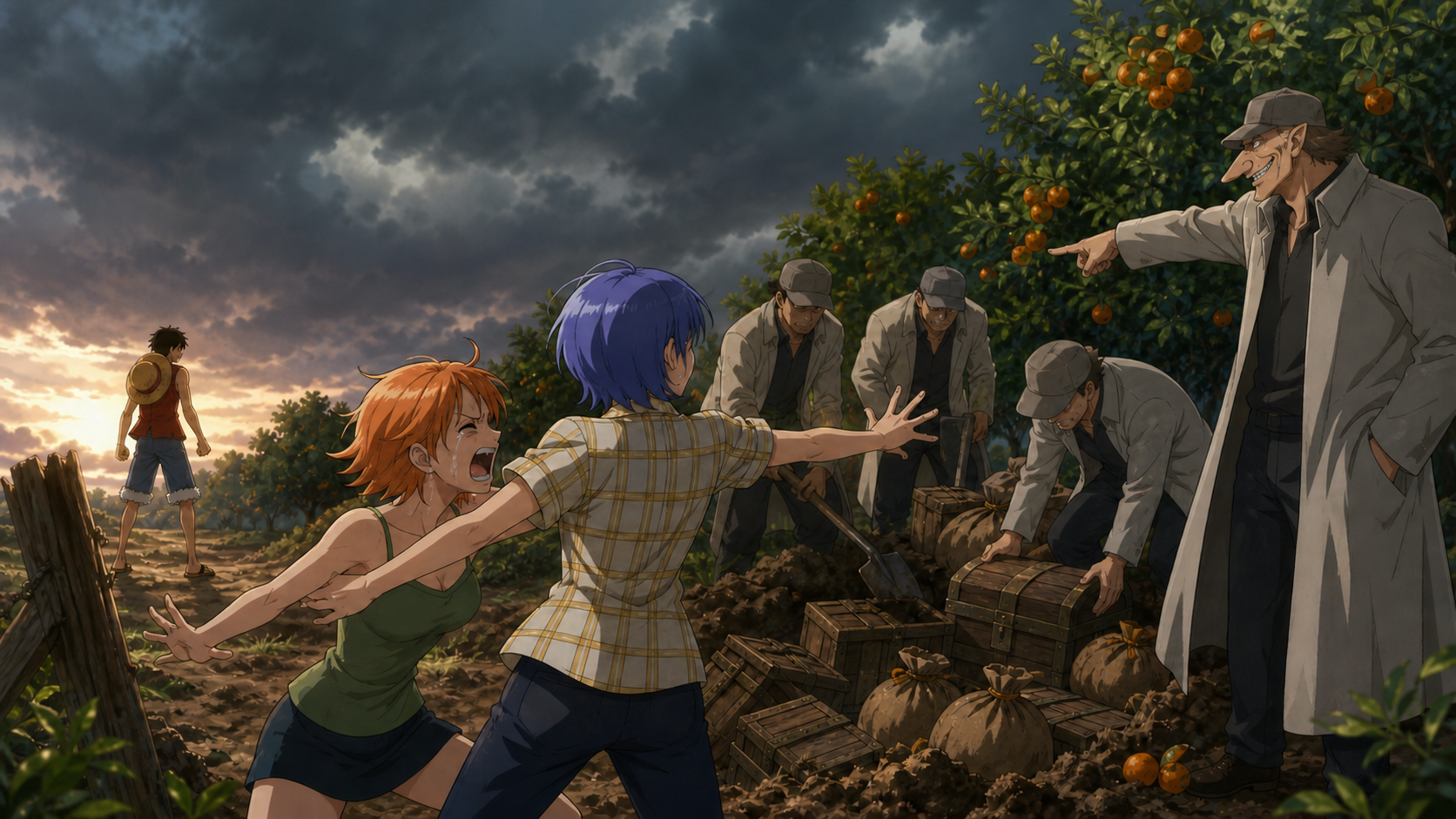
Bellemere’s tangerine field holds the treasure Nami accumulated to save the village. Family inheritance, agricultural livelihood, grief, and resistance occupy the same soil.
Digging there is an invasion of property and memory, not merely retrieval of hidden money.
The treasure emerges piece by piece
Chests and bundles make eight years of effort physically visible. The hoard is not sudden luck or a single dramatic theft.
Accumulation records thousands of decisions made under an agreement Nami believed had a fixed end.
Loss is larger than the current amount. The confiscation removes money, but the seizure also takes time that cannot be returned, opportunities deferred, relationships damaged by cover, and the credibility of planning itself.
Restitution would need to account for more than replacing the face value in the hole.
Arlong weaponizes contract language
He can insist that the promise concerned Nami paying the amount, not his obligation to protect the fund from an “independent” authority. The interpretation treats good faith as irrelevant.
A bargain controlled entirely by one party’s force is not made fair by technical wording.
Consent collapses when exit depends on the coercer. Nami agreed to work and steal because Arlong held the village’s safety. She could not negotiate enforcement, inspection, dispute resolution, or consequences for his breach.
The arrangement was coercive from the beginning even before its fraud became explicit.
Nami sees eight years disappear at once
Her anger is not a failure of emotional control. The anger is a response to proof that patience, secrecy, and self-sacrifice were exploited deliberately.
The system demanded composure for years and then uses force when the victim reacts to betrayal.
She moves toward the officers. Nami’s impulse is to defend the treasure because the fund contains the only strategy she believed could free Cocoyashi. Letting the money go feels like abandoning everyone.
The urgency is understandable, yet charging armed officials risks losing the person the plan was supposed to preserve.
Nojiko tries to stop her
Nojiko places herself between Nami and the confrontation, recognizing that the money cannot justify Nami’s immediate death or capture.
The protective act repeats the family’s pattern of using one body to shield another under coercion.
Nezumi shoots Nojiko
The Marine captain answers intervention with violence, exposing the legal performance around the confiscation. The operation is not neutral evidence handling.
His readiness to injure a resident protects the collusive seizure and communicates that official status will not restrain him.
The shooting destroys any remaining institutional legitimacy. Nezumi’s authority could have been used to investigate Arlong, protect residents, document coercion, and restore property. Instead, his authority shields the extraction network.
The uniform becomes part of the threat rather than a credible path to appeal.
Nojiko needs care before strategy. Once injured, her stabilization, safety, and transport should take priority. The crew cannot let the emotional force of betrayal make medical needs background detail.
Witnesses also need protection from further violence and from pressure to continue explaining while in shock.
Nami’s plan has not merely failed. Failure might imply an honest attempt that did not reach the target. Arlong and Nezumi have actively prevented completion to preserve exploitation.
Naming fraud matters because the word relocates responsibility away from Nami’s competence or perseverance.
She could never earn release from someone needing her captive. Nami’s cartography and theft benefit Arlong. Freeing the village would also free the worker and skill he wants to retain.
The economic incentives were incompatible with honoring the promise, and no independent enforcement existed to change them.
The village now knows the bargain cannot save them
Residents who tolerated Nami’s apparent collaboration may have done so because her plan represented a future endpoint. The seizure makes continued waiting less defensible.
Collective action becomes more likely when private compliance loses its promised reward.
Anger must be organized, not merely released. The revelation can mobilize the village and crew. Uncoordinated retaliation could still expose injured residents, children, homes, and the grove.
Resistance needs objectives, communication, evacuation, and a plan for both Arlong and corrupt officials.
Luffy finally rises
He did not need Nojiko’s full history to trust Nami. He needed Nami’s present condition and the collapse of the plan she had chosen to manage alone.
His movement matters because the movement follows rather than preempts her agency. He has not spent the arc replacing her strategy before its coercive limit becomes undeniable.
Timing distinguishes support from takeover. Intervening earlier might have endangered the village or told Nami that her judgment did not count. Waiting forever would abandon her inside a fraudulent system.
The ethical challenge is to recognize when the person has reached the point where outside support expands options rather than erases them.
Luffy’s trust still needs Nami’s request. Rising signals readiness, not automatic permission to decide every next step. Nami should be able to name whether she wants help, what she wants protected, and what outcome matters.
Solidarity becomes strongest when support answers an expressed need rather than performing rescue for its own identity.
The crew can now see the target as a system
Arlong Park is the visible headquarters, but Nezumi proves the network extends into the Marines. Defeating fighters at the compound will not by itself address official collusion.
Evidence, witnesses, recovered records, and reporting beyond the corrupt local channel will matter after combat.
Collusion changes the meaning of lawful appearance. Residents cannot safely assume that a uniform, warrant-like statement, or official vocabulary signals protection. Nezumi has converted the symbols of public accountability into access for private extraction.
That corruption damages more than one operation. Future honest officers may be distrusted, reports may go unfiled, and survivors may avoid institutions because contact itself has become a route back to Arlong.
Repair therefore requires public acknowledgment of the abuse, removal of the people involved, independent review, and visible protection for those who testify. Quietly replacing Nezumi would leave the system’s credibility and incentives untouched.
The crew cannot supply all necessary repair through force. The Straw Hats can preserve evidence, stop immediate harm, support witnesses, and refuse to let recovered property disappear into another unaccountable chain.
The stolen treasure needs chain-of-custody protection. If recovered, the money should be inventoried with witnesses, kept from becoming pirate spoils, and governed by the community. Some items may have identifiable original owners beyond Cocoyashi.
Restitution must account for Nami’s coerced role, the village’s contributions, and harms across the wider region without letting Nezumi seize control again.
Nami’s labor deserves recognition separate from the goods. Even where objects were stolen, the maps, planning, navigation, and years of work are hers. Arlong’s control does not transfer authorship.
Recovering her charts and deciding their future use should be part of liberation.
Production turns excavation into violation. Miyuki Sato’s art direction places uniforms, shovels, chests, dirt, and tangerine trees in one frame. Bureaucratic seizure physically tears into family ground.
Junichi Fujise’s direction lets the treasure emerge slowly enough to register accumulated time, while Hideaki Maniwa’s animation direction gives Nami and Nojiko’s opposing movements the urgency of love under threat.
RaeRae’s real-time reaction
This is the point where I stop calling the arrangement a broken promise. Arlong arranged for a corrupt Marine to take the money so Nami could never complete the bargain, then preserved the language of the deal as a taunt.
Nojiko getting hurt for trying to keep Nami alive makes the theft even crueler. The fund was supposed to protect the family and village; its seizure immediately creates more harm.
The moment that lands
The treasure is pulled from beneath Bellemere’s tangerine grove. Eight years of hidden labor sit in the open while official uniforms convert fraud into procedure.
The image proves Nami did everything the bargain demanded and that compliance was never going to purchase freedom.
What an accountable response would require. First, secure medical care for Nojiko and protect the household from further searches. Second, document the officers, seized property, statements, witnesses, and any communication linking Nezumi to Arlong.
Third, prevent retaliation against villagers who testify. Evidence without witness protection can become another map for the corrupt network.
Fourth, inventory recovered money and objects through a community-led process. Luffy’s crew should not control distribution because the crew won a fight.
Fifth, recover Nami’s maps and distinguish original work, coerced copies, and sensitive geographic information. She should decide what is preserved, shared, destroyed, or redrawn.
Sixth, identify channels beyond Nezumi’s authority capable of investigating Marine corruption. Any report must include safeguards against information flowing back to him.
Seventh, create a transition plan for food, housing, security, and local governance after tribute ends. Households may have no reserves because the system extracted them for years.
Finally, let Nami define her future. Restitution should not become a new demand that she remain in Cocoyashi forever or surrender her map dream as payment for rescue.
The betrayal should change how the crew makes agreements. Nami’s experience shows that a promise without independent enforcement, transparent terms, and a credible exit can be a tool of captivity. The Straw Hats rely heavily on trust, which is different from formal protection but still needs accountability.
Crew agreements should be understood by everyone affected, allow questions, make resources visible, and include ways to challenge the captain. Personal loyalty cannot be the only remedy when power and information are unequal.
Luffy’s instinct to trust people may prevent manipulation inside the crew, but durable practice should support that instinct when relationships become strained.
Bottom line
Episode 37 reveals that Nami’s eight-year bargain was designed never to end. Arlong and Nezumi combine pirate violence with official authority to confiscate the savings, preserve her captivity, and punish resistance under the appearance of procedure.
RaeRae rating: 9.9/10. Luffy rises only after the fraud becomes undeniable and Nami’s chosen strategy is destroyed. The next step must protect Nojiko, follow Nami’s request, dismantle the collusive system, and return both resources and authorship to the people who paid for them.