
RaeRae Reacts · One Piece Episode 36
Bell-mère and Nami’s Bond
Arlong’s tribute becomes economic coercion while Bell-mère refuses to deny her chosen family under lethal threat
Episode information
Japanese title: Ikinuke! Haha Bellemere to Nami no Kizuna!
English title: Survive! The Bond Between Mother Bellemere and Nami
Japanese broadcast: August 9, 2000
Saga: East Blue
Script: Michiru Shimada
Episode direction: Konosuke Uda
Animation direction: Kazuya Hisada
Art: Yuri Sanami
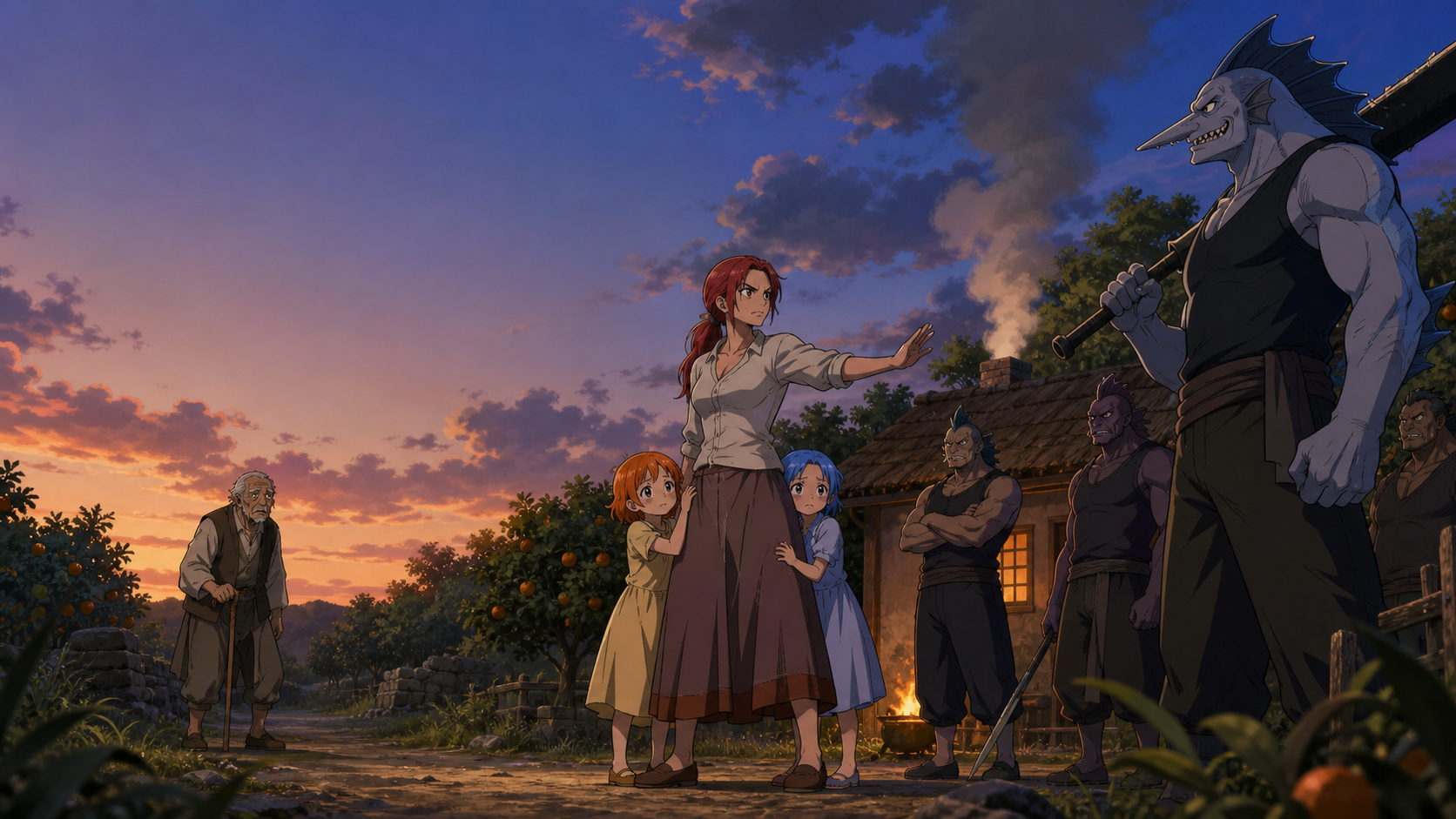
Dinner smoke reveals the remote house
Episode 36 begins with an ordinary act of care becoming a surveillance signal. Bellemere prepares a meal to welcome Nami home, and the smoke lets Arlong’s crew discover the household beyond the village center.
The tragedy is not that feeding a child was foolish. The tragedy is that occupation makes routine domestic life observable and punishable.
Privacy becomes impossible under patrol. A remote home might normally offer distance and autonomy. Arlong’s collection system treats every dwelling, resident, and resource as subject to inspection.
Coercive governance extends power by making unregistered life itself suspicious. The home is unsafe not because the household lacks family but because the occupier controls recognition.
Arlong’s tribute assigns a price to existence
Residents must pay according to the number of adults and children in a household. The demand turns continued life into a recurring fee set by the person threatening death.
This is not taxation in exchange for accountable public service. The tribute is extraction enforced by violence and designed to preserve dependence.
The per-person structure also punishes care. Taking in a child, sheltering a displaced person, supporting an older relative, or forming a larger household increases the amount demanded. Arlong turns mutual responsibility into financial exposure and gives residents an incentive to hide relationships. The policy weakens the networks most likely to help people survive occupation. A just system would recognize caregiving as social capacity. This system treats every additional bond as another collectible unit and makes family formation answerable to the threat of execution.
Per-person assessment targets families differently. Larger households owe more regardless of income, caregiving burden, harvest, health, or ability to pay. Children become liabilities in the occupier’s accounting.
The policy pressures people to hide dependents, split households, surrender resources needed for care, or accept punishment for family itself.
Bellemere has enough for one person
The money available can cover her own assessed tribute but not the two girls. Material scarcity turns recognition into an immediate survival decision.
The shortage is not a moral failure. An unjust price has been imposed on a household already operating with limited resources.
The village tries to make the girls invisible
Because Bellemere is unmarried and lives apart, Arlong’s crew initially assumes she is alone. Genzo and others understand that silence could protect Nami and Nojiko.
Hiding people under occupation can be a necessary survival strategy. The strategy also asks those people to accept public nonexistence as the price of safety.
Administrative erasure can save and harm. If the children are omitted from the count, they may survive the collection. The same invisibility could deny them later claims to family, home, resources, and protection.
Survival tactics should be understood as responses to coercion, not ideal arrangements the family freely chose.
Bellemere refuses to say she has no daughters
She declares that Nami and Nojiko are her children even though the biological connection is absent and the financial consequence is lethal. The statement asserts the family’s truth against an authority trying to price the family out of existence.
Recognition becomes a form of resistance because Arlong’s system depends on deciding which relationships count.
Chosen family is not a lesser category
Bellemere does not describe the girls as temporary dependents, charity cases, or battlefield survivors. They are her daughters.
The declaration rejects the idea that biology determines whether a bond deserves public acknowledgment, sacrifice, or grief.
The choice is powerful and ethically painful
Bellemere values truth and refuses to let the girls hear themselves denied. Her decision also leaves them facing the loss of their only parent.
Admiration should not prevent examination of consequence. A loving motive can coexist with a devastating outcome under impossible conditions.
Arlong manufactured the impossible choice
The moral responsibility for the situation belongs first to the person demanding payment under threat of death. Bellemere did not freely choose between ordinary alternatives.
Critiquing her decision must not shift blame away from the coercive structure that made every option harmful.
There was no clean answer. Paying for herself and hiding the girls could preserve all three temporarily while requiring public denial. Declaring the family protects its truth while exposing Bellemere to violence.
Ethical analysis should resist pretending that a perfect response was available to someone with seconds, limited money, armed occupiers, and children watching.
The girls hear that they belong
Nami and Nojiko receive an unmistakable statement that Bellemere claims them as family. The assurance will remain after her death, shaping both love and debt.
Children deserve belonging without having to witness a parent die to prove the bond. Arlong’s violence corrupts what should have been an ordinary affirmation.
Bellemere uses the last available public power. She cannot defeat the crew or meet the demanded amount. She can refuse the occupier’s description of her household.
Naming the truth does not stop the weapon, but the declaration prevents Arlong from making erasure the official final account.
Arlong kills to enforce the collection system
His violence is not an impulsive argument with one resident. The killing demonstrates what happens when a household cannot or will not fit the imposed accounting.
The death communicates to every witness that affection, poverty, and parenthood will not modify the tariff.
Public violence is policy communication. Arlong needs the village to remember the consequence, not only the victim to be removed. Terror lowers the future cost of collection by making resistance feel impossible.
Each payment afterward carries the memory of what refusal produced.
Economic extraction and physical violence are one system. The tribute may look like a financial demand separate from combat. Its credibility comes entirely from the capacity and willingness to kill.
Analyzing only the money would hide the force underwriting every transaction.
Poverty becomes punishable
Bellemere is not refusing to contribute to a shared good. She lacks enough money to purchase permission for the family to remain alive.
The system turns insufficient wealth into a capital offense, ensuring that the poorest residents face the greatest danger.
Arlong’s accounting ignores care work. The tangerine grove, meals, repairs, and years of raising two children produce real value. None counts against the demanded cash.
Extractive systems recognize only resources that can be seized, not labor that sustains community.
The grove survives the person who tended the land
Trees continue growing after Bellemere’s death, becoming a living record of her work and family. The land can support memory and material survival.
The grove may also become vulnerable to control, appropriation, or forced production. Protecting inheritance requires more than sentiment.
Nami’s future bargain begins in this loss
The episode establishes why money, maps, Arlong, and family become linked in her life. Her later choices are not explained by greed.
She has learned that insufficient money can be used to kill a parent and that skill may be one of the few resources the occupier values.
A child may convert grief into impossible responsibility. Nami can interpret Bellemere’s death as a problem she must solve alone through earning, bargaining, and protecting the village. That conclusion gives pain a plan.
The conclusion also places adult-scale responsibility on a child who should have received collective protection.
Nojiko inherits a different burden. As the older sister, she may feel responsible for Nami, the grove, and the family story while lacking power to stop Arlong. Her survival strategy will not look identical to Nami’s.
Their bond should permit different responses to shared loss rather than demand matching grief.
Genzo witnesses the limits of community protection. He knows the family, understands the danger, and tries to navigate the collection, but he cannot prevent the killing. The failure can create guilt even when the occupier holds the weapon.
Communities under terror often carry responsibility that properly belongs to the violent authority.
The village needs records outside Arlong’s control. Deaths, payments, households, confiscations, and threats should be documented where possible and safe. The occupier’s records will describe extraction, not harm.
Community memory supports later accountability, restitution, and resistance, though recordkeeping must not expose survivors to surveillance.
Bellemere’s Marine past sharpens the institutional failure
A former member of formal authority is killed while the region remains under pirate control. Her service history offers no reliable protection for the family.
The later failed Marine attack reinforces how distant or ineffective institutions can leave residents to manage consequences alone.
Luffy’s crew must not romanticize sacrifice. Hearing the story may inspire them to honor Bellemere through battle. The best honor is not copying her willingness to die.
Honor means creating conditions where Nami, Nojiko, and the village no longer have to choose between recognition, money, and survival.
Protection should target the extraction system. Defeating Arlong physically may be necessary. The crew should also secure collected funds, records, maps, food, land access, and routes of retaliation.
A leader’s fall does not automatically return what the organization took or repair household economies damaged over years.
Restitution belongs to the community. Recovered wealth should not become pirate spoils or a reward controlled by outside rescuers. The wealth came from residents under threat.
Local people should determine distribution, urgent needs, rebuilding, and support for households most harmed by the tribute.
Production holds on the declaration, not spectacle. Yuri Sanami’s art direction frames the modest home, smoke, children, village path, and armed collectors in one domestic space. The scale of violence is measured against daily life.
Konosuke Uda’s direction builds the decision through money and silence, while Kazuya Hisada’s animation direction makes Bellemere’s protective posture and the girls’ response carry more weight than graphic impact.
RaeRae’s real-time reaction
Bellemere saying she has two daughters is beautiful, and I am furious that the situation makes beauty cost her life. A parent should be able to name her children without an armed man turning the truth into a bill.
The tribute is the real weapon before any shot. Arlong makes poverty lethal and then calls the result order.
The moment that lands
Bellemere places herself between the girls and Arlong and refuses to erase them. The statement tells Nami and Nojiko that their family is real even when the governing violence says only payable bodies count.
The bond survives because Bellemere named the family, but survival should never have required that price.
How the crew should act on this history. They should ask Nojiko and village leaders what Arlong collects, where records and money are held, how patrols respond to resistance, and which residents face immediate retaliation. These are operational facts rooted in the testimony.
They should protect the grove and home as family property, not treat them as symbolic scenery after the battle. Nami and Nojiko should control decisions about preservation and access.
They should avoid using Bellemere’s death to pressure Nami into accepting rescue. Her mother’s declaration affirmed agency and family; the declaration should not become another debt that outsiders interpret for her.
Any recovered maps must be identified as Nami’s work. Copies, originals, and access should be governed by her, especially if they contain sensitive locations or were produced under coercion.
The crew should plan for post-conflict food, housing, medical care, and security. Years of tribute likely reduced savings and maintenance across the village, so liberation will begin with material shortage.
They should also preserve space for grief without demanding that residents immediately celebrate. Ending active control does not restore Bellemere or erase the years organized around her loss.
Chosen family deserves protection before crisis. Bellemere’s declaration is necessary because Arlong and social assumptions make her household legibility fragile. A just system would recognize caregiving relationships without forcing proof under threat.
Children in chosen families need secure claims to home, inheritance, safety, and decision makers. Parents need resources that prevent poverty from becoming a challenge to whether the family can remain together.
Community recognition can support those protections, but formal structures also matter. Love should not have to perform heroism to become administratively real.
Bottom line
Episode 36 shows Arlong’s tribute as a system that prices existence and makes poverty punishable. Bellemere refuses to buy safety through public denial of Nami and Nojiko, asserting chosen family against an authority that recognizes only collectible bodies.
RaeRae rating: 10/10. Her declaration is unforgettable because the statement is loving and devastating at once. The responsibility belongs to Arlong’s coercion, and the crew must honor Bellemere by making survival, recognition, restitution, community safety, and Nami’s freedom possible together for everyone still left behind.