
DD Fist of the North Star Review: The Apocalypse Failed, So Masculinity Had to Get a Job
DD Fist of the North Star relocates legendary fighters into modern precarious work. This review examines parody, masculinity, convenience-store labor, unemployment, adaptation, repetition, and what remains when violence stops guaranteeing status.
Bottom Line First
DD Fist of the North Star finds a brutally efficient joke: the apocalypse never happened, so men trained to rule ruins have to survive ordinary employment. The convenience store is funny because schedules, customers, rent, and service discipline cannot be defeated by announcing a technique.
The series is repetitive and frequently broad, but its premise punctures the franchise’s promise that exceptional violence naturally produces importance. Here, masculinity must clock in, cooperate, apologize, and discover that being overqualified for domination does not make anyone qualified for work.
What This Anime Is
DD is a comedy spinoff with super-deformed adult versions of familiar characters in a modern setting. It does not share the dramatic continuity of the original series.
The 2013 television run and the later DD sequel route should be labeled separately even when distribution packages them near Strawberry Flavor.
Labor Replaces Destiny
Kenshiro, Raoh, and Toki possess extraordinary embodied knowledge that the market does not value in its original form. Employment asks whether they can translate identity rather than demand recognition.
The joke lands because many workers know what it means to have abilities that do not produce security.
The Convenience Store Is a Government
Schedules allocate time, managers distribute authority, customers exercise social power, and products arrive through invisible supply chains.
Raoh’s desire to command confronts a system whose rules are banal, impersonal, and still capable of humiliating people.
Parody Exposes Masculine Performance
Reduced proportions do not merely make bodies cute. They reveal how much authority depended on framing, scale, music, and everyone agreeing to take declarations seriously.
Care, patience, and service become harder tests because they cannot be won through intimidation without consequence.
Where the Comedy Wears Thin
A premise this clean can become a machine that repeats recognition instead of developing character. References are not jokes by themselves.
The series works best when modern institutions alter relationships, not when familiar poses are simply relocated beside a cash register.
Japanese Performance
Shinnosuke Tachibana, Kazuya Ichijō, and Tomoaki Morikawa treat absurdity with enough commitment that the characters remain adults confronting indignity rather than mascots.
Voice performance supplies continuity of attitude while making failure elastic enough for comedy.
Verdict
DD is not required viewing, and that freedom is its strength. It can ask what happens when destiny loses market value and legendary bodies enter service work.
The answer is uneven but sharp: masculinity built entirely around dominance becomes unemployed the moment society needs cooperation. The apocalypse did not arrive. Responsibility did.
A runoff earns its own judgment because relationship is not continuity. The page names what the animation is, what it changes, and why its formal choices matter before asking whether familiarity alone can carry it.
The canonical artwork is original and local. It remains the featured image, top hero, directory card, Open Graph image, and Twitter image for this editorial; no unrelated branch image is borrowed.
Peace Is the Cruelest Alternate Universe
The official premise begins with an almost blasphemous revision: the nuclear catastrophe never occurs. Humanity is safe, infrastructure works, and the legendary successor has no wasteland to save. On paper, this sounds merciful. For Kenshiro, it is an identity emergency. Every discipline that once made him indispensable now looks antisocial, unemployable, or absurd.
That is why the comedy has more bite than a simple costume change. DD does not merely place famous men in a convenience store. It asks whether a person can welcome peace when crisis was the only environment that confirmed his value. The answer is uncomfortable: people may sincerely want suffering to end while privately fearing the ordinary life that follows.
The Apocalypse Was Also a Career Ladder
Original Fist of the North Star converts physical mastery into social authority with brutal efficiency. Kenshiro walks into a town, identifies a tyrant, defeats him, and becomes morally legible. DD removes that ladder. A peaceful city has laws, managers, customers, hiring standards, and tasks whose importance cannot be demonstrated through combat spectacle.
Kenshiro’s frustration reveals how exceptionalism can depend on institutional collapse. When every structure fails, the uniquely powerful body becomes a government. When structures function, that same body must negotiate a place among strangers. The joke is not that work is beneath him. It is that cooperation exposes forms of incompetence an apocalypse was designed to hide.
A Convenience Store Measures Different Strength
Retail work demands observation, memory, timing, emotional regulation, cleaning, stocking, cash accuracy, and the ability to keep several small obligations alive at once. None of those skills looks heroic because their success is the absence of disruption. Customers notice the mistake, not the hundred quiet actions that kept the store usable.
For the Hokuto brothers, this is a reversal of visual logic. Their bodies advertise enormous capacity, yet the workplace rewards restraint and consistency. A clenched fist cannot calm an impatient customer. A dramatic entrance cannot fix a register discrepancy. DD is funniest when it respects that mismatch instead of treating service labor itself as the humiliation.
Kenshiro Has to Become Teachable Again
Kenshiro’s canonical identity depends on being the successor, the person whose knowledge authorizes intervention. Employment moves him back into the position of novice. He must receive instructions from people with less physical power and more situational expertise. The challenge is not whether he can learn a task; it is whether he can survive being seen while he does not already know.
That humiliation is psychologically precise. Competence can become armor, especially for men taught that uncertainty invites domination. A supervisor’s correction feels like an attack because Kenshiro has no practiced language for ordinary feedback. Growth begins when he can separate being wrong in a moment from being worthless as a person.
Raoh Discovers That Command Is Not Management
Raoh understands authority as scale: the strongest will bends the surrounding world. A workplace gives him smaller, stranger problems. People can obey an order and still misunderstand it. A schedule can be technically complete and functionally cruel. Inventory can vanish because the process is bad rather than because an enemy stole it.
Management requires information to travel upward, which means subordinates must be safe enough to report failure. Raoh’s intimidation destroys precisely the feedback he needs. DD turns his imperial presence into an operational liability. He can dominate a room and remain unable to make the room work.
Toki’s Illness Meets the Violence of Employability
Toki’s body has always complicated the franchise’s worship of strength. In a modern labor setting, illness enters another moral economy: availability, productivity, accommodation, and the suspicion that an unreliable body reflects an unreliable character. The comedy risks cruelty whenever sickness becomes only a timing mechanism.
Its sharper possibility is to show that work is designed around an imaginary worker who never needs care. Toki’s knowledge and patience remain valuable even when stamina fluctuates. A humane store would adapt tasks and schedules rather than ask him to perform wellness for permission to belong. Disability does not cancel contribution; rigid systems conceal the contributions they refuse to recognize.
Lin’s Competence Rearranges the Power Map
The official setup makes the high-school-aged Lin the person who finds Kenshiro and brings him into the convenience-store world. That reversal is more than a cute reference. She possesses the social literacy, local knowledge, and practical confidence the legendary fighter lacks. Peace expands what counts as expertise.
DD works best when Lin is not simply the normal person reacting to male chaos. She is a translator between systems, someone able to see capacity without mistaking it for readiness. Her power comes from knowing how everyday life is organized. The men need her judgment, and that dependency punctures the assumption that protection always flows from the strongest body toward everyone else.
Bat Becomes Legible Outside Survival
Bat’s original cleverness develops under scarcity, where improvisation protects him and the people around him. A peaceful city does not erase that intelligence; it changes the arena in which it can appear. As a university student, he can navigate institutions the brothers find bewildering, translate expectations, and recognize opportunities before they do.
The contrast also asks what survival skills become when survival is no longer the daily plot. Some adapt into entrepreneurship or social fluency. Others remain hypervigilance without an obvious target. Comedy can honor Bat by letting him be more than an audience surrogate who explains modernity to confused adults.
Chibi Bodies Strip Authority From the Silhouette
Fist of the North Star’s original bodies communicate before anyone speaks. Height, shoulders, scars, and stillness tell the viewer who can reorganize a battlefield. DD compresses those bodies into super-deformed proportions. Heads grow, limbs shorten, and the intimidating silhouette becomes unstable.
This is not merely cuteness. It reveals that masculine authority is partly a visual agreement between artwork, music, camera angle, and audience expectation. Once proportions change, declarations that sounded mythic can sound petulant. The parody asks us to notice how often we mistook aesthetic scale for ethical weight.
The Voice Actors Keep the Men From Becoming Toys
The 2013 production’s Japanese cast includes Shinnosuke Tachibana as Kenshiro, Kazuya Ichijō as Raoh, Tomokazu Seki as Toki, Hidekazu Morishima as Bat, M.A.O as Lin, Yui Horie as Yuria, and Akira Kamiya as Ryūken. Their work gives the compressed designs adult emotional mass.
The performances matter because parody collapses when everyone sounds embarrassed by the premise. Commitment allows a trivial problem to carry the cadence of destiny while tiny hesitations expose panic underneath. The result is not an imitation of the original dramatic register so much as an experiment in how far that register can stretch before it admits vulnerability.
Reference Is Raw Material, Not a Finished Joke
Recognition produces a quick reward: a famous pose appears beside a shelf, a line returns in the wrong context, or a villain becomes an ordinary nuisance. That reward fades if the reference does not alter relationships. The viewer cannot live forever on the pleasure of identifying what moved.
The strongest episodes use familiarity as setup and modern institutions as pressure. A canonical obsession becomes a workplace flaw. A rivalry becomes competition for hours, attention, or status. The weakest moments reverse the order, asking recognition to substitute for escalation, consequence, and character choice.
Retail Customers Reproduce Power Without Muscles
Peace does not eliminate domination; it changes its costume. A customer can weaponize policy, impatience, money, or the assumption that service workers must absorb humiliation. These encounters are smaller than a wasteland massacre, but they expose how authority circulates through ordinary roles.
Kenshiro cannot solve that problem by treating every rude person as a tyrant. He needs boundaries, escalation procedures, coworkers, and managers willing to protect staff. DD brushes against a powerful idea: civilization is not the absence of conflict. It is the attempt to handle conflict without granting anyone unlimited force.
Masculinity Without Crisis Has to Learn Intimacy
The original heroes express care through rescue, sacrifice, and endurance. Those forms are real, but they thrive in catastrophe because danger translates feeling into action. A quiet life asks harder questions. Can these men apologize before loss makes apology dramatic? Can they ask for help while refusal remains possible? Can they notice loneliness without an enemy causing it?
DD’s workplace premise creates space for affection to become repetitive and unglamorous: covering a shift, bringing food, explaining a form, waiting through embarrassment. Such acts look tiny beside Hokuto Shinken. They may be the only acts capable of building a life that does not require perpetual emergency.
The Comedy Should Punch Up at the Myth
Parody earns its freedom by identifying where the original text hides power. Jokes about grandiose masculinity, entitlement, and the mismatch between reputation and competence expose the myth. Jokes that merely humiliate illness, poverty, women, or workers leave the myth intact and redirect cruelty toward easier targets.
This distinction explains why the series can feel sharp in one segment and tired in the next. Broad comedy is not automatically shallow. It becomes shallow when consequence always lands on the person with least authority while the legendary men remain lovable because the franchise already granted them importance.
Adaptation Through Refusal
DD does not adapt the original plot. It adapts the audience’s memory of how that plot works, then refuses its founding catastrophe. That makes it an argument with the source rather than a miniature retelling. Every familiar character arrives carrying dramatic capital that the new world may decline to honor.
The approach is useful for a franchise this culturally established. Fidelity can mean reproducing events, but it can also mean understanding the machinery beneath them well enough to test it under new conditions. DD’s best question is brutally faithful to Hokuto: what is strength for? Peace simply refuses to accept violence as the automatic answer.
Two Seasons Need Clear Labels
The 2013 television run and the 2015 continuation belong to the same comic route, but they should not be collapsed into one anonymous package. Production context, episode grouping, and distribution labels affect what a viewer is actually choosing. The later broadcast’s association with Strawberry Flavor makes accurate labeling especially important.
A clean franchise guide should name the season, year, continuity, and companion material without implying that Strawberry Flavor is merely another DD episode. Comedy branches deserve the same bibliographic care as dramatic canon. Confusion is not part of the joke.
What DD Understands About Work
The series understands that employment is partly a demand to make the self legible to an institution. The brothers cannot submit destiny as a qualification. They must translate discipline, endurance, observation, and responsibility into tasks another person recognizes. That translation can feel like degradation when identity was built around being exceptional.
Yet work also creates relationships that do not depend on prophecy. Coworkers can value Kenshiro because he learned their needs, not because history selected him. The possibility is modest and radical: belonging might be built through participation rather than inherited through technique.
What DD Still Avoids
Comedy can name precarity without dwelling on its structure. Rent, insecure work, illness, and status anxiety become engines for reaction, while the institutions producing them remain scenery. The convenience store may humiliate the brothers, but the series rarely asks who profits from the labor or why dignity depends on pleasing customers.
That limit keeps DD from becoming a full social satire. It is more comfortable mocking men who cannot adapt than examining a labor system that calls adaptation virtue while withholding security. The better reading holds both: the brothers need humility, and workers deserve conditions that do not weaponize humility against them.
The Fan-Art Image Captures the Review’s Argument
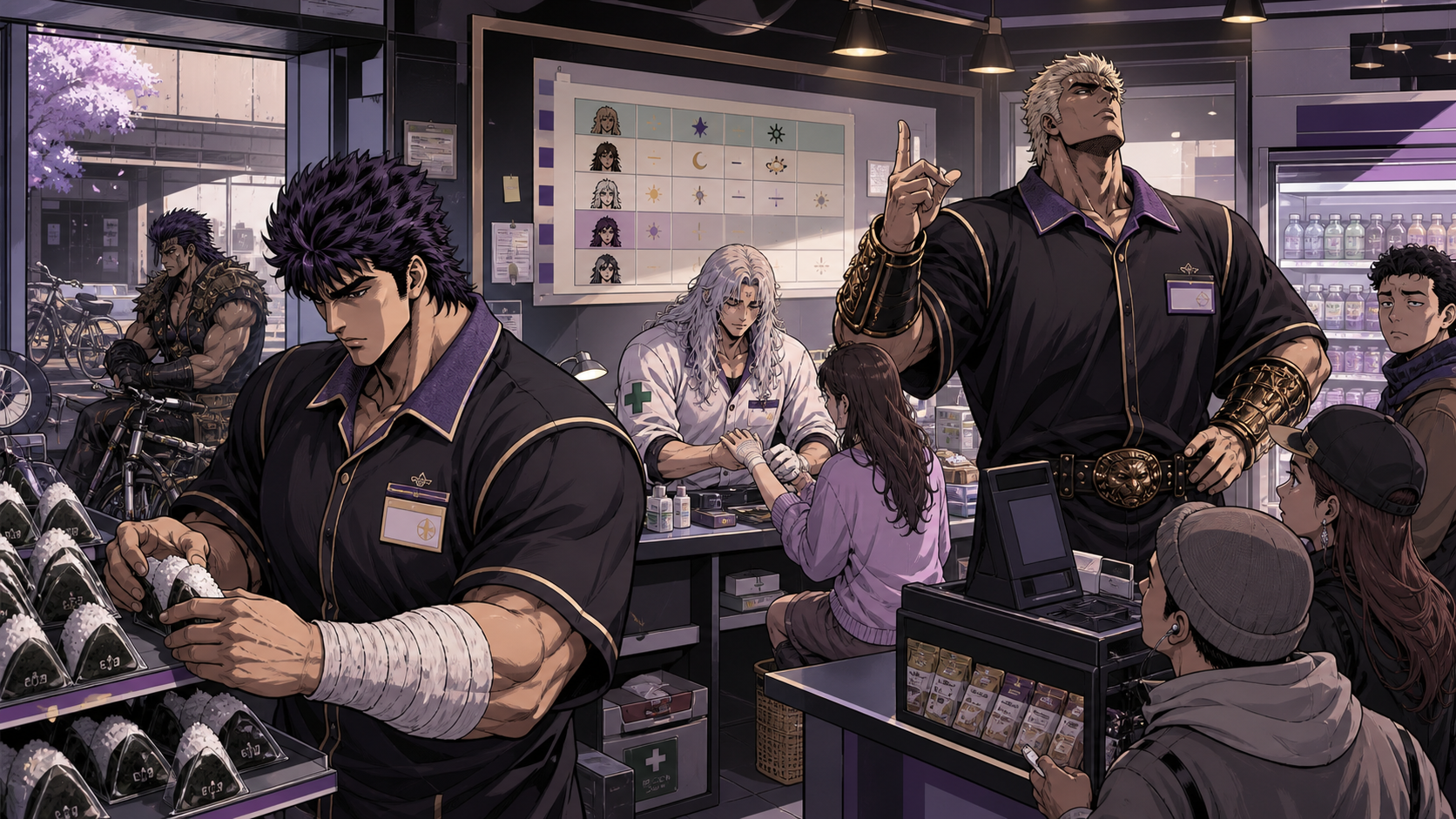
The original CVM artwork places Kenshiro, Toki, and Raoh inside a modern convenience store rendered with the scale and atmosphere usually reserved for battle. Their bodies remain imposing, but the tasks are stocking, service, medicine, and the management of ordinary need. Lavender and plum hold the scene inside CVM identity rather than borrowing an anime palette.
That choice refuses to make service labor visually disposable. The store is not a cheap backdrop pasted behind familiar characters. It is the arena in which their values are tested. The same unique local image serves the featured, hero, directory-card, Open Graph, and Twitter roles so the editorial keeps one coherent visual identity.
Verdict: Responsibility After Relevance
DD Fist of the North Star is uneven because its central joke is stronger than some of the individual jokes built from it. Repetition dulls reference, and broadness can drift toward easy humiliation. Still, the premise discovers something the dramatic franchise cannot ask so directly: what happens when the world improves enough that the hero is no longer necessary?
The answer is not that Kenshiro becomes worthless. It is that worth must detach from emergency. He has to learn tasks, receive correction, cooperate with people who cannot be intimidated, and build relationships without rescue as proof of love. The apocalypse failed to arrive. Masculinity did not lose its purpose; it lost its excuse.
Peace Does Not Feel Peaceful to a Nervous System Built for War
Kenshiro’s problem is not merely résumé translation. A body trained to detect lethal threat does not automatically understand fluorescent light, routine noise, crowded aisles, and customer frustration as harmless. Hypervigilance can turn ambiguity into danger before thought catches up. DD exaggerates that mismatch, but the emotional architecture is recognizable.
Adaptation therefore requires more than telling him to relax. He needs repetition without catastrophe: shifts that end safely, corrections that do not become punishment, conflict that resolves without combat, and coworkers whose presence becomes predictable. Peace becomes believable through accumulated evidence. Until then, the absence of disaster can feel like the pause before it.
The Store Is a Tiny Welfare State With Bad Lighting
A convenience store supplies food, heat, light, cash access, information, bathrooms, medicine, and a public place to exist after other institutions close. For people living precariously, it can become emergency infrastructure without receiving the resources or mandate of one. Workers absorb needs that exceed retail.
That makes the setting a sly substitute for the original village. Strangers arrive hungry, confused, angry, or frightened. Kenshiro still encounters vulnerability, but he cannot solve it by finding a villain behind every problem. Sometimes the antagonist is a missing service, a broken schedule, or a policy no employee has the power to change.
Customer Service Is Choreographed Self-Control
The polite phrase, neutral face, and steady tone of retail are forms of performance. They ask workers to regulate not only action but visible emotion, often while customers are permitted greater volatility. For a man whose canonical stillness signals lethal confidence, service composure becomes a strange mirror.
Kenshiro must learn the difference between control chosen for a purpose and suppression demanded for someone else’s comfort. The show can blur those categories for humor, yet they matter. Professional restraint should not require accepting abuse. A healthy workplace gives the employee a boundary, not merely a script.
Raoh Wants Recognition Before Relationship
Raoh enters rooms expecting status to arrive ahead of him. In the original world, reputation, spectacle, and fear often make that expectation rational. The city refuses to preload his importance. Each customer and coworker meets a large stranger who still has to prove whether he is useful, safe, and reliable.
His comic fury is the pain of having identity made local. He cannot cite destiny as a reference. People know him through the shift he covered, the mess he caused, the apology he avoided, and whether he listened when someone smaller spoke. Relationship is slower than conquest because it cannot be completed alone.
Toki Reveals the Difference Between Care and Usefulness
People often offer care most comfortably when they can frame it as an investment in future productivity. Rest is allowed so the worker can return. Treatment is justified because a skill is valuable. Toki’s presence asks whether care remains available when recovery is uncertain or contribution changes form.
The humane answer cannot depend on his being exceptionally wise. Otherwise the series merely replaces physical worthiness with intellectual worthiness. Toki deserves accommodation because he is a person. His knowledge enriches the workplace, but it should not function as the entrance fee for dignity.
Yuria Cannot Remain a Prize in a Peaceful World
The original romance is structured by pursuit, abduction, sacrifice, and the projection of male destiny onto Yuria. A modern comedy has the chance to expose how strange that structure looks when crisis no longer overwhelms consent. If several legendary men compete for her attention, the joke should land on their entitlement rather than her boundaries.
Yuria needs desires that do not exist to rank the brothers. Peace gives her access to work, friendship, solitude, and ordinary incompatibility. She should be allowed to find grand devotion exhausting. The most subversive romantic outcome may be a clear no that the narrative treats as complete.
The Brothers Are Coworkers Before They Are Rivals
Work forces Kenshiro, Raoh, and Toki into a shared dependency. One person’s failure creates more labor for everyone else; one person’s competence can make the shift survivable. Rivalry therefore becomes expensive in a way the wasteland rarely calculates. Pride leaves someone else cleaning the aisle.
This environment could teach fraternity without sentimental speeches. Cooperation happens because a delivery arrived late, a customer needs help, or illness changed the staffing plan. The brothers build trust through tasks whose stakes are small enough to repeat. That repetition may repair relationships more honestly than one magnificent sacrifice.
Comedy Needs Consequences That Reset Without Erasing
Short-form absurdity often restores the starting arrangement after each segment. The reset protects speed and lets viewers enter anywhere, but total reset can make every lesson disposable. If Kenshiro learns humility and forgets it immediately, the character becomes a mechanism instead of a participant.
The best comic continuity preserves small residues: a new habit, a changed alliance, a running boundary, or a task someone can now perform. Consequences need not become melodrama. They only need to prove that living together leaves marks. Without accumulation, peace becomes another static battlefield.
Super-Deformation Makes Injury Morally Slippery
Chibi bodies stretch, flatten, explode, and return, allowing violence to behave like punctuation. That elasticity is central to the tone, yet it can carry the franchise’s old hierarchy into comedy without examination. Pain remains funny when the body is declared recoverable, but humiliation still has a social target.
The review must ask who is permitted to bounce back. Legendary men often receive cartoon damage as affection, while peripheral characters may absorb ridicule that confirms their lower status. Formal unreality does not eliminate ethics. It changes where ethics must be read—from physical consequence toward patterns of attention and power.
The City Is Not Automatically More Civilized Than the Wasteland
Functioning streets and stocked shelves suggest order, but modern institutions can distribute harm through paperwork, prices, exclusion, and indifference. Nobody needs a spiked shoulder pad to control access to food or housing. DD’s premise is richest when it notices that peace and justice are not synonyms.
Kenshiro’s old moral clarity becomes insufficient because domination is dispersed. There may be no single body to strike. He must learn coalition, procedure, documentation, and patience—tools that feel weak only when power is imagined as personal. The city demands a politics rather than a duel.
A Job Is Not a Complete Identity Either
The brothers need work, but the solution cannot be replacing martial destiny with perfect employeehood. Modern culture also turns occupation into moral proof, treating unemployment as character failure and exhaustion as evidence of seriousness. DD occasionally risks accepting that framework while mocking those who cannot adapt.
A better conclusion separates contribution from employability. Kenshiro can learn service without believing a schedule grants his right to exist. Raoh can become accountable without making productivity his new conquest. Toki can receive care without performing usefulness. Peace should widen identity, not assign a different uniform.
Why the Premise Still Works After the First Laugh
The initial reversal—no apocalypse, no savior career—is instantly understandable. Its durability comes from the larger problem underneath: every person eventually encounters a world that no longer rewards the identity they prepared. Age, illness, technological change, migration, peace, or simple circumstance can make a former competence feel untranslated.
DD turns that fear into slapstick without entirely neutralizing it. We laugh because the mismatch is enormous, then recognize smaller versions in our own lives. Adaptation is humiliating precisely because it proves the self was never finished. That insight gives the parody emotional life beyond recognition.
Japanese Performance Turns Grandiosity Into Panic
The cast frequently begins from full conviction rather than signaling that a joke is coming. A declaration carries heroic weight until the situation refuses to support it. The comedy emerges in the gap between vocal scale and practical consequence. That gap lets the characters keep dignity even as their certainty collapses.
Timing also makes embarrassment communal. Pauses allow coworkers to register what was said; overlapping reactions show a room reorganizing around absurdity. The performances understand that laughter is relational. Someone must hear the grand claim, decide what it means in this workplace, and answer without granting the speaker the world he expected.
Production Credits Matter to the Comic Form
TV Tokyo’s official record identifies Akitaro Daichi as director, Masayuki Sekine as character designer, and Ajia-do as the animation studio, with Jun Abe and Seiji Muto credited for music. These are not decorative facts. Direction, proportion, rhythm, and musical quotation determine whether parody becomes analysis or merely reference.
The production’s compact visual language allows rapid changes of status. A character can occupy mythic framing, collapse into workplace panic, and recover within seconds. That elasticity is the formal engine of the show. The joke lives in editing and performance as much as dialogue.
Where to Place DD in the Franchise
DD belongs after enough exposure to recognize the original’s personalities, poses, and emotional architecture, but it does not require completion of all 152 dramatic episodes. It is a side road, not a sequel and not a replacement introduction. Newcomers may understand the workplace comedy while missing what each inversion costs.
The cleanest guide labels it as a modern alternate-continuity comedy and separates the 2013 run from the 2015 continuation. Strawberry Flavor, even when paired in later broadcasting, remains its own adaptation object. Accurate routes respect playful material instead of treating every joke branch as interchangeable.
Money Replaces Water as the Invisible Pressure
The original wasteland makes scarcity physical. People fight over wells and grain because survival sits visibly in the landscape. Modern Japan appears abundant, yet access still depends on wages, rent, schedules, and prices. DD converts scarcity from an empty shelf into a number that follows the brothers everywhere.
That change matters because money disguises power as neutrality. No tyrant must personally deny Kenshiro food; the transaction simply fails if he cannot pay. The peaceful city can therefore feel morally cleaner while producing exclusion through systems nobody claims to control.
Food Becomes Merchandise Instead of Mercy
In the dramatic series, sharing food can be an act of profound solidarity because every portion may shorten someone else’s supply. A convenience store fills the frame with packaged abundance, but each item belongs to inventory before it belongs to hunger. Kenshiro stands near food he cannot freely distribute.
The contradiction gives the setting ethical tension. Workers are expected to prevent theft and waste while seeing need at close range. Compassion must negotiate policy. DD rarely stays with that discomfort, yet its premise opens a sharp question: what does generosity mean when care has a barcode?
The Uniform Makes Every Body Institutionally Small
The store uniform does what the chibi design begins. It places legendary bodies inside a standardized role, replacing armor, scars, and personal silhouette with employer identity. Customers encounter a worker first and a myth second. The garment does not care who inherited Hokuto Shinken.
Uniformity can create teamwork, but it can also erase difference and make workers interchangeable. Kenshiro’s task is not to reject belonging; it is to learn when shared rules protect people and when standardization asks them to disappear. Peace requires that distinction more often than combat does.
The Register Is a Machine That Does Not Respect Charisma
A cash register records inputs, totals, and discrepancies without being impressed by intention. Raoh cannot command it into balancing. Kenshiro cannot redeem a mistake through moral purity. The device converts action into an audit trail, making accountability procedural rather than personal.
That impersonality can feel humiliating, but it also protects against the rule of reputation. A beloved hero and an unknown employee face the same total. DD finds comedy in technological refusal, while accidentally showing why institutions sometimes need records stronger than charisma.
Surveillance Changes What It Means to Be Watched
In the wasteland, watching usually means scouting danger or witnessing power. Retail surveillance is quieter: cameras, receipts, time clocks, customer attention, and managerial review. Workers become visible in fragments, often without controlling the interpretation of what was recorded.
Kenshiro is accustomed to reading bodies, not being rendered as data. The shift exposes another kind of vulnerability. Accountability can protect coworkers and customers, but surveillance without reciprocal transparency concentrates power. The person observing should also be answerable for how the record is used.
The Schedule Defeats the Fantasy of Unlimited Availability
Legendary heroes appear when the story needs them, carrying no visible childcare plan, commute, medical appointment, or second job. A schedule makes time finite. Covering one emergency can create another obligation elsewhere. Reliability becomes collective coordination rather than infinite self-sacrifice.
For Kenshiro, that boundary may feel dishonorable. Yet a system that requires constant availability is only another apocalypse, one distributed across calendars. Healthy work depends on enough people, predictable rest, and the right to be unavailable without proving that the need is heroic.
Unemployment Is Treated as Shame Before It Is Treated as Policy
The phrase “fighting NEET” turns economic exclusion into identity comedy. The joke lands because the brothers possess absurd capacity and still cannot find a socially recognized use for it. It also risks implying that unemployment is primarily a failure to adapt.
Jobs are created by institutions, not summoned by moral effort. Hiring bias, illness, credential rules, and unstable labor markets shape who gets counted as employable. DD is strongest when embarrassment belongs to a society unable to translate human capacity, not only to men unable to complete an application.
The Manager Is Not a Martial-Arts Master
Training in the store does not follow the lineage model. A manager may understand inventory and still fail at conflict. A veteran employee may hold crucial knowledge without formal authority. Expertise becomes distributed, situational, and occasionally contradictory.
Kenshiro cannot solve that complexity by locating one perfect teacher. He has to compare instruction with outcome, ask coworkers what policy misses, and learn from people whose authority is narrow but real. This is knowledge without a single successor, which may be the most radical alternate universe DD creates.
Coworker Solidarity Is a Technique No One Can Inherit Alone
Hokuto Shinken travels through a chosen line. Workplace solidarity travels sideways. People share warnings, cover breaks, explain unwritten rules, document mistreatment, and refuse to leave one person alone with an abusive customer. Its power exists only in relationship.
That makes solidarity difficult for characters trained to imagine strength as possession. Kenshiro cannot own it, Raoh cannot monopolize it, and Toki cannot sacrifice himself into completing it. The technique works when everyone remains capable of saying no.
Women Should Not Be Cast as Civilization’s Cleanup Crew
Modern-setting comedy often makes women competent so male chaos has someone to contain it. Lin and Yuria risk becoming the managers of emotional labor: translating rules, soothing egos, restoring order, and receiving little narrative disorder of their own. Competence becomes another service obligation.
A stronger version lets women refuse cleanup, make inconvenient choices, and be funny without existing as the straight line against which men bend. Peace should expand their personhood, not merely assign them the invisible labor that keeps legendary masculinity employable.
Failure Is Safer Here, and That Changes Character
In the original series, failure can mean a village destroyed or a loved one killed. Such stakes produce intensity but narrow the range of experimentation. DD allows Kenshiro to fail at a task, feel embarrassment, and try again. The lower stakes make learning narratively possible.
This is one reason comedy can reveal personality with surprising intimacy. The character is no longer purified by catastrophe. He can be petty, confused, defensive, generous, or lazy without the plot immediately turning those traits into death. Safety creates room for contradiction.
Nostalgia Is Both Invitation and Trap
DD depends on affection for voices, poses, rivalries, and phrases accumulated elsewhere. Nostalgia lets the viewer recognize a whole emotional history in seconds. It is efficient, warm, and communal. The audience feels included because it knows why a tiny gesture matters.
The same efficiency can become avoidance. Familiarity may protect weak jokes from scrutiny or discourage the parody from changing relationships too deeply. If every disruption must return the characters to collectible versions of themselves, nostalgia becomes a glass case rather than a conversation.
The Audience Is Asked to Laugh at Lost Status
Much of the comedy begins when someone who expects grandeur receives indifference. That is a reliable reversal, especially for Raoh. Yet status loss is not automatically moral correction. A person can lose prestige without learning accountability, and an institution can humiliate someone without becoming just.
The laughter works best when it targets entitlement rather than vulnerability. Kenshiro struggling with a new task can invite empathy. Raoh demanding worship from customers invites critique. The distinction determines whether comedy opens character or simply enjoys seeing someone reduced.
Everyday Japanese Space Rewrites the Epic Scale
The convenience store, street, apartment, and classroom organize bodies through narrow aisles, posted rules, shared walls, and public etiquette. These spaces resist the monumental framing that once isolated fighters against open sky. Characters must continuously account for other people’s proximity.
That spatial compression is social instruction. Raoh cannot spread into the landscape without blocking someone’s route. Kenshiro’s silence affects coworkers trapped beside him for a shift. Architecture turns coexistence from an ideal into a physical negotiation.
Music Carries a Memory the Image Undercuts
Parody music can summon heroic expectation faster than exposition. A familiar cadence tells the body to anticipate revelation, then the image delivers a register, a snack, or a petty dispute. The laugh arrives from synchronized betrayal: sound remembers the epic while the frame insists on the ordinary.
The device works because the production understands that franchise identity lives beyond plot. Rhythm, vocal attack, pause, and musical scale are part of what viewers recognize. DD adapts that sensory memory and tests how much dignity survives when context changes.
The Best Gags Produce New Information
A durable joke does more than confirm that Kenshiro is serious or Raoh is proud. It places the trait under pressure and reveals its mechanism. We learn what Kenshiro fears about correction, what Raoh thinks respect should purchase, or how Toki negotiates being cared for.
Once a joke generates information, repetition can become development rather than recycling. The setup returns, but a choice changes. Comedy earns continuity one adjustment at a time. Without that movement, reference becomes a vending machine that dispenses the same flavor under different labels.
Parody Can Love a Text Without Protecting It
Affection is sometimes mistaken for refusal to criticize. DD’s premise demonstrates the opposite. It knows the original well enough to remove the catastrophe and watch its hierarchy wobble. The comedy is loving because it believes the characters remain interesting after their most flattering conditions disappear.
That confidence distinguishes parody from brand maintenance. Brand maintenance arranges familiar faces and asks recognition to feel sufficient. Parody risks discovering that a beloved trait was also a defense, a privilege, or a limitation. It lets love survive knowledge.
The Peaceful World Is the Test Kenshiro Never Trained For
Kenshiro trained to place impossible force precisely, endure pain, read intent, and carry responsibility through violence. Peace asks him to distribute rather than concentrate responsibility. It asks for patience with processes that do not reveal immediate moral clarity.
He may never look as impressive learning a register as he does ending a tyrant. That is the point. Civilization depends on people accepting forms of goodness that produce no triumphant silhouette. DD’s deepest joke is that saving the world was easier for Kenshiro than joining it.
Kenshiro’s Silence Stops Looking Automatically Noble
In the wasteland, Kenshiro’s restraint can signify focus, grief, and refusal to waste words on cruelty. In a workplace, silence has less stable meaning. Coworkers may read it as judgment, confusion, disengagement, or a request they are expected to decipher.
Peace makes communication part of responsibility. Kenshiro cannot assume that good intent will travel through posture. He has to name what he needs, acknowledge what he missed, and tell people when he understands. The ordinary sentence becomes a technique against isolation.
Raoh’s Ambition Shrinks Without Becoming Harmless
Moving Raoh from conquest into ordinary work reduces his field, not his appetite for hierarchy. He can turn a small decision into a referendum on status, treat cooperation as surrender, and interpret correction as insubordination. The scale is comic; the pattern remains dangerous.
That continuity prevents the parody from becoming arbitrary. Raoh is funny because the modern setting reveals how domination lives before anyone commands an army. It begins in meetings, schedules, interruptions, and the assumption that other people’s time belongs to the loudest person.
Toki’s Gentleness Needs Boundaries
Toki’s patience can stabilize a chaotic group, but gentleness becomes exploitation when everyone assumes he will absorb the unfinished work. Caregivers are often praised in language that hides how little support they receive. Their reliability becomes permission to demand more.
A meaningful comic arc would let Toki disappoint people deliberately. Saying no, delegating a task, or admitting anger would not betray compassion. It would protect compassion from becoming a role in which the kindest person slowly disappears.
Lin Should Be Allowed to Be Wrong
Competent young women in ensemble comedy often become narrative infrastructure. They explain the premise, correct the men, and maintain reality. Lin gains authority through that position, but perfection can be another kind of confinement. Everyone else receives chaos while she receives responsibility.
Letting Lin misjudge, improvise badly, or pursue a ridiculous desire would make her freedom visible. Authority is richer when it includes the right to fail without losing respect. She should participate in the comedy, not only administer it.
Bat Knows How Systems Bend
Bat’s practical intelligence is different from obedience. He understands that formal rules and actual behavior rarely match. He can identify who makes exceptions, what information people conceal, and how a resource moves when the official route stalls.
That knowledge can protect the brothers, but it can also reproduce the very opacity that confuses them. Bat’s ethical test is whether he uses fluency to widen access or to become the new gatekeeper. Cleverness becomes community knowledge when he teaches the route rather than selling it.
Yuria’s Calm Is Not Consent to Emotional Labor
Characters may project serenity onto Yuria because the franchise has trained them to make her an ideal rather than a person. In a modern setting, that projection can turn her into the listener who receives everyone’s crisis without expressing her own limits.
Peace should permit Yuria to interrupt the fantasy. She can decline explanation, refuse comparison, and leave men to manage feelings they built around her image. Her calm means nothing if the story never lets her choose disturbance.
Ryūken’s Authority Becomes Historically Contingent
The Japanese cast’s inclusion of Akira Kamiya as Ryūken adds a particularly rich bridge to franchise memory. The voice carries institutional weight, but DD places that authority in a world where lineage no longer guarantees social necessity.
A teacher who prepared successors for catastrophe must face the possibility that his curriculum was ethically sincere and practically obsolete. His dignity depends on revising what he taught, not demanding that peace manufacture a battlefield to prove him right.
Shin’s Obsession Looks Smaller Under Fluorescent Light
Epic framing can make obsession resemble tragic destiny. Ordinary space removes that protection. Persistent pursuit, rivalry, and possession become recognizable as boundary violations when no apocalypse provides romantic fog.
Parody has an obligation to place the embarrassment on the pursuer, not the person being pursued. The joke should expose how grand language attempts to make another person’s refusal seem narratively temporary. A no remains complete even when a famous soundtrack begins.
Villains Become Neighbors, Which Complicates Accountability
A modern alternate continuity may place former tyrants inside shared public life. The change invites laughter because cosmic menace becomes mundane irritation. It also creates a serious problem: coexistence cannot mean automatic forgiveness merely because the new world reset the plot.
Character traits still affect others. The response should be proportionate to present harm, not inherited from another continuity, but boundaries remain necessary. Peace is not a room where everyone must socialize. It is a structure in which refusal does not require violence.
The Brothers Compete Because Comparison Organized Love
Kenshiro, Raoh, and Toki do not arrive at rivalry as isolated personalities. A succession system taught them that worth would be ranked and one person would carry legitimacy. Even in a universe without apocalypse, that emotional training can survive its original purpose.
Workplace competition activates the same wound in miniature. Hours, praise, competence, and attention become substitute succession contests. Healing requires more than declaring the stakes silly. The brothers must learn that another person’s success does not revoke their place.
Modern Romance Requires Ordinary Compatibility
Catastrophe makes devotion spectacular and compatibility difficult to observe. A person can cross a wasteland for love without revealing whether they communicate, share labor, respect privacy, or enjoy an uneventful afternoon together. DD’s setting quietly restores those questions.
The comedy could make romance more humane by treating mundane compatibility as consequential. A legendary bond may survive; it may also discover that rescue was carrying the relationship. Neither result diminishes the past. It tells the truth about the future.
Friendship Cannot Be an Audience for Male Performance
Ensemble comedy often turns friends into witnesses who validate a central character’s antics. They react, repair, and reset while he remains the engine. DD risks this whenever supporting characters exist mainly to confirm that the brothers are outrageous.
Friendship becomes real when it redirects the scene. A friend can refuse the performance, introduce a need unrelated to the hero, or change the terms under which everyone gathers. Relationship is not a cheering section. It is reciprocal authorship.
Apology Is the Technique the Franchise Rarely Animates
Combat stories excel at remorse expressed through sacrifice. Apology is smaller and more demanding because the harmed person remains present to answer. The speaker cannot control whether forgiveness follows. No explosion can make the exchange visually complete.
DD has room to make apology funny without making it meaningless. Kenshiro may struggle for words; Raoh may try to turn accountability into a proclamation; Toki may apologize for needs that require no apology. Each failure reveals how masculinity negotiates dependence.
Embarrassment Is Not the Same as Humility
The brothers experience embarrassment whenever modern life refuses their self-image. Embarrassment is involuntary exposure. Humility begins afterward, when a person uses the information rather than attacking the witness or escaping into performance.
This distinction helps evaluate the series’ resets. A character can be repeatedly humiliated and never change. The joke becomes richer when embarrassment opens a choice: defend the myth, or become teachable. Only the second is growth.
Competence Should Travel in More Than One Direction
Lin and Bat teach the brothers how ordinary institutions work. The brothers also possess discipline, perception, endurance, and forms of care that can become useful after translation. The exchange fails if modern competence is treated as inherently mature while martial knowledge is only ridiculous.
A good parody redistributes value rather than reversing a hierarchy. Nobody should become the universal adult. People know different things, and the comedy can arise from negotiating which knowledge matters now. Mutual teaching prevents adaptation from becoming assimilation.
Peace Gives Grief Time to Become Specific
The original world often moves so quickly that grief must transform into action. A peaceful setting allows loss to sit awkwardly inside errands, meals, and work. That contrast can be funny, but it can also reveal how memory persists after the environment stops matching it.
Kenshiro’s sadness does not disappear because the continuity is comic. It changes address. If the series lets grief remain beneath absurdity, the character gains depth without importing dramatic stakes wholesale. Laughter becomes coexistence with pain rather than denial of it.
Found Family Needs Logistics
The phrase “found family” can romanticize relationships whose care work remains unequal. Living and working together means bills, cleaning, food, transport, illness, and the management of conflict. Affection does not allocate those tasks fairly by itself.
DD’s domestic and workplace spaces make logistics visible. Who remembers what everyone needs? Who covers the cost? Who gets quiet? A family becomes safer when love is translated into systems that do not depend on one person noticing everything.
The City Lets Minor Characters Have Independent Lives
A populated modern setting can give side characters occupations, routes, friendships, and obligations unrelated to Kenshiro. Their worlds do not need to pause until the hero arrives. That independence changes how his importance is measured.
The strongest ensemble comedy allows him to enter stories already in motion. Sometimes he helps; sometimes he misunderstands; sometimes the event matters more after he leaves. A world worth saving should be capable of existing beyond the savior’s frame.
A Character Can Be Iconic and Still Need Revision
Parody depends on stable recognition, yet recognition does not forbid change. Kenshiro remains Kenshiro when he learns to ask a question. Raoh remains Raoh when he discovers that command without trust fails. Toki remains Toki when he refuses unpaid emotional labor.
Revision does not dilute an icon. It tests which traits carry identity and which were only habits protected by genre. DD’s alternate world is valuable precisely because it can perform that test without rewriting the dramatic canon.
The Relationship Verdict
DD succeeds whenever modern life turns inherited relationships into negotiations. Brotherhood must become cooperation, romance must encounter consent, mentorship must revise itself, and friendship must distribute attention. Familiar names are not enough; proximity has to produce new obligations.
The series remains uneven because reset comedy often protects the old arrangement from consequence. Yet even that limitation reveals the pressure point. These characters are easiest to merchandise when frozen. They become human when peace forces them to change.
Short-Form Rhythm Rewards Precision
Compact comedy has no room for a premise to wander toward its point. Setup, recognition, reversal, and consequence must arrive with enough speed that the viewer feels inevitability rather than compression. DD benefits when a character’s established trait performs most of the setup before the scene begins.
The danger is confusing speed with noise. A frantic reaction cannot repair an unclear turn. The best segments let one ordinary object—the register, uniform, application, or product—focus the collision between myth and modernity.
Editing Controls Who Owns the Joke
A cut can place sympathy with the person making a grand claim, the coworker forced to hear it, or the institution that ignores both. Reaction shots are therefore ethical decisions. They tell us whose reality anchors the scene after absurdity enters.
When DD cuts toward Lin or Bat, the world regains scale beyond the brothers. When it remains trapped inside male escalation, everyone else becomes scenery. Comic editing distributes subjectivity as surely as dramatic editing distributes danger.
Repetition Needs Escalation of Meaning
A catchphrase can return because the audience enjoys recognition, but each return should alter context. The first use establishes personality; the next exposes inflexibility; a later use might reveal self-awareness or invite another person to seize the phrase.
Without transformation, repetition behaves like branding. With transformation, it becomes memory. DD’s unevenness often comes down to whether a recurring bit remembers what happened the last time it appeared.
Background Labor Should Enter the Frame
The stocked store appears effortless if delivery workers, cleaners, clerks, and maintenance remain invisible. That illusion mirrors how service economies hide the coordinated labor that makes convenience possible. A parody about employment should be curious about the people outside its central shift.
Letting background workers have competence and irritation would strengthen the world. Kenshiro’s lesson is larger when he discovers not one job but an interdependent network whose success cannot be credited to a single hero.
The Product Shelf Is a Wall of Manufactured Desire
The wasteland organizes desire around survival. Retail organizes desire through abundance, placement, branding, and novelty. Kenshiro must navigate a world where need and wanting are deliberately blurred, and where his job may involve helping that blur produce revenue.
His moral directness does not map neatly onto consumption. A product can comfort someone without being necessary; a promotion can be playful and manipulative at once. Peace introduces ambiguity where scarcity once made priorities brutal and clear.
Politeness Can Protect and Conceal
Shared etiquette reduces friction among strangers and gives employees a script under pressure. It can also conceal anger, inequality, and the fact that one person cannot safely answer another honestly. DD uses formal politeness as a container that the brothers repeatedly overfill.
The joke works because social order survives the interruption, but the review should notice who pays for that survival. Courtesy is healthy when reciprocal. When demanded only downward, it becomes a decorative form of obedience.
The City Offers Anonymity the Wasteland Could Not
Legendary reputation follows characters across the dramatic world. A modern city can let Kenshiro pass through a crowd unrecognized. Anonymity wounds the ego, yet it also offers freedom from inherited expectation. He may perform a kind act without converting it into legend.
That privacy is one of peace’s gifts. A person can experiment, fail, and change before the whole world assigns meaning. DD laughs at lost fame while revealing how anonymity can make an unwritten future possible.
Domestic Space Tests the Aftermath of Every Gag
Workplace comedy ends the shift, but bodies and emotions travel home. Someone still has to eat, sleep, clean, and live beside the person who created chaos. Domestic scenes can reveal whether embarrassment became reflection or merely waited offscreen for reset.
The contrast also humanizes scale. Raoh may announce conquest in public and still face a sink of dishes. Ordinary maintenance is not an insult to grandeur. It is the condition that allows anybody to return tomorrow.
Bodies Built for Spectacle Need Rest
The original physique suggests inexhaustible readiness. DD’s peaceful world can admit fatigue without translating it into defeat. Standing through a shift, commuting, irregular sleep, and emotional performance exhaust bodies in ways no battle montage celebrates.
Rest should not be another gag about weakness. It is a boundary against the fantasy that strength means permanent availability. Kenshiro becomes more human when recovery belongs to daily life rather than only the aftermath of catastrophic injury.
Comedy Can Name Trauma Without Diagnosing It
Kenshiro’s reactions may resemble hypervigilance, avoidance, or difficulty interpreting safety, but the review should resist turning a fictional comic pattern into a clinical claim. The valuable question is experiential: what does peace demand from someone organized around danger?
Care begins with curiosity rather than labels. Predictability, choice, explanation, and nonpunitive correction are useful regardless of diagnosis. DD’s exaggeration can open empathy if viewers do not mistake recognition for medical certainty.
Workplace Found Family Must Allow Exit
Coworkers can become intimate through shared pressure, but calling a workplace family often asks employees to replace boundaries with loyalty. The brothers may genuinely attach to the store community while still needing wages, rest, and the freedom to leave.
Belonging becomes trustworthy when exit is possible. A relationship chosen under economic coercion deserves care, but it should not be romanticized into obligation. The store can be community without owning the people who sustain it.
Authority Needs an Appeals Process
Martial succession offers no ordinary appeal from the chosen master. A workplace at least promises policies, supervisors, and records, though those mechanisms may fail. DD can expose the difference between having a rule and having a safe way to challenge its application.
Kenshiro’s instinct is to confront the visible wrongdoer. Institutional justice asks who receives the complaint, protects the speaker, preserves evidence, and corrects the pattern. That slow architecture is less satisfying than a pressure point and more necessary to peace.
Translation Is the Central Skill of the Alternate World
Every character must translate something: strength into service, care into boundaries, ambition into coordination, memory into humor, and franchise iconography into a new visual grammar. Translation preserves meaning by changing form. Literal repetition would fail the new environment.
This is also why DD deserves evaluation as adaptation rather than merchandise. Its premise understands that fidelity is relational. The question is not whether the new Kenshiro behaves identically, but whether the change reveals something true about the old one.
The Viewer Brings the Missing Apocalypse
The peaceful world never needs to show nuclear ruin because the audience carries it as negative space. Every stocked shelf and intact street gains meaning from what did not happen. Comedy operates inside that remembered absence.
This structure gives DD an unusual melancholy. The characters are safer, yet some are less certain who they are. The viewer knows the horror they escaped and must confront the disturbing possibility that purpose had been built from that horror.
Safety Does Not Guarantee Self-Knowledge
Removing danger gives characters opportunity, not insight. Kenshiro may remain silent, Raoh controlling, and Toki self-erasing because those patterns were shaped by more than immediate threat. Peace can expose a wound without teaching anyone how to heal it.
That is why adaptation must be active. The brothers need relationships capable of responding differently over time. Otherwise the peaceful universe becomes a museum where trauma performs harmlessly for an audience.
A Better Workplace Is Part of the Character Arc
Growth should not be demanded only from employees. If the store depends on Lin’s unpaid guidance, ignores Toki’s health, tolerates customer abuse, or schedules too few people, the institution also requires revision. Individual resilience cannot redeem structural neglect.
The most satisfying comedy would let worker knowledge change procedure. A lesson becomes real when the next shift is safer, not merely when Kenshiro understands why the last one hurt. Institutions must be teachable too.
Why Broad Comedy Still Deserves Serious Criticism
Calling a show silly does not make its patterns inconsequential. Comedy trains attention: it tells viewers whose embarrassment is pleasurable, whose boundaries are obstacles, and which institutions appear natural. Serious criticism is not punishment for being funny.
It is a way of taking laughter seriously enough to ask what produced it. DD survives that attention because its premise contains genuine intelligence even when particular jokes settle for less. Uneven art can still carry a sharp idea.
Who Should Watch DD
Viewers who enjoy alternate continuities, workplace absurdity, voice-driven comedy, and affectionate genre critique will find the most value. Familiarity with the original series deepens nearly every reversal, though exhaustive canon knowledge is unnecessary.
Anyone seeking continuation of the dramatic plot, sustained action choreography, or a solemn introduction should begin elsewhere. DD is a conversation with an existing myth. It is not embarrassed about being a side road, and a guide should not sell it as a main route.
Who May Bounce Off It
The repetition, compressed designs, broad reactions, and reference density can exhaust viewers who need escalating narrative consequence. Some jokes remain attached to the social assumptions they might have challenged, and tonal reset can make growth feel provisional.
Those limits are not failures of expectation alone. They are formal tradeoffs. The review can appreciate the premise while naming where the series chooses recognizability over development and speed over ethical follow-through.
The Series Rating Is an Argument, Not a Number
A useful verdict weighs conception, execution, formal fit, performance, repetition, and what the comedy discovers about its source. DD scores highest as an adaptation idea and vocal-performance vehicle. It loses ground when reference substitutes for consequence or vulnerability becomes the easiest target.
No single number can express that shape. The recommendation must tell readers which pleasures endure and which limitations accumulate. A side route can be worth taking without becoming essential.
The Final Human Question
If nobody needs Kenshiro to be a savior, can he still believe his life matters? The convenience store turns that question into embarrassment, but the answer reaches beyond employment. Meaning built entirely from being necessary will always fear another person’s safety.
Peace asks him to want a world that can live without his exceptional intervention and then join that world anyway. He must accept being one person among others—not diminished, not worshipped, and still capable of care. That is harder than defeating anyone.
Final Verdict: The World Lived, So the Men Had to Learn How
DD Fist of the North Star begins with a perfect reversal and spends its uneven run discovering how much the reversal can hold. It punctures heroic scale, exposes the labor beneath convenience, and turns masculinity from a weapon into a set of habits that ordinary people must negotiate.
The series does not always follow its own intelligence far enough. Reset comedy protects familiar shapes; broad jokes sometimes target vulnerability; institutions remain less examined than individual failure. Yet the central insight survives every weak detour. A peaceful world does not make these men irrelevant. It asks them to become responsible without catastrophe doing the emotional translation for them.
Adaptation Score: The Premise Understands the Source
As adaptation, DD earns its strongest marks before an individual gag lands. Refusing the apocalypse does not abandon Fist of the North Star; it isolates the catastrophe’s narrative function. The original world made martial inheritance socially necessary. The alternate world asks what remains when necessity disappears but training, temperament, and relationships survive.
That is a genuine interpretive act. The parody identifies the source’s dependence on crisis, then changes one condition and follows the instability outward. Even weak segments inherit intelligence from that experiment. The adaptation is most faithful when it allows the experiment to unsettle beloved characters rather than arranging references as reassurance.
Comedy Score: Performance Outruns Construction
The Japanese cast supplies conviction, timing, and elasticity strong enough to elevate ordinary setups. Grand vocal scale colliding with mundane consequence remains funny because performers commit to the emotional reality underneath the pose. Direction and editing can transform a simple misunderstanding into a compact status collapse.
Writing is less consistent. Some sequences discover new information about character; others stop at recognition or volume. The gap between performance and construction explains why the show can feel lively while also repetitive. Actors keep finding human panic inside material that does not always give that panic somewhere to go.
Character Score: Familiarity Creates Both Depth and Ceiling
The characters arrive carrying decades of audience memory, so a gesture can contain history without exposition. DD uses that inherited density well when modern life reveals the defense beneath a trait. Kenshiro’s silence becomes communication failure; Raoh’s command becomes management failure; Toki’s care becomes boundary pressure.
The same recognizability limits change. A commercial parody benefits from returning everyone to an instantly identifiable state. Development threatens the loop. Character work therefore arrives in flashes rather than sustained arcs, leaving the viewer to imagine consequences the format repeatedly clears away.
Gender Score: Reversal Is Not Yet Redistribution
Giving Lin practical authority and removing the automatic grandeur from male rivalry creates useful reversals. A teenage girl understands the city better than the legendary successor, and romantic obsession looks less noble when ordinary consent becomes visible. Those choices expose the gendered machinery of the original myth.
Yet competence can trap women in cleanup. Lin and Yuria risk becoming reality managers for men allowed to generate disorder. The parody becomes fully transformative only when women receive comic desire, error, refusal, and narrative space unrelated to stabilizing masculinity.
Labor Score: Sharp Observation, Limited Structural Follow-Through
The convenience store setting recognizes emotional labor, standardization, customer power, scheduling, and the humiliation of skills that a market cannot price. Legendary bodies become workers, and ordinary competence receives unusual dramatic weight. The premise respects service labor whenever the joke lands on male entitlement rather than the job.
Structural criticism remains partial. Wages, ownership, insecurity, accommodation, and the distribution of profit rarely receive the attention given individual adaptation. DD understands that work disciplines identity, but it is less willing to ask who designed that discipline or who benefits from calling it maturity.
Visual Score: Deformation as Criticism
The super-deformed designs do more than announce a lighter genre. They remove the silhouette that once naturalized authority. Large heads, compact limbs, and elastic damage convert physical supremacy into unstable performance. The viewer sees how camera, proportion, music, and stillness helped manufacture masculine inevitability.
That formal idea is stronger than any isolated drawing. Even when animation is economical, the body itself carries the parody’s thesis. DD turns iconography into an argument: if a change in scale can alter our moral reading so quickly, perhaps visual dominance was never the same thing as virtue.
Emotional Score: Melancholy Hiding Inside the Reset
The series’ deepest emotion comes from a world that survived. Safety should be uncomplicated grace, yet it removes the crisis through which these men understood purpose, love, and usefulness. The audience laughs at their confusion while carrying knowledge of the devastation that would have made them legible.
Reset comedy rarely lets that melancholy accumulate, but it remains present as negative space. Every failed job application asks whether a hero can desire peace when peace does not desire a hero. Every ordinary kindness suggests that meaning may return in forms too small for legend to recognize.
The Complete Verdict
DD Fist of the North Star is not essential canon, but it is an unusually revealing side route. Its best insight is that the end of catastrophe does not finish a hero’s development. It begins a different one. Strength must become teachable, authority must become accountable, care must acquire boundaries, and love must survive without rescue as its proof.
The series is repetitive, formally modest, and sometimes too comfortable with easy targets. Still, its central reversal remains potent enough to support serious thought: masculinity built for crisis may secretly depend on crisis continuing. DD imagines the kinder world and refuses to let the men arrive there already whole. That refusal is the reason to watch.
Sources and Viewing Notes
Format label: Comedy spinoff in a separate modern continuity. DD’s television seasons remain distinct from Strawberry Flavor even when later broadcasts paired them.
Viewing expectation: Familiarity improves reference humor, but no dramatic franchise chronology is required.