
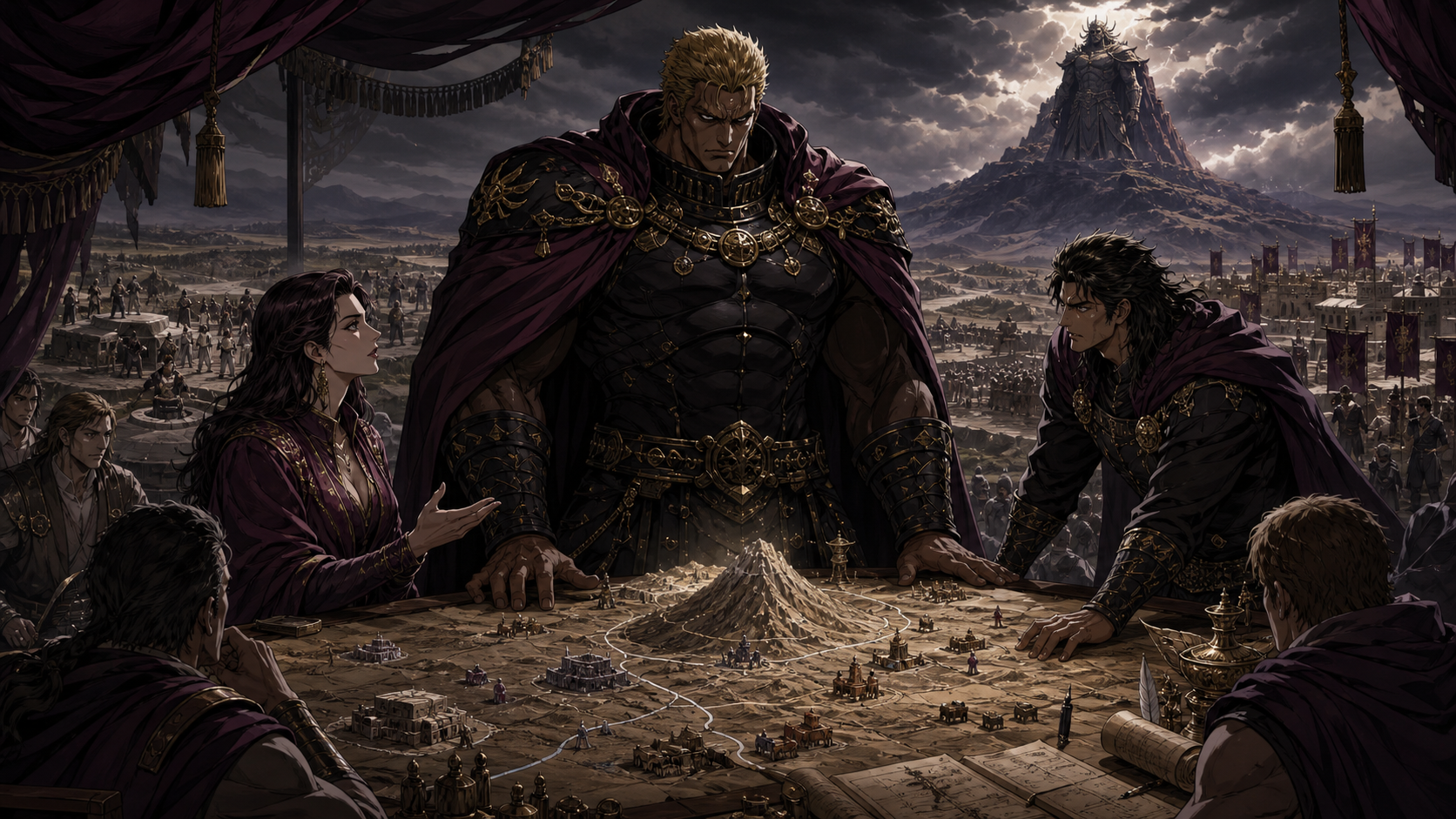
Legends of the Dark King Review: Raoh Could Win a Country Before He Learned How to Govern One
The 13-episode Raoh gaiden follows conquest before Kenshiro’s central journey. This review examines charisma, administration, loyalty, Reina and Souga, resource control, fear, and the difference between winning territory and governing people.
Bottom Line First
Legends of the Dark King gives Raoh the prequel treatment and discovers that conquest is less interesting when nobody asks who counts grain. Its 13 episodes work best when Reina, Souga, troops, civilians, and rivals reveal the labor required to turn one enormous man’s certainty into a regime.
Raoh’s magnetism is real. So is the danger of filming charisma as proof of legitimacy. A villain-viewpoint story becomes valuable when proximity makes power more accountable, not merely cooler.
What This Anime Is
The 2008 television series is a thirteen-episode gaiden centered on Raoh’s rise before his familiar role in Kenshiro’s story. It is a viewpoint expansion, not a replacement timeline or a new season of the original anime.
The route adds advisers, campaigns, and emotional context that explain how the King of Fists gathers loyalty.
Conquest Requires Administrators
Armies need food, routes, medicine, records, repair, negotiation, and discipline. Every banner implies workers whose names the legend can omit.
The anime becomes politically alive when Souga and Reina expose decisions Raoh’s body cannot solve alone.
Reina Deserves More Than Loyal Witness
Her competence cannot exist merely to certify Raoh’s depth. Strategy, judgment, grief, and disagreement make her a political actor.
A better villain prequel lets the people nearest power retain moral authority instead of rewarding loyalty as their entire identity.
Fear Produces Fast Order and Fragile Trust
Raoh can stop raiders and impose routes. Fear may create short-term predictability while destroying the feedback that tells a ruler when policy is failing.
Subjects who cannot speak honestly are not proof that the kingdom agrees.
Kokuoh and the Image of Kingship
The horse enlarges Raoh into landscape. Iconography matters because government begins in what people believe resistance will look like.
The series understands propaganda visually even when its scripts do not fully examine the civilians living beneath it.
Japanese Performance
Takashi Ukaji gives Raoh mass and command while allowing quieter uncertainty to surface. The performance distinguishes private strain from public proclamation.
Reina and Souga’s Japanese performances keep counsel from becoming exposition, especially when affection and political disagreement occupy the same line.
Verdict
The series is not deep because it makes Raoh sympathetic. It is deep when sympathy fails to excuse the machinery assembled around him.
As a compact thirteen-episode route, Legends of the Dark King belongs beside the main franchise as a study of charisma becoming administration. Winning territory is an event. Governing people is the consequence the legend keeps trying to ride past.
A runoff earns its own judgment because relationship is not continuity. The page names what the animation is, what it changes, and why its formal choices matter before asking whether familiarity alone can carry it.
The canonical artwork is original and local. It remains the featured image, top hero, directory card, Open Graph image, and Twitter image for this editorial; no unrelated branch image is borrowed.
Sources and Viewing Notes
Format record: The Raoh-centered gaiden aired as a thirteen-episode television anime in 2008.
Continuity label: This is a villain-viewpoint prequel/side story and not one of the five Legends of the True Savior films and OVAs.