
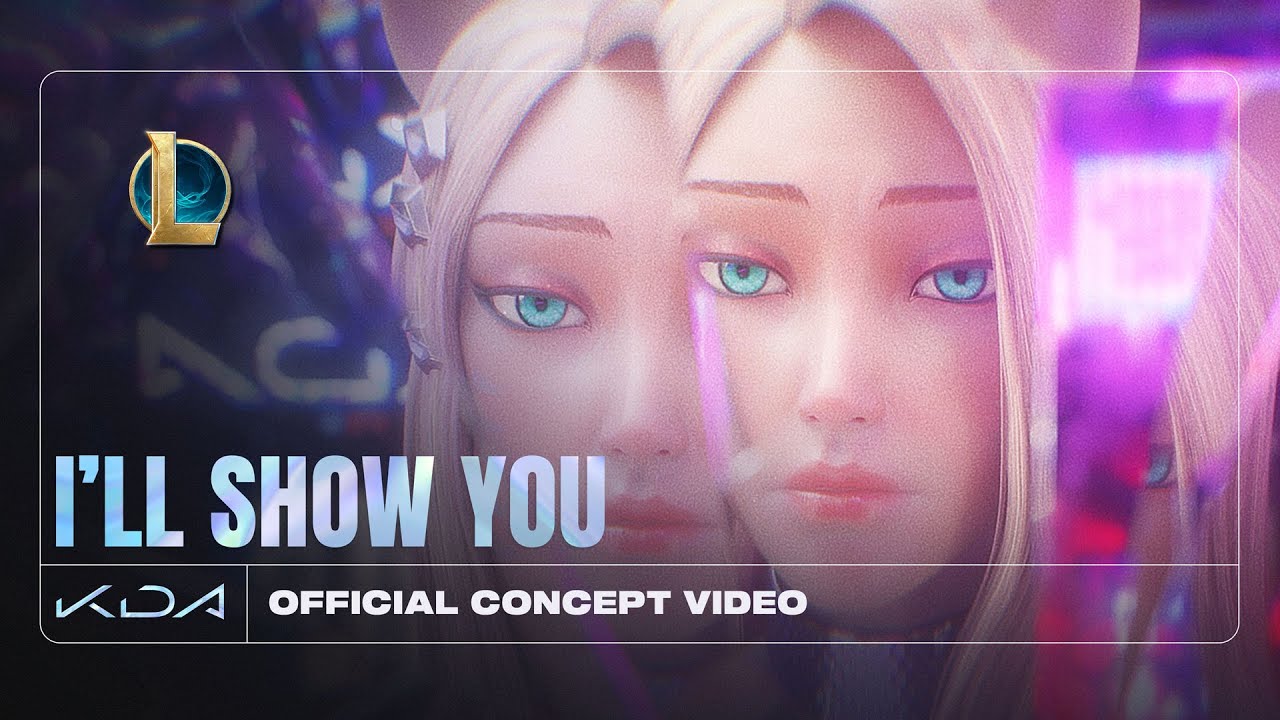
RAERAE REACTS · EXACT VIDEO FILE
I’LL SHOW YOU: K/DA, TWICE, Bekuh BOOM and Annika Wells Built Ahri a Mirror Maze
K/DA gave Ahri a prestige-pop identity crisis, TWICE supplied five voices inside it, and the concept video turned self-belief into a room full of reflections that do not all agree.
Release file
Released: November 27, 2020
Runtime: 03:32
Artist / channel: League of Legends · K/DA with TWICE, Bekuh BOOM and Annika Wells
Exact-file focus: The exact official Ahri concept video for I’LL SHOW YOU, not a lyric upload, fan edit, game montage, or another K/DA track.
First watch: Ahri meets every version of herself at once
The mirror maze is not subtle decoration. Ahri is a pop star built from confidence, fantasy and the uncomfortable knowledge that an audience is always looking. Surrounding her with reflections makes the central problem visible: which version is the self, which version is performance and which version was created because somebody expected to see it?
The concept video lets that question remain glamorous. Identity crises in virtual-pop projects do not have to look like gray rooms and whispered monologues. Color, movement and spectacle can carry doubt. The tension comes from seeing a character who appears completely designed still searching for authorship inside the design.
The vocal casting is a relay, not a group cameo
Nayeon, Sana, Jihyo, and Chaeyoung join Bekuh BOOM and Annika Wells across a track credited through K/DA’s Ahri identity. That arrangement could have become a celebrity scavenger hunt. Instead, the voices function as different pressures inside one pop persona: sweetness, force, rhythmic attack and the brighter lift required by the chorus.
The song works when listeners stop asking which singer gets to own Ahri and hear the multiplicity as part of the point. A virtual performer is already collaborative. Writers, producers, animators, voice performers and game lore all meet inside one face. The shifting voices expose that construction instead of hiding it.
Lyrics and meaning: showing yourself is not the same as proving yourself
The title sounds defiant, but the lyric keeps brushing against insecurity. “I’ll show you” can be a promise of revelation or a threat aimed at people who doubted you. Those motives are not identical. One begins with self-knowledge; the other still lets the skeptic decide what counts as success.
Ahri’s visual story pushes toward the first reading. The mirrors matter because the audience cannot hand her a stable identity. She has to choose among images, discard some and recognize that performance is not automatically fake. A stage self can be real if the performer participates in building it rather than merely obeying the reflection that receives the most applause.
The production gives confidence a polished shell
The track moves through sleek electronic pop with a chorus designed to rise cleanly above the verses. It is less abrasive than K/DA’s hardest material and more interested in controlled lift. That suits Ahri, whose power has always mixed charm, danger and visual precision rather than brute force.
Polish becomes thematic here. The production sounds finished enough to be suspicious, which makes the small vocal textures important. Breath, consonant attack and changes in tone keep the song from becoming a perfect synthetic surface. The human labor inside the virtual character remains audible.
Animation can perform a close-up differently
A virtual face does not accidentally glance away or catch an unplanned emotion. Every pause is authored. That makes the close-ups feel less spontaneous but not less meaningful. The animators choose when Ahri appears certain, when a reflection interrupts and when the camera lets doubt remain visible.
The best shots use multiplicity rather than treating animation as permission for endless impossible motion. Reflections split the frame and create competing centers. The spectacle serves the argument. When the video does go large, the scale feels like a persona expanding after confrontation, not a effects team reminding viewers that rendering was expensive.
TWICE fit because brightness can carry conflict
TWICE are often discussed as if bright vocal color automatically means uncomplicated emotion. This collaboration uses that brightness as tension. A clean, inviting tone can sing determination while still carrying the need to be believed. Jihyo’s force, Nayeon and Sana’s lift, and Chaeyoung’s rhythmic character give the track multiple routes through confidence.
The feature also reminds me why crossover credits need boring metadata. TWICE are performers on this song, but K/DA is the project identity and Ahri is the visual subject. Collapsing all of that into “a TWICE video” would erase the exact object. The relationships belong together without becoming interchangeable.
A virtual group is still a group
K/DA are not less real as a music project because the faces are animated and the performers can change. Group identity can live in songs, visual language, credited roles and an accumulating canon. The humans supplying voices deserve precise credit, while the fictional performers remain the fan-facing act inside the release.
That is why this page belongs in both ecosystems. TWICE participation matters, but Ahri is not a temporary TWICE member and K/DA is not a decorative game logo. Good cataloging can hold both truths at once. Fandom gets richer when collaboration creates relationships instead of forcing every participant into one ownership box.
Where the mirror maze plays too safely
The video raises a delicious question about constructed identity, then resolves it with the confidence expected from a promotional universe. I wanted one reflection to remain unreconciled. Let Ahri walk away without defeating or absorbing every competing image. A self can be chosen without every doubt becoming obedient.
The song also could use a sharper bridge. The chorus delivers, but the path back to it feels familiar. A more fractured vocal arrangement or a moment where the production loses its polished symmetry would let the music experience the identity problem the visuals are already staging.
What changed every time I replayed it
The first replay was about identifying vocal textures. The next belonged to the reflections that remain outside the obvious center. By the third, the concept felt less like a confidence anthem and more like a negotiation among the people required to manufacture a pop identity.
That is why the exact concept video matters. Audio-only, the song is a strong collaborative pop track. With the film, every change of voice acquires another possible meaning: memory, persona, projection or competing self. The animation does not merely illustrate the chorus. It makes the collaboration legible.
RaeRae verdict
“I’LL SHOW YOU” succeeds because the casting and the concept share the same question. Multiple human voices animate one virtual star while Ahri moves through a room of multiple selves. TWICE, Bekuh BOOM and Annika Wells do not weaken the character’s identity; they reveal how many people it takes to build one.
I wanted the ending to leave one mirror cracked and the bridge to become musically stranger. Still, this is more than a brand crossover with expensive lighting. The video understands that confidence is not discovering one untouched true self. Sometimes confidence is choosing which reflection gets to move when the music starts.
Bottom line
K/DA’s Ahri entered a mirror maze carrying six human voices and came out more coherent, not less. The collaboration works because multiplicity is the concept instead of a problem the credits try to hide.
Credits and receipts
The exact file reviewed here is League of Legends’ official K/DA “I’LL SHOW YOU” concept video, video ID WW1BpABbzHs, released November 27, 2020. This React is dated November 29, two days later.
Continue with the TWICE group hub, the site’s canonical K/DA relationship and the exact official concept videoDaily+6.6KTotal views29.3M. Other K/DA videos, lyric uploads and game cinematics remain separate objects.