
Moment of Awakening
Asuma recognizes Limelight while Sora recognizes Furido’s coercion, turning scattered evidence into choices that cannot wait.
Limelight turns three positions into one catastrophe
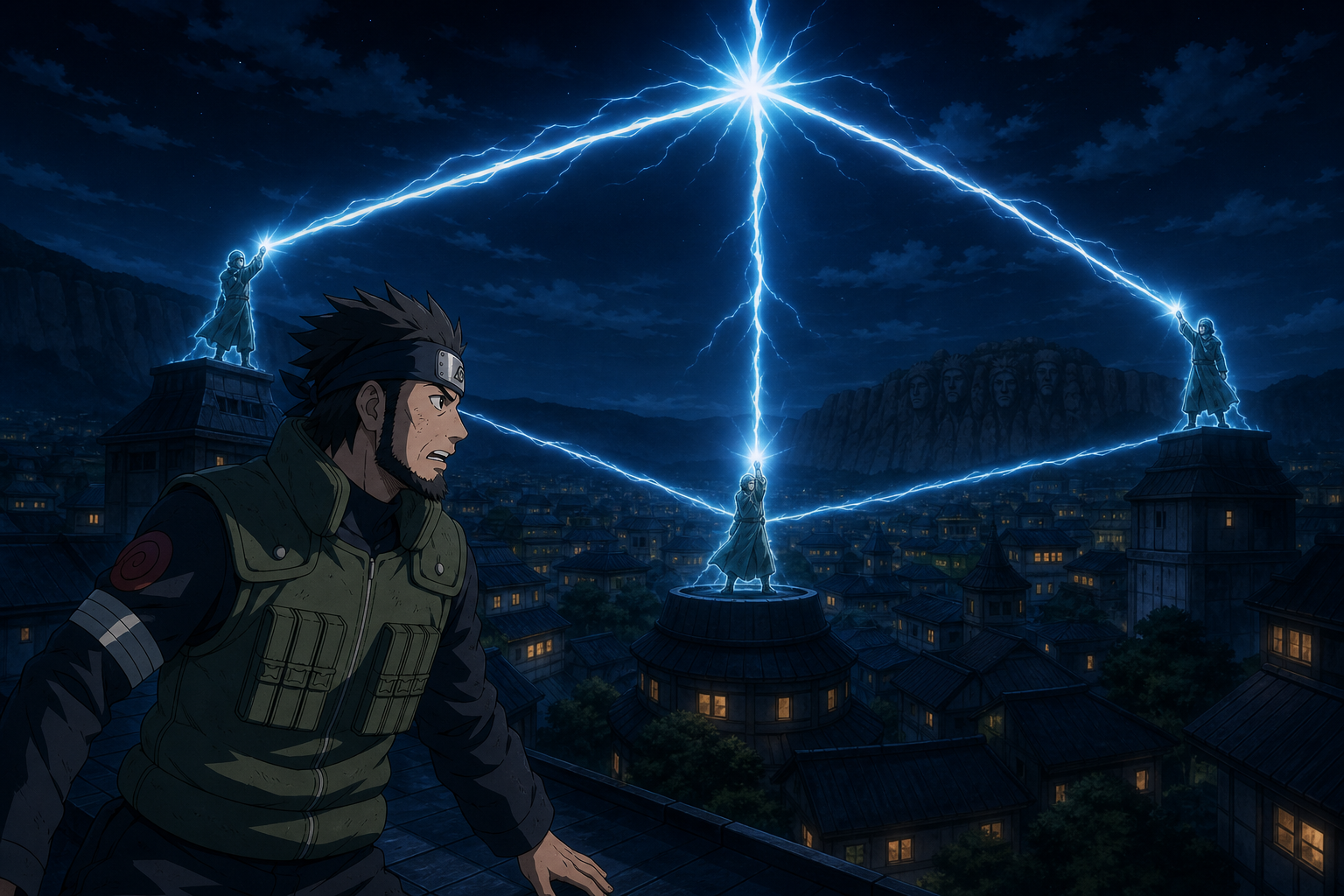
Episode 68 reveals the full purpose of the revived Guardian Shinobi deployment. Kitane's former comrades spread across Konoha and begin assembling Limelight, a lightning technique whose separate channels converge into village-scale destruction.
The design is frightening because no single position contains the whole attack. Stopping one fighter may not be enough once the network reaches completion.
Furido has built a weapon from coordination while counting on Konoha's defenders to remain fragmented.
The moment of awakening is recognition before action
Asuma's most important breakthrough is not a new technique. It is understanding what the enemy is preparing.
Until that moment, the revived guardians appear to be powerful attackers stationed near critical points. Once Asuma recognizes Limelight, every second and every position acquires a different meaning.
Awakening here is the instant when scattered evidence becomes a coherent threat. Knowledge does not solve the crisis, but it makes purposeful action possible.
A cooperative jutsu exposes Furido's contradiction
Furido presents himself as the champion of a purer political order, yet his decisive weapon depends on controlling several people who cannot consent. Limelight requires synchronization, but Revival Jutsu supplies that synchronization through coercion.
The technique resembles teamwork without containing trust. Each revived guardian becomes one component in a system directed by someone else.
That is Furido's model of unity: flawless coordination achieved by removing individual choice.
Konoha must reconstruct a shared battlefield
The barrier, blackout, and multiple attacks prevent any defender from seeing the whole village at once. Limelight exploits that information problem.
Asuma's recognition must travel quickly enough for other teams to identify the lightning points, protect civilians, and redirect their priorities. A fact held by one shinobi cannot stop a networked attack.
The village survives only if information moves faster than the technique assembling above it.
Kitane's absence still shapes the formation
The surviving revived guardians prepare a technique associated with their former unit, but Kitane's place in that history matters. The formation carries the memory of a team that once acted by choice.
Furido converts that memory into a weapon while stripping away the relationships that gave it meaning. The result is technically recognizable and morally inverted.
Asuma is not only fighting former allies. He is watching their shared methods rewritten as evidence for the cause that divided them.
Scale changes the meaning of defense
Against an ordinary opponent, victory can mean defeating the person in front of you. Against Limelight, local success is irrelevant if the other positions finish the circuit.
Asuma has to think beyond his immediate duel. The defenders need simultaneous disruption, rapid communication, and enough trust to act on incomplete reports.
The episode makes strategy an ethical requirement. Focusing only on the enemy nearest to you can abandon an entire village.
Sora's awakening is moral rather than tactical
Sora has learned that Furido intends to destroy Konoha, not simply avenge Kazuma. While Asuma recognizes Limelight, Sora recognizes the nature of the movement that claimed his grief.
Both awakenings depend on seeing a pattern that was deliberately hidden. Asuma connects separated attack points. Sora connects praise, secrecy, revenge, and civilian annihilation.
Each must act before understanding every remaining detail.
Naruto keeps the possibility of return open
Naruto's pursuit of Sora matters because a moral realization is not useful if Sora believes there is nowhere to go after it. Furido has encouraged him to treat doubt as betrayal and Konoha as a closed door.
Naruto offers a route back without requiring Sora to deny his anger. That does not guarantee forgiveness or safety, but it prevents Furido from becoming the only person allowed to interpret Sora's change of heart.
Connection gives awakening somewhere to lead.
Lightning makes invisible coordination visible
The converging arcs reveal relationships the defenders could not see in darkness. Separate rooftops and isolated fighters become one geometric threat over the village.
That image reflects the arc's larger structure. Danzo's secrecy, Furido's manipulation, Kazuma's history, the stolen graves, and Sora's chakra seemed like different problems. They are parts of one attack.
The lightning does not create the connection. It finally makes the connection impossible to ignore.
RaeRae's reaction
Limelight is a great escalation because it rewards the enemy for everything the blackout already accomplished. Konoha's defenders are scattered, so Furido builds a technique that can only be stopped by understanding several distant positions at once.
I also love the double meaning of awakening. Asuma realizes what the revived guardians are doing, while Sora realizes what Furido actually wants. Neither realization feels triumphant. Both arrive with the knowledge that precious time has already been lost.
Seeing clearly is only the beginning. Now they have to choose quickly enough for that clarity to matter.
The village's survival depends on voluntary coordination
Episode 68 sets two forms of collective action against each other. Furido commands resurrected bodies through jutsu and turns them into a perfect destructive circuit. Konoha's defenders must coordinate as living people with incomplete information, fear, and competing responsibilities.
The second system is messier. It is also the only one capable of ethical choice.
Limelight may be technically unified, but its unity belongs to the controller. Konoha's answer must come from people who understand the threat, share what they know, and decide together that the lives beneath the lightning are worth protecting.
Official episode reference: Naruto Official episode guide
Licensed episode route: Crunchyroll licensed episode page
Limelight is a system problem wearing the clothes of a fight
Asuma can defeat the opponent in front of him and still lose Konoha. That is the nasty intelligence behind Limelight. Furido has placed separate lightning users around the village so that their positions matter more than any individual duel. Once their chakra connects, the battlefield stops being a collection of fights and becomes one machine.
Konoha’s defenders therefore need a map, not merely stronger attacks. They must identify every node, learn which connections have formed, decide where interruption remains possible, and move that information through a city trapped under darkness. Muscle helps. Shared understanding decides whether the muscle reaches the correct place.
Asuma’s answer about the king finally meets a practical test
The old Guardian Shinobi argument treated the king as a political abstraction. Is it the feudal lord, the Hokage, the state, or the institution? Asuma’s mature answer points toward the next generation and the ordinary lives a shinobi protects. Limelight forces that belief out of conversation and into action.
If the king means people, then stopping the technique matters more than proving who won the historical debate. Civilians beneath the lightning cannot become collateral in an argument among elite guards. Asuma honors his answer by choosing their future over the pride of settling the past on Furido’s terms.
Kitane’s question deserves more than a slogan
When Kitane asks what the king was, the question carries the weight of comrades who broke apart over loyalty. Asuma cannot repair that history with one polished sentence. He can show what his answer requires now: risk himself for people who may never know his name and refuse to use dead friends as political evidence.
That distinction matters. Furido keeps invoking the past because dead causes cannot correct him. Asuma lets the past challenge his present behavior. One man wants history to obey. The other accepts responsibility for what he learned too late.
Fuka’s technique turns Naruto’s adaptability against him
While Limelight converts several fighters into one circuit, Fuka keeps changing elemental approaches and denying Naruto a stable read. He has spent the arc learning wind nature, yet the fight reminds him that possessing a stronger technique is not the same as understanding the opponent using the battlefield around him.
Naruto’s familiar answer is persistence, but persistence without observation can become predictable. He has to notice how Fuka shifts, what conditions surround each change, and where the performance hides a limitation. Awakening for Naruto means replacing frantic response with a question sharp enough to expose the trick.
The episode refuses to give one character all the important perception
Asuma recognizes Limelight. Naruto studies Fuka. Sora finally sees what Furido intends to do with him. Other teams hold routes and respond to dangers they only partly understand. The story distributes insight because the crisis is too wide for a single point of view.
That choice makes the title plural in spirit even if the word is singular. Several people wake up to different pieces of the same operation. Their knowledge becomes useful only when those pieces reconnect. Furido depends on isolation, so recognition itself becomes a form of resistance.
Sora’s physical awakening is the endpoint of deliberate grooming
The chakra beginning to erupt from Sora is not a random twist. Furido spent the arc cultivating emotional instability, separating Sora from support, feeding him selective history, and keeping the true plan hidden until escape felt impossible. The body crisis arrives after the psychological groundwork.
That makes it crueler than a villain simply activating a weapon. Sora was encouraged to think he was choosing a cause when Furido was preparing to use his body as infrastructure. Every compliment about special power now reads like inventory management. Furido did not see potential. He saw access.
A manipulated body does not make Sora morally disposable
Konoha may soon face enormous force coming through Sora, and fear will make it tempting to collapse person and threat into one target. The distinction has to survive. Sora can be dangerous without becoming the author of everything Furido triggers. Protecting civilians and trying to rescue him are not competing goals.
That does not require reckless softness. Shinobi may need barriers, restraint, evacuation, and force proportionate to the immediate danger. The ethical line is whether they keep looking for the person inside the crisis. Furido erased Sora’s choice. Konoha cannot answer by erasing his humanity.
Naruto is the right person to recognize what possession feels like
Naruto knows the terror of destructive chakra moving through his body while other people debate whether he is a child or a containment problem. That experience does not give him perfect control or magical words. It gives him a reason to refuse the easiest conclusion about Sora.
He can recognize rage without romanticizing it, danger without dehumanization, and isolation without pretending friendship solves every wound. Most importantly, Naruto understands that being used as a vessel can distort action without defining the person forever.
Furido’s perfect coordination is politically empty
Limelight looks like disciplined unity. The revived guardians occupy their positions, perform their roles, and produce one devastating result. Yet none of that cooperation contains consent, debate, correction, or mutual care. It is the efficiency of puppetry.
Furido wants the same structure for the nation: one rightful authority, one direction, and no inconvenient person able to refuse. The technique is not merely his weapon. It is his political philosophy made visible across the sky. Everything aligns because individuality has been removed.
Konoha’s messy cooperation is the better answer
The defenders disagree, lack information, and make mistakes. Messengers can be delayed. Teams may interpret orders differently. Civilians will panic. That disorder looks weak beside Limelight’s precision, but living cooperation can adjust when circumstances change.
A team member can report new evidence. A leader can revise the plan. A medic can redirect resources. A frightened civilian can still help a neighbor. Furido’s controlled network cannot question its controller. Konoha’s imperfect network can learn, and that capacity is why it remains worth defending.
The blackout makes rumors nearly as dangerous as lightning
People trapped in darkness will hear explosions, see flashes, and fill missing information with fear. Furido benefits if residents stampede, defenders chase false threats, or units mistake allies for enemies. Accurate communication is therefore part of civilian protection, not administrative decoration.
Messages should state what is known, what remains uncertain, and what action people can take immediately. False reassurance will collapse at the next blast. Panic grows when authorities pretend certainty they do not possess. Trust survives when instructions are specific and honest.
Stopping one node should not become permission to relax
A networked attack needs redundancy, and Furido has had time to plan. Defenders should assume secondary triggers, replacement routes, or another use for the same positions. The first interruption is a chance to reassess the whole system.
That means confirming every location, checking civilians near likely lines of force, and watching whether the remaining lightning changes direction. Celebration can wait. Limelight teaches the village to judge success by the entire threat, not the most visible clash.
After survival, Konoha owes Sora more than gratitude
If Sora helps stop Furido or survives the transformation, adults cannot praise his courage and quietly restore the conditions that left him vulnerable. He needs the full record of Kazuma, an honest account of the Guardian Shinobi conflict, medical care, and the right to ask questions without being treated as disloyal.
He also needs choices about where he lives and whom he trusts. Rescue that returns a person to the same secrecy is temporary containment. Accountability turns survival into the beginning of something better.
The episode’s real suspense is whether recognition arrives in time
Anime battles often ask whether a hero possesses enough power. This episode asks whether people can understand what they are seeing before a hidden system finishes assembling. Asuma’s knowledge matters because it arrives with a deadline. Sora’s moral horror matters because Furido has already begun using him.
That is why the title lands. Awakening is not a peaceful revelation. It is clarity that comes with an invoice for every minute lost. Once a person sees the pattern, the next choice cannot be postponed without helping it continue.
Leadership means translating insight into coordinated action
Asuma recognizing Limelight is valuable only if he can turn that recognition into instructions other people can use. He needs to name the technique, identify its required positions, explain the consequence of completion, and establish priorities without burying everyone under a history lesson. In a crisis, expertise serves the group when it becomes clear action.
That also requires listening. A defender at another node may see a change Asuma cannot. A messenger may know one route has collapsed. A medical team may need evacuation time before a strike interrupts the circuit. Leadership gathers those facts and revises. It does not confuse having the first answer with owning every answer.
Sora’s return must remain possible during his worst moment
People love redemption when it arrives clean, verbal, and easy to recognize. Sora’s crisis will not cooperate. His body may lash out while his mind is frightened and divided. Naruto and the others have to leave room for return before Sora can perform it neatly.
That means speaking to him while containing the danger, reminding him of choices he made before Furido’s pressure, and avoiding language that defines him by the chakra. Nobody should demand a perfect apology from a child in the middle of being weaponized. Stop the harm, keep him alive, and let responsibility be discussed when he can participate freely.
The village should remember who kept it alive
If Konoha survives, official memory will be tempted to center the strongest shinobi and the final blow. The fuller record should include messengers, barrier teams, medics, civilians who guided others through darkness, and anyone who interrupted one link in Furido’s design.
Remembering those people is political. It proves Asuma’s answer about the king was not decorative. A village is more than the office at its center, and its history should not shrink collective survival into one leader’s victory. Limelight threatens everyone through connection. The answer deserves to be remembered the same way.
The episode also warns against waiting for certainty that a crisis cannot provide. Asuma does not know every position, Naruto has not solved Fuka, and Sora cannot untangle every lie before Furido acts. They still have enough evidence to choose the next responsible move. That is different from guessing. Responsible action names what is known, limits avoidable harm, and stays open to correction when new facts arrive. Furido offers certainty because certainty makes obedience easier. Konoha survives through people willing to act without pretending they control the whole picture. That humility is not weakness. It is the discipline required when several lives, several battles, and one enormous lightning network are moving at once.
RaeRae’s full take
Limelight is one of this arc’s smartest threats because it punishes the heroes for thinking in individual fights. Beat the person in front of you, and the village can still burn from connections you never noticed.
Asuma’s answer about the king matters because he finally has to live it. The people below are not symbols in the Guardian Shinobi argument. They are the point.
Furido’s politics are sitting right there in the technique. His version of unity is flawless because nobody inside it gets a choice. That is not loyalty. It is control with impressive lighting.
Sora’s transformation makes me angry because Furido prepared it while pretending to offer belonging. He praised the very pain he planned to exploit.
Naruto cannot promise an easy rescue, but he can refuse to confuse Sora with the thing being done through him. For a boy who grew up under the same suspicious stare, that distinction is not sentimental. It is personal evidence.
The village survives if living people communicate, adapt, and protect one another faster than Furido’s dead circuit can complete. Messy choice beats perfect obedience. I will take that team every time.
RaeRae checkpoint: Limelight exposes Furido’s whole worldview. He calls forced synchronization unity, calls a manipulated child a chosen heir, and calls mass death justice. None of those words survive contact with the people beneath the lightning.
Receipts and official routes
- Japanese title, Limelight setup, Asuma and Kitane’s confrontation, Naruto’s fight with Fuka, and Sora’s transformation: Naruto Official Site episode guide.
- Licensed title, episode number, synopsis, and watch route: Crunchyroll.