
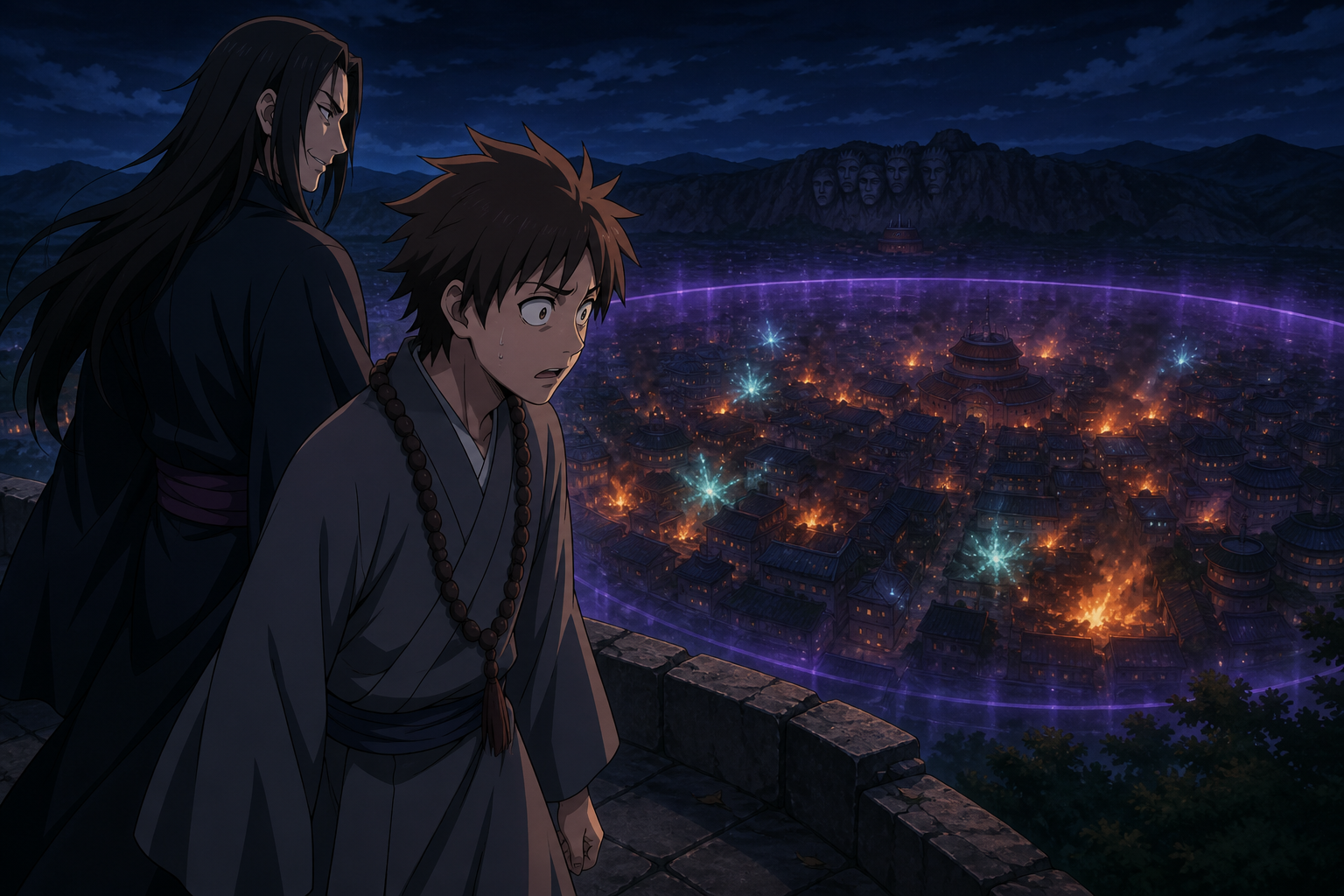
Everyone’s Struggle to the Death
Sora discovers that Furido recruited his grief for annihilation, forcing him to separate justified anger from an unjustifiable cause.
Sora discovers the revenge story was never the whole plan
Episode 67 gives Sora the information Furido could not reveal until escape felt impossible. The plan is not limited to killing the Hokage or punishing Asuma. Furido intends to annihilate the Hidden Leaf Village.
That scale breaks the moral frame Sora had been offered. Revenge could be presented as a personal debt. Destroying a village means killing people who had no role in Kazuma's death.
Sora is forced to see that Furido did not recruit his grief to honor it. He recruited grief because it could power someone else's war.
Moral shock interrupts Sora's certainty
Sora has spent several episodes moving toward a simpler explanation: Konoha lies, Asuma betrayed his father, and Furido alone respects his power. The annihilation plan makes that certainty harder to maintain.
His shock matters because it proves anger never erased his concern for innocent people. He may resent Konoha as an institution, but he has not chosen the deaths of everyone living inside it.
Furido's revelation creates the first clear distance between Sora's pain and the cause trying to claim it.
Furido treats civilian lives as political scenery
An ideology that promises purification often hides who must be removed for the purified future to exist. Furido speaks about rulers and rightful authority while reducing ordinary villagers to an obstacle.
The attack exposes that logic. Children, shopkeepers, medical workers, and shinobi families become acceptable losses because they live under the wrong political structure.
Sora can now judge the movement by what it does to people rather than by what it says about his father.
Everyone's struggle means the village cannot rely on heroes alone
The title widens the episode beyond one decisive duel. Konoha is sealed, its power is disabled, revived warriors attack critical infrastructure, and defenders are scattered across multiple emergencies.
Survival depends on many people doing limited work correctly. Barrier teams investigate the seal. Shinobi protect civilians. Medical personnel prepare for casualties. Messengers carry information through broken systems.
No single victory restores the village. Collective endurance is the answer to an assault designed around fragmentation.
Sora must choose without receiving perfect absolution
Rejecting Furido does not make Konoha's failures disappear. Asuma still withheld the truth about Kazuma. Village leaders still discussed Sora as a security problem. Danzo's faction still treated elimination as policy.
That complexity makes Sora's choice meaningful. He does not need to declare every Leaf decision righteous in order to refuse mass murder.
Moral agency begins when he separates justified anger from an unjustifiable demand.
Naruto's earlier protection becomes evidence
Naruto took a hit meant for Sora before anyone knew how Sora would respond. That action now competes directly with Furido's claim that Konoha only wants to control or destroy him.
One sacrifice cannot erase every institutional failure, but it proves Furido's totalizing story is false. At least one person chose Sora's life without asking for obedience first.
Naruto gave him evidence he can use when deciding whom to believe.
The revived guardians make coercion visible
Across the village, Asuma fights the stolen bodies of former Guardian Shinobi. Their forced return mirrors what Furido is attempting with Sora.
He takes a person's history, removes inconvenient choice, and turns identity into a weapon for his cause. The dead cannot resist the jutsu. Sora still can.
That parallel makes his realization larger than personal betrayal. Furido's political method depends on controlling the living and the dead alike.
Konoha's defenders fight for a flawed community
The Hidden Leaf is not innocent simply because it is under attack. The village contains secrecy, prejudice, competing authorities, and people willing to sacrifice an inconvenient child.
It also contains relationships, accountability, and the possibility of change. Defending Konoha does not require pretending its failures are imaginary.
The struggle is worth making because living people can confront those failures. Annihilation removes every possibility except Furido's imposed answer.
Struggle becomes proof of belonging
Sora's temporary place on Team Kakashi was never guaranteed to feel secure. During the assault, belonging is measured less by labels than by whom each person chooses to protect.
Naruto keeps pursuing Sora. Asuma defends the village while carrying the consequences of Kazuma's death. Sora faces the difference between vengeance and responsibility.
A teammate is not someone who never doubts the group. A teammate is someone whose choices begin accounting for lives beyond his own injury.
RaeRae's reaction
Sora's horror is the most important thing in this episode. Furido expected grief to make every escalation acceptable, but Sora still has a moral line.
I appreciate that rejecting annihilation does not require him to forgive Asuma immediately. He can remain furious about the truth being hidden and still understand that civilians are not payment for his father's death.
That distinction gives Sora back some agency. Furido offered him a script where anger had only one ending. Shock opens another choice.
The battle is now over who gets to define the future
Episode 67 reveals the actual stakes of the Guardian Shinobi conspiracy. Furido wants to erase Konoha and replace shared political life with a single purified vision. The defenders struggle to preserve a community capable of surviving disagreement.
Sora stands between those futures. His power can become the final tool in Kazuma's inherited war, or he can refuse the idea that being a son requires repeating his father's conflict.
Everyone is struggling to the death, but the deepest fight is against a story that treats other people's deaths as proof of loyalty.
Official episode reference: Naruto Official episode guide
Licensed episode route: Crunchyroll licensed episode page
Furido reveals annihilation only after Sora has crossed several boundaries
He waits until Sora has fled teammates, accepted private explanations, and entered the sealed crisis. Earlier disclosure might have exposed the plan as monstrous before dependence formed.
The timing proves that Furido never trusted Sora with a choice. He managed information until refusal became costly.
A cause that hides its real objective from recruits has already answered whether it respects them.
Sora’s horror proves grief did not erase his moral judgment
He wanted answers and felt betrayed. Neither fact means he consented to civilian deaths. His reaction shows a boundary Furido assumed anger would dissolve.
That boundary matters because manipulation often reframes hesitation as weakness or disloyalty.
Sora can remain furious at Konoha while refusing to make unrelated people payment for his pain.
Rejecting mass murder does not require declaring Konoha innocent
The village withheld history, debated Sora as a threat, and allowed competing authorities to operate in secrecy. Those failures remain real during the attack.
Furido depends on a false choice: endorse his destruction or excuse everything Konoha did.
Sora regains agency by rejecting both demands and insisting on a more complicated truth.
Civilians are not symbols of the Hokage system
Furido reduces everyone inside the barrier to political scenery. Children, workers, patients, families, and dissenting residents become one undifferentiated enemy because they live within Konoha.
Collective punishment erases individual responsibility while pretending to deliver justice.
Sora’s shock recognizes people where Furido sees only a target population.
The title distributes heroism across many simultaneous acts
No single fighter can restore power, break the barrier, stop revived guardians, protect every district, and reach Sora. Survival depends on people completing limited responsibilities under incomplete information.
Medical teams, messengers, seal specialists, civilians helping neighbors, and shinobi holding routes all matter.
Collective struggle defeats an attack designed to fragment attention.
Every defender needs a success condition larger than winning a duel
An attacker may retreat to pull a shinobi away from shelter routes or barrier nodes. Pursuit can feel victorious while weakening the village elsewhere.
Teams should measure choices against civilian safety, communication, and system recovery.
The enemy controls less when defenders refuse the scoreboard it offers.
Sora can choose one protective action before resolving every betrayal
He does not need complete emotional clarity to warn Naruto, resist Furido, reveal a route, or protect a civilian. Immediate moral action can coexist with unresolved grief.
That smaller decision avoids turning the moment into an impossible loyalty oath.
Agency returns through choices specific enough to make now.
Naruto’s protection becomes a pattern rather than one dramatic exception
He welcomed Sora, trained beside him, took an attack for him, and continues pursuing contact. Furido can dismiss one act as strategy. Repetition is harder to erase.
Naruto’s pattern does not absolve the village.
It gives Sora evidence that Furido’s claim about universal rejection is factually incomplete.
Naruto must not use sacrifice as emotional leverage
Taking the hit does not purchase Sora’s agreement. If Naruto demands trust because he suffered, protection becomes another transaction.
He can name danger, challenge Furido’s lies, and remain present without presenting an invoice.
Unconditional care leaves the protected person free to think.
The revived guardians expose Furido’s definition of loyalty
He forces dead bodies to continue a cause and expects Sora to inherit his father’s position automatically. In both cases, personal choice is an inconvenience to be removed.
The spectacle reveals the future Furido is building.
His promised rightful order begins with obedience that survives even death.
Asuma’s fight and Sora’s decision mirror one another
Asuma must oppose familiar bodies without denying who they were. Sora must oppose Furido without denying his father or his own anger.
Both separate memory from coerced continuation.
Respecting the past does not require permitting someone else to weaponize it.
Konoha is worth defending because living communities can change
The village contains prejudice and unaccountable power. It also contains relationships, public leadership, argument, repair, and people capable of challenging those failures.
Annihilation ends victims and perpetrators together while Furido claims the authority to decide.
Defense preserves the possibility of accountability that destruction removes.
The crisis should not disappear into a victory narrative afterward
If Konoha survives, leaders must investigate Danzo’s secrecy, the grave breach, Sora’s treatment, infrastructure failure, and civilian harm. Defeating Furido cannot become permission to avoid those questions.
Triumph stories often protect institutions from examining vulnerability.
Real recovery includes uncomfortable evidence about why the attack worked.
Sora deserves an exit from Furido that does not depend on instant forgiveness
He may fear that returning means accepting Asuma’s explanation or surrendering every grievance. Naruto should make the offer narrower: help stop the killing now, then keep asking questions afterward.
A safe return preserves future disagreement.
Furido’s control weakens when departure does not require Sora to erase himself.
The village’s struggle includes protecting the people Furido recruited
Manipulated participants can cause real harm and still remain targets of exploitation. Defenders need proportionate force, capture routes, medical support, and ways to interrupt control.
Calling everyone an enemy may simplify combat but repeat Furido’s dehumanization.
Protection is hardest and most meaningful when categories overlap.
Furido mistakes pain for permanent ownership
He believes that because he named Sora’s wounds, he owns their direction. Recognition becomes entitlement to decide what anger must do.
Sora’s horror breaks that claim. Pain can influence a choice without eliminating the chooser.
No adult earns a young person’s future by explaining his past first.
The barrier changes what responsibility looks like inside the village
Once Furido seals Konoha, ordinary movement becomes a strategic problem. A parent cannot simply run toward a child across town. A medic cannot assume a clear road to the next patient. A shinobi cannot chase the loudest enemy without asking which route that pursuit leaves exposed. The episode makes responsibility painfully local: protect the person in front of you, keep the passage open, pass accurate information, and trust someone else to handle the danger beyond your sight.
That structure rejects the fantasy that one spectacular fighter is enough. Naruto matters, but so do people who never receive a finishing move or a dramatic speech. Furido built his attack around isolation. Every act of coordination answers him.
Information control is Furido’s first weapon, not a side detail
He does not merely lie about one event. He curates Sora’s entire field of interpretation. He decides when to mention Kazuma, which part of Asuma’s history to emphasize, what Konoha’s suspicion supposedly proves, and when the annihilation plan becomes visible. Each revelation is timed to make the next step feel inevitable.
This is why telling Sora the truth later will not be enough. A factual correction cannot instantly repair a mind trained to expect every explanation to hide a trap. Naruto and Asuma have to tolerate questions, anger, and delayed trust. Otherwise, their demand for a quick decision starts resembling Furido’s pressure with kinder language.
Asuma has to answer for silence even while fighting the man who exploited it
Furido’s manipulation does not erase the opening created by adult secrecy. Asuma knew more about Kazuma, the Twelve Guardian Ninja, and the political split than Sora did. Maybe he had reasons to wait. Those reasons still had consequences. Sora learned the most emotionally explosive version from someone who wanted to weaponize him.
The honest response is not self-defense. Asuma can oppose Furido, protect the village, and still admit that withholding history left Sora vulnerable. Accountability does not weaken his side. It gives Sora a reason to believe that choosing against Furido will not mean returning to the same wall of silence.
The episode separates anger from permission
Sora is allowed to be angry. He can resent Konoha, question the Hokage system, distrust Asuma, and grieve a father other people remember as an enemy. None of those feelings authorize Furido to use his body or spend civilian lives. The distinction sounds obvious until an extremist presents violence as the only proof that pain is real.
That is the trap. If Sora refuses, Furido can accuse him of betraying Kazuma. If he obeys, Furido gets to define what Kazuma’s memory demands forever. Sora’s path out begins when he treats anger as information about injury, not a command that somebody else gets to translate into mass murder.
Konoha’s defenders cannot copy the enemy’s logic under pressure
A village under attack will want simple categories: loyal or traitorous, safe or dangerous, ours or theirs. Sora complicates every one. He is frightened, powerful, manipulated, furious, and still capable of recognizing wrong. If the defenders see only a weapon, they confirm Furido’s story that Konoha never saw a person.
Restraint is not softness when one mistake could trigger more damage. It means identifying the actual threat, creating room for surrender, and remembering that rescuing Sora is part of stopping the attack. A victory that destroys the child Furido exploited would preserve the village while conceding his ugliest premise.
The revived dead make political nostalgia look as rotten as it is
Furido presents the old cause as pure, disciplined, and unfinished. Then he drags dead comrades back without consent and makes their bodies continue an argument they can no longer revise. That image strips nostalgia of dignity. The past is not being honored. It is being prevented from ending.
Living people are allowed to reconsider. They learn what their ideals cost, recognize who was harmed, and choose another route. Furido’s version of loyalty cannot survive that freedom, so he prefers bodies that cannot object. Sora should notice exactly what kind of inheritance is being offered to him.
A better rescue gives Sora choices specific enough to believe
“Trust us” is too large. “Forgive Asuma” is premature. “Love Konoha” ignores what happened. Naruto can offer smaller choices with visible consequences: help move these civilians, tell us where the barrier node is, step away from Furido, or let someone treat your injuries. Each choice lets Sora test whether cooperation leads to control or respect.
Small promises matter too. Naruto can say what he knows, admit what he does not, and return when he says he will. Trust grows through boring reliability. Anime loves a speech, but a traumatized person may need consistent follow-through more than one perfect sentence.
Survival will not settle the political argument, and it should not
Stopping annihilation answers whether Furido may kill Konoha. It does not answer whether the village governed well, whether Kazuma’s grievances contained truth, or whether leaders treated Sora justly. Those questions belong after the emergency, when fear cannot be used to force a convenient consensus.
The strongest ending would preserve disagreement. Sora can help save people and still demand records, explanations, and accountability. Asuma can defend the Hokage and still admit failures. Naruto can love his village without pretending love requires blindness. A community worth protecting must survive criticism as well as attack.
That is the standard here: protect people first, preserve their choices, tell the whole truth, and leave enough room for accountability after survival.
RaeRae’s full take
Sora’s recoil is the moral center. Furido thought he had converted grief into a blank cheque, then discovered Sora still sees civilians as people.
I refuse the false choice that rejecting annihilation means forgiving Konoha. The village failed Sora in several ways. Those failures do not turn children and hospital workers into responsible parties.
Naruto’s repeated presence matters. He is building evidence through actions, not demanding that one sacrifice erase years of distrust.
The revived guardians expose Furido completely. He talks about honoring a cause while stripping its supposed heroes of consent. Sora is next if he accepts the same definition of loyalty.
Let Sora choose one thing now: stop innocent deaths. The rest can remain unresolved long enough for honest answers.
Everyone struggles because no hero can solve this alone. A village survives through people protecting routes, bodies, information, and one another while the grand political speeches burn themselves empty.
RaeRae checkpoint: Sora does not owe Konoha forgiveness to refuse Furido. He only has to recognize that justified anger never grants another person the right to spend innocent lives.
Receipts and official routes
- Episode number, Japanese title, Sora learning the annihilation plan, village-wide fighting, and official placement: Naruto Official Site episode guide.
- Licensed title and episode route: Crunchyroll.