
Revived Souls
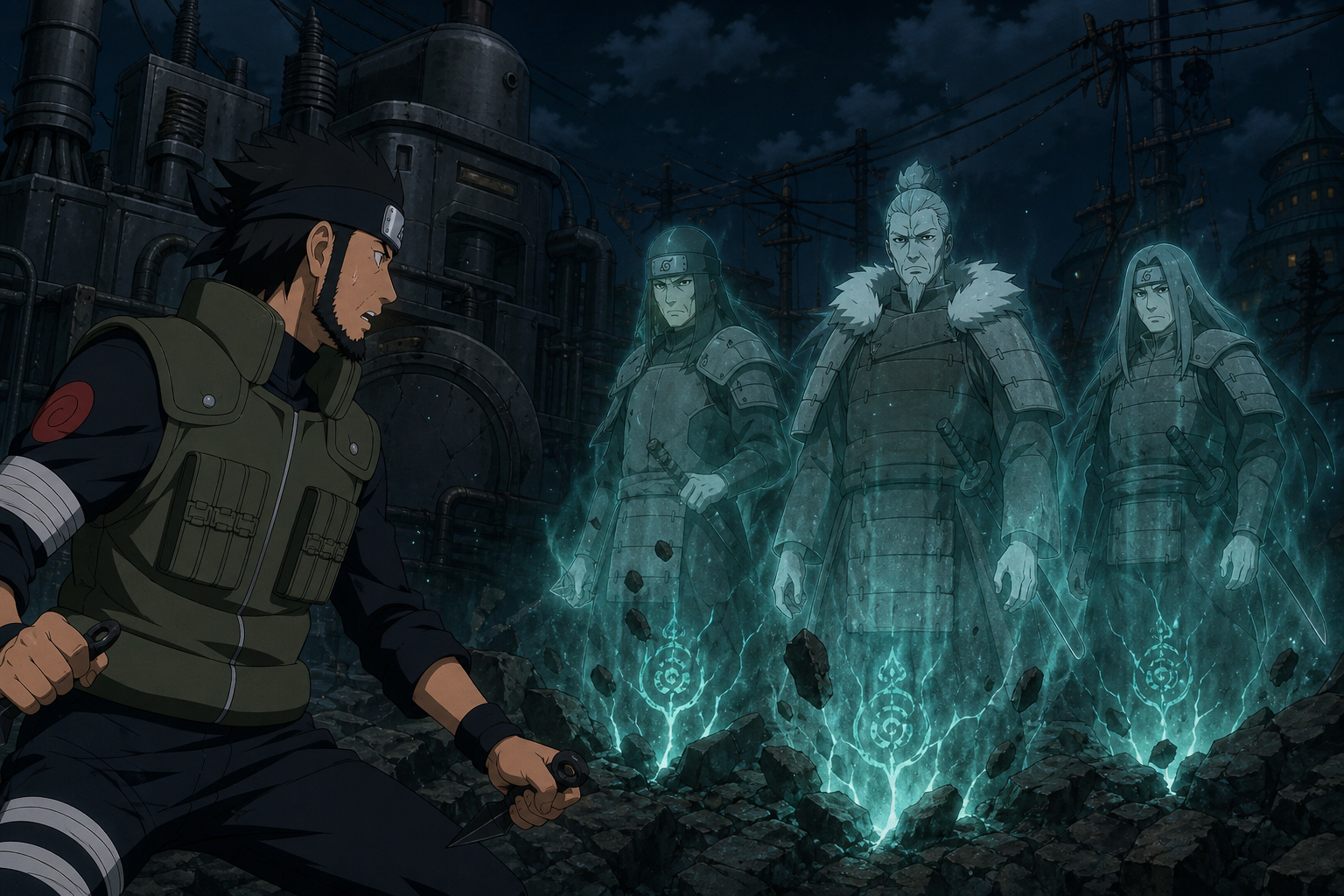
The stolen Guardian Shinobi return as unwilling weapons, forcing Asuma to defend Konoha from the bodies of his own political past.
The stolen graves reveal their intended weapon
Episode 66 delivers the answer hidden inside the earlier grave robberies. The bodies of the Guardian Shinobi Twelve were not stolen for ransom, desecration, or symbolism alone. Furido's group needed them as weapons.
Revival Jutsu turns honored dead into active participants in an assault they did not choose. The crime therefore reaches beyond theft. It takes the meaning of a person's life and forces the body to serve an opposing purpose.
Asuma confronts not strangers, but the corrupted return of people connected to his own past.
Asuma reaches the generator expecting infrastructure
Asuma rushes toward Konoha's electrical generator because restoring power appears to be an immediate strategic need. Instead, the site becomes an ambush built from history.
The location links two forms of power. The generator supplies the village's ordinary systems. The revived guardians represent political power from an unresolved conflict over who should rule the Land of Fire.
Furido attacks both at once. He disables the present and resurrects the past to keep Konoha from coordinating its defense.
Revival Jutsu removes consent from sacrifice
The Guardian Shinobi originally chose whom and what they would protect. Bringing them back under enemy control strips that sacrifice of its moral center.
A body moving with familiar skill is not the same as a person freely continuing a mission. The jutsu exploits reputation, memory, and technique while denying the dead any authority over their return.
That makes the confrontation painful even before the first strike. Asuma must defend the village from people whose former service helped define his own.
The past is being edited into propaganda
Furido has already given Sora a simplified history: Kazuma represented a rightful cause, Asuma betrayed him, and the Hokage system stole power from the Fire Daimyo.
The revived guardians make that story look physically present. Their bodies can be displayed as though the old faction itself has returned to finish unfinished work.
But resurrection is not endorsement. Furido is using the dead as visual evidence for a political claim they cannot confirm, question, or refuse.
Asuma must fight memory without surrendering to it
Asuma's knowledge of the Guardian Shinobi gives him insight into their techniques, but it also creates hesitation. Every familiar stance carries a relationship or a reminder of the conflict that divided them.
The enemy benefits from that emotional delay. Revival Jutsu makes recognition part of the trap.
Asuma's task is not to stop caring about who they were. It is to honor that memory by refusing to let their stolen bodies destroy the people they once served.
Konoha's blackout isolates the people most able to respond
The barrier and power outage divide the village into local emergencies. Asuma cannot immediately rely on the full command structure. Other shinobi are protecting civilians, investigating the seal, and pursuing separate attackers.
That isolation gives the revived guardians room to operate near critical infrastructure. It also tests whether Konoha's defenders understand shared priorities without waiting for perfect instructions.
Restoring the generator matters, but preventing the dead from becoming tools of mass harm matters more.
Sora's family history is embedded in the battle
Kazuma's rebellion, Asuma's decision, and the Guardian Shinobi split are not background lore to Sora. They define the story he is being asked to inherit.
Furido wants him to see inheritance as obedience. If his father chose a side, then Sora must finish that cause. The revived dead reinforce the idea that history itself demands continuation.
The episode offers another possibility: inheritance can mean understanding a past honestly enough not to repeat its coercion.
A resurrected fighter is both threat and victim
Asuma cannot respond as though the guardians are only innocent bodies, because their techniques can kill people in the present. He also cannot reduce them to ordinary attackers, because their participation is forced.
That double truth complicates every defensive choice. Stopping them may require violence, but the moral responsibility belongs to the person controlling the jutsu.
The distinction prevents tactical necessity from becoming hatred toward the victims being used.
The generator site becomes a contest over continuity
Electric power represents Konoha's ability to keep daily life functioning through crisis. Revival Jutsu represents an enemy's attempt to force old conflict back into the present unchanged.
Asuma stands between those versions of continuity. One keeps a living community operating. The other preserves grievance by denying both the dead and the young permission to choose differently.
Furido calls his plan restoration. The episode shows how much destruction that restoration requires.
RaeRae's reaction
The reveal makes the grave-robbing plot feel much crueler. Furido did not only steal bodies. He stole the authority those people once had over what their service meant.
I feel for Asuma because the fight demands exactly the wrong emotional posture. He has to recognize the guardians fully and still move against them. Pretending they are strangers would be easier, but it would also let Furido define them entirely by what the jutsu makes them do now.
Asuma's resistance can be an act of respect if it protects the future they no longer have the freedom to choose.
The dead return because the living left the conflict unresolved
Episode 66 turns political history into an immediate battlefield. The Guardian Shinobi division, Kazuma's ideology, Danzo's hidden authority, and Tsunade's public leadership all converge during Konoha's blackout.
Revival Jutsu supplies the literal resurrection, but secrecy made the village vulnerable to it. Sora learned the past through manipulation because honest explanations arrived too late.
Defeating the revived guardians will stop bodies. Defeating Furido's story requires the living to tell the truth, accept responsibility, and give Sora a future that is not chained to his father's unfinished war.
Official episode reference: Naruto Official episode guide
Licensed episode route: Crunchyroll licensed episode page
The resurrection answers the grave mystery by making it worse
The missing bodies were never trophies. Furido’s group stole trained shinobi because their techniques, reputations, and political history could be redeployed. The reveal converts desecration into forced service.
Death should have ended every command placed on these people. Revival Jutsu extends institutional use beyond consent’s final boundary.
The horror is not merely that bodies move. It is that somebody claims authority over what their movement means.
Asuma faces comrades as evidence manipulated into weapons
The revived guardians carry familiar faces and abilities, but Furido controls the context. Their appearance is meant to suggest that the old cause has returned with its original supporters.
Asuma knows a moving body cannot verify that political claim. Recognition still hurts because memory responds before analysis.
He must separate who they were from what the jutsu forces them to do now.
Stopping a victimized attacker remains necessary
The guardians lack meaningful consent, yet their techniques can kill civilians and defenders. Compassion cannot require Konoha to absorb unlimited harm.
Asuma’s ethical task is to use the force necessary to stop present danger while directing blame toward the controller.
That distinction allows protection without rewriting coerced victims as willing monsters.
The generator site links ordinary survival with political memory
Electricity supports hospitals, homes, communication, and movement. The revived guardians embody an old argument about national authority. Furido places both forms of power in one battlefield.
Disabling infrastructure makes the living vulnerable while resurrection makes the dead useful.
His promised restoration depends on breaking the systems people currently need to survive.
Asuma cannot let guilt decide the tempo of the fight
Past conflict may make him hesitate, overcompensate, or accept injury as punishment. None of those responses honors the revived guardians or protects Konoha.
He needs enough emotional honesty to recognize guilt without handing it command.
Responsibility means acting effectively now and examining the past when immediate lives are secure.
The jutsu weaponizes knowledge of a defender’s relationships
Furido understands that familiar opponents slow Asuma differently than anonymous attackers. Recognition creates openings, and old techniques invite memories that consume attention.
This is emotional targeting built into tactical design.
Defenders need partners or signals that can interrupt paralysis when the battlefield deliberately activates grief.
Revival does not restore political consent
Even if a guardian once supported Kazuma’s faction, forced resurrection cannot prove that person would endorse Furido’s present methods. Time, consequences, and new information might have changed any survivor’s judgment.
Furido freezes identity at the point most useful to him.
History becomes propaganda when dead people are denied the possibility of complexity.
Sora is being asked to inherit a cause staged with stolen bodies
The revived guardians make Furido’s story look inevitable. His father’s allies appear to rise, and Sora is encouraged to see himself as the missing continuation.
Yet the spectacle itself reveals coercion. If the cause were secure, it would not need corpses stripped of choice to demonstrate support.
Sora can honor his father without submitting to an enemy’s reconstruction of him.
Naruto should recognize the parallel with jinchuriki exploitation
A jinchuriki’s body is often valued for contained power rather than personhood. Revival Jutsu makes the same reduction visible in another form: a human body becomes delivery equipment for a technique.
Naruto knows the damage caused when institutions call use protection or duty.
That recognition should deepen his defense of Sora and the revived dead without erasing the danger either can pose.
Konoha needs sealing knowledge as much as combat strength
Destroying a body may not end the technique if the controlling mechanism remains active. Specialists should identify anchors, commands, and conditions that sustain revival.
Sealing work can interrupt coercion at its source rather than forcing defenders through repeated battles.
A village prepared only to hit threats will struggle against systems that reuse them.
The dead deserve restoration of identity after the battle
If Konoha stops the revived guardians, officials should document that their participation was forced. Families and communities should not be left with public memories of loved ones attacking the village without explanation.
Ritual reburial, accurate records, and acknowledgment of desecration matter.
Repair includes protecting reputation from the controller’s final theft.
Infrastructure workers are part of the defense
Technicians who understand the generator may identify damage, safe restart procedures, and whether the site has been rigged further. Shinobi should protect their expertise instead of assuming combat victory automatically restores power.
The village depends on labor that does not wear a headband.
Recognizing that work broadens the meaning of who protects Konoha.
The episode refuses a clean boundary between past and present
Old political violence returns through bodies while current secrecy shapes how effectively Konoha responds. The past is not invading from elsewhere. It survived inside institutions, family silence, and unexamined authority.
Revival Jutsu supplies movement to grievances the living preserved.
Ending the technique will not end the history that made it useful.
Asuma’s resistance can honor the people he fights
Refusing to let stolen bodies destroy the village does not betray former comrades. It rejects Furido’s claim that their only remaining meaning is obedience to his cause.
Asuma can remember their choices while stopping the actions imposed upon them.
Sometimes respect requires preventing a person’s image from being used to harm what they once protected.
The word souls risks hiding the importance of bodies
The title sounds spiritual, but the crime is material. Graves were opened. Remains were transported. Bodies became tools. Calling them souls should not make the violation abstract.
Bodily autonomy remains central even after death because communities, memory, and consent attach to remains.
The jutsu’s spectacle begins with a physical theft.
Furido’s politics reveal themselves through method
He speaks about rightful authority and restoration while controlling corpses, trapping civilians, and manipulating Sora’s grief. Those methods show what his promised order would value.
A movement cannot build freedom through practices that erase every inconvenient choice.
The revived guardians are not proof of legitimacy. They are proof that Furido treats people as means.
The jutsu forces Asuma to defend both Konoha and the guardians’ memory
If the revived fighters reach civilians, their final public image may become destruction committed under somebody else’s control. Stopping them protects living people and prevents Furido from rewriting coerced violence as their chosen legacy.
Asuma therefore carries two responsibilities in the same strike. He must interrupt danger without forgetting who the bodies belonged to.
That double awareness makes the fight harder and morally clearer.
Recognition can guide tactics without becoming emotional paralysis
Asuma may remember favored weapons, stance habits, elemental affinities, and team formations. Those memories can predict attacks and identify weaknesses in the revival’s imitation.
Using that knowledge does not exploit former comrades in the same way Furido does. The purpose is to end their coercion and protect others.
Memory becomes resistance when it helps restore boundaries the controller violated.
The revived guardians may expose limits in the technique
Forced bodies may repeat patterns, rely on commands, or lack the adaptation living fighters once possessed. Asuma should look for moments where familiar skill becomes mechanical.
Those gaps can reveal whether control comes from seals, proximity, spoken orders, or a sustaining caster.
Understanding the limitation may allow Konoha to stop the jutsu with less damage to the remains.
Families deserve involvement after immediate danger passes
Officials should not rebury the guardians quietly to avoid embarrassment. Relatives, temple caretakers, and communities connected to them deserve truthful notice, choices about memorial rites, and support around public misinformation.
Privacy still matters. Accountability does not require turning grief into spectacle.
Repair should center the people whose relationship to the dead existed before Furido claimed it.
Asuma’s account can help Sora distinguish Kazuma from Furido
Sora needs more than the fact that his father joined a faction. He needs specific history about what Kazuma believed, what actions followed, where Asuma disagreed, and how Furido’s current methods compare.
That detail prevents inheritance from collapsing into obedience.
Sora can decide what parts of his father’s concerns deserve thought without accepting corpse theft and civilian confinement as their inevitable continuation.
Konoha should investigate how the graves became accessible
Revival required locations, identities, transport, and time. Someone knew which tombs held useful bodies and how their protection worked. Defeating the revived guardians will not close that information breach.
The temple and village should review records, access, patrol patterns, and possible surveillance without blaming caretakers automatically.
Security improves through evidence, not convenient suspicion toward the least powerful person nearby.
The generator cannot simply be restarted because the battlefield goes quiet
Furido’s group may have damaged components, planted seals, or prepared a second failure. Technicians must inspect the system while shinobi secure the area and document interference.
Rushing power restoration could compound harm to hospitals and neighborhoods already operating under strain.
Infrastructure recovery deserves the same precision the fight demanded.
Victory needs a definition larger than defeating three bodies
Konoha must stop the revived guardians, restore power, break the barrier, protect civilians, recover Sora, identify Furido’s network, and preserve evidence. A dramatic combat win addresses only one branch.
Broad objectives help leaders resist the enemy’s attempt to focus every defender on the spectacle.
The village survives when systems and relationships recover alongside territory.
The surviving witnesses need space to describe coercion accurately
Asuma and other defenders can record how the revived guardians moved, whether they spoke, and what signs indicated external control. Those details matter for sealing research and for protecting the dead from false blame.
Witness accounts should distinguish observation from interpretation. Grief can shape memory, especially when familiar faces appear in violent circumstances.
Careful documentation gives later investigators usable evidence without demanding that witnesses suppress emotion.
Ending the jutsu should restore rest rather than merely remove usefulness
Once control breaks, Konoha must treat the remains as people’s bodies, not captured enemy equipment. Secure handling, identification, consultation with the temple, and proper rites should follow.
The urge to study the technique cannot automatically override dignity. Research may be necessary to prevent recurrence, but it should use the least intrusive evidence available and clear oversight.
Furido’s crime began by deciding usefulness outranked consent. Konoha cannot answer him by repeating that decision under a different banner.
The village also owes the temple a full account of how its buried guardians were located, removed, controlled, and recovered. That record should identify confirmed failures without turning uncertainty into accusation. Shared review can improve patrols, records, seals, and communication while respecting the temple’s authority over its sacred ground. Repair becomes credible when institutions learn publicly enough to prevent repetition and privately enough to protect families from needless exposure during their grief afterward as well.
RaeRae’s full take
This reveal is nasty because it steals more than bodies. Furido steals the right those guardians had to define their own service, then displays their techniques like endorsements.
Asuma has to recognize them and fight anyway. That is not disrespect. Letting Furido use their faces to kill the living would hand him the final word on who they were.
I need Konoha to aim beyond the bodies. Find the seal, controller, and sustaining mechanism. Do not force victims through endless destruction because hitting is easier than understanding.
Sora should look hard at the contradiction. Furido claims to honor Kazuma’s cause while removing consent from everyone used to perform it. That is not liberation with rough edges. That is the governing philosophy.
The generator matters too. Ordinary people need hospitals, lights, and communication while elite history stages itself nearby. Protect the workers who know how to restore those systems.
Afterward, give the dead their names back. Record the coercion, repair the graves, and refuse to let their last public image belong to the person who stole them.
RaeRae checkpoint: A revived body is not a renewed vote. Furido can force technique and movement, but he cannot manufacture consent from the dead no matter how dramatic the spectacle looks.
Receipts and official routes
- Episode number, Japanese title, generator battle, revived Guardian Shinobi, Revival Jutsu reveal, and official placement: Naruto Official Site episode guide.
- Licensed title and episode route: Crunchyroll.