
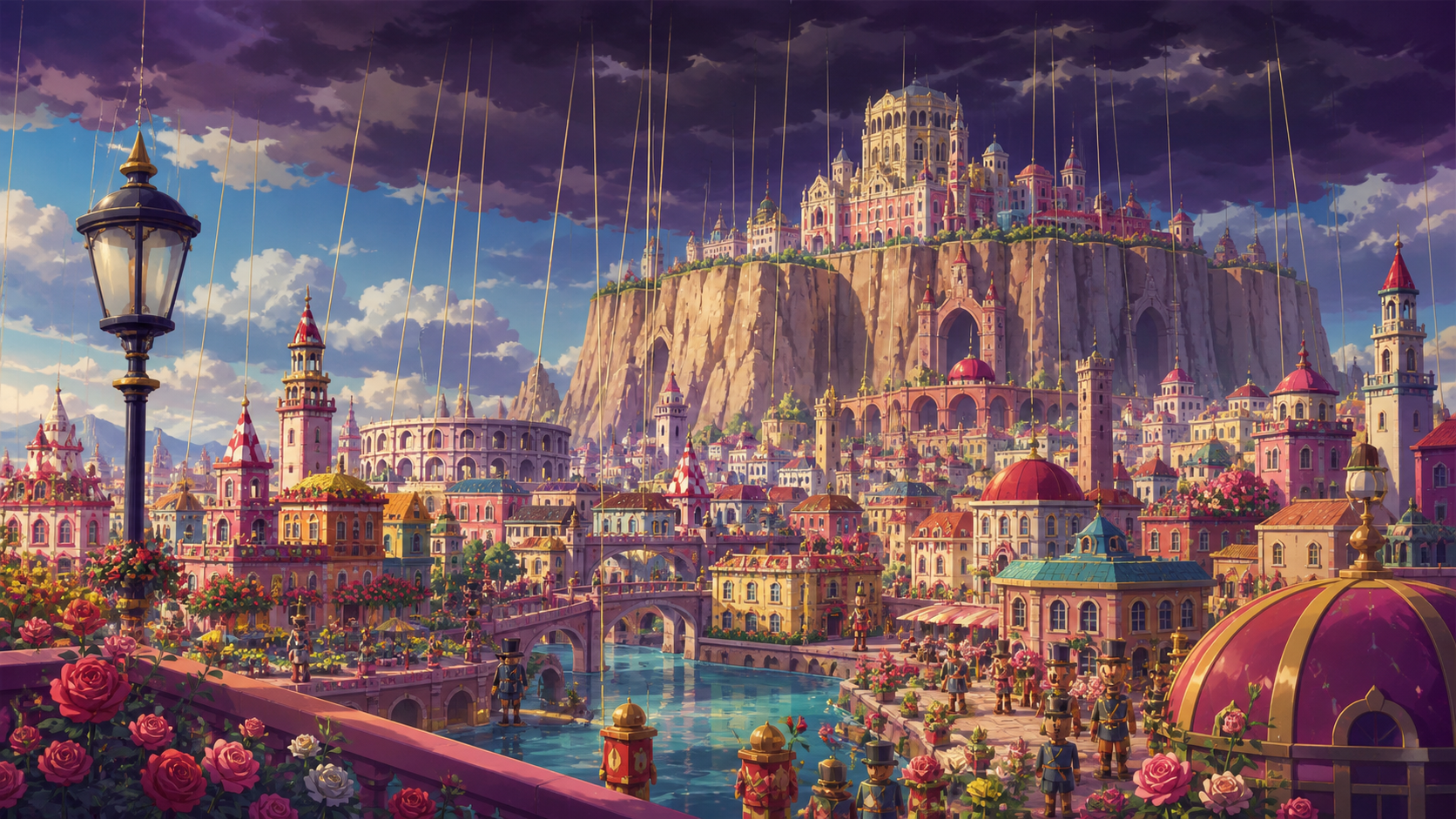
One Piece Dressrosa Saga Guide
What this saga covers
The Dressrosa Saga includes Punk Hazard and Dressrosa. The Straw Hats ally with Trafalgar Law, uncover the SMILE supply chain, and confront Doflamingo’s control of a kingdom built on stolen memory.
Punk Hazard and experimental bodies
Caesar treats children, prisoners, and workers as materials. Scientific authority becomes cover for coercion when subjects cannot refuse and institutions reward results while outsourcing the harm.
Alliance and incomplete trust
Law’s proposal gives Luffy a strategic route toward Kaido, but both captains bring private motives. Cooperation works through negotiated action rather than perfect transparency.
Toys and erased relationships
Sugar’s power converts people into laboring toys while removing them from collective memory. Dressrosa’s cheerful surface depends on families being unable to name who is missing.
Doflamingo’s rule
Doflamingo controls information, markets, military force, and the language of legitimacy. The Birdcage makes his political system physical: everyone is enclosed while he defines the available choices.
Rebecca and spectacle
The colosseum turns violence into entertainment and directs public hatred toward a young woman carrying her family’s stigma. The anime’s framing too often sexualizes Rebecca while asking viewers to condemn her exploitation.
The Grand Fleet
The captains who pledge themselves to Luffy do so despite his refusal to administer them. The arrangement expands his influence while raising the question of responsibility for actions taken in his name.
Dressrosa manufactures happiness as public policy
Doflamingo’s kingdom looks festive because suffering has been removed from visible memory. Sugar turns people into toys, contracts force obedience, and families forget the transformed person ever existed. The system does not only imprison bodies. The system edits grief out of the public record.
That mechanism explains why the kingdom can appear stable. Citizens cannot organize around missing people they no longer remember. Toys perform labor while smiling under rules nobody else can see. Happiness becomes evidence demanded by the regime.
The toy contract makes labor disappear
Toys build, serve, entertain, and maintain the city without wages, rights, family recognition, or control over their bodies. The arrangement literalizes an economy where consumers enjoy products while workers become invisible.
Usopp’s accidental victory over Sugar is ridiculous, but the consequences are politically enormous. Memory returns all at once. Families must process years of stolen relationships in the middle of an uprising. Liberation creates truth before anybody has the safety to absorb truth.
Law’s revenge is also a survivor’s trap
Corazon gives Law love, medicine, and a future beyond Doflamingo. Law still organizes much of adulthood around making Doflamingo pay. Revenge gives grief a target, but the target can consume every reason Corazon wanted him to live.
Luffy’s refusal to treat Law as a disposable strategist changes the alliance. Law cannot quietly trade his life for the plan while calling the exchange rational. Their conflict is messy because friendship disrupts the clean arithmetic of martyrdom.
Rebecca is denied the violence she is trained to survive
Rebecca fights in an arena where the crowd despises her for a history Doflamingo wrote. She survives without cutting opponents, an extraordinary discipline the anime too often frames through sexualized armor and repeated distress.
Kyros wants to keep her hands clean, but protection can become another decision made over her body. The story has to hold the tenderness and the limit together. Rebecca deserves safety, agency, anger, and clothing designed for combat rather than spectators.
The Birdcage turns borders into a weapon
The cage shrinks while people push from every side. Doflamingo converts the kingdom’s boundary into an execution device and forces citizens to experience geography as pressure. Fighters, Marines, pirates, and civilians must coordinate because no single victory arrives fast enough.
Fujitora’s presence complicates the Marines. He protects civilians and later bows publicly, but he also uses the kingdom’s suffering to force institutional change. The gamble asks whether a leader can expose corruption without treating endangered people as pieces in the exposure.
The Grand Fleet is born from shared action, not ownership
Luffy does not want formal subordinates. The captains declare affiliation anyway, turning gratitude and shared battle into a network he cannot fully control. The arrangement suits his politics better than an empire would. Relationships create obligations without pretending every crew surrendered autonomy.
My Dressrosa verdict admires the systems underneath the crowded pacing. Memory, labor, borders, celebrity, and family history all become instruments of rule. The saga needs more room for consequences and less repetition, especially in the anime, but the central image remains brutal: a smiling country built on workers nobody is allowed to remember.
Dressrosa is governed through edited memory
Doflamingo’s rule depends on more than force. Sugar’s power removes people from social memory, converts bodies into laboring toys, and binds those workers to commands. Families experience absence without knowing whom they lost. The kingdom’s visible happiness rests on a population unable to name the missing.
The system makes propaganda intimate. King Riku appears responsible for a massacre Doflamingo engineered, while citizens cannot access the memories needed to challenge the replacement narrative. Liberation therefore requires more than defeating the ruler. People must recover relationships, grief, and a history whose evidence was stored inside their own altered minds.
The toy economy hides labor under spectacle
Dressrosa markets color, romance, arenas, and living toys while hiding who performs the work. The toys maintain streets, households, and entertainment without recognition as people. The arrangement resembles slavery precisely because the public is trained to treat workers as objects whose feelings do not count.
Usopp’s role becomes politically important through an accident wrapped in courage. Freeing the toys does not make his earlier fear disappear. His later decision to act at a distance protects Luffy and Law when nobody else can reach Sugar. The saga gives his sniper work public consequence without pretending bravery means a permanent absence of panic.
Law’s history connects private trauma to state power
Flevance is destroyed after Amber Lead poisoning becomes a pretext for isolation and extermination. Corazon gives Law care, information, and a route away from Doflamingo, but cannot remove the trauma by loving him correctly. Law’s alliance with Luffy carries revenge, strategy, and a death wish he rarely names directly.
Doflamingo understands family as hierarchy enforced through fear and reward. Corazon offers another model through protection that costs him everything. The contrast explains why defeating Doflamingo matters to Law while also showing why revenge alone cannot decide what Law wants after survival becomes possible.
The colosseum expands the liberation coalition
The tournament introduces fighters with separate ambitions, countries, debts, and grudges. Their later loyalty to Luffy should not flatten them into followers who discovered the correct hero. The Grand Fleet grows from mutual action during crisis, and Luffy’s refusal to command the arrangement preserves some independence inside the bond.
Rebecca’s treatment remains one of the saga’s clearest weaknesses. Her history, endurance, and relationship with Kyros carry emotional weight, while the camera repeatedly turns vulnerability into fan service. Dressrosa can condemn a spectacle economy and still reproduce spectacle around a young woman. RaeRae’s verdict keeps both truths visible.
Victory restores memory before restoring a country
Sugar’s defeat returns names and relationships in one overwhelming wave. Citizens remember spouses, parents, friends, soldiers, and workers whose absence had been normalized. The recovery is joyful and cruel because restored memory also restores awareness of years stolen from every relationship.
King Riku’s return therefore cannot be a simple reset. Dressrosa needs homes, trust, public records, accountability, and care for people whose bodies and families were used by the regime. Kyros and Rebecca choosing a quieter family life shows one form of repair outside royal spectacle. The Grand Fleet’s departure leaves the country with freedom, but residents still carry the work of deciding what freedom becomes after the Birdcage disappears.
RaeRae’s verdict
Dressrosa is long because domination reaches into memory, labor, family, media, and law. Its best moments show liberation as the recovery of relationships a regime needed people to forget.