
One Piece Summit War Saga Guide
What this saga covers
The Summit War Saga includes Sabaody Archipelago, Amazon Lily, Impel Down, Marineford, and the Post-War arc. Its center is the state’s planned execution of Ace and the alliances formed to stop the execution.
Sabaody and the price beneath luxury
The archipelago places tourism, slavery, policing, and elite immunity in the same landscape. A Celestial Dragon can purchase a person because law organizes the market, not because the abuse occurs outside civilization.
The crew is separated
Kuma’s intervention looks like annihilation because Luffy cannot protect anyone through force. Separation breaks the fantasy that willpower alone can close every power gap and creates the conditions for deliberate training.
Impel Down
The prison turns punishment into architecture. Luffy’s rescue effort builds unstable solidarity among people with incompatible histories. Escape does not make the institution just, and shared danger does not erase prior harm.
Marineford as state theater
Ace’s execution is designed for an audience. The Marines defend authority, Whitebeard defends family, and both sides mobilize bodies around symbols larger than any single fighter. News coverage shapes what the world believes the battle means.
Ace and the limits of rescue
Love reaches Ace, but love cannot neutralize every choice, provocation, and institution surrounding him. His death refuses the usual promise that enough determination guarantees recovery.
Aftermath and the return to memory
Luffy’s childhood with Ace and Sabo reframes grief through chosen brotherhood. Jinbe helps him recognize what remains without demanding that gratitude cancel mourning.
Sabaody makes the world’s hierarchy visible
The Celestial Dragons do not hide domination behind respectable language. They buy people, shoot civilians, wear bubbles, and expect the entire island to organize around their comfort. Marines protect the arrangement. Auction houses turn captivity into commerce. Pirates can oppose the nobles while still participating in the market.
Luffy punching Charlos is emotionally satisfying because somebody finally refuses the performance of untouchability. The punch does not dismantle the system. Admirals, Pacifistas, and state retaliation arrive immediately, which reveals why private courage cannot substitute for collective power.
The crew’s separation is a defeat with purpose
Kuma sends the Straw Hats away one by one while Luffy cannot stop him. The scene destroys the captain’s assumption that determination will always protect everybody nearby. Sabaody does not let another speech unlock hidden strength. The crew is outmatched.
Each destination later becomes training, but the terror should not be polished into a gift. Nobody knows Kuma’s intention. Luffy experiences every disappearance as loss. Growth begins inside a failure that remains emotionally real even after the hidden protection becomes clear.
Impel Down turns imprisonment into administration
The prison sorts bodies into themed suffering and calls the arrangement justice. Heat, cold, hunger, animals, poison, and surveillance become policy. Prisoners include dangerous people, political enemies, and individuals whose convictions the audience barely knows. The institution does not need moral precision once punishment becomes the proof of guilt.
Bon Clay’s solidarity keeps interrupting that logic. Friendship crosses assigned levels and criminal categories. Ivankov’s hidden community creates survival inside the architecture, but escape still depends on people accepting costs no single hero could carry.
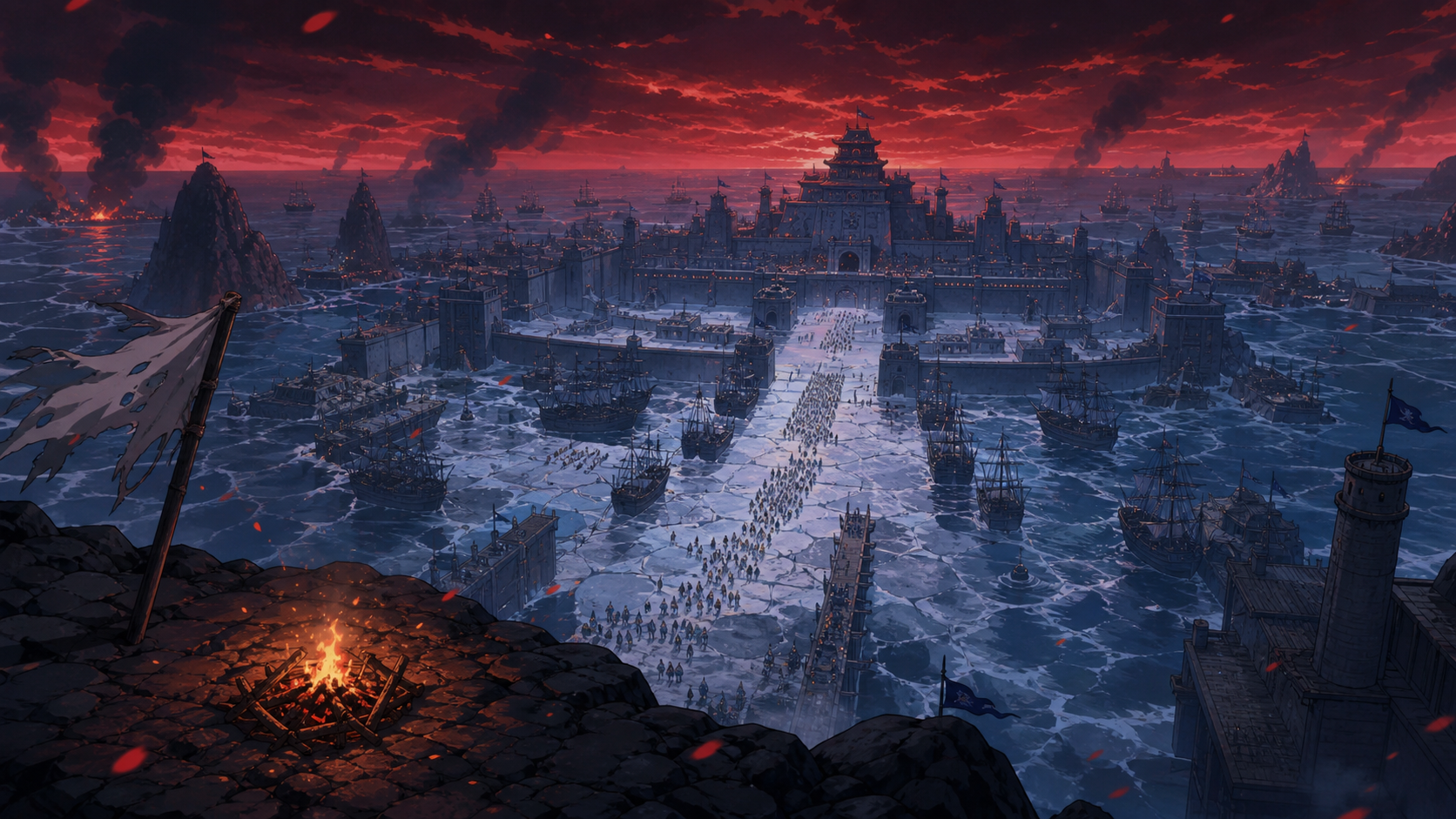
Marineford is public theater before becoming a battle
The execution is broadcast because the government wants more than Ace’s death. The state wants spectators to witness Roger’s lineage being punished and Marine authority being restored. Whitebeard’s arrival contests the story in public. He names Ace as a son rather than inherited contamination.
Every faction understands the cameras differently. Sengoku controls disclosure. Buggy discovers celebrity. Whitebeard uses final words to reopen the age the government hoped to close. Information becomes another battlefield alongside ice, magma, blades, and Haki.
Ace’s death cannot be reduced to one bad decision
Ace turns back after Akainu insults Whitebeard. Pride matters, but the provocation targets the fatherhood that gave Ace a reason to live. Years of inherited shame made that bond both refuge and vulnerability. Explanation does not erase accountability. Explanation keeps the tragedy from becoming a smug lesson about listening better.
Luffy reaches Ace through the work of dozens of people and still cannot bring him home. The failure breaks the belief that love plus effort guarantees rescue. Grief becomes part of the captain’s future rather than a temporary obstacle.
The Summit War ends by redistributing consequences
Whitebeard and Ace die. Marineford is damaged. Blackbeard acquires power. Shanks stops the fighting after enough bodies have already been spent. The government protects an image of victory while the pirate world reorganizes around the vacuum.
My verdict is that the saga succeeds because scale never fully erases individual terror. The weakness arrives when spectacle makes unnamed soldiers and prisoners look disposable. War is not meaningful only where famous men fall. The whole structure depends on ordinary people being ordered to absorb decisions made far above them.
The Summit War Saga is a sequence of institutional doors
Sabaody, Amazon Lily, Impel Down, Marineford, and the postwar aftermath keep placing Luffy before systems he cannot overpower alone. The Celestial Dragons rely on slavery, military protection, inherited status, and public fear. Impel Down organizes punishment into architecture. Marineford converts an execution into a broadcast lesson about which bloodlines the state considers dangerous.
Each location also depends on people working inside or around the institution. Rayleigh interrupts an auction. Hancock controls access while carrying the history of enslavement. Ivankov and the Newkama community build mutual protection inside a prison. Whitebeard mobilizes an enormous family structure. The saga widens beyond individual strength because every route to Ace requires networks, debts, compromises, and labor.
Sabaody destroys the fantasy of protected adventure
The crew has survived stronger enemies before reaching the archipelago, but strength does not grant immunity from a world economy built around human sale. Camie’s capture turns the auction system into an immediate crisis. Luffy’s punch against Charlos satisfies a moral demand, yet the response demonstrates why personal defiance cannot dismantle an institution protected by Admirals and Pacifista weapons.
Kuma’s separation of the crew feels like annihilation because Luffy cannot recognize rescue inside the violence. Every member lands somewhere connected to a future skill, but the benefit does not make the experience harmless. The sequence forces the captain to confront a limit his optimism cannot talk away.
Impel Down makes alliance morally uncomfortable
Luffy enters prison to save Ace and works beside people who have harmed others. Crocodile remains responsible for Alabasta. Buggy remains opportunistic. The escape does not cleanse either man. One Piece asks whether cooperation against a brutal institution creates temporary solidarity, permanent forgiveness, or something messier.
Bon Clay’s repeated sacrifices give the escape an emotional center, while Ivankov’s community turns hidden space into organized survival. Magellan is not framed as a simple weak bureaucrat. His power and commitment make the prison function effectively, which sharpens the question of what effectiveness means when the institution includes torture and indefinite dehumanization.
Marineford turns family into a public argument
Ace’s parentage becomes state evidence before a crowd. Whitebeard answers by naming Ace as his son, refusing the claim that inherited blood determines moral worth. Garp stands between institutional duty and family love. Sengoku controls the official narrative. The battlefield becomes a struggle over bodies and over the meaning attached to those bodies.
Luffy reaches Ace through help from nearly every alliance built across the saga. The rescue briefly succeeds, then Akainu targets Ace’s deepest wound through an insult to Whitebeard. Ace’s death and Luffy’s collapse are not proof that effort meant nothing. The loss changes what the surviving characters must understand about pride, power, timing, and the cost of entering war before readiness.
RaeRae’s verdict
Summit War changes One Piece because victory is no longer the only measure of love. Luffy fails to save Ace, survives, and must build a future that does not turn survival into betrayal.