
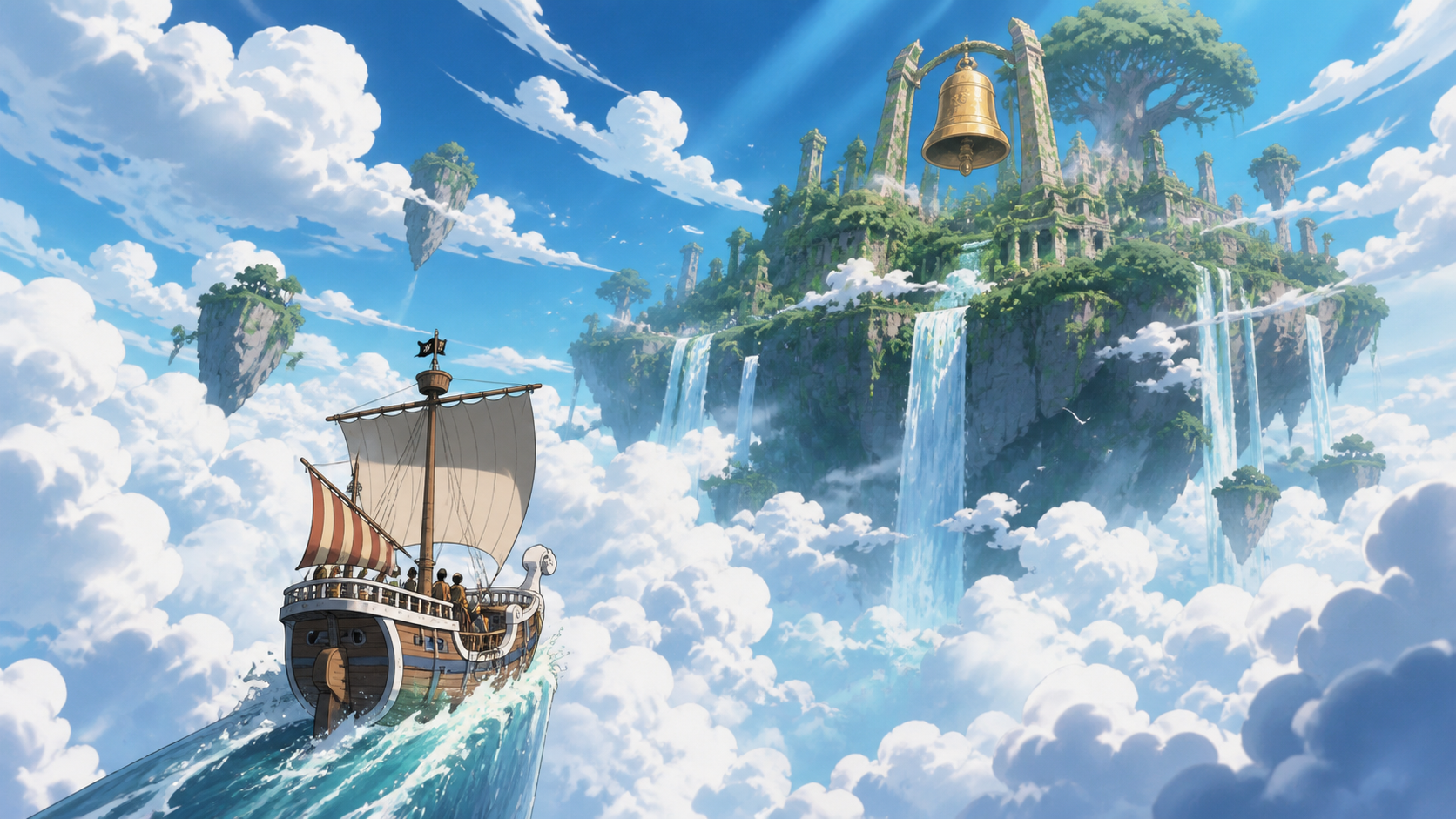
One Piece Sky Island Saga Guide
What this saga covers
The Sky Island Saga includes Jaya and Skypiea. A search for a route into the sky becomes a conflict over Upper Yard, the Shandians’ displaced homeland, and Enel’s rule through surveillance and divine violence.
Jaya and the politics of ridicule
Bellamy treats dreams as evidence of weakness because cynicism performs maturity in his world. Luffy’s refusal to fight over mockery is not passivity. He saves force for threats that actually constrain another person’s future.
Noland, Calgara, and broken testimony
The story of a liar becomes an archive distorted by catastrophe. Noland tells the truth, but material proof is lifted into the sky. Calgara’s promise survives through descendants who inherit both friendship and incomplete evidence.
Knock Up Stream
Reaching Skypiea requires scientific observation, preparation, and collective risk. The impossible route works because wonder is supported by weather knowledge and ship labor rather than replacing them.
Upper Yard and occupation
The island called sacred land is stolen Shandian territory. Gan Fall’s regret and Enel’s tyranny do not erase the deeper conflict over who has the right to inhabit, govern, and name the land.
Mantra and surveillance
Enel’s Observation Haki lets religious authority appear omniscient. Fear becomes self-policing when people assume every dissenting word is heard. The regime depends on spectacle as much as electricity.
The golden bell
Ringing the bell is victory, historical proof, and a message across generations. The bell tells Cricket that the city existed and completes a promise neither original friend lived to hear.
Sky Island begins with a fight over what counts as real
Jaya is full of men who treat disbelief as intelligence. Bellamy’s crew laughs at sky islands, dreams, and anybody who refuses the narrow world their power can measure. The mockery is not neutral skepticism. The mockery polices imagination by making hope socially expensive. Luffy’s refusal to fight Bellamy at first recognizes that no punch can force somebody to value a dream.
Cricket gives the argument material stakes. His family name has been attached to a lie for generations, and his search is part archaeology, part grief, and part desire to stop inherited humiliation. When the bell finally rings, the sound crosses worlds. Proof becomes communication with somebody who has spent a life looking upward.
Upper Yard is occupied land
Skypiea becomes much sharper once Upper Yard stops being treated as a fantasy battlefield and becomes what the story says: land torn from Jaya, occupied by Skypieans, and reclaimed through generations of Shandian resistance. Gan Fall can be kinder than Enel and still belong to a political order built on displacement.
The Shandians are not fighting because warrior culture makes conflict inevitable. They are fighting over land, ancestors, access, and a promise attached to the bell. The saga sometimes romanticizes battle so heavily that civilian life disappears, but the political foundation remains visible. A peaceful settlement cannot mean the displaced community politely forgetting why the war began.
Enel turns observation into government
Mantra allows Enel to hear people across Skypiea, and the power transforms surveillance into divine performance. Citizens do not know which private sentence will become evidence. Punishment can arrive from the sky without a visible officer. The uncertainty trains people to police themselves.
His lightning ability makes the performance convincing, but electricity is not what makes him a god. Institutions, priests, fear, and controlled knowledge make the claim socially effective. Enel’s plan to destroy Skypiea follows the logic of a ruler who values proof of authority more than subjects. If everybody can be erased, obedience was never about governing a community.
Nami and Robin make exploration legible
Nami’s weather knowledge turns an impossible environment into navigable conditions. She does not understand every dial or cloud current immediately. She observes, tests, and revises. Robin reads ruins as evidence that political histories crossed oceans and skies long before the current crew arrived.
I wish the saga centered their work even more. Exploration stories often reward the person who plants a flag after other people mapped the route, translated the record, maintained the vehicle, and kept everybody alive. Sky Island contains enough wonder to show that discovery is collective labor, not ownership earned by arrival.
The bell joins personal promise to public history
Calgara and Noland begin with mistrust, medical conflict, and cultural misunderstanding. Their friendship grows through argument rather than instant mutual admiration. Noland saves lives while also violating sacred space before he understands what the trees mean. Calgara changes his judgment without surrendering the right to condemn the violation.
Their promise outlives both men because geography makes fulfillment impossible. The Knock Up Stream sends Shandora into the sky, and Noland dies branded a liar. Ringing the bell cannot undo execution, occupation, or centuries of war. The sound restores a connection power and disaster tried to sever.
Adventure does not erase colonial language
Sky Island uses ideas about primitive tribes, gods, sacred land, and exploration that deserve scrutiny. The Shandians receive dignity and history, yet the visual framing sometimes turns them into an exotic warrior culture for the audience’s adventure. The story is better when their political claims remain specific and worse when aesthetics replace those claims.
My verdict is that Sky Island contains one of One Piece’s clearest arguments about inherited history. The saga asks who gets believed, who controls land, and how a promise can survive institutional lies. The answer arrives through a bell, but the work after the sound still belongs to communities learning how to share a sky.
Skypiea rewards preparation before spectacle
The flight into the sky looks like pure fantasy, but the crew reaches the Knock Up Stream through Cricket’s research, Nami’s weather reading, Usopp’s repairs, Sanji’s supply work, and a community willing to help. Wonder arrives through accumulated labor. That balance matters because One Piece never needs realism to become ordinary; the series needs consequences and relationships that make the impossible route feel earned.
Dials extend the same idea after arrival. Tools developed for daily life become weapons, transport, recording devices, and future components in Nami’s Clima-Tact and Usopp’s arsenal. Technology moves between communities through contact. The useful question is not who owns innovation forever, but who controls access and which purposes receive social approval.
Survival games are Enel’s propaganda theater
Enel predicts how many fighters will remain, then treats the result as proof of divinity. The prediction works because he controls the battlefield, watches participants, removes people with overwhelming force, and defines success after creating the conditions. Authoritarian certainty often functions this way: power manufactures an outcome, then points to the outcome as evidence that power was naturally correct.
Luffy’s resistance carries symbolic weight because rubber makes Enel’s most theatrical weapon ineffective. The immunity is funny, but victory still requires Nami’s navigation, Sanji and Usopp’s sabotage, Robin’s historical work, Wyper’s resistance, and the shared desire to stop the island’s destruction. A perfect matchup creates possibility rather than replacing collective labor.
Why the saga matters later
Poneglyph history, Poseidon’s location, Roger’s message, Observation Haki, inherited promises, scientific weather knowledge, and the struggle over erased history all continue beyond the white sea. Skypiea feels separate only when viewers define importance as immediate movement toward the next villain. The saga builds the interpretive tools needed for the World Government, the Void Century, and inherited will.
Use the Jaya and Skypiea episode directories for close Reacts. Read Robin’s profile for the political danger attached to literacy, and return to the main saga directory for the next bounded route. Every non-profile card uses “Read More” because these guides open coverage rather than personal dossiers.
RaeRae’s verdict
Skypiea is not a detour. The saga is One Piece in concentrated form: exploration reveals buried history, authority calls theft sacred, and liberation becomes meaningful when a sound reaches someone who needed the past to be real.