
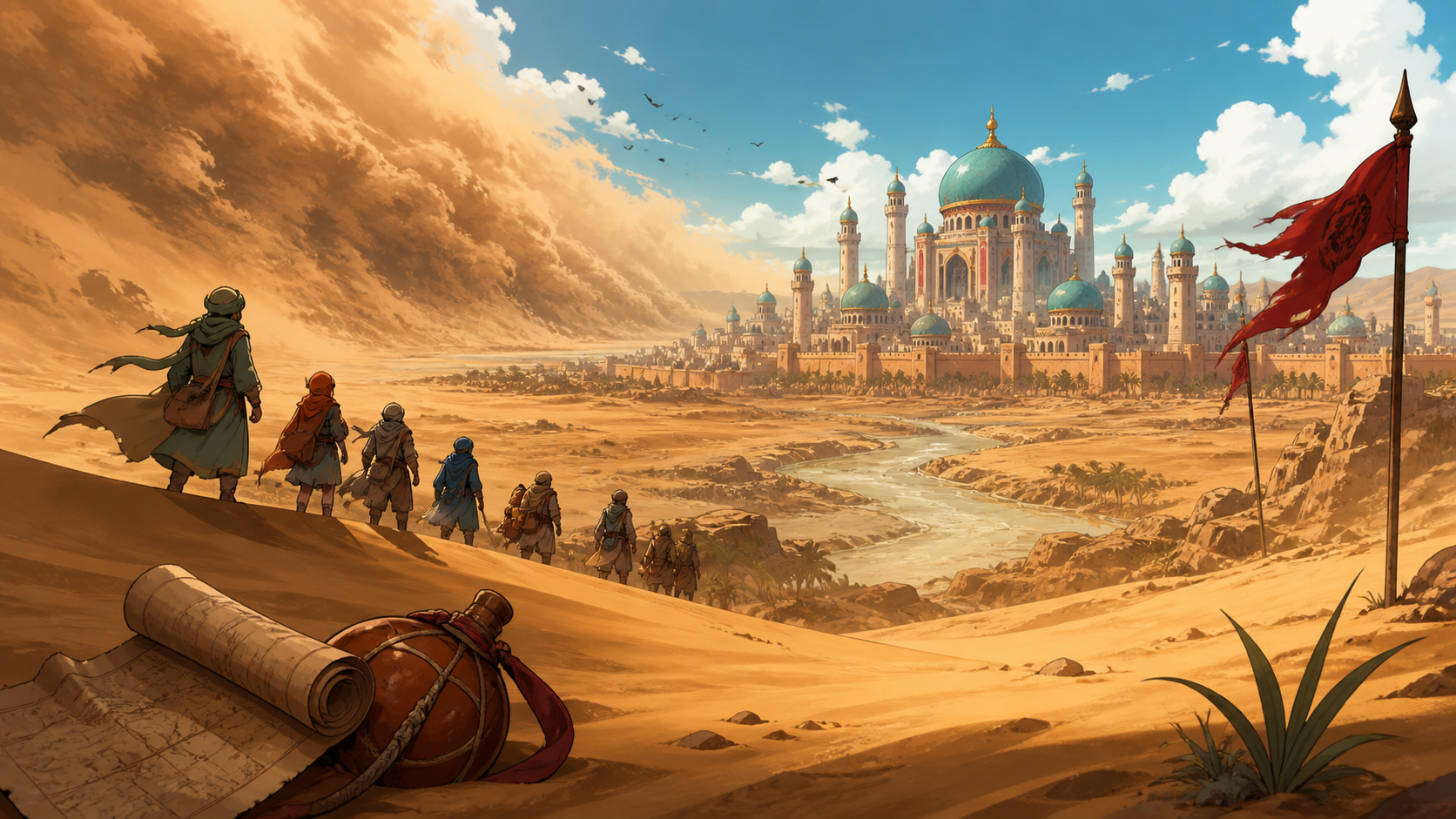
One Piece Alabasta Saga Guide
What this saga covers
The Alabasta Saga runs through Reverse Mountain, Whisky Peak, Little Garden, Drum Island, and Alabasta. The saga follows Vivi’s attempt to expose Baroque Works and stop Crocodile from seizing her country through engineered conflict.
Reverse Mountain and the promise to Laboon
The Grand Line begins with a whale carrying decades of grief. Luffy’s promise to return reframes progress: the destination matters, but so do obligations created along the route.
Whisky Peak and hidden institutions
A welcoming town reveals itself as a bounty-hunter operation. Vivi’s identity turns the crew toward a political mission, while the numbered structure of Baroque Works shows how anonymity can distribute responsibility without eliminating accountability.
Little Garden and weaponized scale
Dorry and Brogy’s century-long duel mixes honor with manipulation. Mr. 3 does not need their strength; he exploits the rules they have built around the tradition. The arc asks when tradition becomes a vulnerability someone else can administer.
Drum Island and public health
Nami’s illness makes medicine urgent, while Wapol’s monopoly on doctors exposes healthcare as political infrastructure. Chopper joins after a story about stigma, training, grief, and the difference between hope and competent treatment.
Alabasta’s manufactured civil war
Crocodile controls water, rumor, infiltrators, and public perception. The conflict cannot end just because Vivi tells the truth. People need enough safety and shared evidence to hear the truth through years of accumulated fear.
Robin and the buried record
The Poneglyph introduces history the state cannot safely permit. Robin’s interest in the past is already political, while Crocodile treats the archive as a route to military monopoly.
Alabasta turns scarcity into a weapon
Crocodile does not conquer Alabasta by walking into the palace and announcing a coup. He makes the public stop believing the kingdom can protect them. Dance Powder creates rain in one place while drought spreads elsewhere. Staged attacks, manipulated witnesses, and Baroque Works agents convert environmental crisis into political certainty. The lie succeeds because people are already thirsty.
That distinction matters. Propaganda does not float above material life. A family watching crops die does not need to be foolish to believe somebody caused the drought. Crocodile supplies an explanation, repeats the explanation through trusted channels, and makes every attempt at correction look like royal self-defense. By the time the rebellion gathers, facts have to cross a country faster than fear.
Vivi keeps trying to save people who cannot hear her
Vivi knows the conspiracy and still cannot simply tell everybody the truth. Distance, violence, weather, rank, and controlled information block her. The clock tower sequence makes the problem physical. She can see the armies destroying one another, but her voice disappears inside the noise. Leadership becomes the exhausting work of building conditions where people can hear before asking them to agree.
I love that she never reduces the rebels to traitors. Koza and the rebellion respond to real deprivation, even when Crocodile has engineered the evidence. Vivi wants to stop the war because both armies contain her people. That refusal to sort citizens into loyal lives and disposable lives is the center of her politics.
Baroque Works makes employment part of the villainy
The numbered agents are colorful fighters, but the organization is also a workplace designed to prevent solidarity. Code names hide identities. Partners are assigned. Advancement depends on secrecy, obedience, and competition. Nobody below Crocodile receives the whole plan. Workers can commit atrocities while imagining the next promotion will finally make the structure safe for them.
Robin survives near the top because she controls rare knowledge and never mistakes employment for belonging. Her betrayal of Crocodile is not sudden goodness emerging from nowhere. She has watched powerful men use her literacy while planning to kill her once the translation is complete. Alabasta brings that survival pattern to the point where survival without trust stops looking like a life.
The Straw Hats win through divided labor
Alabasta gives nearly every active crewmate a fight, but the deeper strength is distribution. Nami fights while learning a weapon Usopp built. Usopp and Chopper combine fear, invention, medicine, and stubborn loyalty. Sanji moves through the information network under an identity Crocodile failed to record. Zoro treats a near-fatal battle as a technical problem about what he can perceive and cut.
Luffy still confronts Crocodile, yet three attempts are required and outside help keeps him alive. The final victory is not proof that one destined captain could have solved the country alone. Vivi provides knowledge. Robin interferes with Crocodile’s certainty. Pell, Koza, Chaka, Toto, Karoo, and ordinary citizens keep the country from becoming a background set for the pirate duel.
The bomb exposes the limit of defeating one villain
Crocodile plans for discovery. Even if people learn the truth, the bomb can preserve mass death and make reconciliation impossible. That contingency reveals how authoritarian projects use chaos as insurance. Losing formal control becomes acceptable if the public inherits ruins.
Pell’s apparent sacrifice carries enormous emotional force, which is why the survival reveal remains divisive. Survival does not insult viewers merely because tragedy would have felt cleaner. The problem is consequence. The anime asks the audience to experience a death, then offers too little bodily or political aftermath for surviving a city-level explosion. Hope needs material weight too.
Where Alabasta remains unfinished
The civil war stops, rain returns, and Crocodile’s plot becomes public. None of that automatically repairs irrigation, farms, local government, medical access, trade, or the trust destroyed by years of manufactured evidence. Vivi stays because rebuilding is another adventure, one with fewer dramatic punches and more people asking when water will reach their district.
My Alabasta verdict stays high because the saga understands that stories can be weapons and because Vivi refuses a victory that abandons the people who believed the wrong story. The weakness arrives whenever royal virtue substitutes for examining why one private pirate organization gained so much control over a country’s public life.
Alabasta changes the scale of responsibility
East Blue lets the crew topple local rulers and leave. Alabasta asks what happens when millions of people cannot be moved onto one ship and a villain has converted ordinary survival into evidence for civil war. Vivi brings the crew into a problem that cannot be solved by locating one captive or destroying one building. Travel time, weather, illness, military command, public trust, and access to water all shape the outcome.
Luffy’s conflict with Vivi matters because his refusal to accept her self-sacrifice forces the mission to acknowledge shared risk. His argument is not a rejection of her leadership. He recognizes that Vivi has been treating her own death as the only morally acceptable cost. The crew cannot promise a bloodless rescue, but they can refuse the fiction that the princess must carry every possible casualty alone.
Drum Island belongs inside the political story
Chopper’s recruitment is often remembered as a tearful character origin placed between larger arcs. Drum Island also prepares the saga’s argument about public institutions. Wapol removes doctors from common access, then makes care dependent on proximity to the ruler. Kureha’s difficult personality does not cancel her medical competence. Hiriluk’s dream gives the country hope, while his failures underline the difference between a beautiful intention and safe treatment.
Dalton’s later responsibility begins with admitting his participation in the old system. A new flag and a kinder leader cannot restore public trust by themselves. Healthcare capacity, food, transport, and accountability still require work after the villain leaves. That unfinished labor connects Drum directly to Vivi’s choice to remain in Alabasta.
How to read Robin before she joins
Miss All Sunday helps Crocodile while keeping enough distance to protect her private goal. The contradiction should stay visible. Robin is a survivor of state violence, but survival does not make every action harmless. She saves Luffy and withholds the weapon Crocodile wants, yet Baroque Works still harms a country around her. Her later place in the crew gains meaning because One Piece allows trust to grow without rewriting her history as spotless.
Use Robin’s profile beside this guide for the full Ohara chronology. Use Vivi’s profile for the political labor hidden by the honorary-crewmate label. The episode Reacts stay closer to individual choices and adaptation decisions, while this page keeps the entire manufactured crisis in view.
RaeRae’s verdict
Alabasta expands One Piece without abandoning the human scale. A kingdom is saved through countless acts of trust, yet the story refuses to pretend liberation erases drought, death, or the responsibility of governing afterward.