
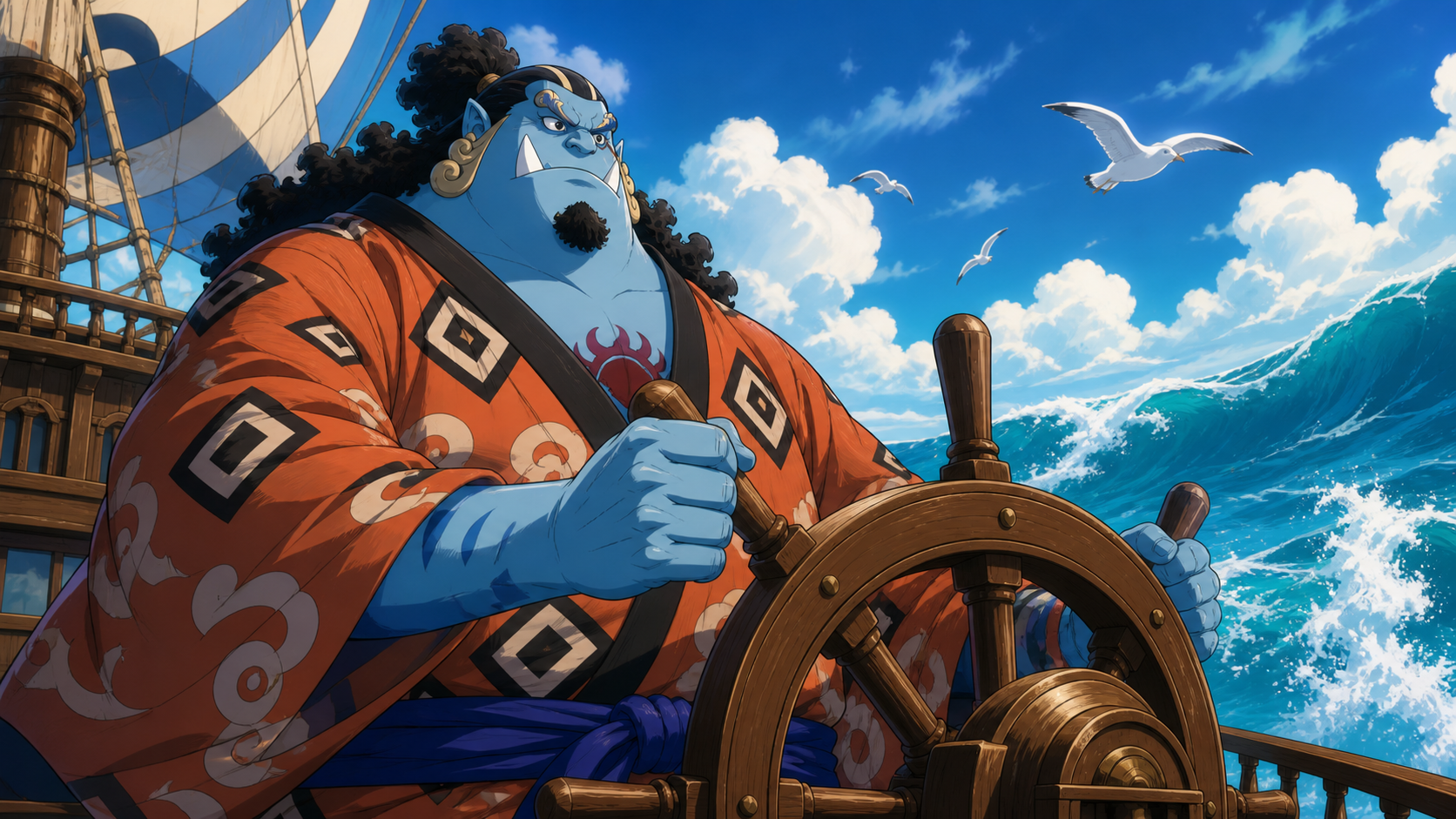
Jinbe: One Piece Character Profile
Quick profile
Jinbe is a whale shark fish-man, former Warlord of the Sea, former captain of the Sun Pirates, and the Straw Hats’ helmsman. His choices link Fisher Tiger, Otohime, Arlong, Big Mom, and Luffy across generations of conflict.
Helmsmanship is judgment
Steering the Thousand Sunny requires reading waves, current, weight, and timing. Jinbe turns the ship itself into a responsive body. His expertise matters most when the sea is too violent for strength alone.
Fisher Tiger and inherited struggle
Jinbe inherits a movement divided between justified rage, survival, diplomacy, and retaliation. He respects Fisher Tiger without pretending pain automatically produces a workable politics. Memory becomes a responsibility to choose, not a command to repeat.
Fish-Man Karate
His martial art manipulates water inside and around bodies, extending force through the environment. The technique fits a character who understands connection materially: no body is truly separate from the sea that sustains every life.
Responsibility for Arlong
Jinbe apologizes to Nami for his part in enabling Arlong’s release and rise. Nami decides how to receive that apology. The scene avoids making forgiveness a debt owed to the remorseful person.
Leaving Big Mom
Jinbe’s refusal to fear Big Mom is more than a power moment. He withdraws consent from a coercive hierarchy and accepts the risk publicly. Loyalty to Luffy is meaningful because the bond is chosen after years of political compromise.
Official profile and place in the crew
ONE PIECE.com lists Jinbe as a 46-year-old whale shark fish-man from the Ryugu Kingdom, born April 2, with a bounty of 1.1 billion berries. He has served as a Neptune Army soldier, a member and later captain of the Sun Pirates, a Warlord of the Sea, an ally of Big Mom, and finally the Straw Hat helmsman. Each title records a political choice rather than a clean promotion.
Fish-Man District and the limits of respectable service
Jinbe grows up in the Fish-Man District, then joins the Neptune Army. State service offers order but cannot resolve the violence produced by slavery, segregation, and abandonment. When Fisher Tiger frees enslaved people at Mary Geoise and forms the Sun Pirates, Jinbe leaves official respectability to protect a movement the World Government defines as criminal.
His early violence reflects a world where humans have made cruelty routine. Tiger refuses to pass hatred to the next generation even while carrying wounds he cannot release. Jinbe inherits that contradiction: rage can be justified, yet justified rage does not automatically produce a future where children are safe.
Fisher Tiger, Otohime, and two strategies for freedom
Fisher Tiger creates immediate escape routes and armed protection. Queen Otohime pursues legal recognition, migration, and contact with the surface. The story does not make either path sufficient by itself. Enslaved people need rescue now, while a nation also needs institutions capable of changing tomorrow.
Jinbe learns from both. He respects Tiger without turning pain into a command to repeat every decision. He supports Otohime without pretending diplomacy can charm violent power into innocence. His mature politics lives in the difficult space between survival, negotiation, force, and memory.
Becoming a Warlord was a compromise with consequences
After Tiger’s death, Jinbe becomes captain of the Sun Pirates and accepts a Warlord position. The bargain protects Fish-Man Island, gives former slaves legal room to live, and leads to Arlong’s release. A decision can help one vulnerable group while exposing another community to danger.
Arlong uses that freedom to terrorize Cocoyasi Village and enslave Nami’s labor. Jinbe later apologizes for his role without demanding that Nami comfort him. She controls the response because remorse does not create a debt. Accountability begins with hearing the harmed person rather than centering the person who feels guilty.
Impel Down and Marineford reveal his definition of loyalty
Jinbe refuses to fight Whitebeard because Whitebeard’s protection kept Fish-Man Island safer. The World Government imprisons him in Level Six for declining an order from the institution that supposedly legitimized him. His Warlord title proves conditional the moment conscience overrides obedience.
At Marineford he shields Luffy, confronts overwhelming force, and carries the devastated younger pirate away from the battlefield. After Ace’s death, Jinbe refuses to let Luffy reduce his life to absence. Asking what remains is not cheap optimism. The question reconnects Luffy to a crew still waiting for him.
Fish-Man Island and the blood shared across a manufactured divide
Hody Jones represents hatred reproduced without direct memory of its original injuries. Jinbe understands that defeating him physically cannot erase the conditions that made inherited hatred useful. The battle must protect the kingdom while refusing a story where every fish-man becomes evidence for human prejudice.
Jinbe gives blood to Luffy despite a taboo against fish-man and human transfusion. The act makes interdependence literal. Blood does not solve political conflict, but the scene breaks a rule designed to keep bodies symbolically separate even during a medical emergency.
Leaving Big Mom means withdrawing consent from coercion
Jinbe delays joining Luffy because the Sun Pirates remain entangled with Big Mom’s protection and punishment. He refuses to purchase personal freedom by leaving his former crew exposed. At Whole Cake Island, his formal departure turns obligation into a public confrontation with coercive power.
His refusal to surrender lifespan works because fear is Big Mom’s collection mechanism. Jinbe does not claim she lacks power. He decides that fear will not authorize her ownership. Loyalty to Luffy becomes meaningful because Jinbe chooses the relationship after years of alliances built under political necessity.
Helmsmanship makes the Thousand Sunny fully legible
Jinbe reads currents, wave faces, wind, weight, and the response of a hull under stress. Franky builds a remarkable ship, Nami chooses routes, and Jinbe translates their knowledge into movement at the wheel. The role joins engineering and navigation rather than competing with either.
During the escape from Totto Land, he guides the Sunny through a massive wave with Green Room, using the wave’s internal space instead of trying to overpower the sea. That decision defines his expertise. Strength matters, but judgment finds the path strength alone cannot see.
Fish-Man Karate treats water as connection
Fish-Man Karate and Fish-Man Jujutsu manipulate water in the environment and within living bodies. Jinbe can project force, redirect attacks, and weaponize currents without needing a conventional solid target. The technique fits a character whose politics begins with the fact that apparently separate lives remain materially connected.
His combat style is disciplined rather than passive. Calm gives him more choices under pressure; calm does not mean accepting injustice. When Jinbe strikes, the action usually follows an assessment of who needs protection, what the environment allows, and which consequence he is prepared to carry.
A former captain learning to join another captain
Jinbe enters the Straw Hats with more command experience than most of the crew. He could easily become a corrective adult who exists only to restrain Luffy. Instead, he offers information, voices disagreement, and still recognizes Luffy’s authority after a decision is made.
The balance protects both characters. Luffy gains an elder who understands institutions and historical consequences. Jinbe gains a captain whose impossible commitments are not coded excuses for domination. Respect moves in both directions, which is why the relationship feels chosen rather than inherited.
Japanese performance and the weight of succession
Daisuke Gōri established Jinbe’s early anime gravity. Katsuhisa Hōki assumed the role after Gōri’s death and carries the character with warmth, deliberation, and a rough maritime authority. The measured cadence makes urgency sound like focused attention rather than panic.
Jinbe’s humor also needs space. Formal speech, crew chaos, and his earnest participation in ridiculous plans keep maturity from becoming stiffness. A helmsman can carry generations of political history and still belong at the party.
RaeRae’s final word
Jinbe is not valuable because he always has the correct answer. He is valuable because he remembers who paid for every compromise. His choices connect Tiger’s rescue, Otohime’s organizing, Arlong’s violence, Nami’s judgment, Whitebeard’s protection, Big Mom’s coercion, and Luffy’s invitation without flattening those histories into one moral slogan.
The Straw Hats need that memory. Adventure creates consequences beyond the next island, and power without historical attention repeats old harm while calling itself freedom. Jinbe brings the wheel, the water, and the patience to choose a line through danger. That is active maturity, not background calm.
Jinbe’s restraint was built under political pressure
Jinbe often appears calm beside louder Straw Hats, but the calm belongs to a man who spent years knowing any public anger could be used against every Fish-Man nearby. Respectability becomes a survival tactic when the World Government already treats Fish-Men and merfolk as suspect. That pressure helps explain his careful speech, diplomatic patience, and willingness to negotiate with institutions that do not deserve his trust.
Fisher Tiger and Otohime offer different strategies without fitting the easy opposition of violence versus peace. Tiger understands that enslaved people cannot wait for polite approval before escaping. Otohime understands that legal structures and public opinion shape whether children inherit the same danger. Jinbe carries both projects, plus the failures and compromises neither leader lived long enough to resolve.
I respect his willingness to name responsibility for Arlong, but responsibility should not become collective guilt assigned to an entire people. Arlong made choices inside a history of racial violence. Jinbe made compromises he believed might protect Fish-Man Island. The World Government built the conditions where both men had to negotiate with a system that profited from enslavement. Accountability grows weaker, not stronger, when institutional power disappears from the explanation.
Joining Luffy is not surrendering political judgment
Jinbe does not become a Straw Hat because Luffy replaces every earlier commitment. He delays joining to settle obligations, withdraw from Big Mom, and protect people who would bear the retaliation. That delay is leadership. Freedom purchased by quietly transferring danger to subordinates would repeat the coercion he is trying to escape.
Once aboard, helmsmanship makes his intelligence physical. Jinbe reads currents as forces with history and direction, then positions the Sunny so everybody else can do their work. The role matches his politics. He does not command the ocean into submission. He understands pressure, moves with power where possible, and intervenes decisively when the ship would otherwise be consumed.
My hope for Jinbe’s final story is that the crew keeps listening when his experience complicates Luffy’s instinct. Loyalty does not require silence. A former captain, soldier, Warlord, prisoner, diplomat, and revolutionary ally brings knowledge the younger crew cannot manufacture through enthusiasm. His belonging should make the collective wiser, not make him smaller.
His bond with Luffy begins long before the formal toast. Jinbe protects Luffy through grief, gives blood when Fish-Man Island needs a public rejection of racist taboo, and trusts him enough to argue. That blood-transfusion scene works because the relationship becomes a material challenge to separation. The law said their bodies should remain divided. Care proves the law was political, not natural. Joining the crew extends that refusal across every sea they cross.
Jinbe also changes the age balance aboard the Sunny. He has made public mistakes, buried leaders, commanded crews, and survived institutions younger Straw Hats know mainly as enemies. Experience does not make him automatically correct. Experience gives the crew another archive of consequences. The strongest version of his role lets that archive challenge enthusiasm without extinguishing hope.
The Sun Pirates tattoo carries this argument on the body. A new sun covers the hoof mark placed on enslaved people, but the same symbol is also given to members who were never enslaved so outsiders cannot identify who survived captivity. Privacy becomes collective protection. Nobody has to disclose trauma to prove belonging. The symbol does not erase the scar or make every pirate politically identical. The symbol reorganizes visibility so the World Government cannot sort bodies as easily. Jinbe inherits that practice along with its tensions, which helps explain why he measures public gestures by the people a gesture might expose after the heroic moment ends.
That care makes his calm active, never passive. He is always calculating who pays after the room stops cheering.
Official sources and routes
ONE PIECE.com: Jinbe official character profile
ONE PIECE.com: current anime staff and Japanese cast
Watch One Piece on Crunchyroll
Browse One Piece character profiles