
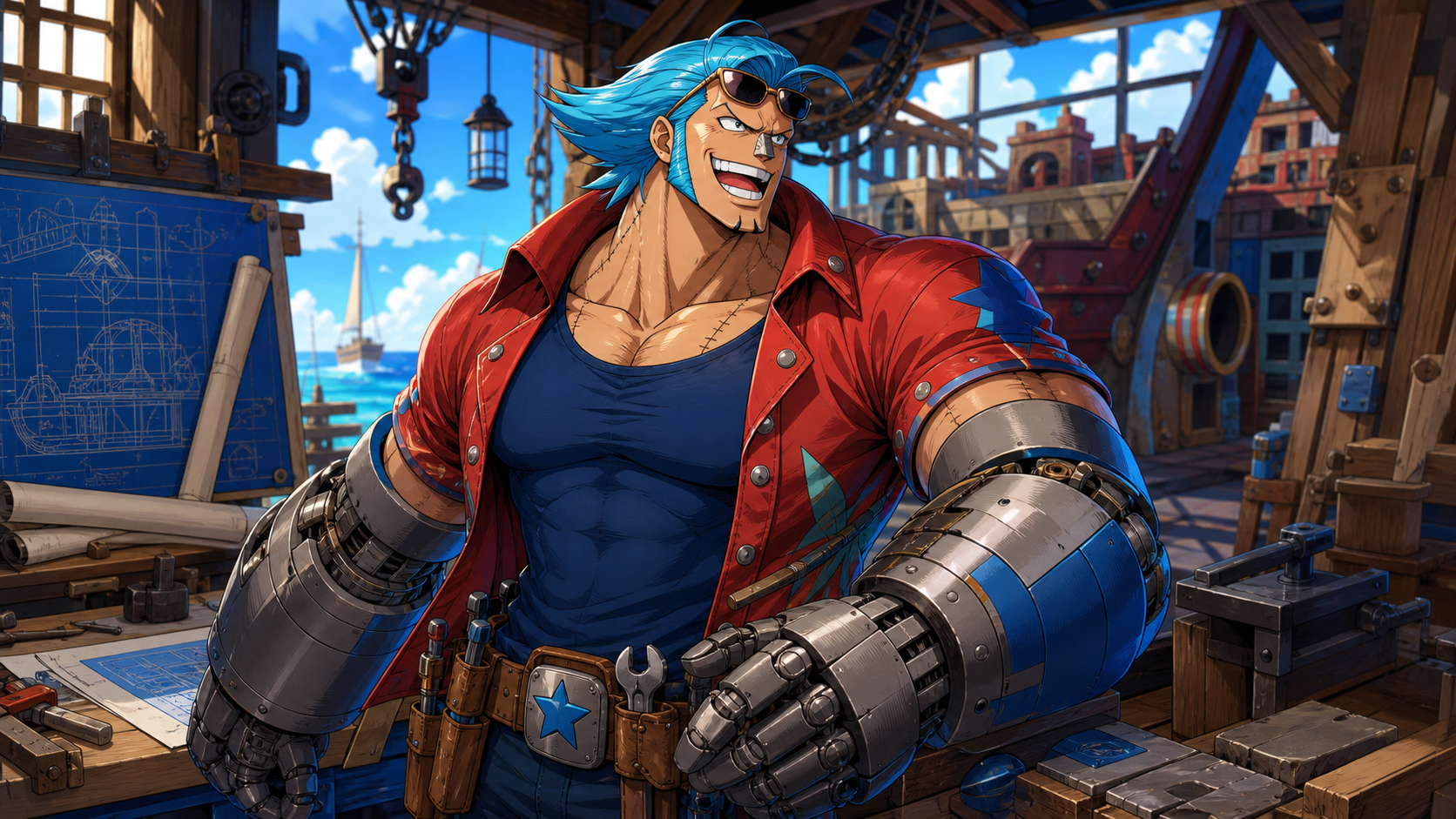
Franky: One Piece Character Profile
Quick profile
Franky is the Straw Hat shipwright, the builder of the Thousand Sunny, and a cyborg who rebuilt his own body after being struck by the Sea Train. He inherits Tom’s craft and the burden of seeing his own designs weaponized.
Shipbuilding is collective survival
A ship is home, transport, workplace, and emergency shelter. Franky’s maintenance keeps the crew’s dreams physically afloat. His work makes clear that adventure depends on skilled trades and continuous repair.
Tom and the ethics of creation
Tom teaches pride in making, but Franky’s battle ships are used to frame their creator. A builder cannot control every future use of a tool, yet refusing all responsibility is too simple. Franky learns to pair invention with stewardship.
The body as workshop
Franky turns trauma into deliberate reconstruction. His cyborg body is comic, powerful, and intensely personal. Each modification asks whether the body can be treated as an ongoing project without becoming property of the institutions that want its technology.
The Thousand Sunny
Adam wood, the Coup de Burst, docking systems, workshops, and living spaces make the Sunny a design for the crew that actually inhabits the result. Franky does not build an abstract masterpiece. He listens to the needs of cooks, navigators, doctors, fighters, and dreamers.
Pluton knowledge
The blueprints place Franky inside a lineage of dangerous technical information. Burning them is a choice about trust and containment, not proof that knowledge itself is evil. The government wants monopoly, while Franky chooses accountability on his own terms.
Masculinity as performance
Franky’s tears, posing, nudity jokes, and flamboyance refuse a narrow version of masculine composure. The jokes work best when bodily difference is celebrated rather than treated as permission to ignore other people’s boundaries.
Japanese performance
Kazuki Yao built Franky’s original vocal identity from swagger, mechanical rhythm, explosive sentiment, and the famous super declaration. The performance makes emotional openness part of strength rather than its opposite.
RaeRae’s verdict
Franky is a maker who understands that every dream needs materials, maintenance, and people willing to repair what breaks. His loudest performances hide no shame about caring. That may be his most radical piece of engineering.
Tom’s Workers and the responsibility of making things
Cutty Flam grows up under Tom with Iceburg and learns shipbuilding from the man who built Gol D. Roger’s ship. Tom teaches pride in the object a craftsperson creates. That lesson becomes painful when Spandam uses Franky’s battle ships to attack Water 7 and frame Tom.
A maker cannot control every future use, but design choices still carry consequences. Franky responds by disowning his name, punishing himself, and hiding rather than abandoning engineering. The healthier lesson arrives later: build with purpose, protect dangerous knowledge, and refuse to let an abuser define the value of the craft.
The train, the broken body, and self-reconstruction
Franky tries to stop the sea train carrying Tom and suffers catastrophic injuries. He survives by rebuilding his own body from available materials. The cyborg form is emergency medicine, engineering, and identity work performed without a safe laboratory.
His front is armored and weaponized, while the back remains a known vulnerability because he could not reach every surface during reconstruction. Cola powers major systems. Fuel limits, maintenance, ammunition, and access to replacement parts keep the body mechanical rather than magical.
Water 7, the Franky Family, and chosen responsibility
Franky becomes the leader of dismantlers, bounty hunters, and people pushed outside Water 7’s respectable labor structure. The Franky Family hurts Usopp and steals the crew’s money, so friendship does not begin from innocence. Enies Lobby forces former enemies to work together against a larger state threat.
Leaving Water 7 means trusting Iceburg, the Family, and the city to continue without him. The farewell is loud because Franky’s emotions have never been subtle. Chosen responsibility includes knowing when care no longer requires staying in the same place.
The Thousand Sunny is a job, not a finished trophy
Franky builds the Sunny from Treasure Tree Adam wood with help from Galley-La. The ship contains Coup de Burst, Soldier Dock systems, the Gaon Cannon, specialized rooms, storage, and workspaces designed around the crew’s actual lives. A dream ship must carry people, food, medicine, books, weapons, tools, and repairs across hostile water.
Construction is only the beginning. Franky inspects damage, replaces parts, improves systems, manages materials, and works with Nami’s routes and Usopp’s inventions. The Sunny reaches the end of the sea only if somebody keeps doing maintenance between adventures.
Weapons, limits, and the comedy of engineering
Strong Right, Weapons Left, Coup de Vent, Fresh Fire, and Franky Radical Beam turn his body into a mobile workshop and weapons platform. The names are intentionally excessive. Franky announces mechanisms like a performer unveiling a stage trick, so combat carries the same theatrical confidence as his shipbuilding.
The spectacle does not erase practical limits. Cola supply affects output, ammunition runs out, joints can be restrained, and attacks expose the difference between armor and invulnerability. After studying Vegapunk’s abandoned laboratory during the time skip, Franky returns with larger systems and the Franky Shogun. The upgrades widen his options without replacing judgment, teamwork, or repair.
Why the Pluton blueprints matter
Tom entrusts the Pluton blueprints to Iceburg and Franky as a countermeasure against the ancient weapon falling into hostile hands. Spandam wants the plans because the World Government treats knowledge as something power should own. Franky carries the pages inside his body, placing dangerous information under personal protection rather than institutional control.
At Enies Lobby, he burns the blueprints after deciding that Nico Robin is not trying to awaken Pluton. The act is not casual destruction. Franky removes the government’s route to reproducing the weapon and stakes his decision on Robin’s stated will. Trust becomes an informed risk with consequences, which is much stronger than blind faith.
Relationships reveal the man behind the pose
Tom gives Franky a craft, Iceburg gives him a rival and brother, and Kokoro keeps the history of their household alive. The Franky Family shows his instinct to collect people discarded by respectable society. Their devotion also exposes how much care sits beneath his claims of being a criminal boss.
Within the Straw Hats, Usopp understands the emotional life of ships, Robin recognizes the burden of forbidden knowledge, and Chopper approaches the cyborg body with a doctor’s curiosity. Franky and Brook share the perspective of older crew members whose bodies no longer fit ordinary definitions. Luffy provides the impossible destination, while Franky makes sure the crew has a vessel capable of reaching the final island.
Design, identity, and the time-skip silhouette
Franky’s pre-time-skip design mixes pompadour delinquent styling, Hawaiian shirts, metal forearms, and conspicuously minimal clothing. The visual joke is immediate, but the silhouette also communicates a man who refuses concealment after years spent hiding his name and guilt.
His post-time-skip body becomes larger, modular, and visibly artificial. Interchangeable hair, oversized shoulders, mechanical hands, and exposed seams move him farther from a conventional human outline. The design can be deliberately ridiculous and still support a serious point: bodily autonomy includes choosing a form other people may not find tasteful.
A voice built to survive a handoff
Kazuki Yao defined Franky’s Japanese voice from the character’s 2005 anime debut through decades of performance. Health concerns led to his departure from the role, and Subaru Kimura was announced as the successor. A change that large cannot sound identical without becoming imitation.
The durable core is emotional architecture: explosive confidence, mechanical cadence, shameless crying, and the ability to turn the word super into a full-body event. A successful transition protects those dramatic functions while allowing the new performer to build a living interpretation.
RaeRae’s final word
Franky works because the series never forces a choice between technical competence and open feeling. He can calculate propulsion, maintain a transoceanic ship, carry forbidden military knowledge, grieve loudly, and pose in the middle of danger. The same hands build weapons and bedrooms. The moral distinction comes from who receives protection and who seeks control.
The Thousand Sunny is his clearest argument. Dreams do not travel on inspiration alone. Somebody selects the wood, measures the load, repairs the mast, stocks the workshop, and checks the systems after everybody else goes to sleep. Franky makes that labor impossible to overlook, then throws his arms into a star and demands applause.
Engineering always leaves somebody responsible
Franky understands better than most characters that an invention does not stop belonging to its maker once another person uses the invention badly. Tom refuses to condemn shipbuilding because pirates sailed his ships, yet the Battle Frankies show the other side of that argument. Franky builds weapons for pride and experimentation, Spandam steals them, and the resulting harm cannot be dismissed as somebody else’s choice.
The lesson is not that makers control every future use. Nobody can. The lesson is that design carries assumptions about access, power, repair, and foreseeable harm. Franky spends years turning guilt into self-punishment before Water 7 forces him to make responsibility collective. He protects dismantlers, employs people the city discarded, and eventually builds a ship whose power belongs inside relationships he is willing to answer to.
I like the Thousand Sunny because the ship is never framed as finished. Somebody must maintain the Coup de Burst, repair damage after Luffy treats physics as a rumor, manage fuel, and adapt rooms as the crew changes. The dream ship is a living workplace. Franky’s pride becomes healthier when pride includes maintenance nobody applauds.
The loudest body in the room was built after trauma
Franky reconstructs himself after the sea train nearly kills him. The cyborg body is funny, powerful, and deliberately theatrical, but the spectacle begins with a young man alone in an abandoned ship using available materials to stay alive. Every exposed mechanism sits beside that memory. He makes survival visible because hiding the machinery would mean pretending the rupture never happened.
His masculinity works the same way. The poses, tears, briefs, shouting, and “super” performance reject the idea that strength requires emotional restraint. Franky cries with his whole face. He adopts a gang of vulnerable men and gives them work, names, and protection. The performance can be absurd without being empty. He is building a public self large enough to contain shame without letting shame run the workshop.
My concern arrives whenever the joke asks another person to carry the cost of his spectacle. Consent still matters around bodies, experiments, and weapons. Franky is at his best when flamboyance opens space for other people rather than swallowing the room. The shipwright who once built alone becomes a crewmate because collaboration finally feels safer than punishment.
Franky’s real inheritance is permission to build differently
Tom tells Franky to love the ships he creates, even when the world uses them in ways that hurt. The lesson saves Franky from believing creation itself is a crime, but adulthood asks for a harder version. Love for a creation includes questioning who can operate the machine, who repairs the damage, and whose neighborhood becomes the testing ground.
Iceburg answers the same inheritance through civic infrastructure. Franky answers through pirate engineering and mutual aid among the city’s discarded workers. Their paths disagree, yet both men turn Tom’s workshop into systems that keep other people moving. Water 7 survives because shipwright knowledge is shared across apprentices, companies, docks, and families rather than locked inside one genius.
The Sunny carries that inheritance away from the city. Adam wood, stolen money, Galley-La labor, Franky’s plans, and the crew’s needs all meet inside one hull. Calling the ship Franky’s masterpiece is true. Calling the ship his alone would miss the point. The best thing he builds is a structure where collective dreams can travel without pretending collective means ownerless.
His relationship with the Franky Family should remain part of the ending too. Those men are not disposable evidence that Franky had a life before the Straw Hats. They are workers he organized, protected, sometimes enabled, and eventually trusted to continue without him. Leaving Water 7 is possible because departure does not erase responsibility. Iceburg, Galley-La, Kokoro, and the Family form an infrastructure that can hold the city after the pirate ship leaves. Franky learns the difference between making himself indispensable and helping a community become durable. The Sunny carries his dream forward, while Water 7 proves his care can keep working at a distance.
Official sources and routes
ONE PIECE.com: Franky official character profile
ONE PIECE.com: current anime staff and Japanese cast
Watch One Piece on Crunchyroll
Browse One Piece character profiles