
Impossible Dream
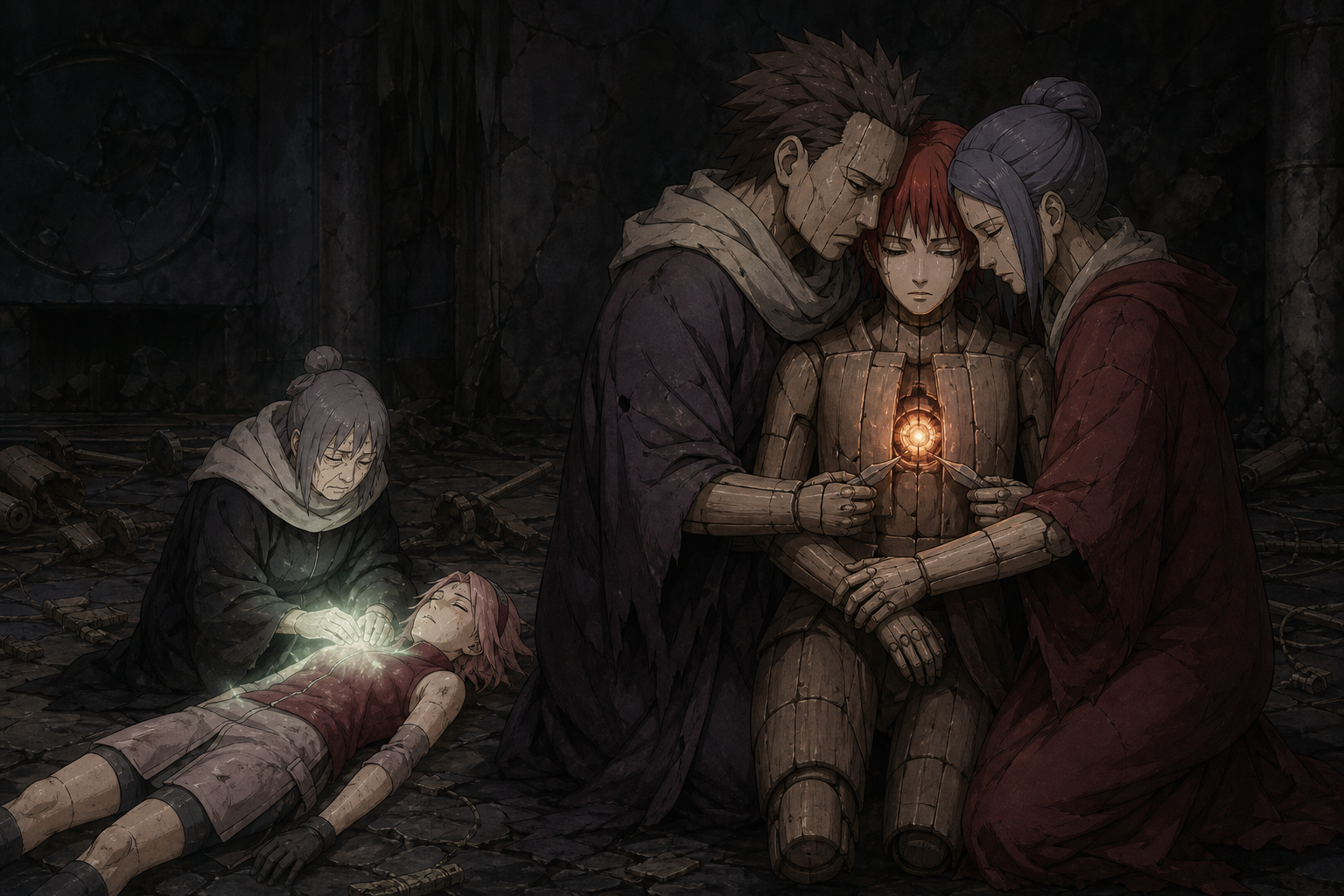
Chiyo gives Sakura the last antidote, while Sasori meets a final embrace that explains his wound without erasing his choices.
Care is the choice Sasori cannot price
Naruto Shippuden Episode 27 brings the Sasori battle to its emotional center through a decision that has nothing to do with winning. Chiyo is poisoned. Sakura is collapsing. Only one antidote remains. Chiyo gives it to Sakura.
Sasori mocks the exchange because he reads tenderness as weakness and sacrifice as bad arithmetic. If survival is the only value, the older woman should preserve herself. If people are replaceable materials, using a scarce resource on someone else makes no sense. Chiyo's choice confronts the entire system Sasori built.
She does not save Sakura because Sakura belongs to her. She saves her because Sakura is alive, vulnerable, and still has a future. The act gives without converting care into ownership. Sasori has spent years trying to possess what he fears losing. Chiyo finally responds to loss by protecting someone she cannot keep.
The final antidote is not a victory prize
Sakura created the antidote, but Chiyo decides who receives the remaining dose. The moment could have become a reward for individual achievement. Instead, it becomes proof that knowledge circulates through relationship.
Sakura's medical work saved Kankuro, protected her during the battle, and now returns to her through Chiyo's hand. No one person owns the chain of survival. Each action makes another action possible.
The limited supply gives the choice weight. If there were endless doses, using one would reveal nothing. Scarcity exposes priorities. Chiyo has every reason to fear death, yet she values Sakura's remaining life more than extending her own by a few minutes.
That does not make Chiyo careless with herself. It shows that she has stopped treating younger lives as pieces in an old village argument. Sakura is no longer merely Tsunade's student or a Leaf ninja. She is the partner Chiyo trusts.
Sasori attacks the bond he cannot understand
Sasori's mockery is defensive. Chiyo and Sakura have built the kind of connection his philosophy claims is useless. They accepted vulnerability, depended on each other, and became more capable because of it. His collection offers obedience without risk of rejection. Their partnership offers trust precisely because either person could have chosen otherwise.
When Sasori attacks Chiyo after the antidote exchange, he is not only exploiting an opening. He is attempting to punish the relationship. The choice Chiyo made threatens the story he tells about permanence. If temporary human bonds can create courage, knowledge, and survival, then a frozen collection is not superior simply because it lasts.
Sakura's response reinforces that threat. She protects Chiyo even after the older woman gave up her own antidote. Care moves in both directions without becoming a transaction.
This is what Sasori's puppets cannot reproduce. They can hold weapons, preserve techniques, and imitate an embrace. They cannot decide to give the last dose away.
Father and Mother return as a boundary
Chiyo turns the Father and Mother puppets against Sasori during the final exchange. The choice is emotionally brutal. These are the figures Sasori built as a child when he wanted his parents to hold him. Now their arms carry blades toward his living core.
The scene does not erase the original tenderness. It makes the distance between the child and the adult impossible to ignore. A lonely boy created an embrace. A grown man built a life around stolen bodies, poison, assassination, and control. The first wound belongs in the story. It does not cancel everything that followed.
Sasori appears capable of evading the strike. Chiyo recognizes that he could have moved. He does not. That hesitation is not a full redemption, and the episode wisely avoids turning it into one. A final choice can reveal that a buried attachment remained without repairing the lives he destroyed.
The parent puppets grant the shape of the dream, not the reality. Wood and steel close around him. The parents themselves are still gone. The embrace cannot provide forgiveness, childhood, or a different history.
Explaining the wound is not laundering the crimes
Sasori's childhood matters because suffering shapes people. It does not force one inevitable future. Grief helps explain why he first built puppets of his parents and why permanence became attractive. It does not make murder, kidnapping, poison, or human puppetry unavoidable.
Chiyo carries responsibility too. The adults around Sasori concealed the truth of his parents' deaths, failed to meet his grief honestly, and watched him withdraw into craft. She cannot undo that failure by loving him at the end. Regret is not retroactive care.
What Chiyo can do is act differently now. She protects Sakura. She confronts Sasori. She refuses to let affection stop her from opposing the harm he continues to cause. Love without accountability would only repeat the pattern of avoiding painful truth.
The episode holds grief and responsibility together. Sasori was wounded. Sasori wounded others. Both statements remain true.
The life-transfer technique changes meaning
Chiyo uses her life-transfer technique to stabilize Sakura. The jutsu introduces a frightening exchange: life can be given from one person to another. In this case, Sakura is not fully dead, so Chiyo survives the transfer. The exact boundary matters for what the arc will ask next.
The technique could resemble Sasori's philosophy if reduced to mechanics. Energy moves between bodies. One life becomes a resource for another. The moral difference lies in consent and purpose. Chiyo offers her own life. She does not steal someone else's.
Sasori takes bodies and turns them into extensions of his will. Chiyo risks her body to restore another person's will. The same world that allows terrifying control also allows radical care.
This moment quietly prepares us for Gaara without draining the current scene of meaning. Chiyo now knows what the technique requires. The audience sees that stabilization has a cost even when the recipient has not crossed fully into death.
Sasori leaves intelligence behind
Before dying, Sasori gives Sakura information about a spy connected to Orochimaru. The disclosure complicates his final minutes without cleansing them. He offers something useful, but the story does not pretend one piece of intelligence balances a career of harm.
Why he gives it matters less than what the act reveals. Sasori is still capable of choosing an outcome not dictated by his collection. He can pass information to the people who defeated him. The core that claimed to have removed human weakness remains human enough to act unpredictably.
That contradiction makes him more interesting. His philosophy was never as complete as he wanted it to be. Attachment, irritation, memory, and choice continued inside the supposedly permanent form.
The intelligence also keeps the narrative moving beyond this chamber. Orochimaru and the hidden spy route point toward another confrontation, another set of loyalties, and the possibility of reaching Sasuke. Sasori's end becomes a bridge without becoming a pardon.
Chiyo survives, and that detail matters
Chiyo expects the life-transfer technique to cost her life, but Sakura has not yet died. The transfer stabilizes her rather than resurrecting her, allowing Chiyo to remain alive. This is not a loophole inserted to soften the scene. It establishes the jutsu's operating rule.
The distinction between saving and resurrecting carries ethical and emotional weight. Stabilizing a living person demands enormous chakra and risk. Returning someone from death requires the giver's entire life. The technique refuses to make sacrifice abstract.
Chiyo receives a little more time after choosing to spend herself for Sakura. That time is not a reward guaranteeing peace. It is another opportunity to decide what her life will serve.
Sakura also wakes into a debt she did not request. The healthiest response will not be obedience to Chiyo. It will be carrying the care forward. Chiyo saved a future, not a possession.
Sasori's impossible dream
The title can refer to several impossible wishes. Sasori wanted his parents back. Chiyo wanted to reach the grandson she failed. Sasori wanted permanent art immune to loss. Each dream tries to remove the fact that time changes relationships.
The parent-puppet embrace is the closest Sasori can come to his childhood wish, and it proves why substitutes cannot complete it. The shapes are accurate. The emotional situation is not. A child wanted comfort from living parents. An adult receives a fatal strike from objects he built.
Calling the moment beautiful without its horror would flatten it. The embrace is moving because it contains love, failure, memory, and consequence at once. Sasori's refusal to dodge suggests that some part of him recognizes the figures. It does not tell us that he has repaired what he broke.
Chiyo's impossible dream may be reconciliation. She cannot recover the child by defeating the adult. She can only acknowledge both and stop the harm.
Sakura carries the living future
Sakura is unconscious for part of the episode's emotional climax, yet her presence determines Chiyo's choice. She represents a future that is neither guaranteed nor owned by the older generation.
Chiyo has spent years inside grief and village resentment. Saving Sakura is a decision to invest in what comes after her rather than preserve herself at any cost. It is also an admission that the younger generation has already exceeded some of the boundaries their elders maintained.
Sakura came from the Leaf to rescue the Sand's Kazekage. She learned from Tsunade and used that knowledge to counter a poison created by a Sand prodigy. Her body carries evidence that the old divisions are not the only possible structure.
This is why Sasori's contempt cannot define the exchange. He sees one foolish person wasting medicine on another. Chiyo sees someone worth protecting. The episode asks us to notice which worldview creates a future.
Final reaction
Impossible Dream gives Sasori a tragic ending without using tragedy as absolution. The parent puppets close around him in the shape of the comfort he wanted as a child. He chooses not to evade. The moment explains the wound that remained inside his core, but it cannot erase the people he turned into tools.
Chiyo's choice provides the moral center. She gives Sakura the final antidote and risks her life to stabilize her. Care becomes costly, voluntary, and directed toward someone else's future. It is everything Sasori's collection cannot manufacture.
The episode ends with grief, intelligence, and unfinished work. Sasori dies. Chiyo survives. Sakura carries information that may lead toward Orochimaru and Sasuke. Gaara still needs more than recovery of his body. The impossible dreams do not vanish, but the living characters still have choices available.
Official episode reference: Naruto Official episode guide
Licensed episode route: Crunchyroll licensed episode page
The final antidote reveals what scarcity cannot measure
A dose has chemical value, tactical value, and a limited supply. None of those measurements decides whose life deserves it.
Chiyo gives the antidote to Sakura because care refuses Sasori’s arithmetic of replaceable bodies. The choice is personal without becoming possession.
Sakura’s medicine returns through another person’s hand
She created the antidote, used it to save Kankuro, and carried it into the cave. Now Chiyo administers the remaining protection when Sakura cannot act for herself.
Knowledge circulates through relationship. The chain keeps no single hero at its center and still preserves the achievement of the medic who made survival possible.
Chiyo does not earn ownership through sacrifice
Giving away the dose and using life-transfer chakra do not create a debt that makes Sakura’s future belong to her.
Healthy care protects another person’s ability to choose after the crisis. Chiyo saves a life she may never control, and that is precisely why the act contradicts Sasori.
Sasori mocks the exchange because it exposes his poverty
He has a hundred bodies, rare techniques, replaceable shells, and no relationship capable of making voluntary vulnerability look rational.
Calling tenderness foolish protects his worldview from evidence. Chiyo and Sakura became stronger through the risk of depending on somebody who could answer back.
Care becomes threatening when domination calls itself permanence
Sasori eliminated refusal from his collection so nothing he keeps can leave. Chiyo’s choice accepts the opposite condition: Sakura may survive, change, disagree, and carry the gift somewhere Chiyo cannot follow.
A temporary bond creates a future his permanent objects cannot.
The parent puppets deliver consequence, not forgiveness
Father and Mother close around Sasori in the shape of the embrace he wanted as a child. Their blades do not transform that image into parental judgment from beyond death.
The puppets are Chiyo’s tools and Sasori’s creations. They can end the fight without speaking for the parents whose absence first gave them meaning.
Sasori’s failure to evade remains a choice, not redemption
Chiyo believes he could have escaped the final strike. If he stopped resisting, the decision reveals that attachment remained capable of interrupting his system.
One hesitation cannot balance murder, poison, conquest, or human puppetry. It complicates the final record without laundering it.
The child inside the image does not erase the adult timeline
Sasori’s longing for his parents was real and deserved care. Years still passed in which he developed skill, joined Akatsuki, killed people, and converted bodies into property.
Explanation respects chronology when it includes both wound and choice. Absolution would collapse the adult back into the child whenever accountability becomes painful.
Chiyo’s regret cannot travel backward
She cannot tell the truth earlier, remain present in the missed years, or give Sasori the parents whose deaths were concealed from him.
Regret becomes ethical only when it changes what she does with the life still available: protect Sakura, oppose ongoing harm, and stop hiding family failure behind silence.
Life transfer resembles exchange while reversing possession
Chakra and vitality move from Chiyo into Sakura, but the giver offers her own body rather than taking another person’s.
The technique restores the recipient’s agency. Sasori’s craft preserves bodies by removing the agency that once made them lives.
Stabilization establishes the boundary before resurrection
Sakura has not fully died, so Chiyo’s transfer does not take the elder’s entire life. The distinction gives the jutsu a real operating rule rather than vague sacrificial magic.
That rule also prepares the audience to understand what a later use for Gaara would demand without making Sakura’s recovery emotionally disposable.
Chiyo surviving creates another responsibility
She receives more time after being willing to spend it. The continuation is not a reward that proves virtue guarantees safety.
It is another interval in which she must decide whether remorse becomes service, truth, and repair or settles back into private sorrow.
Sakura wakes into continuity, not repayment
The healthiest response to being saved is not obedience to the savior. Sakura can carry the care forward through medicine, friendship, and choices Chiyo cannot script.
Generational repair succeeds when the younger person receives possibility rather than a new form of control.
Sasori’s information remains useful without becoming moral balance
The intelligence about Orochimaru’s spy can help Sakura and Team 7 pursue another urgent relationship. It is still one act at the end of a long harmful record.
Information should be evaluated for accuracy and consequence, not treated as currency purchasing retroactive innocence.
The hidden core remained human enough to contradict itself
Sasori claimed to have moved beyond ordinary attachment, yet his final choices include hesitation and disclosure. The system of permanence never removed every unpredictable response.
That contradiction does not rescue him. It proves the philosophy was incomplete even before the body failed.
The impossible dream belongs to more than one person
Sasori wanted his parents restored, Chiyo wanted the child recovered inside the adult, Sakura wants a route toward Sasuke, and the rescue team still wants Gaara returned.
Each dream confronts a limit. The moral question is whether people respond to that limit through possession, denial, care, or accountable action.
Chiyo chooses a future she cannot supervise
Sakura represents a younger generation crossing village lines with knowledge Chiyo did not create. Saving her is an investment in difference rather than reproduction of the elder’s own path.
That humility matters. Repair cannot require the future to resemble the person attempting it.
The episode refuses the comfort of a clean moral ledger
This is where the ending earns its ache. Nobody leaves the cave with a tidy account showing suffering paid, guilt cleared, and love returned to the correct owner. Sakura survives because several people shared knowledge and risk. Chiyo faces what her silence helped shape, but remorse does not magically convert into repair. Sasori dies with one last contradiction visible: the man who tried to make feeling obsolete still responds to the shape of an embrace.
That mess is not a flaw in the conclusion. It is the conclusion. Naruto keeps asking what people do after inherited pain reaches them, and this battle gives three different answers in the same room. Sasori freezes pain into ownership. Chiyo finally lets care move forward without demanding control. Sakura wakes with a future made possible by other people, then remains responsible for what she does with it.
I do not need the episode to declare one person pure before I can feel the loss. I need it to remember the victims, preserve Sakura’s agency, and let Chiyo’s love matter without pretending love arrived on time. “Impossible Dream” does exactly that. It closes the fight with tenderness in the frame and accountability still standing beside it.
RaeRae’s full take
The final antidote is the whole argument in one tiny dose. Sasori sees bad arithmetic because he can count bodies without recognizing futures. Chiyo sees Sakura, the person who saved Kankuro, fought for Gaara, trusted her strings, and still has choices nobody should own.
The parent-puppet strike is tragic without becoming forgiveness. Sasori may decide not to dodge, and that tells us his philosophy never removed every attachment. It does not restore the Third Kazekage, erase the poisoned victims, or make the dead parents speak through wood.
Chiyo’s real answer to her impossible dream is not recovering the child Sasori was. It is protecting someone alive now without turning that protection into control. She gives Sakura time and accepts that the future will belong to Sakura.
RaeRae checkpoint: Care is the choice Sasori cannot price because its value lies in a future the giver does not own. Chiyo saves Sakura and lets that future remain hers.
Receipts and official routes
- Episode number, titles, Chiyo’s antidote and life-transfer choices, Sasori’s final exchange, and the intelligence he leaves behind: Naruto Official Site episode guide.
- Licensed episode route: Crunchyroll.