
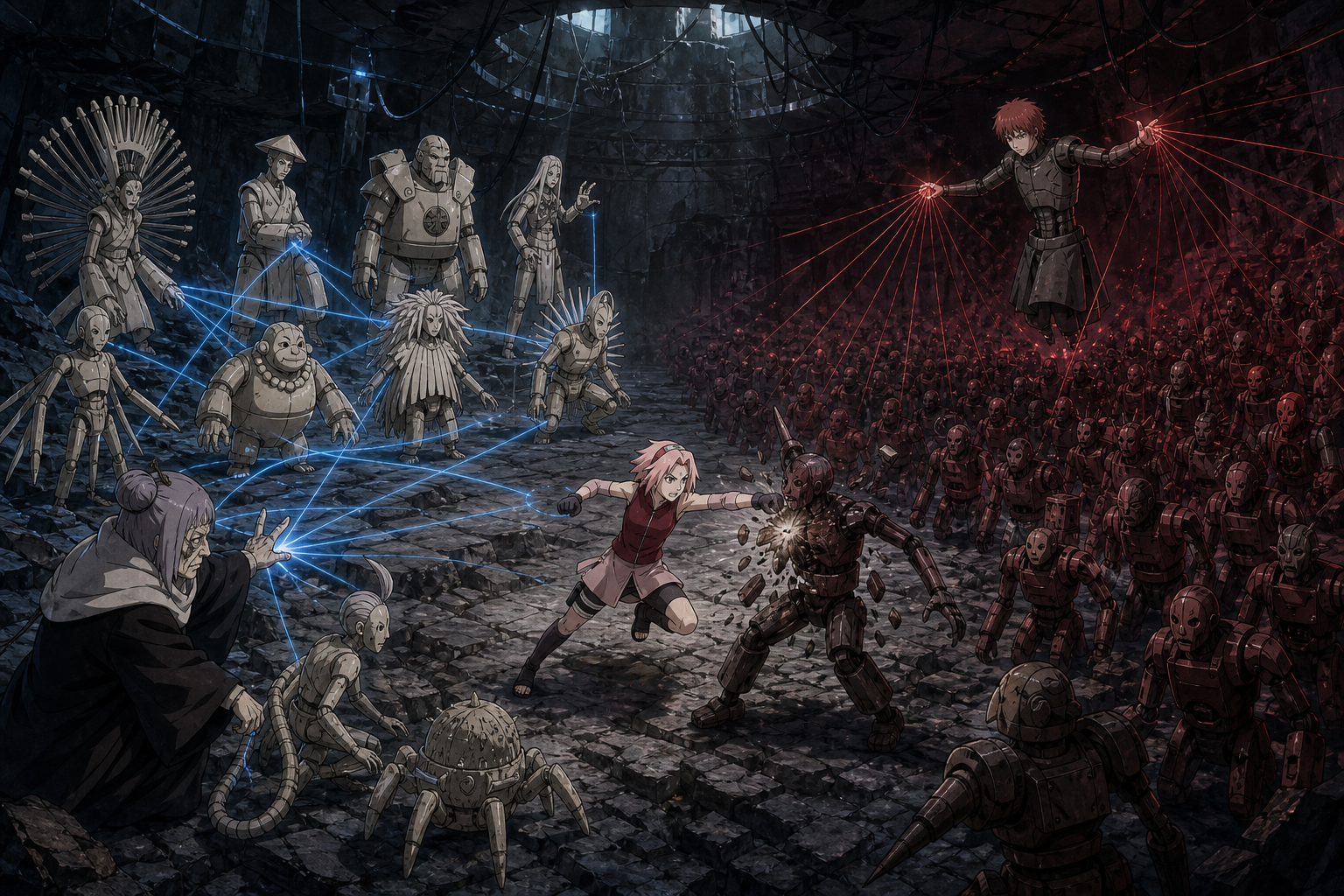
Puppet Fight: 10 vs. 100!
Chiyo answers Sasori’s army with ten masterworks, but Sakura keeps the fight from becoming a contest of collections.
The numbers are the least interesting part
Naruto Shippuden Episode 26 advertises a fight between ten puppets and one hundred, but the strongest idea is not arithmetic. Sasori fills the chamber with bodies emptied into weapons. Chiyo answers with a smaller collection that demands exquisite control. Sakura enters the swarm as the one participant who cannot be reduced to a string, a mechanism, or a number.
The scale is spectacular. It is also horrifying. Sasori's army represents people transformed into inventory and deployed in bulk. Individual histories disappear inside the formation. Chiyo's ten masterworks remain distinct, each designed for a particular function and controlled through a separate finger. The contrast is not simply quantity versus quality. It is accumulation versus relationship.
Sakura complicates both systems. She accepts Chiyo's guidance without surrendering her judgment. She moves through a battlefield built around controlled bodies while remaining capable of making an unexpected choice. That is why Sasori cannot fully calculate her.
Sasori turns conquest into a collection
Sasori's hundred-puppet technique carries a claim about his past. He boasts that this force allowed him to bring down a nation. The statement treats destruction as proof of artistic value. A country becomes the scale against which a collection is measured.
The puppets make that logic visible. They crowd the chamber until bodies seem interchangeable. One falls and another replaces it. Their weapons differ, but their role is the same: extend Sasori's will. He has converted human form into repeatable military capacity.
This is the endpoint of the philosophy he has been explaining since the battle began. Sasori values permanence, but his version of permanence requires removing everything that makes a person unpredictable. Memories, loyalties, aging, consent, and ordinary need all interfere with possession. The puppet keeps the useful technique and loses the inconvenient self.
One hundred puppets therefore do not make Sasori look less alone. They make the loneliness enormous. Every body in the room answers him, and none can answer back.
Chiyo's ten require presence
Chiyo's white secret technique uses ten master puppets, one for each finger. The smaller number is not a limitation she needs to apologize for. Each puppet has a role, and coordinating them demands constant attention. Chiyo does not flood the chamber. She creates a network of complementary actions.
Her mastery is visible in timing. One puppet blocks while another attacks. A third opens a route. The collection functions because Chiyo understands how separate tools can support one another without becoming identical.
That structure reflects the partnership with Sakura. Chiyo is not trying to make Sakura an eleventh puppet. The chakra strings help, but Sakura contributes perception and force that Chiyo cannot manufacture. Their teamwork gains strength from difference.
Sasori's army tries to erase difference through scale. Chiyo's technique coordinates difference through practice. The battle asks whether domination can overwhelm collaboration before the antidote window closes.
Sakura is not part of either collection
Sakura enters the puppet swarm directly, and her living presence changes the visual grammar. Puppets can be repaired, sacrificed, or replaced according to a controller's plan. Sakura can be poisoned. She can hesitate. She can also recognize a possibility no mechanism was assigned to pursue.
Her vulnerability is not a weakness the episode needs to hide. It is what makes her decisions matter. Sasori's puppets do not choose to enter danger. Sakura does. Each movement carries responsibility because the consequences belong to her body.
This also clarifies why Chiyo's guidance differs from Sasori's control. Sakura can resist, improvise, or protect Chiyo when the plan changes. The strings do not cancel her agency. They create another channel through which two people coordinate.
Sasori keeps attempting to convert living opponents into predictable materials. Poison should turn Sakura's body into a countdown. Numbers should turn her into a target lost inside the mass. She refuses both reductions by continuing to read and choose.
The cost of commanding a hundred
Sasori's technique looks limitless until the fight exposes its tradeoffs. More puppets mean more attack lines, more weapons, and more pressure. They also mean divided attention. Control becomes broad rather than intimate.
Chiyo understands that weakness because she knows the craft. A puppet master does not gain perfect command merely by adding strings. Each additional body creates another set of joints, distances, collisions, and timing problems. Sasori's genius lets him operate at extraordinary scale, but scale still has structure.
Sakura attacks that structure. Her strength removes puppets, but the important effect is disruption. A broken line opens space. A sudden advance forces Sasori to redistribute attention. Chiyo's ten can exploit gaps the mass formation creates.
The episode therefore avoids presenting the hundred as a simple power level. Numbers change the battlefield, but they do not remove the need for judgment. Sasori still has to decide where his living core, his attention, and his most useful pieces should be.
Chiyo is poisoned
When Chiyo is poisoned, the battle's emotional balance shifts. She has spent the confrontation protecting Sakura and guiding her around attacks that allow no error. Now the older master becomes the person in immediate medical danger.
The wound is not merely a countdown added for suspense. It forces the partnership to reveal its priorities. Chiyo cannot pretend she is only a controller standing outside the consequences. Her body is part of the fight. Sakura cannot focus solely on defeating Sasori while ignoring the person who made her survival possible.
Poison again becomes Sasori's attempt to claim the future. Once the toxin enters Chiyo, he assumes time belongs to him. Sakura's knowledge challenges that assumption, but resources remain limited. The antidote is not an endless answer.
This is where medical responsibility and combat urgency collide most painfully. Saving Chiyo may consume the tool protecting Sakura. Continuing the attack may leave Chiyo without enough time. There is no clean choice, only a choice that reveals what the characters value.
The sealing attempt almost works
Chiyo and Sakura manage to create what looks like a decisive opening. Sasori's puppet body is trapped, and for a moment the structure of his supposed permanence appears defeated. Then his living core transfers into another puppet.
The escape explains his design more clearly than another speech could. Sasori does not identify with the body the way other people do. The body is a platform. The core is the portable point from which control continues.
That mechanism is clever and deeply sad. He has solved the problem of a damaged body by making bodies disposable. Survival depends on always having another shell available. A collection that seemed like an army also functions as a supply of replacements.
The transfer does not make Sasori immortal. It reveals the narrow vulnerability he cannot eliminate. The living core must go somewhere. It has to travel, connect, and resume control. Permanence still depends on movement through temporary forms.
Mastery is not morality
Episode 26 puts two extraordinary puppet masters in direct comparison without pretending skill determines virtue. Sasori is capable of controlling a scale few people could imagine. Chiyo can animate ten masterworks simultaneously with precision. Both accomplishments are technically remarkable.
What matters is what the skill serves. Sasori's collection expands through murder and possession. Chiyo's technique, whatever its history, is used here to protect Sakura and stop further harm. Expertise does not excuse purpose.
Sakura reinforces that point. Her strength, medical knowledge, and chakra control become meaningful through responsibility. She does not need the largest technique in the chamber. She needs the correct action for the person beside her.
The episode respects craft while refusing to worship it. Sasori's hundred puppets are impressive. They are also evidence.
Ten versus one hundred is also intimacy versus distance
Chiyo's ten puppets remain close enough to read as individuals. Their different shapes and roles make the collection legible. Sasori's army recedes into a mass. Distance turns bodies into pattern.
That visual contrast mirrors the characters. Chiyo is being pulled back into relationship despite decades of isolation. She is learning to trust Sakura, to confront what happened to Sasori, and to act for Gaara's future. Sasori increases distance whenever relationship threatens him. He places shells, armies, poison, and philosophy between his core and everyone else.
The larger his collection becomes, the less contact he has to tolerate. Chiyo's smaller force requires her full presence. She cannot hide from each individual string.
Sakura crosses the distance physically. She moves into the army instead of treating it as an abstract wall. Her punches restore consequence to bodies Sasori considers replaceable. Each broken puppet changes the route to the person controlling them.
A human variable breaks the equation
The title frames the fight as ten against one hundred, but Sakura does not fit the equation. She is not one of Chiyo's puppets, even when chakra strings assist her. She is not merely another target in Sasori's formation. She is a decision-maker whose medical knowledge has already changed the expected outcome.
That makes her the most dangerous element Sasori failed to count. Collections behave according to design. Sakura learns during the fight. She can recognize when Chiyo needs protection, when a formation creates an opening, and when the cost of a plan has changed.
Sasori's transfer into another body shows the limit of a numerical victory. Destroying one shell does not end him. Sakura and Chiyo must understand the system rather than count defeated puppets.
The episode's action works because the intellectual problem and emotional problem are the same. How do you reach a person who has built an army of substitutes between himself and human contact? Force can clear space. It cannot guarantee that the person at the center wants to be reached.
Final reaction
Puppet Fight: 10 vs. 100! delivers the spectacle promised by its title, then gives the numbers meaning. Sasori's hundred represent scale without relationship, bodies made interchangeable under one will. Chiyo's ten represent concentrated mastery and coordination. Sakura represents the agency neither collection can reproduce.
The fight also exposes the instability inside Sasori's claim to permanence. His body can be trapped, so his core changes shells. His army can lose members, so he treats them as replaceable. Survival continues, but only through constant substitution.
Chiyo and Sakura survive through a different kind of exchange. They share knowledge, protection, timing, and risk. When Chiyo is poisoned, that relationship becomes more important than the score between two collections.
The episode leaves Sasori active and the danger unresolved, but it has already broken his favorite assumption. More bodies do not equal complete control. One living person who can learn, care, and choose remains impossible to count.
Official episode reference: Naruto Official episode guide
Licensed episode route: Crunchyroll licensed episode page
One hundred bodies make disappearance look efficient
Sasori’s army overwhelms the eye until individual forms blur into a moving wall. That loss of distinction serves his philosophy: a body matters as long as it extends his will and can be replaced when broken.
Mass production hides biography. The chamber is crowded with human shapes and emptied of recognized people.
Bringing down a nation is not an artistic credential
Sasori cites conquest as proof of what his collection can do. The boast turns a country’s destruction into a measurement attached to his name.
Scale can demonstrate technical power without granting moral value. A larger casualty count is evidence against the work before it is evidence of mastery.
Chiyo’s ten remain legible as different tools
Each puppet carries a distinct role, mechanism, and position in the formation. Chiyo’s control depends on remembering difference rather than flattening every piece into interchangeable force.
The smaller collection behaves as a network. Blocking, attacking, opening routes, and protecting Sakura matter because the roles answer one another.
Ten fingers reveal the cost of attention
Chiyo cannot command infinite detail simply by adding more strings. Every puppet asks for timing, distance, collision awareness, and a portion of her concentration.
Her mastery is not the number alone. It is the ability to keep separate functions coordinated while her own body remains exposed inside the fight.
Sasori’s hundred widen control and thin intimacy
He gains coverage, pressure, and replacement capacity at the price of treating the formation broadly. The army becomes strongest as pattern rather than as one hundred individually considered bodies.
That breadth creates gaps a living opponent can exploit. Scale is formidable, but it still depends on attention moving through a finite core.
Sakura is dangerous because she can revise herself
A puppet performs according to construction and command. Sakura observes the new field, protects Chiyo, and makes choices no controller assigned in advance.
Her vulnerability gives those revisions meaning. The consequences belong to her body, so adaptation carries responsibility rather than functioning as another replaceable mechanism.
Chiyo’s threads do not make Sakura number eleven
The connection supplies guidance without absorbing Sakura into the collection. She can resist, improvise, redirect attention, and act when Chiyo becomes the person in danger.
Their coordination gains value from the fact that two wills remain present. Sasori’s ideal system removes that complication entirely.
The antidote window keeps the human variable finite
Sakura can change the equation, but she cannot act without bodily limits. Poison protection expires, fatigue accumulates, and the battlefield keeps adding new demands.
Agency is not magical exemption from consequence. It is the ability to choose within conditions that remain real.
Chiyo’s poisoning tests whether care can change direction
The elder spent the fight guiding and protecting Sakura. Once poisoned, she becomes the person whose future Sasori expects chemistry to claim.
Sakura must hold combat pressure and medical obligation together. Reciprocity stops being an ideal and becomes an immediate allocation of attention and antidote.
A medic cannot treat relationship as a distraction
Saving Chiyo may consume time or resources that could be used against Sasori. Ignoring her would sacrifice the person whose expertise keeps Sakura alive and whose life matters beyond utility.
Medical judgment refuses that reduction. The patient is not valuable only because the mission needs another puppeteer.
The apparent seal exposes a body designed for substitution
Chiyo and Sakura create what should be a decisive capture, only for Sasori’s living core to transfer into another shell.
The escape reveals that the army was never only an offensive collection. It is also reserve embodiment, a field of possible places from which Sasori can continue controlling others.
Portability is not immortality
The core must still move, connect, and avoid destruction. Sasori has narrowed vulnerability instead of abolishing it.
His permanence depends on constant access to disposable structures. Survival becomes a supply problem disguised as transcendence.
Every replacement body enlarges the loneliness
Sasori can inhabit another shell without asking anyone for help, yet the achievement leaves him surrounded by extensions incapable of relationship.
Independence has become absolute control over objects rather than the ability to live among people who can surprise, refuse, and care.
Chiyo’s technique keeps her visibly accountable
She stands inside the chamber, attached to each string and vulnerable to the consequences of her decisions. Her body cannot pretend distance from the fight.
Sasori builds layers between his core and harm. Chiyo’s mastery requires presence, which makes error and responsibility harder to outsource.
Quantity does not erase the need for purpose
One hundred puppets can attack everywhere, but the formation still needs an objective selected by the core. Chiyo’s ten serve survival, protection, and interruption of further harm.
The episode respects both techniques while asking the question spectacle often avoids: what does this mastery make possible for other people?
The nation inside Sasori’s boast remains offscreen
We hear the achievement through the victor’s accounting, not through the people whose homes, bodies, or institutions were destroyed.
That absence is part of how conquest becomes a clean credential. RaeRae’s reading has to put the missing public back into the sentence.
Sakura restores consequence to a replaceable field
Every puppet she breaks creates space, changes attack lines, and forces Sasori to redistribute attention. The army may treat pieces as disposable, but their loss still alters the system.
Her strikes do not recover the lives behind any human puppets. They prevent those bodies from continuing to function as consequence-free extensions of the killer.
RaeRae’s full take
The numbers are a trap for the audience too. One hundred sounds automatically superior until we ask what the count contains. Sasori’s army is made powerful by bodies whose histories no longer matter to him. Chiyo’s ten remain different because she has to know what every one can do and keep their functions connected.
Sakura ruins the equation because she is alive in every sense Sasori’s system rejects. She gets tired, can be poisoned, changes her mind, protects Chiyo, and learns while the battle is happening. The risk is hers, which means the decision can be hers too.
Sasori moving his core into another shell is clever, but it is not freedom. He survives by always having another body available to use. Chiyo and Sakura survive by letting care, expertise, and responsibility move between two people who never become interchangeable.
RaeRae checkpoint: Ten versus one hundred is not a math problem. It is a fight between coordinated difference, mass possession, and one living person whose next choice cannot be stored in Sasori’s inventory.
A battlefield count can never become a human accounting
Ten and one hundred tell viewers how many controlled forms enter the exchange. Those numbers cannot tell us how many victims, craftspeople, histories, or acts of coercion made each collection possible.
Sasori prefers arithmetic because arithmetic removes names. Chiyo’s technique still risks reducing puppets to tools, but her alliance with Sakura forces a living person back into the center of judgment.
The honest accounting therefore tracks more than pieces destroyed. It asks who chose, who was used, who remains capable of refusal, and whose body carries the cost after the impressive formation disappears.
Receipts and official routes
- Episode number, titles, Chiyo’s ten master puppets, Sasori’s hundred-puppet army, and the continuing cave battle: Naruto Official Site episode guide.
- Licensed episode route: Crunchyroll.