
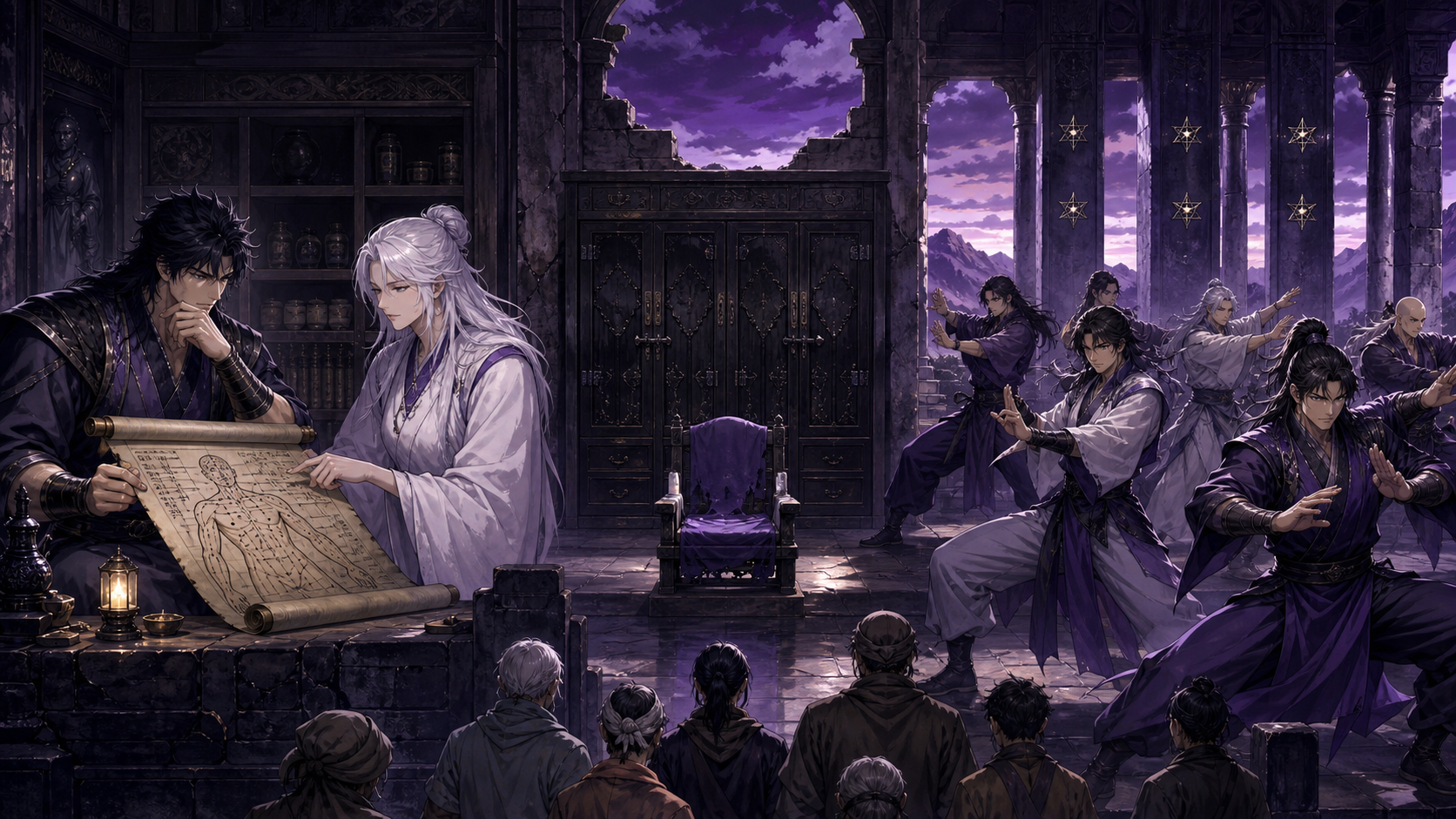
Hokuto and Nanto: Schools, Secrecy, and Political Power
Hokuto and Nanto control dangerous knowledge through succession, schools, stars, and secrecy. The real question is what those institutions owe the public.
Martial Arts Are Institutions
Hokuto and Nanto are not collections of cool moves floating outside society. They are institutions that select students, restrict knowledge, authorize heirs, preserve myths, and decide who may use extraordinary force. Those choices affect people who never enter a training hall.
The apocalypse does not erase institutional power. It makes private control of medicine, anatomy, mobility, and violence even more consequential.
Hokuto’s One-Successor Rule
Hokuto Shinken concentrates legitimacy in one successor. The rule may protect dangerous knowledge from uncontrolled spread, but it also turns family into competition and makes succession vulnerable to secrecy, favoritism, and violence.
A system that can heal or kill through intimate knowledge needs accountability. One heir may simplify command while creating a catastrophic single point of failure.
Nanto’s Fractured Plurality
Nanto contains multiple traditions, stars, techniques, and loyalties. Plurality allows specialization and competing philosophies, but fragmentation can make coordination difficult when a ruler weaponizes rivalry.
The six major traditions do not automatically form a democratic federation. Different schools can reproduce hierarchy even while no single successor owns the whole art.
Secrecy Can Protect and Exploit
Some techniques are dangerous enough that unrestricted teaching creates obvious risk. Secrecy can prevent abuse. It can also let masters avoid scrutiny, control students through dependency, and decide whose suffering counts as acceptable training cost.
The ethical question is not secrecy versus openness in the abstract. It is who governs access, how abuse is reported, and what obligations accompany rare knowledge.
Healing Knowledge Should Not Be Privately Hoarded
Toki proves Hokuto knowledge has therapeutic use. Once that possibility exists, succession becomes a public-health question. Why should one lineage decide who receives relief?
Dangerous medical knowledge needs training and safeguards, but scarcity created by tradition is not morally neutral when villages lack care.
Training Creates Bodies and Loyalties
Schools teach more than movement. They shape emotional language, masculinity, obedience, rivalry, and the meaning of strength. Students learn who deserves mercy and what failure says about identity.
Jagi, Raoh, Kenshiro, Toki, Rei, and Juda demonstrate that technique cannot be separated from the social rules learned around it.
Masters Need Accountability Too
A master’s authority can determine succession, exile, punishment, and which history becomes official. Tradition often treats that authority as natural because skill is visible.
Skill does not guarantee ethical judgment. Institutions need ways to question a master without forcing students to choose between silence and family collapse.
Villages Pay for School Conflicts
When elite fighters settle inheritance through combat, wells break, roads close, armies move, and ordinary people become leverage. The public absorbs costs while the schools call the conflict personal.
A responsible martial institution would plan for evacuation, repair, medical response, and limits on where techniques may be used.
The Empty Seat Problem
Succession stories obsess over who sits in the central chair. The harder question is what the chair is allowed to control. Replacing a cruel heir with a kind heir leaves the structure concentrated.
Kenshiro’s restraint helps, but good character is not a substitute for systems that can survive a bad successor.
What a Better Order Might Look Like
Hokuto’s medical applications could be separated into supervised teaching. Nanto schools could coordinate disaster response while preserving distinct traditions. Villages could participate in decisions affecting local safety.
The franchise does not need to become administrative fiction. Asking these questions reveals what its battles already decide.
RaeRae’s Verdict
Hokuto and Nanto stay fascinating because power comes with history, beauty, family, and consequence. The mythology becomes deeper when we stop treating succession as a private trophy.
A school earns legitimacy through what its knowledge does for people who cannot throw a single named technique. If the village only exists to bury students, the tradition has failed.