
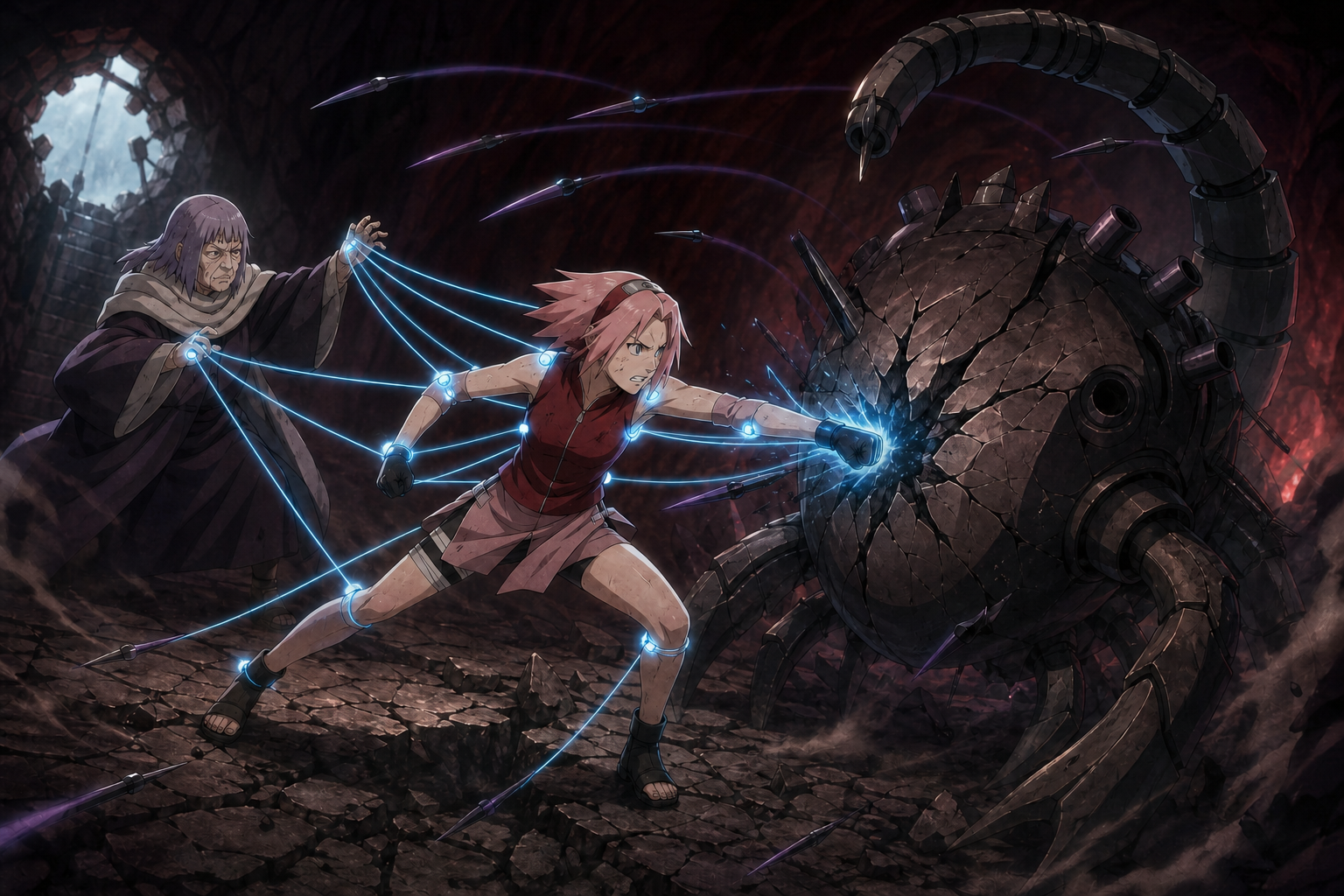
Hiruko vs. Two Kunoichi!
Chiyo guides Sakura through Hiruko’s lethal poison weapons while Sakura supplies the trust, precision, and force needed to break the shell.
Two bodies become one combat system
Naruto Shippuden Episode 20 gives Sakura and Chiyo a problem neither can solve alone. Hiruko protects Sasori behind armor, traps, a segmented tail, and poison capable of turning a scratch into a death sentence.
Chiyo can read the puppet's mechanisms, but her aging body cannot execute every evasive movement at Sakura's speed. Sakura has the strength to break Hiruko, but she cannot yet predict every weapon hidden inside it.
Their answer is chakra-thread coordination. Chiyo guides Sakura's movement while Sakura supplies the body, trust, judgment, and impact. Calling Sakura a puppet misses what makes the tactic work. She agrees to share control because each woman knows exactly what the other contributes.
Hiruko protects Sasori from consequence
Sasori fights from inside Hiruko, an armored puppet designed for offense and defense at once. The shell absorbs danger while launching weapons from concealed angles.
This is Akatsuki's recurring preference made personal. The organization used substitute bodies for Itachi and Kisame. Sasori uses a puppet body to place distance between his own flesh and retaliation.
Hiruko is not a neutral wall. Its shape controls what opponents can know. Sakura sees a monstrous exterior before she understands that Sasori occupies the structure within it.
To reach the person responsible, the women must first destroy the protected surface that lets him cause harm without appearing exposed.
Poison changes the meaning of a near miss
Hiruko's weapons do not need to land cleanly. A graze can be fatal because Sasori coats the blades and needles with poison.
That condition makes ordinary combat instincts unreliable. A fighter may accept a small wound to create an opening against a stronger opponent. Sakura cannot make that trade here.
Her medical knowledge gives the danger specificity. Poison is not an abstract status effect. It moves through circulation, damages systems, and consumes the limited time available for treatment.
The fight therefore demands precision before power. Sakura's strength matters only if she reaches Hiruko without allowing the puppet to convert a scratch into a delayed victory.
Chiyo reads the grandson behind the machine
Chiyo recognizes Hiruko's construction and the habits behind its attacks. She is not guessing at an unknown style. She is reading work shaped by the grandson she helped train.
That familiarity is painful, but it is also operational. She can anticipate where weapons are hidden, how the tail changes angle, and which movements signal the next trap.
The episode does not let knowledge remain private grief. Chiyo speaks it quickly enough for Sakura to use.
This is a meaningful reversal of secrecy. Puppet techniques often belong to lineage and village authority. Chiyo places inherited knowledge into the hands of a Leaf medic because survival matters more than ownership.
Sakura chooses the threads
Chiyo's chakra threads can move another body, but the strategy depends on Sakura's consent. She enters lethal range knowing that someone else will influence her balance and timing.
Trust of that kind is physical. Sakura must resist the impulse to fight every adjustment or anticipate Chiyo's movements independently. At the same time, she cannot become passive. She still reads the attack, controls chakra, and decides when to commit force.
The arrangement works because both women understand its temporary purpose. Chiyo is not claiming Sakura's body. She is lending timing to a teammate who lends strength in return.
Their agency is shared without becoming indistinguishable.
Chiyo does not replace Sakura's skill
The threads improve Sakura's evasive timing, but they do not create her medical training, balance, chakra control, or strength.
Sakura's body can survive the rapid changes because she trained it. Her punch can fracture Hiruko because she learned to concentrate chakra at the moment of impact.
Chiyo does not manufacture those abilities. She routes them through a field Sakura cannot yet read alone.
This distinction matters whenever support work is mistaken for proof that the supported person contributed nothing. Assistance changes what skill can accomplish. It does not erase the skill already present.
Sakura gives Chiyo reach
The partnership works in both directions. Sakura receives tactical guidance, while Chiyo receives a body capable of acting at the speed and force the plan requires.
Age has not removed Chiyo's knowledge. It has changed which forms of execution are sustainable. Rather than deny that limit, she builds around it.
This is competence without vanity. Chiyo does not insist on delivering the final strike because Sasori is her grandson. She recognizes that Sakura is the better instrument for that task.
Delegation becomes an expression of responsibility. Chiyo chooses the outcome over the appearance of individual mastery.
The women answer a control specialist with cooperation
Sasori's art is based on control. He turns puppets into extensions of his will and uses poison to dictate how opponents may move.
Chiyo also uses control threads, but the relationship is different. Sakura participates knowingly, retains her purpose, and benefits from the connection.
The visual similarity creates an ethical contrast. A technique does not determine the morality of its use. The relationship among the people using it does.
Sasori hides inside a body he commands. Chiyo stands visibly beside the person whose movement she assists. One arrangement conceals responsibility; the other requires trust.
Sakura's punch is the end of a long sentence
When Sakura breaks Hiruko, the impact is spectacular. The episode makes clear that the punch is not a self-contained miracle.
Chiyo identified the shell. She explained the poison. The two women practiced a shared rhythm under live attack. Sakura evaded weapons whose smallest contact could kill her. Only then did the opening become available.
The punch is the final clause in a sentence written through information, trust, and timing.
This makes the moment more impressive, not less. Strength used at the wrong instant would have been wasted or fatal. Sakura turns collective preparation into one decisive action.
Breaking armor reveals another layer
Destroying Hiruko does not defeat Sasori. It exposes the person who has been operating inside the shell.
That progression keeps the battle honest about systems of protection. Removing one barrier may only reveal the next layer of power.
The women still gain something important. Sasori can no longer attack through Hiruko's complete armor while hiding his form. Information increases as protection breaks.
The rescue team has repeatedly fought surfaces: projected Itachi, projected Kisame, the five-seal barrier, and now Hiruko. Progress means learning not to confuse the visible obstacle with the full opponent.
Kunoichi is not a lesser combat category
The title calls attention to Sakura and Chiyo as two women ninja. The episode answers any implication of novelty by giving them a technically demanding fight rather than a symbolic showcase.
Their skills are not interchangeable decorations around a stronger male opponent. Medical control, puppet knowledge, physical power, and tactical trust determine whether either survives.
The pairing also crosses age and village. A teenage Leaf medic and an elderly Sand puppeteer create a method neither institution trained as a standard unit.
Their effectiveness comes from treating difference as material for cooperation rather than a hierarchy.
Medical training belongs inside combat
Sakura's medical identity is often discussed as support after injury. Hiruko's poison makes medical thinking necessary before contact occurs.
She understands why a minor wound is unacceptable, how little time treatment might provide, and why reckless exchanges favor Sasori.
That knowledge shapes footwork, risk tolerance, and attack selection. Medicine becomes battlefield intelligence.
The episode continues Sakura's development from healer to combat medic without pretending those roles are separate. Her ability to preserve life changes how she applies force.
Trust has a technical shape
The chakra threads make trust visible. Every line connects Chiyo's fingers to a joint Sakura must move at the correct instant.
If Chiyo reads the attack badly, Sakura is exposed. If Sakura resists the guidance or commits force too early, the pattern breaks.
Their trust is not based on long friendship. They have known each other for days and began the mission with different assumptions about villages and generations.
What makes the tactic possible is earned evidence. Sakura cured Kankuro when Chiyo could not. Chiyo supplied knowledge during the Itachi fight. Each has watched the other place skill in service of the mission.
The fight revises the meaning of puppet
Sasori treats puppets as controlled bodies whose value lies in obedience. Chiyo and Sakura temporarily borrow the same visual language without accepting that definition.
Sakura is never reduced to material. Her strength, consent, and choices are the reason the connection works.
This revision matters beyond the fight. Shinobi institutions often call obedience teamwork while asking younger people to surrender agency.
Episode 20 shows a healthier model: expertise can guide another person's movement without claiming ownership of the person.
Precision is not the opposite of power
Sakura's reputation for strength can make precision look like a secondary concern. The Hiruko fight proves they are the same discipline expressed at different scales.
Her impact works because chakra reaches the fist at a controlled instant. Her evasions work because muscles answer small corrections without losing the larger attack line. Her medical judgment works because she can distinguish a survivable risk from poison exposure that ends the fight later.
Chiyo's threads operate through similar precision. A pull that is too early places Sakura in the next needle's path. A pull that is too strong disrupts the balance needed for the counterattack.
Neither woman is simply adding more force. They are reducing error until Sakura can apply enormous power once, where it matters.
That is why the battle fits Sakura's training under Tsunade. Medical ninjutsu and monstrous strength both depend on exact chakra control. The spectacle at the end is evidence of precision maintained under pressure.
Chiyo accepts a partner instead of a replacement
Chiyo could treat Sakura as a younger body substituting for her own physical limits. The episode gives the partnership more dignity than that.
Sakura brings knowledge Chiyo does not possess, including newer medical methods and a style of chakra-enhanced combat built outside Sand puppetry. Chiyo must respond to that expertise rather than merely direct it.
Their coordination develops through feedback. Sakura's balance tells Chiyo how far a thread can pull. Chiyo's adjustments tell Sakura which hidden weapon has changed the safe route. Each woman reads the other while reading Hiruko.
This turns the tactic from remote operation into conversation. The threads carry movement in one direction, but information travels both ways.
The distinction will matter as Sasori reveals deeper layers. A partner can improvise when the plan changes. A replacement can only repeat the function assigned to it.
The shell breaks before the family argument begins
Hiruko lets Sasori postpone direct recognition. Chiyo must fight a constructed exterior before she can look at the grandson within it.
That delay mirrors how families and institutions hide conflict behind roles. Sasori appears first as Akatsuki operative, poison maker, and armored threat. Chiyo carries grandmother, elder, and former puppeteer. Each role contains truth while protecting the person from a more painful encounter.
Sakura's punch destroys the physical shell, but it also removes Sasori's ability to keep the confrontation entirely mechanical. The next stage must involve the face Chiyo remembers.
Breaking armor does not solve the family history. It makes avoidance harder.
Sakura is essential precisely because she stands outside that history. She can recognize Sasori as a lethal opponent without losing sight of Chiyo's grief, and she can keep the fight moving when recognition threatens to freeze the elder in place.
Fandom arguments worth sorting out
One argument says Chiyo does all the work because she moves Sakura. Chiyo supplies timing and puppet knowledge. Sakura supplies trained movement, medical judgment, trust, and the force that breaks Hiruko.
Another argument says Sakura's strength makes strategy unnecessary. A single poisoned scratch can kill her. Strength matters only after the strategy creates safe contact.
A third argument treats Hiruko as Sasori's real body. It is an armored puppet shell protecting and concealing the operator inside.
The final argument calls the thread tactic humiliating for Sakura. Voluntary coordination under lethal conditions is not loss of agency. It is a sophisticated use of trust.
RaeRae's verdict
“Hiruko vs. Two Kunoichi!” understands that cooperation can join bodies without erasing people. Chiyo lends Sakura the timing produced by decades of puppet knowledge. Sakura lends Chiyo the speed, control, and force her aging body cannot provide alone.
Sasori also links himself to a puppet, but he uses that connection to hide, armor himself, and control danger from a protected interior.
The contrast gives the battle its meaning. Control is not the same as cooperation. The difference lies in consent, visibility, and whether both participants remain ends rather than tools.
Sakura's fist breaks Hiruko, but the victory belongs to the system the two women chose together. Knowledge created the route, trust kept it stable, and strength finished the sentence.
Consent changes the meaning of every chakra thread
From a distance, Chiyo moving Sakura resembles Sasori operating a puppet. The ethical difference is not cosmetic. Sakura understands the plan, chooses the connection, and remains capable of judgment inside it.
The threads support her agency because they help her survive toward an objective she shares. Sasori’s control replaces the purposes of bodies with his own.
Sakura is not empty space waiting for Chiyo’s expertise
Chiyo can identify Hiruko’s mechanisms, but the plan requires Sakura’s trained balance, chakra control, medical awareness, courage, and force. A body without those capacities could not execute the guidance.
The partnership joins two active forms of knowledge. Calling one woman the controller and the other a tool erases the conversation happening through movement.
Chiyo trusts Sakura with the part she cannot perform
Age changes Chiyo’s speed and endurance without erasing her tactical understanding. She refuses the vanity of pretending knowledge must remain valuable only when her own body delivers the final strike.
Delegation becomes responsibility. She gives Sakura the timing instead of demanding ownership of the victory against her grandson.
Poison makes precision a form of life support
A small cut can decide the fight after the visible exchange ends. Sakura cannot purchase an opening with the kind of wound another battle might treat as acceptable.
Her medical training determines movement before injury occurs. Prevention, diagnosis, and combat become one discipline because every choice has to account for what poison will do next.
Hiruko hides authorship as well as flesh
The shell makes attacks appear to come from a monstrous body rather than the person directing it. Sasori receives armor, concealment, and emotional distance from Chiyo.
Breaking Hiruko restores a line between action and actor. The women still face a lethal opponent, but he can no longer let the puppet absorb every consequence and every recognition.
Sasori and Chiyo use related craft toward opposite relationships
Both understand bodies, joints, threads, timing, and controlled movement. Technique alone cannot tell us whether the connection is care or domination.
Purpose and consent decide the difference. Chiyo adapts her control around Sakura’s survival; Sasori adapts bodies around obedience to himself.
The plan depends on communication too fast for speeches
Chiyo cannot explain every needle, tail angle, and concealed weapon while it moves. Sakura has to read pressure through the threads and respond with trained instinct.
Their coordination is a language built during danger. Each adjustment carries information, and Sakura’s physical response tells Chiyo whether the instruction matched the field.
Sakura’s strength becomes meaningful through restraint
She has enough power to fracture Hiruko, but throwing that power early would expose her to poison or strike the wrong surface. The decisive punch requires waiting for an opening precise enough to survive.
Restraint does not soften her strength. It proves she owns it rather than using impact as the only answer available.
Breaking the shell does not complete the family confrontation
Hiruko’s destruction removes one protective body and reveals Sasori’s face. It does not reconcile Chiyo with the child she remembers or settle responsibility for the adult before her.
Progress makes the real conflict visible. The women earn information and access, not emotional closure disguised as a shattered puppet.
Sakura stands outside the family story without becoming indifferent
She can recognize Chiyo’s grief while continuing to treat Sasori as an active threat. That external position is necessary when memory makes timing dangerous.
Support does not mean forcing Chiyo to forget love. Sakura helps ensure love does not grant Sasori control over whether both women survive.
The title names two women without reducing them to one role
Sakura is a medic and powerhouse; Chiyo is an elder, puppeteer, grandmother, and strategist. Their womanhood does not make their authority identical.
The fight works because difference is preserved and connected. Neither woman has to become a copy of the other to form a complete combat system.
The victory belongs to preparation as much as impact
The broken shell is visually Sakura’s moment, but the route includes Kankuro’s poisoning, Sakura’s antidote work, Chiyo’s recognition, and the trust accumulated since the teams met.
One punch carries an entire chain of evidence that these women can place skill in service of somebody beyond themselves.
RaeRae’s full take
I will not call Sakura a puppet here. A puppet does not choose the thread, bring medical judgment to every dodge, correct its own balance, or decide when to commit the strength that breaks the shell. Sakura remains present in every inch of this plan.
Chiyo is equally active without pretending her body can do what Sakura’s can. That humility matters. She gives timing, inherited knowledge, and the ugly truth about Sasori’s poison to a younger woman from another village because survival is more important than ownership.
Sasori’s craft makes bodies disappear beneath control. Their partnership does the opposite. The threads make cooperation visible, and the punch proves that shared authority can produce force without turning either participant into material.
RaeRae checkpoint: Chakra threads do not decide whether a body has agency. Consent, shared purpose, and the right to keep judging inside the connection decide that.
Receipts and official routes
- Episode number, titles, Chiyo’s explanation of Hiruko and its poison, the chakra-thread strategy, and Sakura’s strike against the shell: Naruto Official Site episode guide.
- Licensed episode route: Crunchyroll.