
Traps Activate! Team Guy’s Enemy
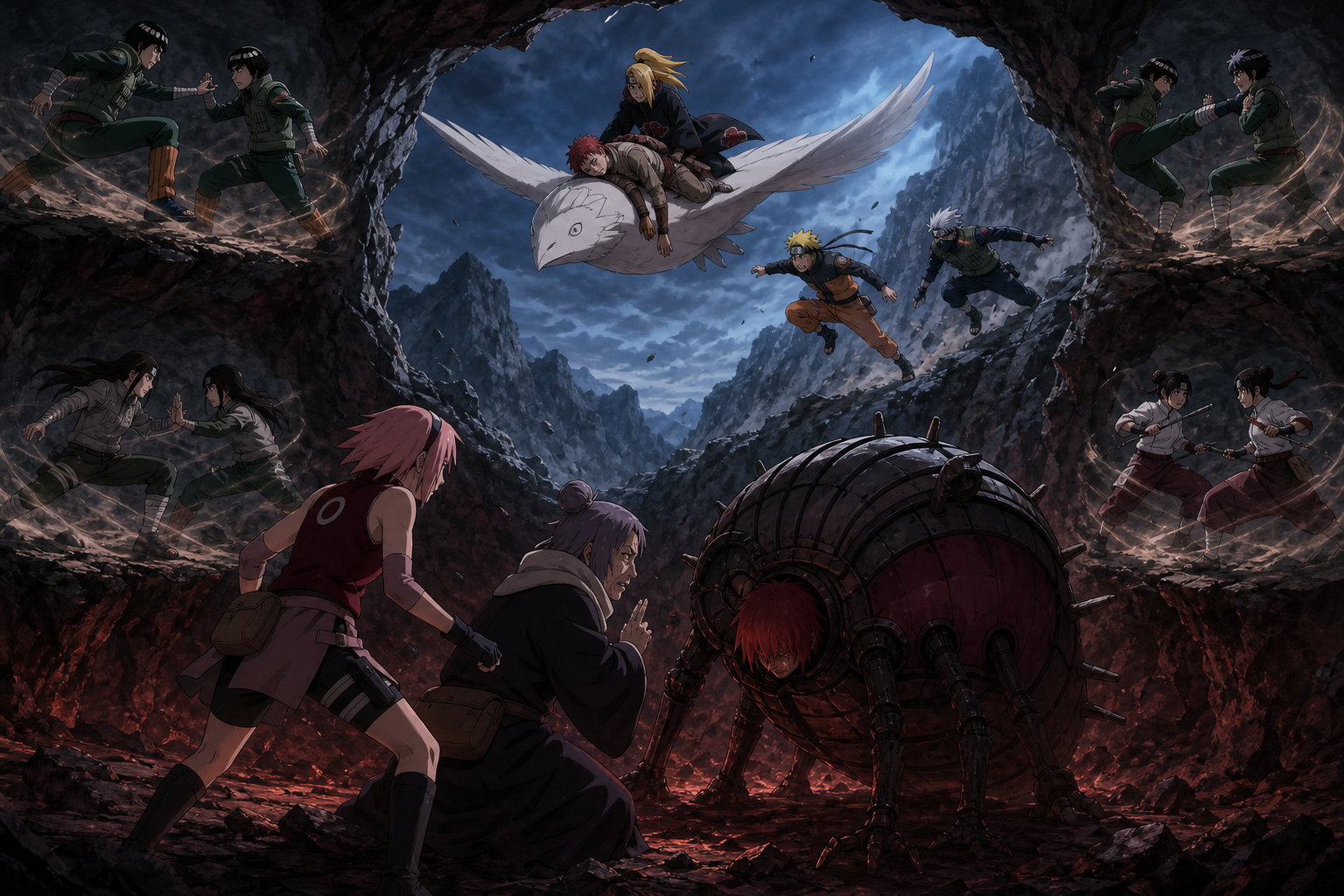
Akatsuki splits the rescue force as Naruto pursues Gaara’s body, Sakura stays with Chiyo, and Team Guy fights fresh copies of itself.
The rescue force is sorted by emotion
Naruto Shippuden Episode 19 divides the rescue force into three battles, but the split is not random. Team Guy remains isolated with perfect copies. Deidara carries Gaara's body away to pull Naruto and Kakashi from the cave. Sakura stays with Chiyo to confront Sasori.
Each path targets a different vulnerability. Team Guy must solve fatigue against familiar ability. Naruto must keep grief from becoming tactical capture. Sakura must enter a fight where Chiyo's knowledge is the difference between courage and ignorance.
Akatsuki does not need every member to defeat every rescuer. It needs to sort the group into smaller problems, then control the terms of each one.
Deidara understands that Gaara's body still has power
The extraction is complete, and Akatsuki no longer needs Gaara as a host. Deidara still recognizes that the body can control Naruto's movement.
This is another form of weaponization. Gaara's personhood did not matter to Akatsuki while he was alive, and his remains do not receive dignity after death. The body becomes bait.
Deidara does not have to explain the tactic. He leaves visibly enough for Naruto to follow. Grief performs the rest.
The cruelty works because Naruto refuses Akatsuki's definition of Gaara as an emptied container. He sees his friend. Deidara exploits that respect without sharing it.
Naruto chases because stillness feels like abandonment
Naruto cannot watch Deidara take Gaara away. The pursuit is emotionally inevitable even when it is strategically dangerous.
He has spent the arc fighting delay. Now the person he came to save is within sight, motionless and being carried farther away. Remaining in the cave would feel like agreeing that Gaara is already beyond help.
Naruto's movement therefore contains both loyalty and manipulation. The loyalty is real. The enemy's ability to direct it is also real.
The episode does not ask Naruto to care less. It asks whether care can survive contact with a tactic designed around its most immediate expression.
Kakashi follows the risk, not the bait
Kakashi knows Naruto cannot be left alone with Deidara. He follows, turning one impulsive pursuit into a two-person operation.
That choice protects Naruto but reduces the force facing Sasori. Leadership here is triage. Kakashi cannot keep every specialist together after Deidara creates motion.
His warning to Sakura and Chiyo not to take unreasonable risks sounds almost inadequate because he knows exactly whom they are facing. Yet he also knows that dragging Naruto back by force could waste the opening and leave Gaara unrecovered.
Kakashi follows the person most likely to be isolated by grief, while trusting the two people with the best chance of understanding Sasori.
Sakura stays where knowledge can become action
Sakura does not chase Naruto. She remains with Chiyo in the cave.
That is not emotional distance from Gaara. It is mission discipline. Sakura recognizes that Deidara's movement has created two objectives and that Sasori cannot be ignored.
Her medical knowledge, chakra control, and physical strength are suited to a close confrontation where poison and puppetry are likely. Chiyo can explain the enemy, but explanation requires someone able to act on it.
Staying also marks Sakura's growth beyond defining Team 7 as following Naruto wherever he runs. She occupies the position the mission needs rather than the position that offers emotional reassurance.
Chiyo faces the grandson she remembers
Episode 18 left Chiyo remembering Sasori as a lonely child. Episode 19 places his weaponized shell in front of her.
The distance between memory and present is the emotional terrain of the fight. Chiyo knows his techniques because she helped teach the craft that shaped them. She also knows that technical familiarity will not restore the child she remembers.
Her knowledge creates advantage and responsibility. She can identify mechanisms, anticipate poison, and explain how Sasori hides behind Hiruko. She cannot pretend that expertise is neutral.
The confrontation asks what an elder owes after recognizing that inherited skill became an instrument of harm.
Sasori chooses armor that looks like a body
Hiruko lets Sasori fight from inside a puppet shell. The design protects his real body, conceals movement, and turns distance into defense.
It also fits his larger philosophy. Sasori treats bodies as materials that can be preserved, modified, and controlled. He does not simply operate a weapon. He inhabits a structure that makes the boundary between operator and object difficult to see.
Sakura and Chiyo must attack without assuming the visible form is the whole enemy. That echoes the earlier Itachi and Kisame decoys. Akatsuki repeatedly places a replaceable surface between its members and consequence.
The difference is personal for Chiyo. She knows the person concealed inside this one.
Team Guy fights equality without context
Guy, Lee, Neji, and Tenten confront copies that reproduce their abilities with startling accuracy. Technique alone offers no obvious advantage.
The copies have movement and power, but they do not share the path that produced those skills. They did not train together, choose assignments, or spend chakra reaching the seals.
That missing context may matter more than any isolated technique. Real fighters adapt through memory, relationships, and purpose. A copy can reproduce a move without necessarily understanding why its original changes the move under pressure.
The episode begins the test before revealing the solution. It establishes the unfair baseline: the doubles have matching ability and fresher bodies.
The trap taxes competence
Team Guy did everything correctly. They found the tags, reached the positions, synchronized removal, and opened the barrier. The reward was an enemy tailored to each participant.
This is a trap built to tax competence. A weaker team might never open the door. A stronger team activates a more personalized defense.
Akatsuki assumes capable opponents will cooperate, so it turns cooperation into dispersal. It assumes specialists will solve assigned problems, so it prepares copies of those specialists at the solution sites.
The episode makes preparedness feel predatory. The enemy has studied not only who might arrive but how trained rescuers are likely to behave.
Mirror fights expose the cost of fatigue
The real Team Guy members begin these battles after Kisame's decoy, long travel, and the seal operation. Their copies appear ready.
Equal ability under unequal fatigue is not equality. The doubles can match pace while the originals pay for every earlier mission stage.
This explains why simply using a stronger familiar technique may fail. The copy can answer with the same escalation while holding a better energy position.
The heroes need a difference the technique cannot reproduce. That difference may be growth during the battle, commitment to teammates, or the ability to exceed the version of oneself captured when the trap formed.
Tenten's mirror validates and confines her
Tenten's replica proves the trap recognizes her full combat ability. She is not excluded from Akatsuki's preparation.
That recognition is double-edged. The copy validates her as a necessary threat while confining her inside the same toolkit she already uses.
Her challenge is not to show that weapons mastery matters. The enemy has already conceded that by reproducing it. She must find how judgment, timing, terrain, or invention makes mastery more than a fixed inventory.
The matchup offers a useful standard for every Team Guy fight: a person is not reducible to the abilities an observer can catalogue.
Neji faces the danger of a fixed self
Neji's early worldview treated destiny as something visible and predetermined. A perfect copy is that worldview turned into an opponent.
The replica implies that Neji can be completely described by bloodline, stance, and technique. If that description is complete, neither fighter can create an advantage.
Neji's growth has already challenged fixed destiny. The mirror fight asks him to apply the same lesson to combat identity.
He must become more than the snapshot Akatsuki copied. Adaptation becomes another refusal to accept that inherited structure determines every outcome.
Guy and Lee cannot out-repeat repetition
Guy and Lee trust training because repetition transformed their bodies. The copy trap makes repetition available to the opponent without the same history.
The obvious response is to work harder, move faster, and strike with greater force. That may only invite a mirrored escalation.
Their deeper advantage lies in what training taught beyond muscle memory: how to endure discouragement, how to read one another, and how to create effort when an earlier limit has already been reached.
The doubles resemble the product of training. The originals carry the meaning that kept the training alive.
The cave pair has complementary authority
Chiyo knows Sasori's background, puppets, and likely poisons. Sakura understands modern medical practice, precise chakra control, and devastating physical force.
Neither expertise is sufficient alone. Chiyo can recognize danger without having Sakura's current body or training. Sakura can act powerfully without knowing every hidden mechanism.
Their partnership refuses a false contest between age and youth. The fight needs inherited knowledge and newer technique connected in real time.
This pairing also continues their work from Kankuro's treatment. Chiyo supplies context from the poison maker's world; Sakura converts that context into intervention.
Naruto and Sakura choose different forms of loyalty
Naruto pursues Gaara's body. Sakura stays to confront one of the people responsible. Both choices serve the rescue, but they express loyalty differently.
Naruto refuses separation from the friend he can see. Sakura accepts separation so the enemy cannot control every remaining path.
The episode avoids declaring one emotional form pure and the other cold. Naruto's pursuit needs Kakashi's protection. Sakura's discipline needs Chiyo's knowledge.
Teamwork does not require identical responses to grief. It requires those responses to cover one another's vulnerabilities.
Akatsuki tries to own the team's attention
Deidara controls Naruto's eyes with Gaara's body. Sasori controls the cave through threat and history. The replicas force Team Guy members to focus entirely on themselves.
Each defense narrows attention. Naruto sees only the fleeing body. Chiyo sees the grandson inside the shell. Team Guy sees familiar movements reflected back.
The rescue force must keep a larger mission alive while every local fight demands total concentration.
That is Akatsuki's strategic advantage. It does not merely divide bodies across terrain. It divides the stories each fighter believes they are inside.
Fandom arguments worth sorting out
One argument says Naruto foolishly falls for obvious bait. The bait works because abandoning Gaara's body would violate the bond driving the mission. Kakashi follows to keep that loyalty from becoming isolation.
Another argument says Sakura is left behind. She stays with the one ally who understands Sasori and becomes the physical force of the cave team. That is assignment, not abandonment.
A third argument dismisses Team Guy's copies as repetitive animation. The matchups establish unequal fatigue and ask whether a person exceeds a copied toolkit.
The final argument treats Chiyo's connection to Sasori as a weakness only. It is also the source of information Sakura needs to survive.
RaeRae's verdict
“Traps Activate! Team Guy's Enemy” is about deliberate separation. Akatsuki turns Gaara's body into a leash for Naruto, leaves Sasori as a personal wall for Chiyo, and forces every Team Guy member into an exhausting argument with a fresh version of themselves.
The rescuers answer by redistributing care. Kakashi protects Naruto's pursuit. Sakura stays where her strength and medical control can serve Chiyo's knowledge. Team Guy keeps fighting alone so the cave remains open.
No path is emotionally neutral. Naruto risks capture because he cannot leave Gaara. Chiyo risks hesitation because the enemy is her grandson. The originals risk despair because their own abilities appear to belong to the trap.
The episode's real question is whether relationships produce something Akatsuki cannot copy or manipulate. The next battles will have to answer with more than stronger versions of familiar moves.
Akatsuki assigns every person a private emergency
Deidara gives Naruto a fleeing body, Sasori gives Chiyo the grandson she failed to reach, and the replicas give Team Guy opponents who occupy every familiar movement. The rescuers are separated physically and narratively.
Each person begins experiencing a different mission even though every fight belongs to Gaara’s recovery. Akatsuki gains power when those private emergencies crowd the shared objective out of view.
Gaara’s body becomes a command without his consent
Deidara knows Naruto will read movement as urgency. Carrying Gaara away says follow me more effectively than any spoken challenge.
The tactic extends the violence already done to Gaara. Akatsuki used his living body for Shukaku and now uses his dead body to move another jinchuriki across the battlefield.
Naruto’s pursuit is manipulated and morally intelligible
Calling the chase an obvious mistake ignores what refusal would mean to him. Leaving Gaara’s body in Akatsuki’s hands would repeat the world’s claim that a host stops mattering once the useful power is gone.
The danger lies in letting that correct refusal determine every tactical detail. Kakashi follows because love needs protection from the enemy studying its expression.
Kakashi chooses accompaniment over condemnation
He could spend precious seconds scolding Naruto for reacting. Instead, he joins the pursuit and works to keep Naruto from facing Deidara alone.
Leadership meets the person where the risk already exists. Kakashi cannot erase grief on command, but he can keep grief connected to another trained perspective.
Sakura’s decision is not abandonment
Staying in the cave may look emotionally quieter than chasing Gaara. It preserves pressure on an Akatsuki member, protects Chiyo, and prevents Sasori from controlling the entire entrance.
Sakura’s loyalty appears as position discipline. She trusts Kakashi to cover Naruto while using the skills only she can bring to the fight remaining in front of her.
Chiyo’s knowledge carries love and complicity together
She recognizes Sasori’s craft because she participated in the world that taught it. The same intimacy that creates hesitation also gives Sakura information capable of keeping them alive.
The episode refuses to make family knowledge innocent or useless. Chiyo must face what she enabled while spending that knowledge against the harm her grandson now chooses.
Hiruko makes distance look like invulnerability
Sasori hides inside a puppet body, attacks through mechanisms, and keeps his own flesh away from immediate consequence. The shell turns protection into an identity.
Breaking Hiruko will require more than hitting the visible shape. Sakura and Chiyo need to understand how the operator, weapon, poison, and concealed body function as one system.
The cave team joins two incomplete kinds of authority
Chiyo knows Sasori’s history and puppet design. Sakura has contemporary medical training, precise chakra control, and the force needed to break a defense.
Neither woman is reduced to assistant. Their authority overlaps without becoming interchangeable, and survival depends on treating both forms of knowledge as central.
The mirror copies begin with stolen freshness
Guy, Lee, Neji, and Tenten already fought, traveled, climbed, and removed the seals. Their replicas arrive without paying any of those costs.
Matching techniques disguise an unequal contest. Akatsuki copies the visible product of training while leaving the original person responsible for every exhausted step that produced the encounter.
A copy captures a record, not a future
If the replicas reproduce the fighters as they were when the trap activated, the originals still possess the ability to change after that moment.
Growth becomes tactical rather than inspirational. A person can create a difference by learning inside the fight, revising a habit, and refusing to remain the version the enemy catalogued.
Tenten’s fight deserves the same structural reading
Her weapons are copied because her station mattered enough to defend. The trap acknowledges the danger of her range and precision even when the larger narrative gives her less attention.
Her problem is not proving relevance. It is turning terrain, timing, and judgment into an advantage a static inventory cannot guarantee.
Neji confronts destiny in combat form
The double suggests his bloodline and mastered techniques completely determine what he can become. That premise resembles the fixed worldview he once defended.
Escaping the matchup requires the lesson he learned through Naruto: inheritance describes real conditions without exhausting the future. Adaptation is another argument against a finished fate.
Guy and Lee need more than the labor the trap stole
Their disciplined repetition built extraordinary bodies, but simply repeating harder gives the replicas the same script. The trap copies performance and waits for fatigue to decide the result.
The originals carry relationships, teaching, failure, and purpose. Those histories can generate choices that a reproduced technique does not know it needs.
Distributed care prevents the split from becoming abandonment
Kakashi stays with Naruto, Sakura stays with Chiyo, and Team Guy members continue holding the remote danger created by opening the cave. Nobody receives complete protection.
The mission survives because responsibility is redistributed rather than withdrawn. Separation becomes dangerous, but it does not have to mean that anyone has been discarded.
The episode asks whether grief can remain accountable
Naruto’s anger is justified, Chiyo’s sorrow is real, and Sakura’s determination is personal. Each feeling still produces consequences for teammates.
Accountability does not demand less love. It asks every person to notice when an enemy is using love to narrow options, isolate bodies, or decide whose danger becomes invisible.
RaeRae’s full take
Deidara understands Naruto with disgusting accuracy. He does not need to defeat Naruto’s love for Gaara. He only needs to point it down one path and separate it from everybody else. Kakashi following is the difference between witnessing grief and leaving a grieving teenager alone inside a trap.
Sakura staying with Chiyo is equally loyal. She does not have to chase the most visible body to prove she cares. Her job is to keep Sasori from owning the cave, make Chiyo’s knowledge actionable, and survive the poison waiting inside that puppet shell.
Team Guy receives the cruelest version of equality: the same skills without the same fatigue. The originals have one advantage Akatsuki cannot manufacture cleanly. They can become different during the fight because their techniques belong to lives still moving forward.
RaeRae checkpoint: Akatsuki does not merely split the rescue team. It gives every person a private story urgent enough to forget the shared one. Care survives when somebody remains connected across each separation.
Receipts and official routes
- Episode number, titles, Team Guy’s replicas, Deidara carrying Gaara away, Naruto and Kakashi pursuing, and Sakura remaining with Chiyo against Sasori: Naruto Official Site episode guide.
- Licensed episode route: Crunchyroll.