
Charge Tactic! Button Hook Entry!!
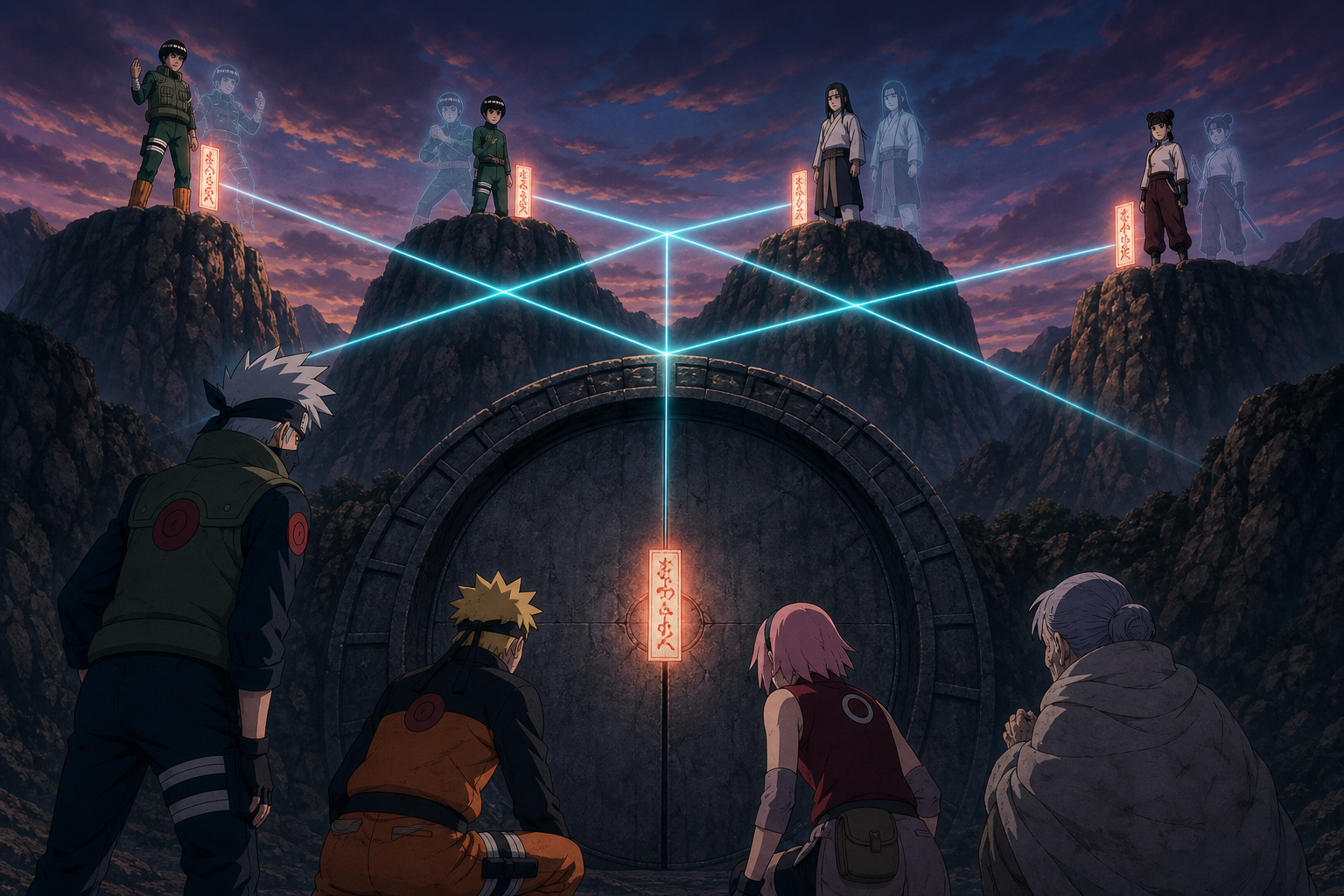
Neji maps Akatsuki’s five-seal barrier as two teams coordinate a simultaneous entry and Team Guy discovers the trap inside the solution.
The cave entrance is a coordination problem
Naruto Shippuden Episode 18 brings both rescue teams to Akatsuki's hideout, then refuses to let arrival count as access. A five-seal barrier protects the entrance. The only way through is to remove every tag at the same moment.
The obstacle changes the meaning of strength. Naruto cannot overwhelm it with chakra. Sakura cannot break the stone before the seal is disabled. Kakashi cannot solve it alone through experience. The teams need Neji to locate the distant tags, Team Guy to reach them, and everyone to trust a synchronized count they cannot verify by sight.
That is why the button-hook entry matters. It is a method for entering danger through coordinated angles, not a dramatic name pasted onto a charge. The rescue succeeds or fails through distributed work.
Neji makes the invisible system legible
The Byakugan gives Neji the episode's decisive information. He can see how the barrier extends beyond the stone door and identify the four remote tags hidden across the surrounding terrain.
Vision here is not merely combat superiority. It is systems analysis. Neji recognizes that the object in front of the team is only one node in a larger design.
Without that information, Sakura might waste strength against a door that automatically repairs its protection. Naruto might treat persistence as the missing ingredient. Neji replaces trial and error with a map.
His contribution also validates a form of leadership that does not issue every order. Kakashi remains mission commander, but the plan depends on accepting Neji as the authority on what his eyes reveal.
Five tags require simultaneous trust
Removing the tags one by one will not work. The barrier exists as a network, so the countermeasure must behave like one too.
Team Guy splits across the region while Team Kakashi remains at the entrance. Once separated, the participants cannot watch every hand reach every seal. They must rely on timing, radio communication, and each teammate's ability to arrive ready.
This is trust stripped of sentimental language. Nobody receives reassurance from seeing the full formation. Each person controls one small action whose value depends on four other actions occurring elsewhere.
The plan also makes lateness collective. A single missed count preserves the barrier for everyone. That pressure could turn teammates against the slowest person. Instead, the operation treats synchronization as a shared responsibility.
Team Guy stops being “backup”
Support teams are often framed as optional insurance for the main heroes. Episode 18 makes that hierarchy impossible. Kakashi's team cannot enter without Guy, Lee, Neji, and Tenten occupying the remote seal positions.
Each assignment removes one fighter from the concentrated force at the door. That is a risk, but keeping everyone together would guarantee failure.
The mission therefore values coverage over spectacle. Team Guy's dispersed labor may be less visible than Sakura striking the entrance, yet it creates the condition that makes her strike meaningful.
This is the episode's strongest argument about teamwork. A person working alone on a distant cliff is still part of the central action. Distance does not reduce contribution when the system requires every position.
Sakura's strength needs a prepared opening
Sakura stands ready to break through once the barrier drops. Her strength remains extraordinary, but the episode places it inside a chain of dependencies.
Neji must find the tags. Team Guy must reach them. The seals must be removed simultaneously. Only then can Sakura's punch turn access into entry.
That sequence does not diminish her power. It gives the power a precise job. Force becomes useful after information and coordination create the correct target.
The distinction matters because the series often celebrates the visible finishing move more loudly than the work that enables it. Episode 18 keeps both layers in the same plan. The final impact belongs to Sakura, while the opening belongs to everyone.
Kakashi manages a team he cannot keep together
Kakashi's command problem becomes harder when Team Guy disperses. He must coordinate people beyond immediate sight while protecting Naruto, Sakura, and Chiyo at the entrance.
The situation tests whether leadership can survive decentralization. Kakashi cannot personally correct every movement or inspect every seal. He gives the plan enough structure, then allows specialists to execute it.
That restraint is part of competence. A commander who insists on controlling every detail would slow the operation and undermine the very expertise the mission needs.
Kakashi also has to preserve focus after learning Gaara may already be dead. The barrier encourages frustration because it places another procedure between Naruto and the person he wants to reach. Kakashi turns urgency into sequence.
Naruto has to accept indirect action
Naruto's instinct is to move directly toward Gaara. The five-seal barrier demands the opposite. Progress requires waiting while teammates travel away from the cave.
For Naruto, that delay feels intolerable. He has just learned that extraction kills the host, and every obstacle confirms his fear that they are too late.
Accepting the plan is therefore emotional discipline. Naruto must trust work he cannot see and understand that immediate contact with the door is not the same as useful movement.
This lesson extends his growth from the Itachi fight. He does not prove devotion by isolating himself from the formation. He honors Gaara by helping the formation function.
Akatsuki designed the barrier around rescue behavior
The five-seal barrier does more than block entry. It predicts how a competent rescue team will respond.
An unprepared group may fail to find the remote tags. A prepared group will divide its strength to remove them. That division activates the next layer of the trap.
Akatsuki has turned correct problem-solving into exposure. The heroes must do exactly what the enemy expects because no alternative route exists.
This is more sophisticated than a locked door. The barrier gathers information about the rescuers, controls their positions, and arranges them for isolated combat. It converts their teamwork into a map the enemy can exploit.
The copies weaponize self-knowledge
When the seals come off, replicas of Guy, Lee, Neji, and Tenten appear near the remote positions. Each fighter must confront an opponent built from their own abilities.
The trap removes the comfort of matchup advantage. Speed cannot surprise a copy with the same speed. Technique cannot exploit ignorance when the opponent mirrors the technique. Familiarity becomes a weapon pointed backward.
The copies are especially cruel because Team Guy has already spent energy reaching the seals. The replicas arrive without sharing that fatigue.
The problem is not merely “fight yourself.” It is fight the version of your skill that has not paid the price of the mission so far.
Fatigue is the hidden inequality
A perfect technical copy may look equal, but the battlefield conditions are not equal. The real Team Guy members fought Kisame's substitute, traveled to the hideout, dispersed across difficult terrain, and removed the seals.
Their doubles begin at the moment of confrontation. They inherit abilities without inheriting exhaustion.
This makes the trap another example of Akatsuki outsourcing cost. The organization wants the rescuers to spend energy reaching each layer while its defenses appear fresh at every stage.
Endurance becomes more than physical toughness. The team must recognize that repeating familiar techniques against a rested mirror may only deepen the disadvantage.
Tenten's position matters as much as the door
Tenten often receives less narrative attention than the teammates around her. The five-seal plan cannot afford that habit.
Her tag is one of the required five. If she does not reach it, identify the count, and remove it on time, the barrier remains closed.
The operation gives every station equal structural value even when the characters have different abilities or screen time. That equality is not a claim that all fighters are interchangeable. It means the system needs each distinct assignment completed.
Her emerging copy also confirms that Akatsuki considered every remote participant worth trapping. The enemy's preparation recognizes contribution even when storytelling traditions sometimes do not.
Guy and Lee face the limits of repetition
Guy and Lee built their strength through disciplined repetition. The copy trap turns that strength into a question: what happens when an opponent can repeat the same practiced movements without carrying the same fatigue?
Their training still matters. It gives them bodily knowledge, resilience, and the ability to read familiar techniques from the receiving side.
Yet winning cannot depend on proving they can perform the same action harder forever. A mirror matchup rewards adaptation.
The trap therefore tests whether training produced only execution or also understanding. A fighter who knows why a technique works can begin searching for the condition that makes the copy fail.
Neji becomes both mapmaker and target
Neji's vision made the barrier operation possible, which means the trap uses the successful plan to isolate the person who understood it.
His copy can reproduce combat ability, but the real Neji holds contextual knowledge gathered through the mission. He knows where teammates went, how the barrier responded, and why timing mattered.
That difference may become the opening. A replica can mirror technique without necessarily sharing the relationships and decisions that shaped its use.
The episode leaves the fight unresolved, but it frames cognition as part of the contest. Self-knowledge is dangerous when reduced to a static list of skills. It becomes useful again when connected to new information.
The entrance and the remote fights are one battle
Once Sakura breaks the door, it would be easy to treat Team Kakashi's cave entry as the main story and Team Guy's copies as a side obstacle. The barrier's design proves they are one battle.
The remote fighters created the entrance, and their isolation is the price of creating it. Team Kakashi advances because Team Guy remains occupied.
That arrangement creates responsibility across distance. Entering the cave does not mean forgetting the people outside. It means using the opening quickly enough that their risk produces more than another delay.
The mission now has two simultaneous obligations: confront Akatsuki inside and survive the replicas outside.
Fandom arguments worth sorting out
One argument says the five-seal barrier is padding before the real confrontation. It reveals Akatsuki's preparation, gives Neji decisive systems work, and turns Team Guy into a necessary part of entry.
Another argument treats the copy trap as proof Team Guy was careless. The barrier could only be removed by dispersing. Akatsuki weaponized the required solution.
A third argument says Sakura simply punches another wall. Her strike works because information, travel, timing, and trust prepare one exact opening. The impact is the final link, not the entire plan.
The final argument reduces the replicas to power-scaling exercises. Their real advantage is rested equality against exhausted originals.
RaeRae's verdict
“Charge Tactic! Button Hook Entry!!” understands that entry is labor. Neji maps the invisible system. Team Guy turns four distant locations into one synchronized action. Kakashi trusts specialists beyond his sight. Naruto accepts that urgency must sometimes move sideways before it can move forward. Sakura converts the opening into access.
Akatsuki answers by making good teamwork expensive. The barrier forces separation, then gives each remote fighter a fresh copy of their own abilities.
The episode's cleverest idea is that the enemy does not merely resist the correct solution. It prepares to punish anyone capable of finding it.
The teams still break the seal. That achievement matters because no person can claim it alone. The cave opens through five hands acting as one system, even as the trap tries to turn four of those people back against themselves.
The barrier turns geography into a team member
The four remote seals mean cliffs, trees, distance, and travel time become part of the formation. Nobody can solve the cave by standing near the entrance and wanting access harder.
Terrain distributes responsibility. The plan succeeds only when each person understands their assigned place as connected to every other place they cannot see.
Neji’s vision changes the problem before anybody spends force
His Byakugan prevents the team from confusing the visible door with the whole defense. That diagnostic work saves chakra Sakura and Naruto might otherwise spend attacking the wrong layer.
Information is not a prelude to action here. It is the action that makes every later movement meaningful and keeps urgency from becoming waste.
Synchronization requires agreement about time
Five people separated across the area must treat one count as authoritative. If each participant follows only personal readiness, the barrier survives.
The shared count creates a temporary institution: communication, expectation, and responsibility strong enough to coordinate bodies beyond sight. Trust becomes measurable in the instant every tag leaves its surface.
A distant assignment can still carry equal stakes
Tenten’s seal may receive less visual emphasis than Sakura’s strike, but the barrier does not care about screen time. One missing tag invalidates the whole operation.
The episode gives structural weight to work that fandom often calls secondary. Centrality is determined by dependency, not by who receives the loudest impact shot.
Sakura’s punch is the visible end of invisible labor
Her strength deserves the spectacle, yet the stone breaks only because Neji found the system, Team Guy traveled, Kakashi coordinated, and every participant met the count.
Celebrating the final motion should not erase the chain that prepared it. Power becomes effective when other forms of competence create the exact moment where force belongs.
Kakashi leads by releasing control
Once Team Guy disperses, he cannot supervise every footstep or confirm every hand on every tag. He establishes the shared objective and allows specialists to own their positions.
That release is not passivity. It is disciplined confidence that refuses to slow the mission by making one commander the bottleneck for all information and choice.
Naruto must tolerate progress that looks like waiting
Gaara’s death makes any pause feel unbearable. Still, touching the sealed door repeatedly would not move Naruto closer to him.
Trusting the remote team asks Naruto to distinguish visible motion from useful motion. The fastest route sometimes contains a moment when another person’s unseen work is the only thing capable of opening the way.
The trap anticipates competent rescuers
Akatsuki does not rely on the teams failing to understand the barrier. Its next defense depends on them understanding it correctly, separating, and occupying predictable locations.
This makes the design especially vicious. The enemy studies good behavior and attaches punishment to it, turning successful cooperation into the trigger for isolation.
The replicas receive skill without biography
Each double can reproduce a fighter’s techniques and immediate appearance. It does not arrive carrying the miles traveled, the Kisame battle, the worry about Gaara, or the relationships giving those techniques purpose.
That absence may eventually matter. Ability is not only a list of motions. It includes judgment shaped by history and the reason a person chooses one motion instead of another.
Fresh equality is not fair equality
The copies appear matched to Team Guy, but identical techniques do not create identical conditions. The real fighters arrive tired, separated, and responsible for a larger mission.
Akatsuki’s defense hides advantage inside the language of mirroring. A rested copy fighting an exhausted original is not a neutral test of who possesses the same power better.
The trap tries to make every fighter self-contained
Team Guy succeeds by functioning as a network, then each member is forced into a private battle. The copies attack the relationship structure as much as the individual body.
Isolation prevents teammates from combining complementary skills and from verifying one another’s condition. Akatsuki’s answer to cooperation is to remove the social advantage that made cooperation work.
Self-knowledge has to include limits
A fighter who knows only their strongest techniques gives the replica a predictable script. Real self-knowledge includes fatigue, habits, emotional reactions, and the situations where repetition stops producing progress.
The copy battle therefore asks more than “Can you beat yourself?” It asks whether training created adaptability or only a polished routine the enemy can return unchanged.
Team Kakashi enters on borrowed risk
The cave opens because Guy, Lee, Neji, and Tenten accept isolated positions. Naruto, Sakura, Kakashi, and Chiyo inherit an obligation to use that opening before the remote cost grows.
Forward movement should not turn outside fighters into forgotten support. Every decision inside the hideout remains connected to the danger holding the path open.
The mission now has two centers of care
Gaara’s body waits inside while Team Guy fights outside. Treating only one location as real would reproduce the hierarchy Akatsuki exploits.
The teams need a victory capable of recovering Gaara and preserving the people who made recovery possible. Rescue cannot be built by quietly designating new disposable bodies.
RaeRae’s full take
I love how thoroughly this episode refuses the fantasy of one hero breaking the right wall. Neji sees the system. Tenten, Lee, Guy, and Neji occupy the distances. Kakashi holds the count. Naruto waits when waiting is the only honest form of urgency. Sakura gives all that invisible labor a physical opening.
Then Akatsuki reveals that it planned for competence. The team is punished because it solved the barrier correctly. Each remote fighter receives a fresh imitation after already paying for the journey, the Kisame battle, and the seal removal.
That is not a fair mirror match. It is an exhausted person confronting stolen ability without the life that taught it. Team Guy’s eventual answer has to come from more than repeating the same strength. It has to come from the part a copy cannot acquire by matching a stance.
RaeRae checkpoint: The cave opens because five separated people agree to become one action. Akatsuki’s next trap tries to punish them by pretending each fighter was ever only an isolated collection of techniques.
Receipts and official routes
- Episode number, titles, the five-seal barrier, simultaneous removal plan, cave entry, and Team Guy replica trap: Naruto Official Site episode guide.
- Licensed episode route: Crunchyroll.