
Naruto’s Growth
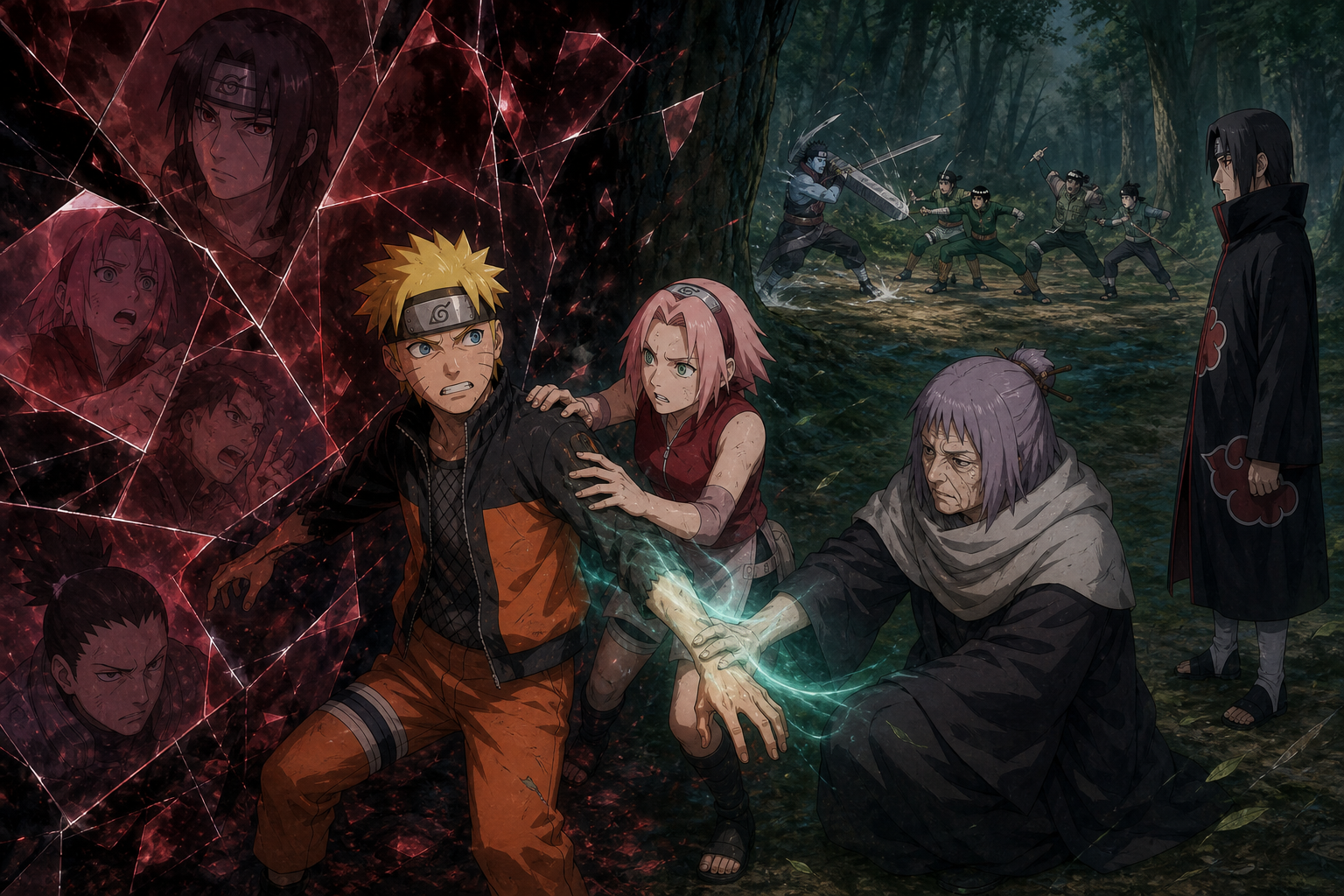
Sakura and Chiyo pull Naruto out of Itachi’s genjutsu while Kisame turns Team Guy’s support route into a second coordinated delay.
More power does not close an old wound
Naruto Shippuden Episode 14 gives Naruto a test that his larger chakra reserve and new techniques cannot solve alone. Itachi catches him in genjutsu by exploiting the images of Sasuke and the people Naruto fears disappointing. The trap works because training can improve faster than grief.
That is the real meaning of “Naruto's Growth.” The episode does not measure maturity by asking whether Naruto has become impossible to hurt. It asks whether he can be reached when hurt, whether teammates recognize the danger, and whether he accepts help before the illusion becomes control.
Sakura and Chiyo break the genjutsu with him. Their intervention does not diminish Naruto's progress. It proves he no longer faces every private wound in isolation.
Itachi chooses memory as a weapon
Itachi understands that Naruto's mind contains unfinished rooms. Sasuke's departure, the Valley of the End, promises made to Sakura, and fear of failing Gaara can all be rearranged into accusation.
Genjutsu turns those memories into hostile witnesses. The figures Naruto loves appear to judge him using words his own guilt already knows how to supply. Itachi does not create the wound. He controls its lighting.
This is more dangerous than a simple false landscape because Naruto wants to engage with the people he sees. His instinct is relational. He answers accusation, defends promises, and reaches toward pain. The illusion uses empathy as an entry point.
The attack also shows why psychological defense cannot be reduced to willpower. Naruto is determined before the trap begins. Determination does not automatically distinguish an enemy's construction from the fears a person carries honestly.
Sakura recognizes the teammate inside the target
Sakura's role in breaking the illusion is one of the episode's clearest signs of Team 7's growth. She does not stand outside Naruto's crisis waiting for him to overpower it. She identifies the genjutsu and acts.
Her intervention combines technical knowledge with familiarity. Sakura knows what Naruto looks like when he is angry, distracted, performing confidence, or genuinely disconnected from the room. That relational knowledge becomes tactical information.
The moment also reverses an old team habit. Naruto once threw himself into danger to protect Sakura while concealing how much he needed recognition. Here, Sakura helps return him to himself without making the rescue a debt.
She can do this because her attention has widened. The medical crisis in Sunagakure established Sakura as someone who notices bodies, symptoms, and changes in response. Genjutsu is not poison, but both threats demand that she observe what an enemy has altered inside another person.
Chiyo changes from critic to participant
Chiyo helps Sakura disrupt the genjutsu, placing her own chakra and judgment into Naruto's recovery. A few episodes earlier, she spoke about jinchuriki through fatalistic policy. Now she helps protect one.
That action does not erase her earlier beliefs, but it creates evidence of change. Chiyo is no longer discussing hosts as an abstract category. She is physically connected to Naruto while trying to restore his agency.
The cooperation also deepens her relationship with Sakura. Chiyo saw the young medic save Kankuro. Now the two women coordinate to help another teammate under a different kind of internal attack.
Their partnership models the alliance at human scale. A Leaf student and a retired Sand elder do not need identical histories to share responsibility for the person between them.
Being rescued can be a form of growth
Shonen storytelling often treats receiving help as proof that a hero has not developed enough. Episode 14 offers a better measure. Naruto's growth includes having relationships strong enough to interrupt an enemy's access to him.
The original Naruto spent years demanding that the village see him while assuming he had to generate every answer alone. Teamwork frequently meant adding his strength to other people's plans, not letting other people handle his vulnerability.
Accepting rescue is difficult because it limits the fantasy of total self-sufficiency. Yet isolation is exactly what made Naruto and Gaara vulnerable as children. Connection should change not only what they fight for, but how they survive being attacked.
Sakura and Chiyo do not solve Naruto's grief about Sasuke. They stop Itachi from owning the moment in which that grief appears. The distinction respects both the wound and the intervention.
Team Guy faces a parallel obstruction
Elsewhere, Kisame intercepts Team Guy and turns support into a second battlefield. Akatsuki does not merely defend the hideout at its entrance. It projects force outward to divide, delay, and exhaust rescuers before they arrive.
Kisame is an effective opponent for Guy's team because his scale challenges their coordination. His water techniques and enormous chakra presence can reshape the environment, forcing close-combat specialists to fight on unfamiliar terms.
The confrontation also gives Team Guy its own responsibility. They are not waiting to become reinforcements in Team Kakashi's story. Their obstacle consumes time and resources that belong to the same rescue clock.
Akatsuki's paired delays reveal institutional planning. Itachi targets Team Kakashi's emotional and perceptual vulnerabilities. Kisame targets Team Guy's movement and formation. The organization chooses tools suited to the teams it needs to slow.
Growth appears as recovery speed
Naruto's progress is not that Itachi cannot trap him. It appears in how the team responds and how quickly Naruto can rejoin the present.
Earlier psychological attacks often isolated him inside shame until anger broke outward. Here, teammates name the mechanism, provide chakra disruption, and restore orientation. Naruto does not have to pretend the images were meaningless before returning to the mission.
That recovery speed matters under Gaara's deadline. Emotional resilience is not the absence of reaction. It is the ability to experience a reaction without letting an enemy convert it into permanent direction.
Kakashi's preparation helps as well. His warning about Itachi's eyes gives the team a framework for interpreting unusual behavior. Even when the trap uses another route, they know perception itself is contested.
Sasuke remains powerful without being present
Sasuke does not physically enter the forest, yet his relationship with Naruto shapes the fight. That absence is part of his power in the early Shippuden story.
Naruto organizes promises, training, and identity around the goal of bringing him back. Sakura carries her own grief and responsibility. Kakashi sees the failure of his first Team 7. Itachi can touch all of those connections by invoking one missing person.
The genjutsu asks whether loyalty becomes less sincere if it is managed tactically. The answer is no. Naruto can care about Sasuke and refuse to let an enemy use that care to abandon Gaara.
This is a necessary evolution in his promise. Loyalty without boundaries can become another form of control. Naruto's commitment grows stronger when it can survive postponement, competing obligations, and help from others.
The episode refuses a simple before-and-after
The title invites viewers to compare teenage Naruto with his younger self. The episode avoids pretending three years of training produced a finished person.
His chakra control, combat awareness, and techniques have improved. His emotional triggers remain recognizable. Those facts can coexist without making the training meaningless.
People do not develop every capacity at the same rate. A fighter can master new movement while still carrying guilt in an old voice. A leader can inspire others while needing help when memory distorts the present.
The episode's honesty lies in making growth relational. Naruto has changed, and so has the network around him. Sakura can intervene. Kakashi can prepare. Chiyo can cooperate. Progress exists between people as well as inside one body.
The rescue team learns to treat the mind as terrain
Shinobi missions train people to inspect roads, weather, traps, scent, and enemy formations. Itachi forces Team Kakashi to include mental state in the same tactical map. Naruto's guilt is not a private footnote once an opponent can enter through it.
That does not mean every emotion should be reported like equipment inventory. It means leaders and teammates must know enough about one another to notice when behavior changes under pressure. Sakura's recognition of Naruto's altered state becomes as practical as spotting a wire trap.
The lesson has ethical limits. Knowing someone's wound can support care or enable control. Itachi uses knowledge of Sasuke and Team 7 to destabilize Naruto. Sakura uses knowledge of Naruto to restore his agency. The same intimacy points in opposite directions depending on purpose.
Kakashi has reason to understand this distinction. His career is shaped by loss, secrecy, and techniques acquired through another person's death. He knows that compartmentalization can keep a shinobi functional while making hidden injuries easier for the right enemy to exploit.
Chiyo brings a different form of awareness. She recognizes chakra disruption and contributes experience from a generation that developed poison, puppetry, and countermeasures. Helping Naruto requires her to apply technical knowledge without dismissing the emotional content of the trap.
The team succeeds because nobody argues that the illusion is “only in his head.” A mental attack produces operational consequences. Treating it seriously is not indulgence. It is mission discipline.
This approach also protects Naruto's dignity. Sakura and Chiyo do not debate whether his feelings about Sasuke are reasonable while Itachi controls the scene. They interrupt the mechanism first. Meaning can be discussed after agency returns.
For a story full of characters trained to hide pain, that priority matters. The immediate question is not whether Naruto should have healed by now. It is whether the people beside him can recognize when his history is being used without his consent.
Kisame shows why support teams need support
Team Guy's encounter with Kisame exposes the risk of calling anyone “reinforcements” as if the label makes them safe. Support teams travel through the same hostile territory, face tailored opposition, and may need their own rescue capacity.
Guy, Lee, Neji, and Tenten bring complementary skills, but Kisame's water-based control can separate those strengths. Neji's vision, Tenten's range, Lee's speed, and Guy's experience matter only if the group preserves enough formation to combine them.
The parallel battle prevents the narrative from treating Team Guy as a spare battery for Team Kakashi. They are people whose delay, injury, and decisions affect the larger operation. Akatsuki understands that and assigns force accordingly.
This is another institutional contrast. Akatsuki coordinates obstacles from a protected extraction site. The allied teams coordinate while moving, separated by terrain and incomplete information. Their cooperation is harder because it must remain adaptive.
The support mission therefore has its own moral clock. Every minute Kisame holds Team Guy is a minute they cannot spend breaking barriers, scouting the cave, or protecting the primary team. Winning is not enough if the fight consumes the entire window.
That pressure makes restraint part of power. Guy's team must solve the opponent presented without forgetting the person the opponent is meant to keep them from reaching.
Fandom arguments worth sorting out
One argument says Naruto falling for genjutsu proves he learned nothing. Itachi is an elite specialist who targets Naruto's deepest unresolved relationship. Vulnerability to that attack does not erase growth elsewhere.
Another argument says Sakura and Chiyo rescuing him weakens the hero. Their intervention proves the team can recognize and counter a threat designed to isolate him. That is operational strength.
A third argument treats Sasuke imagery as repetitive obsession. Repetition becomes the mechanism because Naruto has not resolved the promise. Itachi weaponizes the emotional fact the story established.
The final argument calls the Kisame fight a distraction. It demonstrates Akatsuki dividing the rescue across coordinated delays and gives Team Guy an independent tactical burden.
RaeRae's verdict
“Naruto's Growth” earns its title by refusing to confuse growth with invulnerability. Naruto has more power, but Sasuke's absence still opens on command.
The difference is that he is no longer alone inside the opening. Sakura recognizes the trap. Chiyo contributes chakra and knowledge. Kakashi's warnings give the team a framework. Connection changes the outcome.
Team Guy's clash with Kisame expands the same lesson to the operation. Strength is distributed, obstacles are coordinated, and no single fighter can carry the rescue clock.
Naruto's growth is not that Itachi fails to hurt him. It is that hurt no longer guarantees isolation. His teammates can reach him, and he can return to Gaara's mission without pretending Sasuke means less.
The illusion borrows the voices Naruto already fears
Itachi does not need to invent strangers who hate Naruto. He gives familiar faces the accusations Naruto has rehearsed privately: Sasuke is gone, Sakura trusted him, Gaara is in danger, and every promise may expose another limit.
That choice makes the genjutsu intimate. The attack gains credibility from affection because Naruto cares what these people think. Emotional knowledge becomes a weapon when an enemy can strip relationship away from consent and context.
Guilt speaks in absolutes because missions do not
The illusion treats one failure as proof that Naruto fails everyone. Actual rescue work is messier. He can regret losing Sasuke, keep faith with Sakura, and still prioritize Gaara’s extraction clock without ranking one friend’s worth against another.
Guilt wants a single verdict. Teamwork returns him to specific decisions: identify the technique, interrupt the chakra flow, recover orientation, and move. Concrete action breaks the false courtroom Itachi built.
Sakura practices care without demanding confession
She does not require Naruto to explain every image before she helps him. She reads the changed state, applies what she knows, and works with Chiyo to restore his control.
That order matters. A person under psychological attack does not owe an audience a perfect account of the wound before receiving care. Safety comes first; interpretation can follow when Naruto owns his attention again.
Chiyo crosses the distance between policy and person
Sand doctrine taught her to discuss jinchuriki as military assets and predictable casualties. Chakra contact with Naruto makes abstraction difficult. The host is a frightened teenager trying to reach her grandson’s victim before Akatsuki finishes its work.
Helping him does not settle Chiyo’s accountability, but it creates a choice against the system she once accepted. Change appears through repeated participation, not a speech that erases history.
The release technique is collective knowledge
Genjutsu can feel like the most private kind of defeat because perception itself has been compromised. Episode 14 answers with a shared method. Teammates recognize the disruption and lend chakra from outside the closed loop.
The countermeasure refuses the idea that the mind must heal alone. Skill, trust, timing, and physical presence combine. Naruto’s survival belongs to a network without becoming less his own.
Recovery does not require pretending the images were false in every sense
The figures are fabricated, but the fear beneath them is real. Naruto worries he disappointed Sakura and failed Sasuke. Calling the genjutsu an illusion does not make those emotions meaningless.
Freedom comes from separating a true feeling from the enemy’s claimed conclusion. Naruto can carry regret without accepting that regret as an order to freeze, lash out, or abandon Gaara.
Kisame tests the meaning of a support squad
Team Guy is called reinforcement, yet Akatsuki assigns them an opponent capable of turning terrain into water and dividing their formation. Support is exposed to danger before reaching the people it was sent to help.
The label cannot become an excuse to overlook their injuries or choices. A real alliance plans for the rescuers to need rescue, communication, and independent authority when the route changes.
Akatsuki spends copies to consume real bodies and time
Its projections can delay two squads while the extraction continues elsewhere. The rescuers must answer with genuine chakra, attention, and risk even before they understand the limited nature of what blocks them.
That imbalance is part of the organization’s power. Victory must be measured against the cost imposed. Defeating the obstacle after the deadline would still serve Akatsuki’s design.
Team Guy has to preserve formation under spectacle
Kisame’s scale invites everyone to answer the largest visible threat separately. His water techniques reward panic, distance, and fractured attention.
Neji’s sight, Tenten’s range, Lee’s movement, and Guy’s experience matter most as connected resources. Growth for a team is not four impressive performances. It is keeping those performances available to one another.
Naruto’s title belongs partly to the people around him
Three years changed Naruto, but they also changed Sakura and the conditions of Team 7. She has medical discipline, diagnostic confidence, and the willingness to act when he cannot announce what is wrong.
A hero’s growth can be visible in the relationships capable of reaching him. Naruto built enough trust that intervention arrives as solidarity instead of humiliation.
Needing help does not reduce leadership
Naruto will ask other people to believe in impossible rescues. If he cannot receive help when his own perception fails, that leadership becomes a performance of exceptionalism rather than mutual obligation.
Accepting disruption from Sakura and Chiyo teaches the same rule he wants villages to learn: nobody should be discarded because danger entered through a wound they did not choose.
The episode places care inside combat rather than after it
Stories often postpone care until a battle ends, as though tending to a mind or body belongs outside the action. Here, care is the action that makes continued movement possible.
Sakura and Chiyo’s intervention is tactical, emotional, and medical at once. The categories overlap because the person they are protecting cannot be divided into separate mission-approved parts.
RaeRae’s full take
I refuse the reading that Naruto getting caught means his training failed. Itachi reaches for the one relationship guaranteed to hurt, then gives that hurt the voices of everyone Naruto wants to protect. That is expertise meeting an open wound, not proof that the wound should have vanished on schedule.
Sakura and Chiyo are the reason the title works for me. Growth is not Naruto becoming unreachable. Growth is Sakura knowing him well enough to see the absence behind his face, Chiyo choosing to help the kind of child her generation reduced to policy, and Naruto returning without treating their hands as an insult.
Team Guy’s fight keeps the rescue honest. Akatsuki is buying time on two roads while Gaara pays for every minute. The squads cannot chase beautiful individual victories. They have to protect one another, spend carefully, and remember who is waiting beyond the opponent.
RaeRae checkpoint: Naruto’s growth is not immunity to grief. It is the fact that grief no longer seals him away from everyone who loves him, and help no longer has to feel like failure.
Receipts and official routes
- Episode number, titles, Naruto’s genjutsu struggle, Sakura and Chiyo’s intervention, and Team Guy’s encounter with Kisame: Naruto Official Site episode guide.
- Licensed Naruto Shippuden series route: Crunchyroll.