
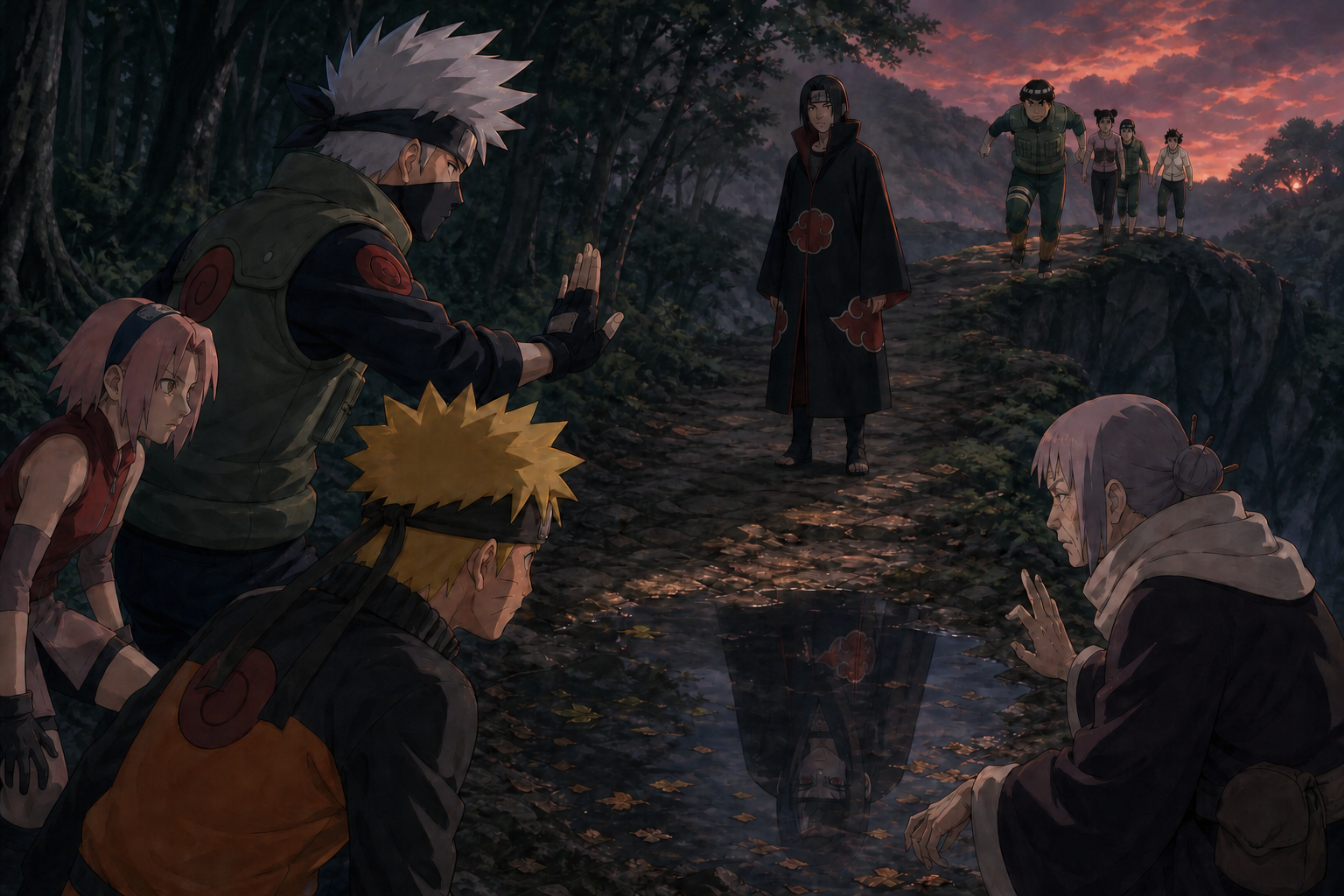
A Meeting With Destiny
Itachi blocks Team Kakashi’s route and turns Naruto’s unfinished promise to Sasuke into an emotional ambush during Gaara’s rescue.
The trail turns into an emotional ambush
Naruto Shippuden Episode 13 interrupts the rescue with a face that belongs to another unfinished mission. Team Kakashi encounters Itachi Uchiha on the road to Gaara, and Naruto cannot see him without seeing Sasuke, the promise he made, and the failure he still carries.
That is what makes “A Meeting With Destiny” more than a checkpoint fight. Akatsuki places an enemy in the team's path who can attack attention before attacking the body. Itachi is tactically dangerous, but his relationship to Sasuke makes him psychologically expensive.
The rescue already runs under a deadline. Any opponent would cost time. Itachi costs focus as well, forcing Naruto and Kakashi to manage memories that do not belong to the current victim but can still determine whether they reach him.
Itachi occupies two missions at once
For Kakashi, Itachi recalls a defeat built around the Mangekyo Sharingan and Tsukuyomi. For Naruto, he is the brother whose violence shaped Sasuke's life and eventual departure. The encounter pulls Team 7's private history directly into the Kazekage rescue.
Akatsuki benefits from that overlap. It does not need to convince Naruto to abandon Gaara. It only needs to make Sasuke emotionally present enough that Naruto divides his judgment.
This is a sophisticated form of terrain control. Forest paths, distance, and concealment matter, but so do relationships. Itachi stands where Naruto's loyalties intersect and lets the conflict inside him create delay.
The episode's title calls the meeting destiny, yet the danger is built from choices. Itachi chose the massacre under conditions the story has not fully explained. Sasuke chose revenge and departure. Naruto chose a promise. Akatsuki chose where to place its obstacle. “Destiny” names the accumulated force of those decisions.
Kakashi's warning is institutional memory
Kakashi immediately warns the team not to look into Itachi's eyes. The instruction is not cowardice. It is knowledge paid for through prior injury.
This is what experience should provide under pressure. Kakashi does not turn his trauma into mystique or pretend he can absorb the same attack again. He translates defeat into a rule that may protect the people behind him.
The warning also challenges ordinary combat instincts. Shinobi are trained to read an opponent's face, hands, and gaze. Against Itachi, one of the most basic channels of information becomes a weapon. The team has to fight while deliberately refusing a familiar source of control.
Kakashi's authority matters because Naruto's emotions make the rule harder to follow. Naruto wants answers connected to Sasuke. Looking directly at Itachi feels like confrontation; tactically, it may be surrender.
Naruto's promise to Sasuke becomes exploitable
Naruto's bond with Sasuke gives him persistence, but persistence can become a handle. Itachi does not have to insult Sasuke for the connection to shape Naruto's response. His presence alone activates the promise Naruto treats as proof of loyalty.
That promise contains love and ego. Naruto wants to rescue Sasuke because he understands isolation and refuses to abandon a friend. He also wants to repair the moment at the Valley of the End when strength, persuasion, and identification were not enough.
Itachi represents the part of Sasuke's story Naruto cannot reach through determination alone. The older brother knows the family history, controls the trauma at its center, and belongs to the organization now extracting Gaara's tailed beast.
The encounter therefore connects Naruto's two most personal rescue narratives. Gaara is the jinchuriki who found a way back to people. Sasuke is the teammate still moving away. Naruto must not let the pain of one prevent him from reaching the other.
Chiyo sees a different kind of inherited violence
Chiyo travels with Team Kakashi because her family history leads to Sasori. Meeting Itachi places another damaged family system in front of her.
She does not know the Uchiha story in full, but the parallel is visible. A gifted child becomes entangled in village violence, leaves home, and returns as a threat connected to an organization that converts alienation into power.
The comparison does not make Sasori and Itachi identical. It emphasizes that hidden villages repeatedly produce people whose talents outgrow the moral structures meant to guide them.
Chiyo's presence keeps the encounter from belonging only to Team 7 nostalgia. She is walking toward her grandson while Naruto is confronted by Sasuke's brother. The rescue party is surrounded by the consequences of families and institutions failing younger members.
Team Guy turns support into a second front
Team Guy moves toward the rescue from another route, bringing speed, reconnaissance, weapons expertise, and close combat. Their deployment expands the mission beyond Team Kakashi's immediate perspective.
Support matters because Akatsuki can create multiple obstacles. A single celebrated team would be easier to isolate. Two teams create redundancy and the possibility of splitting tasks at the hideout.
Guy's team also arrives without Team 7's emotional history with Itachi. That does not make them immune to Akatsuki, but it gives the operation another set of eyes and instincts.
The episode keeps the teams separate long enough to make coordination feel logistical rather than magical. They cannot instantly share every discovery. Each group has to continue under incomplete information while trusting the other is moving.
Genjutsu attacks certainty before perception
Itachi's reputation changes how the team interprets everything around him. If eye contact can compromise the mind, then sight no longer guarantees knowledge. The opponent can make certainty itself dangerous.
That threat suits an episode about emotional history. Naruto already sees more than the person on the path. He sees Sasuke's pain, his own promise, and the possibility of another failure. Genjutsu weaponizes the gap between what is present and what the mind supplies.
Kakashi's warning tries to create disciplined uncertainty. The team must accept that it cannot read Itachi in the usual way and still act. Good tactics sometimes begin by naming which information cannot be trusted.
This is the opposite of Naruto's preferred approach. He often breaks confusion through direct engagement. Itachi punishes directness, forcing growth that cannot be measured by a larger technique.
The rescue clock keeps running offscreen
Every moment on the forest path belongs to Gaara's extraction. The episode does not need to cut constantly to the cave for the deadline to remain present.
This creates moral frustration. Team Kakashi did everything required to obtain a trail, assemble specialists, and depart. Akatsuki can still impose another delay using one projected member and an emotional history the rescue did not create.
The situation prevents easy blame. Naruto cannot simply ignore Itachi, because the enemy blocks the route. He also cannot allow the encounter to become a substitute mission about Sasuke.
Kakashi's job is to solve the obstacle at the scale necessary for passage. Victory means preserving the team's capacity and continuing, not satisfying every unresolved question.
Destiny is a name for relationships with momentum
The episode uses “destiny” less as prophecy than as the feeling of meeting consequences already in motion. Naruto was always likely to encounter Itachi because of Sasuke and Akatsuki. Chiyo was always likely to confront Sasori because retirement did not undo family history.
Calling these meetings destined can hide the institutions that created them. The Uchiha massacre, jinchuriki system, hidden-village wars, and Akatsuki's recruitment all involve political choices.
Naruto's value is that he refuses to let inherited momentum become final instruction. He can recognize the force of history without accepting the outcome it predicts.
The challenge is applying that refusal with discipline. Breaking destiny does not mean charging at every symbol of the past. Sometimes it means refusing an enemy permission to choose which relationship controls the present.
The formation reveals who Team 7 has become
The encounter measures Team 7 through positioning rather than nostalgia. Kakashi takes the information lead because he has survived Itachi's genjutsu before. Sakura holds a guarded support position where she can observe teammates and respond to injury. Naruto carries offensive force, but he must submit that force to a plan designed around perception.
This is a more mature formation than the original team could have maintained. Younger Naruto would have treated warning as doubt and direct attack as proof of courage. Younger Sakura might have watched Sasuke's family history pull her attention away from the immediate tactical problem. Shippuden gives both characters responsibilities that require them to manage feeling without denying it.
Chiyo complicates the formation productively. She is not under Kakashi's authority in the same way as his students, yet survival requires her to respect his knowledge of Itachi. Kakashi, in turn, must respect her experience with Sasori and puppetry. The mission is a coalition, not a classroom.
That distinction matters when teams cross village lines. Command cannot depend only on rank or national loyalty. It has to earn cooperation by making accurate judgments visible. Kakashi's eye-contact warning is persuasive because the danger is specific and his history supports it.
Naruto's growth will be tested by whether he can remain emotionally honest and tactically usable at the same time. Pretending Itachi means nothing would be false. Allowing that meaning to control every decision would endanger Gaara, Sakura, Kakashi, and Chiyo.
Sakura's steadiness carries its own emotional achievement. Itachi is tied to Sasuke, the teammate she also wants back, but she does not turn the encounter into a private claim. Her medical experience in the Sand has already widened her attention beyond Team 7's old triangle.
The formation therefore tells a story before the fight develops. Kakashi converts trauma into protocol. Sakura converts concern into readiness. Naruto tries to convert loyalty into disciplined action. Chiyo learns to rely on a Leaf commander whose family once represented loss.
Itachi threatens each of those conversions. His strength lies partly in making old identities feel more urgent than present roles. If the team fractures into survivor, abandoned friend, grieving teammate, and resentful elder, Akatsuki wins time before winning combat.
Holding formation becomes an ethical act. It says Gaara's rescue deserves more authority than the enemy's attempt to reopen every private wound on the road.
Fandom arguments worth sorting out
One argument says Naruto should ignore Itachi and keep moving. An Akatsuki opponent with elite genjutsu is not scenery. The team has to neutralize the obstruction without surrendering the entire mission to it.
Another argument treats Kakashi's eye-contact warning as repetition. Repetition is useful when the remembered fact can prevent catastrophic failure. Leadership turns past defeat into shared protocol.
A third argument calls Naruto's Sasuke fixation irrelevant to Gaara. It is relevant because Itachi makes it operational. Emotional history becomes part of the battlefield whether Naruto wants it there or not.
The final argument says Team Guy's parallel travel is padding. Their movement establishes support capacity and the second front the hideout's defenses will require.
RaeRae's verdict
“A Meeting With Destiny” understands that an ambush can target a relationship. Itachi blocks the forest path, but Sasuke is the pressure point.
Kakashi responds with the most useful version of experience: a clear warning built from an earlier loss. Naruto has to learn that loyalty to Sasuke does not require letting Sasuke's brother control his attention.
Chiyo travels toward her own family reckoning while Team Guy closes from another route. The rescue expands across generations, villages, and unfinished histories.
Gaara remains the person whose clock matters. The episode's test is whether Team Kakashi can meet the past without allowing it to choose the future. Destiny may bring Itachi onto the road. Discipline determines whether the team gets past him.
The ambush selects a relationship before a battlefield
Any Akatsuki member could delay Team Kakashi physically. Itachi delays them through Sasuke, Kakashi’s prior defeat, and every promise attached to Team 7’s unfinished history.
The path matters less than the emotional intersection. Akatsuki places an obstacle where Naruto’s two rescue commitments can compete for attention.
Itachi occupies Gaara’s mission and Sasuke’s story
He belongs to the organization extracting a jinchuriki and to the family trauma driving Sasuke away from Konoha. Naruto cannot treat those roles as unrelated.
The danger is allowing the older mission to consume the present one. Sasuke matters. Gaara’s extraction clock does not stop while Naruto proves that loyalty.
Kakashi turns trauma into protocol
His warning against eye contact comes from losing to Tsukuyomi. Experience becomes useful when an earlier wound produces a rule capable of protecting other people.
He does not pretend immunity or disguise fear as mystery. Naming the attack’s condition gives the team a concrete behavior that reduces risk.
Ordinary combat instinct becomes a vulnerability
Shinobi read faces, eyes, hands, and posture to predict action. Itachi makes one of those information channels dangerous enough that disciplined refusal becomes necessary.
Looking away can feel passive, but surviving genjutsu requires the team to accept less visual certainty than training usually rewards.
Naruto’s promise contains care and self-judgment
He wants Sasuke safe because abandonment repeats the loneliness both boys know. He also wants to repair the Valley of the End, where determination and strength failed to bring his friend home.
Itachi activates both motives without saying much. Naruto must distinguish loyalty to Sasuke from the need to prove that his earlier failure did not define him.
Direct confrontation may surrender control
Looking into Itachi’s eyes feels like meeting the threat honestly. Under these conditions, the gesture can hand perception to the opponent.
Courage cannot be measured by performing the action an enemy wants. Discipline sometimes means refusing the dramatic symbol of bravery in favor of a less satisfying path through danger.
Chiyo travels between two family failures
She joined the rescue because Sasori turned family history into poison and Akatsuki service. Itachi places another gifted child shaped by village violence and kinship trauma in front of her.
The men are not identical. Their presence together reveals how often hidden villages produce alienated talent without building moral structures capable of holding it.
Team Guy provides emotional redundancy too
A second squad brings Byakugan reconnaissance, weapons expertise, speed, and close combat. It also enters without Team 7’s private history with Itachi.
Operational redundancy includes different emotional pressure points. Akatsuki cannot manipulate every team through the same relationship, even when it can create multiple physical fronts.
Separate routes make trust logistical
Neither squad receives instant knowledge of every obstacle facing the other. Each must continue under incomplete information while believing the parallel team still moves.
Support is not magical arrival on cue. It is planning that accepts communication gaps and preserves enough capacity for both groups to function independently.
Genjutsu weaponizes what the mind supplies
Naruto already sees Sasuke’s pain, his promise, and the possibility of another failure when he looks at Itachi. The opponent does not need to invent every image from nothing.
Manipulation becomes powerful because perception arrives mixed with memory. Kakashi’s protocol creates space between what appears and what the team agrees to trust.
The rescue clock judges the size of victory required
Team Kakashi does not need every answer about Itachi, Sasuke, or the Uchiha past before continuing. It needs to neutralize the obstruction enough to preserve the route.
Letting the encounter expand into a complete private reckoning would give Akatsuki the delay it wants. Mission success requires boundaries around unfinished grief.
RaeRae’s full take
I understand why Naruto cannot see Itachi as one more cloak blocking a road. Sasuke is inside that face for him. So is the promise, the Valley of the End, and every fear that his friend is moving somewhere Naruto cannot follow.
Kakashi gives the correct answer without asking anyone to become emotionless. Do not look into the eyes. Hold formation. Use what prior failure taught. Trauma becomes protection when the survivor can translate it into knowledge rather than mystique.
Gaara remains the clock that matters. Destiny may bring Itachi onto the path, but destiny does not get to decide which relationship controls Naruto’s next move. Loyalty to Sasuke cannot require abandoning the friend Akatsuki is destroying now.
RaeRae checkpoint: Itachi does not only block the road. He makes Sasuke stand emotionally between Naruto and Gaara. Discipline means refusing to let one promised rescue sabotage the other.
Coalition command must persuade across different authority
Kakashi can issue orders to Naruto and Sakura through an established team structure. Chiyo is a senior Sand shinobi with separate experience, loyalties, and reasons to distrust his family name.
His warning succeeds because it is specific, relevant, and supported by direct knowledge of Itachi. Cross-village command cannot rely only on rank. It must make the accuracy of the judgment visible enough that cooperation remains rational for people outside the formal hierarchy.
Emotional compartmentalization is not emotional denial
Naruto does not need to pretend Sasuke, the massacre, or the Valley of the End mean nothing. Repression would make those pressures harder to recognize when Itachi uses them.
He needs to decide which feelings receive operational authority now. Sasuke’s pain can inform caution without selecting the mission, tempo, or risk allowed around Gaara’s rescue.
Sakura’s steadiness shows Team 7’s center has shifted
Itachi is tied to the teammate she wants back too. Earlier Sakura might have allowed Sasuke’s family story to reorganize her entire attention.
Medical responsibility in Sunagakure has widened her field. She now watches the formation, injury risk, Chiyo, and Naruto’s reactions while carrying her own grief without making it the only urgent fact.
The projection makes delay cheaper for Akatsuki
The organization can obstruct pursuit without placing every member’s physical body on the road. Even partial presence demands real time and caution from the rescuers.
This asymmetry explains why simply defeating the visible opponent may not equal progress. Team Kakashi must learn what kind of Itachi it is facing while preserving enough strength for the people waiting at the hideout.
A bounded victory protects the larger promise
Naruto does not betray Sasuke by refusing to solve their entire history in this encounter. He protects the promise by staying alive, keeping Sakura and Kakashi safe, and reaching the organization connected to both brothers.
Choosing a smaller tactical objective can serve a larger emotional commitment better than demanding closure from an enemy-controlled moment.
Receipts and official routes
- Episode number, titles, Team Kakashi encountering Itachi, Kakashi’s eye-contact warning, and the parallel Team Guy approach: Naruto Official Site episode guide.
- Licensed Naruto Shippuden series route: Crunchyroll.