
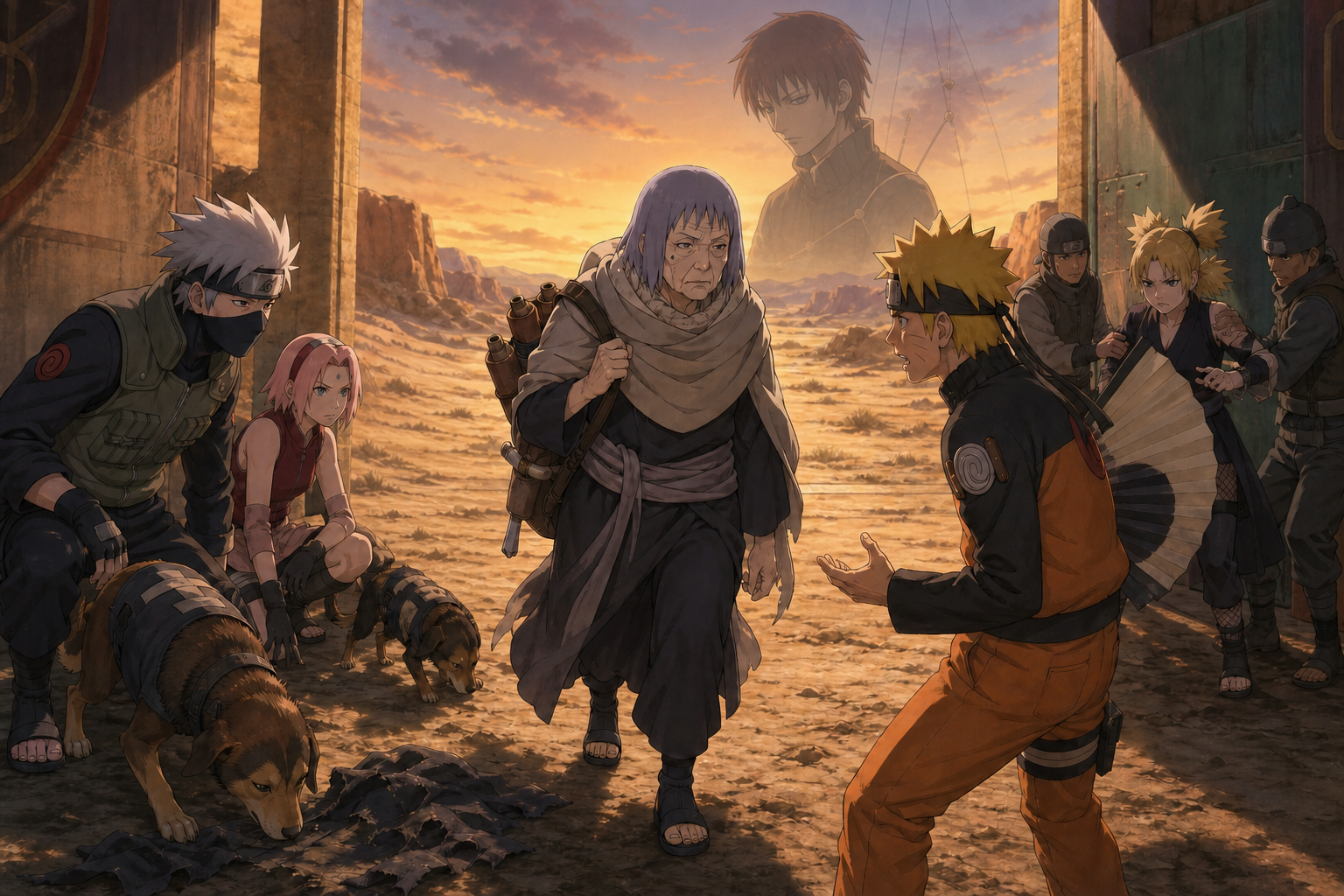
The Retired Granny’s Determination
Chiyo leaves retirement to confront Sasori while Naruto rejects the old fatalism that treats Gaara and other jinchuriki as expendable tools.
Chiyo finally walks toward the consequences
Naruto Shippuden Episode 12 gives Chiyo a decision that is easy to call brave and harder to call clean. She leaves retirement to join Team Kakashi's pursuit of Akatsuki, knowing Sasori waits at the other end of the trail. The choice matters because he is not merely an enemy from her village. He is her grandson and part of a family history she helped shape.
“The Retired Granny's Determination” does not erase Chiyo's responsibility by making her useful. She belongs to the generation that treated jinchuriki as military tools, accepted child sacrifice as policy, and allowed personal grief to harden into withdrawal. Joining the rescue begins accountability. It does not complete it.
That difference makes her determination worth watching. Redemption without consequence is reputation management. Chiyo steps toward a mission where her knowledge is necessary and where every mile will expose another decision the adults around Sasori and Gaara failed to make.
Pakkun gives urgency a direction
Pakkun locating Akatsuki's hideout turns Kankuro's cloth fragment into a route. The rescue is no longer a general desire to find Gaara. It has terrain, scent, distance, and a destination.
This progression rewards the chain of competence built across several episodes. Kankuro attached the cloth. Sakura kept him alive long enough to hand it over. Kakashi deployed tracking summons. Pakkun followed the trace. Chiyo can interpret the enemy waiting ahead. The mission moves because each person's work becomes another person's starting point.
The trail also ends the illusion that preparation can continue indefinitely. Gaara's extraction is underway. A located hideout turns every remaining discussion into a cost measured against his body.
Kakashi still has to resist panic. Knowing where to go does not mean the team should abandon supplies, intelligence, or the people whose skills make arrival meaningful. Direction sharpens leadership rather than replacing it.
Naruto refuses polite fatalism
Chiyo speaks about jinchuriki through the language her generation normalized. Hosts are weapons, deterrents, and sacrifices produced by village necessity. Naruto hears the person being removed from the sentence.
His anger is not youthful ignorance interrupting an elder's realism. Naruto is the evidence against her abstraction. He lived inside the policy she describes. Adults placed a tailed beast inside him, feared the result, and expected gratitude for whatever protection the arrangement provided.
Gaara lived an even more brutal version of that logic. Sunagakure weaponized him, tried to control him, and eventually tried to eliminate him when control failed. He became Kazekage despite that history, not because the system cared for him properly.
Naruto's refusal matters because administrative language can make violence sound inevitable. Calling jinchuriki “necessary sacrifices” shifts responsibility away from the adults who selected children and designed the conditions of their isolation. He drags choice back into the room.
Chiyo's knowledge is both remedy and evidence
The rescue needs Chiyo because she understands poisons, puppetry, Sunagakure history, and Sasori. Every useful fact she carries is also evidence of proximity. She knows him because she helped raise him. She recognizes the craft because it grew inside the village. She understands the old system because she participated in it.
That gives her role moral texture. Expertise does not prove innocence. Sometimes the person best equipped to repair damage is close to the choices that produced it.
Chiyo could remain retired and describe Sasori as the younger generation's failure. Joining the pursuit rejects that escape. She puts her body, knowledge, and family authority into a confrontation she cannot delegate.
The decision also respects Sakura's influence. Sakura saved Kankuro and demonstrated that younger shinobi can use inherited techniques differently. Chiyo has seen care cross a border. She now has to decide whether her own knowledge will cross the distance between regret and action.
Temari staying behind is not lesser courage
Temari wants to join the rescue. She is Gaara's sister, a capable jonin, and one of the people with the strongest personal reason to pursue him. Sunagakure orders her to remain and help guard the village.
The choice is painful because it is strategically credible. Akatsuki already proved the village can be penetrated and its leader removed. Sending every elite fighter into the desert could turn one crisis into two.
Temari's frustration should not be read as a failure to act. Defense is part of the rescue's cost. Someone has to protect civilians, stabilize command, and make sure Gaara has a village to return to.
Her position also exposes how institutions distribute grief. Naruto can run toward Gaara because Konoha assigned him to the mission. Temari must serve Gaara by staying behind. Personal devotion does not always receive the role it wants.
The team crosses generations and villages
Team Kakashi leaves with a strange but necessary composition. A Leaf commander, two young Leaf ninja, tracking summons, and an elderly Sand puppeteer move toward an Akatsuki hideout to rescue the Sand's Kazekage.
The group exists because old categories have become insufficient. Chiyo cannot defeat Sasori's future by remaining inside Sand isolation. Naruto and Sakura cannot navigate his past without her. Kakashi cannot command family history, but he can create space in which it becomes actionable.
Their alliance is not based on emotional harmony. Naruto openly rejects Chiyo's fatalism. Chiyo carries resentment toward Kakashi's family. Sakura has only recently earned her respect. Cooperation becomes meaningful because disagreement remains visible.
The mission asks whether shared responsibility can be stronger than inherited suspicion. Nobody has to pretend the wars did not happen. They have to decide that Gaara's life matters more than preserving the habits those wars produced.
The Sand alliance becomes personal instead of ceremonial
Konoha and Sunagakure have called themselves allies since the original series, but Episode 12 tests what the word means when cooperation becomes expensive. The Leaf team is not attending a summit or exchanging formal promises. It is walking into danger for a foreign leader while trusting a Sand elder whose history includes hostility toward Konoha.
Chiyo's presence changes the mission from outside assistance into joint responsibility. She is not a guide hired to point at a cave. Sasori is part of her family and Gaara is the product of policies her generation defended. The rescue belongs to her village as more than a request for help.
The alliance also requires Sunagakure to accept vulnerability. Its Kazekage has been captured, one senior fighter has been poisoned, and its own specialists needed a Leaf medic. Institutions often hide weakness to preserve authority. Here, survival depends on admitting which help is necessary.
Konoha must avoid turning assistance into superiority. Sakura's medical success does not prove the Leaf is a better village. Kakashi's command does not make the Sand subordinate. The point is that expertise can move toward need without becoming a claim of ownership.
Naruto embodies the alliance's most personal possibility. He does not care for Gaara because diplomatic paperwork tells him to. He recognizes another child shaped by a tailed beast and chooses kinship across village lines. That bond gives the treaty emotional substance the institutions did not manufacture.
Chiyo challenges that substance with every fatalistic remark. Naruto challenges her in return. Their disagreement is evidence that the alliance can hold more than polite agreement. It can carry accusation, grief, and accountability without collapsing into enemy categories.
Temari's order to remain behind completes the picture. Cooperation does not send everyone toward the same visible objective. Some people pursue, some heal, some track, and some defend. The alliance works only if those roles are treated as parts of one effort rather than a hierarchy of heroism.
By the time Team Kakashi leaves the gate, the relationship between villages has become embodied. Sakura's hands saved Kankuro. Chiyo's knowledge travels with Leaf ninja. Naruto carries Gaara's pain as his own. Those facts make the alliance more real than any banner could.
Retirement did not stop the past from moving
Chiyo and Ebizo withdrew from active village life, cultivating distance from politics and younger shinobi. Sasori's return proves the past continued without their supervision.
Retirement protected Chiyo from daily responsibility, but it did not protect Kankuro from Sasori's poison or Gaara from the weapon system her generation helped normalize. Withdrawal is not neutrality when unresolved harm keeps shaping other people's lives.
This does not mean elders are forbidden rest. It means authority cannot claim credit for building institutions and then disclaim every consequence that arrives later. Chiyo's determination begins when she recognizes that her relationship to the crisis is not optional.
Ebizō remaining behind gives the choice additional weight. The siblings do not move as a matched pair. Chiyo personally chooses the road toward Sasori.
Naruto and Chiyo argue about what realism means
Chiyo's worldview calls sacrifice unavoidable. Naruto's calls abandonment unacceptable. Both positions arise from suffering, but they produce different obligations.
Chiyo survived long enough to watch villages repeat war, betray alliances, and turn children into weapons. Cynicism can look like the only honest response. Naruto survived the social consequences of the same system and still insists relationships can interrupt it.
His hope is not uninformed. He knows isolation, hatred, and the Nine-Tails from inside. When he rejects fatalism, he is not denying the cost. He is refusing to let cost become permission for repetition.
The argument matters beyond Gaara. Naruto is also defending his own future. If jinchuriki death is treated as an unfortunate but expected feature of the world, then the adults around him have already prepared language for his disposal.
The hideout makes Akatsuki's head start visible
Finding the cave does not erase the enemy's advantage. Akatsuki selected the site, installed barriers, began the extraction, and coordinated members before the rescue knew where to travel.
Pakkun's success narrows uncertainty while exposing distance. The team can now imagine the route and therefore understand how late it is.
That tension keeps departure from feeling triumphant. Chiyo's decision is valuable, but Gaara does not receive extra time because an elder found courage. Accountability begins under a deadline created by earlier failures.
The rescue party must carry hope without confusing it for control. They have a trail, the right specialists, and a reason to move. Akatsuki still owns the clock.
Fandom arguments worth sorting out
One argument says Naruto is disrespectful to Chiyo. Respect for age cannot require silence when an elder describes sacrificed children as inevitable tools. His anger targets the logic that harmed both him and Gaara.
Another argument treats Chiyo joining the team as instant redemption. Useful action matters, but it does not erase her role in Sunagakure's jinchuriki system or her family's failures around Sasori. The episode opens a reckoning.
A third argument says Temari is sidelined. Her exclusion hurts precisely because she is qualified and personally invested. Guarding a destabilized village is still necessary work, though the story could give that burden more screen weight.
The final argument calls the episode another delay before combat. It locates the hideout, defines the pursuit team, brings Chiyo out of retirement, keeps Temari on defense, and stages the central ideological argument about jinchuriki. The mission changes shape.
RaeRae's verdict
“The Retired Granny's Determination” works because determination is not presented as innocence. Chiyo walks toward Sasori carrying knowledge, regret, and responsibility. The road does not promise forgiveness.
Naruto supplies the episode's moral refusal. He will not let officials discuss Gaara as a failed container or natural sacrifice. The anger may be uncomfortable, but comfort is what bureaucratic language protects.
Pakkun's trail gives the team direction. Sakura's care made that trail available. Kakashi organizes its use. Temari guards the village she wants to leave. Every role carries a different cost.
Chiyo finally chooses movement over cynical distance. That is not the end of her accountability. It is the first time she stops asking younger people to live with consequences she helped create.
Determination begins after the expertise becomes inconvenient
Chiyo could remain retired, condemn Sasori as a younger generation’s failure, and let active shinobi carry the consequences. The poison in Kankuro’s body and Gaara’s abduction make that distance impossible to describe as neutrality.
Her knowledge matters because she is close to the history. That proximity makes her useful and responsible at the same time.
Joining the pursuit is accountability, not absolution
Chiyo’s decision places her body and skill in service of repairing present harm. It does not erase participation in a village system that weaponized jinchuriki or the family conditions surrounding Sasori.
Redemption becomes meaningful when action accepts consequence without demanding immediate forgiveness. The road opens a reckoning; it does not finish one.
Pakkun converts sacrifice into navigation
Kankuro’s torn cloth remains inert until a tracking specialist reads its scent and follows it across terrain. The route exists because several people preserve and transform one another’s work.
Kankuro marks the enemy. Sakura preserves Kankuro. Kakashi deploys summons. Pakkun produces direction. Rescue is a chain, not a solo revelation.
A known destination increases rather than reduces pressure
Before the hideout is located, delay feels abstract. Once the cave has direction and distance, every remaining preparation can be measured against Gaara’s extraction.
Kakashi still cannot discard supplies, medical stability, or necessary expertise. Leadership means distinguishing an essential step from fear disguised as preparation while the enemy controls the clock.
Naruto refuses the grammar of inevitable sacrifice
Chiyo describes jinchuriki through military necessity because her generation normalized children becoming containers for village power. The language makes chosen policy sound like weather.
Naruto’s anger returns adults to the decisions hidden beneath inevitability. Someone selected the child, imposed the seal, withheld care, and called the resulting suffering useful.
He is evidence inside the argument
Naruto does not challenge Chiyo from a sheltered theory of justice. He lived the social consequences of the same system and knows what happens when a village sees danger before it sees a child.
His hope remains informed by harm. Refusing repetition is not denying the cost. It is refusing to let cost become permission.
Chiyo’s knowledge carries the history of its production
Poison expertise, puppet knowledge, and familiarity with Sasori did not arrive from nowhere. They grew inside wars, family loss, village policy, and a craft later turned against Sunagakure.
Using knowledge for rescue can redirect its future without sanitizing the conditions that created it. Technique can serve repair while history remains accountable.
Temari protects Gaara by staying behind
She has every personal reason and enough skill to join the chase. A damaged village without its Kazekage also needs command continuity, defense, and someone prepared for a second attack.
The assignment hurts because necessary service does not always resemble devotion. Temari must protect the place Gaara sacrificed himself to preserve while other people run toward him.
Defense should not become lesser heroism
Pursuit receives motion, confrontation, and visible risk. Remaining in Sunagakure carries responsibility for civilians, frightened shinobi, damaged security, and the possibility that Akatsuki expects everyone to leave.
The rescue succeeds only if Gaara has a functioning village to return to. Temari’s role belongs inside the same mission even when the camera travels away.
The pursuit team works because categories have failed
A Leaf commander, young Leaf jinchuriki, Leaf medic, retired Sand puppeteer, and tracking summons move toward a Sand missing-nin to save a Kazekage.
No old village hierarchy can organize that combination honestly. Each person holds knowledge the others lack, and cooperation must remain possible even while disagreement stays visible.
Alliance does not require emotional harmony
Chiyo resents Kakashi’s family, Naruto rejects her fatalism, and Sakura only recently forced her respect. Shared responsibility matters precisely because none of those tensions vanish before departure.
Peace becomes credible when it can carry accusation and grief without returning everyone to enemy categories.
RaeRae’s full take
I will not call Chiyo redeemed because she put on travel clothes. I will call the decision necessary. She finally stops asking younger people to live alone with consequences her generation helped create.
Naruto is right to be disrespectful toward any politeness that protects the phrase necessary sacrifice from the children sacrificed. Age deserves recognition. Harm does not become wisdom because it survived long enough to explain itself calmly.
Pakkun gives the mission a road, Sakura’s care makes the clue available, Temari guards the village she wants to leave, and Chiyo walks toward her grandson. Determination matters here because every useful step costs somebody the easier role.
RaeRae checkpoint: Chiyo’s knowledge can help save Gaara because she stands close to the history that endangered him. Usefulness begins accountability; it does not erase the record.
Retirement can preserve expertise and preserve avoidance
Distance from daily politics may protect judgment from factional pressure and give an elder time to maintain specialized knowledge. It can also make cynicism feel like wisdom because other people absorb the consequences outside view.
Chiyo’s return matters because she stops using withdrawal as proof that present harm belongs entirely to younger shinobi. The decision does not condemn rest. It recognizes that her particular relationship to Sasori and the jinchuriki system makes continued absence consequential.
Institutional memory needs more than fear records
Sunagakure remembered Gaara’s instability well enough to monitor him and remembered Sasori’s skill well enough to speak of his danger. It did not build a response capable of protecting Gaara from extraction or anticipating how Sasori’s knowledge might return.
Memory becomes useful when it shapes preparation, not when it merely preserves reasons to distrust people. Chiyo can help translate old history into present defense.
Determination becomes credible through the role accepted
Chiyo does not join as a symbolic elder blessing the young team. She brings poison knowledge, puppet expertise, family context, and willingness to face the grandson whose work reached Kankuro.
The mission can now ask something specific of her. Courage gains meaning when it accepts a responsibility nobody else can perform in quite the same way.
Receipts and official routes
- Episode number, titles, Pakkun locating the hideout, Team Kakashi preparing pursuit, Chiyo joining, and Temari remaining to defend Sunagakure: Naruto Official Site episode guide.
- Licensed Naruto Shippuden series route: Crunchyroll.