
The Medical Ninja’s Student
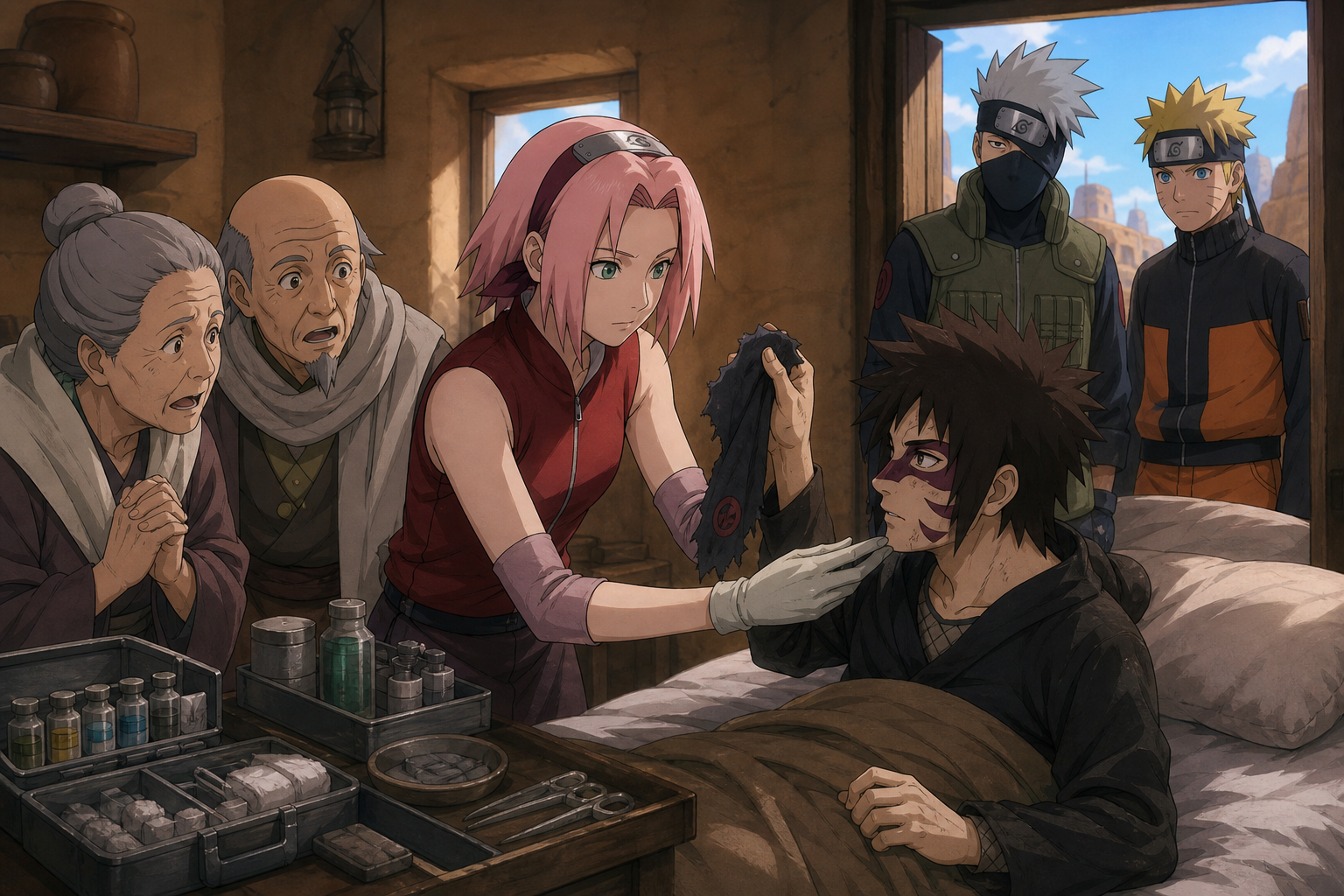
Kankuro wakes with Sasori’s cloth clue as Sakura proves Tsunade’s teaching can cross an old enemy border and change the rescue.
A student becomes the authority in the room
Naruto Shippuden Episode 11 gives Sakura a title that sounds secondary and a role that is anything but. “The Medical Ninja's Student” identifies her through Tsunade, yet the episode's proof comes from what Sakura can do when her teacher is far away. Kankuro wakes because Sakura examined the poison, stabilized his body, prepared an antidote, and stayed responsible for what happened after the first dose.
Mentorship works here as transmission, not imitation. Sakura does not need to perform Tsunade's personality or reproduce one famous technique. She applies a method under conditions Tsunade cannot control for her. The student becomes useful precisely because the teacher is absent.
The episode therefore marks a more important graduation than a new rank. Sakura enters Sunagakure as outside reinforcement and leaves the clinic as the person whose medical judgment changed the village's available future. Kankuro can speak. The rescuers have a clue. Chiyo has a reason to join the pursuit. One treatment reorganizes the mission.
Recovery is information returning to the story
Kankuro waking is not only emotional relief. Consciousness restores a witness. He can describe Sasori, confirm what happened in the desert, and hand over the piece of cloth he attached to the enemy. The body Sakura preserved becomes an active source of intelligence.
That link between care and pursuit matters. Stories often separate healing from action, as if medical work merely returns fighters to the part of the plot that counts. Episode 11 shows treatment creating the next action. Without Sakura, the tracking clue might remain beside a dead patient or arrive too late to interpret.
Kankuro's fragment also complicates his earlier recklessness. Pursuing Gaara alone nearly killed him, but he kept enough tactical awareness to mark Sasori. The decision was bad; the follow-through still matters. Failure does not erase every competent choice made inside it.
His recovery remains conditional. The antidote bought time and interrupted the poison, but Sakura does not pretend his body has forgotten the attack. That refusal to stage a cinematic reset makes her success more credible. Medical victory can mean a future that still requires rest, monitoring, and repair.
Sakura's hands are the argument
The episode does not need a long speech about Sakura's growth because her hands make the case. They prepare compounds, control chakra, assess response, and move without the uncertainty that defined much of her younger self. Precision becomes characterization.
This is a better answer to old complaints about usefulness than simply giving Sakura a larger punch. Physical strength can win a moment. Medical judgment changes who survives to reach the next one. Her contribution cannot be replaced by Naruto's determination or Kakashi's experience.
Sakura also establishes authority without humiliating the Sand medics. She works with the room, not against it. Their earlier efforts preserved Kankuro long enough for specialized help to arrive. Her training supplies the missing answer. Cooperation becomes additive rather than competitive.
That matters politically. A Leaf ninja uses one of Konoha's most advanced disciplines to save a Sand shinobi whose family remembers war with the Leaf. No treaty speech could demonstrate the alliance more directly.
Tsunade's teaching crosses a border
Tsunade is physically absent, but her choices structure the episode. She trained Sakura seriously, maintained Konoha's medical tradition, recognized the Sand emergency, and sent a team capable of answering more than combat. Her leadership arrives through the student she prepared.
This is what institutional knowledge should do. Expertise should not remain trapped inside the prestige of one famous person. A teacher builds capacity that can travel, adapt, and serve people the teacher may never meet. Sakura's success expands Tsunade's impact without shrinking Sakura into a copy.
The border crossing adds historical weight. Tsunade grew up within wars that pitted hidden villages against one another. Her student now uses that inherited knowledge in Sunagakure, not as conquest or leverage, but as care. The same shinobi system that produced generational injury can transmit tools for repair.
Chiyo recognizes the lineage and has to revise her assumptions. She expected the young Leaf visitors to carry old arrogance or old threats. Sakura carries competence directed at Chiyo's grandson instead.
Chiyo and Ebizo confront the younger generation
Chiyo and Ebizo have spent years observing the shinobi world from retirement. Distance can look like wisdom, especially after enough loss, but it can also harden into a belief that the next generation has learned nothing. Sakura disrupts that comfort.
The elders' surprise is partly technical. A teenager identified and countered a poison connected to Sasori, a prodigy whose methods came from their own village. It is also moral. Sakura accepted responsibility for a stranger across an old enemy line without demanding gratitude first.
Ebizō's presence keeps Chiyo's reaction from becoming a private conversion. The siblings represent a retired generation measuring what has changed since they stepped away. They see youth not merely inheriting techniques, but redirecting them.
That recognition does not automatically absolve the institutions that harmed their family. The value lies in refusing to make the past the only evidence available. Sakura is a new fact. Chiyo has to decide what to do with it.
The cloth fragment turns love into a trail
Kankuro's scrap of Sasori's cloak is small enough to look insignificant beside Akatsuki's ritual. Pakkun and the tracking team can make it operational. The rescue moves forward because one injured brother preserved a trace and other specialists know how to read it.
This is another episode about distributed competence. Kankuro provides the scent. Sakura preserves Kankuro. Kakashi organizes the search. Tracking summons locate the route. Chiyo carries knowledge of Sasori. Naruto keeps Gaara's personhood at the center. No single hero owns the rescue.
The fragment also exposes a limit in Akatsuki's control. The organization prepared an extraction site and coordinated members across distance, but its agents still move through a physical world. Cloth tears. scent remains. Witnesses survive. Logistics create traces.
That gives the rescue hope without making the enemy careless. Kankuro paid heavily for the clue, and following it will lead toward opponents who already defeated the Kazekage. Evidence opens a path; it does not make the path safe.
Naruto has to let Sakura's pace count
Naruto's instinct is to measure commitment by forward motion. Every minute in the village feels like a minute stolen from Gaara. Episode 11 asks him to accept that Sakura's bedside work is part of the rescue, not an obstacle to it.
That lesson matters for Team 7. Naruto's urgency is morally valuable, but a team cannot organize itself around the loudest form of care. Sakura's slower, exact labor keeps Kankuro alive and produces information needed to find Gaara. Waiting for that work is not hesitation.
Kakashi mediates between these tempos. He does not dismiss Naruto's fear, and he does not pull Sakura away before her responsibility is complete. Leadership means protecting the sequence in which different skills can matter.
The result is a team with more than one center. Naruto can drive the emotional mission while Sakura commands the medical crisis. Growth means neither person has to shrink for the other to be important.
A professional knows what happens after success
Sakura's clearest sign of maturity may be that she plans beyond the dramatic moment. Preparing the antidote is not the end of her responsibility. She explains what Kankuro still needs, leaves instructions for continued treatment, and makes sure the local team can carry the work after she joins the pursuit.
That handoff distinguishes expertise from performance. Someone interested only in appearing brilliant would center the instant Kankuro opens his eyes. Sakura centers the patient's next hours. She understands that a solution is not complete if it cannot survive the departure of the person who introduced it.
The clinic therefore becomes a small model of sustainable cooperation. Konoha supplies specialized analysis, but Sunagakure retains responsibility for Kankuro's recovery. Knowledge is transferred instead of guarded. The alliance gains capacity rather than a dependency on one visiting prodigy.
This is another way Sakura differs from Akatsuki. The organization centralizes rare knowledge so its members can control targets and conceal objectives. Sakura distributes what she knows so other people can keep someone alive. Both approaches produce power. Only one leaves the people around it more capable.
Kankuro's gratitude also carries more weight because Sakura does not demand it. She treated him before knowing whether he would wake, praise her, or provide a clue. The rescue benefits from his recovery, but the medical effort did not make survival conditional on usefulness.
That principle matters in a military world. Shinobi institutions often assign value according to rank, weapon, bloodline, or mission utility. A medic at the bedside has to resist that arithmetic. The patient is not a resource whose repair must justify its cost. Kankuro's later contribution is welcome, not the reason he deserved treatment.
By showing instructions, monitoring, and cooperation after the antidote, Episode 11 makes Sakura's achievement larger rather than smaller. She did not produce a convenient potion. She established a chain of care strong enough to continue when the story follows her out the door.
Why this is Sakura's real Shippuden introduction
Episode 3 demonstrated Sakura's new strength through the bell test. Episode 11 demonstrates the adult weight of her training. A cracked landscape can impress an audience. A poisoned patient forces a decision whose consequences cannot be laughed away.
Sakura succeeds because she can combine knowledge with composure. She understands the toxin, but she also understands the room. She gives instructions, manages expectations, and speaks with enough confidence that other people can act.
The distinction matters for a character often judged through combat comparisons. Sakura does not need to become a second Naruto to justify her place. Her medical discipline expands what Team 7 is capable of attempting.
This episode also gives her success beneficiaries beyond her closest relationships. Kankuro is not Sasuke, Naruto, or Kakashi. Sakura helps him because he is a patient and because the alliance needs every life it can preserve. Professional ethics broaden her circle of responsibility.
Fandom arguments worth sorting out
One argument says Sakura only succeeds because Tsunade handed her elite knowledge. That is what teaching is for. Access does not perform the examination, synthesize the antidote, manage the dose, or carry responsibility for the outcome. Sakura turns instruction into judgment.
Another argument calls the elders' amazement cheap praise. Their reaction is grounded in the difficulty of Sasori's poison and in Chiyo's own expertise. Surprise measures the problem Sakura solved, not a demand that every viewer worship her.
A third argument says Kankuro's awakening removes the consequences of his defeat. He remains injured, requires continued care, and cannot join the immediate pursuit. Survival is not the same as reset.
The final argument treats this as another preparation episode. Kankuro returns as a witness, the rescue gains a tracking sample, Chiyo's position changes, and Sakura establishes medical authority. The mission is materially different at the end.
RaeRae's verdict
“The Medical Ninja's Student” understands that a teacher's greatest achievement is not a student who stays dependent. Tsunade's influence is visible because Sakura can act without her.
Kankuro waking gives the episode its relief, but the deeper payoff is structural. Care restores information. Information creates a trail. The trail draws Chiyo and Team Kakashi toward the same enemy. Sakura's medical work is not beside the plot. It is the hinge.
Chiyo and Ebizō see a younger generation capable of carrying inherited techniques somewhere new. Naruto learns that urgency sometimes has to respect another person's pace. Kakashi gains the clue needed to organize pursuit.
Sakura leaves the clinic with no need to announce that she has changed. A living patient, a working antidote, and a rescue route say it for her. The title calls her a student. The episode treats her as a professional.
The title names lineage while the episode proves independence
Sakura is Tsunade’s student because serious knowledge had to come from somewhere. She becomes an authority because the teacher is absent and the patient still requires decisions.
Mentorship succeeds when instruction can travel beyond the mentor’s reach. Sakura does not imitate Tsunade’s personality. She applies a method to evidence Tsunade never examined for her.
Kankuro waking restores more than comfort
Consciousness returns a brother, witness, puppeteer, and source of information to the mission. He can describe Sasori’s tactics, identify the encounter, and explain the clue preserved on the road.
Medical care creates intelligence because a living patient can participate in what happens next. The clinic does not pause the pursuit; it rebuilds part of its capacity.
Recovery remains conditional after the dramatic moment
The antidote interrupts the toxin without erasing tissue damage, exhaustion, or the need for continued observation. Kankuro cannot simply stand and join the chase because his eyes opened.
Sakura’s honesty about aftercare makes success credible. A professional protects the hours following improvement instead of treating visible consciousness as the end of responsibility.
Instructions turn one intervention into a chain of care
Sakura must leave the clinic to pursue Gaara, so local medics need dosage, monitoring signs, risks, and response plans capable of continuing without her.
Knowledge transfer prevents the visiting specialist from becoming another single point of failure. Sunagakure gains capacity instead of temporary dependence on one Leaf prodigy.
Sakura’s hands carry character development
Measured movements, controlled chakra, compound preparation, and attention to response replace the uncertainty that once made her look toward teammates for proof she belonged.
The episode does not need a speech announcing maturity. A patient survives decisions for which Sakura accepts direct responsibility.
Physical strength and medical precision come from the same discipline
The crater in the bell test and the antidote in Sunagakure may look like opposite abilities. Both depend on exact chakra control, timing, and understanding how much force a body or material can withstand.
Sakura’s range does not come from collecting unrelated powers. It comes from applying a core strength to destruction and preservation without confusing the two.
The Sand medics make Sakura’s success possible too
They stabilize Kankuro before Team Kakashi arrives, maintain the treatment space, provide observations, and continue care after Sakura departs.
Collaboration should not become a competition where praising Sakura requires declaring everyone local incompetent. Specialized expertise works because general care kept the patient alive long enough to receive it.
Chiyo sees the future through her grandson’s survival
A young Leaf medic saves a member of her family using knowledge inherited from Tsunade. That fact cannot undo wartime death, but it complicates the category Chiyo uses for Konoha.
Present care does not demand forgiveness as payment. It creates evidence that cooperation can produce something grief alone could not.
Retired expertise becomes relevant through consequence
Chiyo knows Sasori’s childhood, puppet tradition, poisons, and the choices surrounding his departure. Remaining outside public life no longer keeps that history private when his methods return inside Kankuro’s blood.
Joining the pursuit can protect Gaara and confront consequences her generation helped pass forward. Knowledge carries responsibility when withholding it leaves younger people exposed.
The cloth fragment gains meaning through specialists
A scrap is not a route by itself. Tracking summons, scent work, witness context, and command turn material residue into direction.
This is another distributed achievement. Kankuro preserves the trace, Sakura preserves Kankuro, Kakashi organizes the search, and trackers read what the enemy left behind.
Naruto must accept care at another person’s pace
Forward movement feels like the purest measure of commitment while Gaara’s extraction continues. Pulling Sakura away early would sacrifice the witness and antidote knowledge the rescue needs.
Waiting for exact work is not caring less. It is allowing a teammate’s form of urgency to count even when it looks quieter than running.
RaeRae’s full take
This is Sakura’s real arrival in Shippuden for me. Breaking the ground was satisfying. Keeping Kankuro alive proves what kind of adult weight her training can carry when applause is irrelevant and a wrong decision does not reset with the scene.
I also love that Tsunade’s presence is strongest through absence. A teacher built enough capacity that her student could cross a border, meet an unfamiliar poison, command a room, and leave local medics able to continue the work.
The title calls Sakura a student, but the episode treats her as a professional. Kankuro’s open eyes, the preserved tracking clue, Chiyo’s revised attention, and the rescue route all exist because her knowledge changed the available future.
RaeRae checkpoint: Sakura does not prove she learned from Tsunade by copying her. She proves it by making the right decisions where Tsunade cannot make them for her.
The handoff is part of the treatment
Sakura cannot remain beside Kankuro and pursue Gaara at the same time. Leaving safely requires more than announcing that the antidote worked. She must transfer observations, dosage, warning signs, and clear thresholds for escalation to the local team.
A professional solution survives the specialist’s departure. The handoff protects Kankuro from becoming dependent on Sakura’s physical presence and protects Sakura from treating unfinished care as somebody else’s problem once the story moves her toward the cave.
Medical knowledge changes the next encounter with Sasori
Understanding one poison does not make every weapon harmless, but it removes total ignorance. Sakura now knows something about Sasori’s preparation, preferred lethality, and confidence in delayed effects.
The information shapes supplies and caution for the pursuit. Treatment of the first victim becomes preparation for preventing a second one.
Kankuro’s gratitude is not the price of care
His awakening helps the mission and allows him to acknowledge Sakura. Neither outcome explains why he deserved treatment. Sakura worked while praise, intelligence, and recovery remained uncertain.
That ethic matters in a military culture trained to calculate usefulness. The patient is a person before he becomes a restored witness, skilled puppeteer, or Kazekage’s brother.
Receipts and official routes
- Episode number, titles, Sakura’s treatment of Kankuro, the antidote result, Chiyo’s response, and the tracking clue moving the rescue forward: Naruto Official Site episode guide.
- Licensed Naruto Shippuden series route: Crunchyroll.