
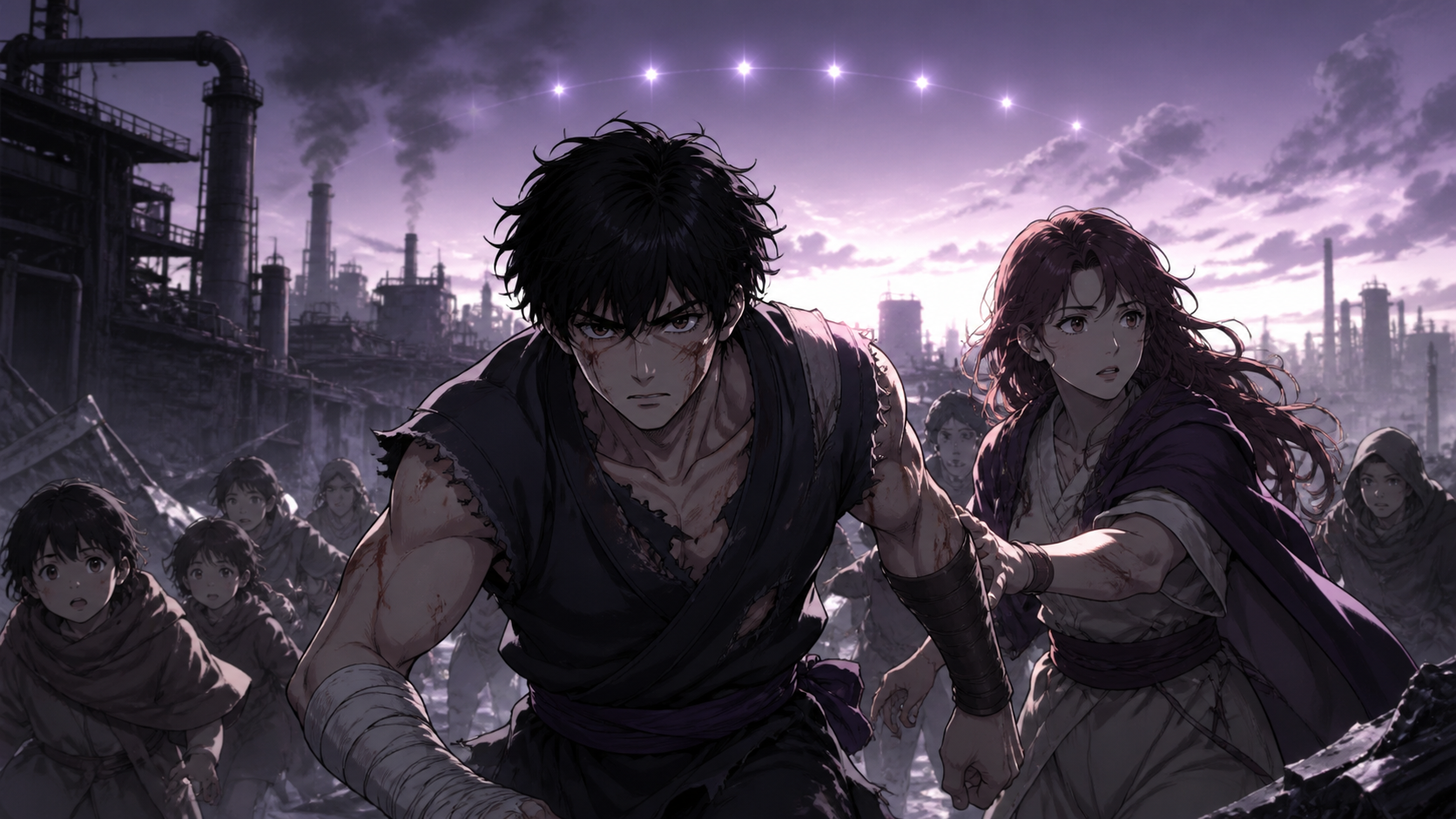
Kenshiro Legend Review: The Savior Was Built in Captivity
The savior does not emerge from a training hall fully formed. Kenshiro Legend enters the missing space after Shin defeats him and takes Yuria, then asks what turns a wounded successor into a man unable to abandon strangers whose captivity mirrors his own.
Spoilers: This Review discusses the complete 2008 film, including Gesso City, Dan, Fugen, Jugai, Siska, and the bridge into Kenshiro’s meeting with Bat and Lin.
The 2008 finale risks an entirely original bridge between famous wounds and the manga’s first chapter
The official Hokuto no Ken archive identifies Kenshiro Legend as the fifth and final work in the Legends cycle, released theatrically in Japan in October 2008. Unlike the preceding retellings, it uses a completely original story set after Shin defeats Kenshiro and takes Yuria but before Kenshiro meets Bat and Lin.
That placement carries unusual responsibility. The film must explain growth without pretending the original opening was psychologically empty. New characters including Fugen, Jugai, Dan, Siska, and the Yaman family enter a narrow canonical gap. Their lives cannot feel like disposable scaffolding erected solely to manufacture the hero audiences already recognize.
The film makes Kenshiro’s compassion politically legible and sometimes treats suffering like tuition charged to everybody around him
The central insight works: inherited technique does not make Kenshiro a savior until he chooses responsibility for people who cannot advance his personal quest. Wounded, grieving, and unable to use his full strength, he encounters slavery and hostage rule from below rather than arriving as an untouchable legend.
The danger is developmental extraction. Gesso City’s residents may suffer so Kenshiro can learn what viewers know he becomes. The film succeeds when they remain people with families, strategies, fear, and agency. It weakens when torment becomes a dramatic gym where the future hero trains his conscience.
Physical wounds matter because defeat has fractured identity, love, and confidence at the same time
Shin does more than carve seven scars. He defeats Kenshiro, removes Yuria, and turns the title of successor into an apparent contradiction. A man trained to protect cannot protect the person closest to him. Technique remains inside a body whose confidence no longer knows what technique means.
The desert collapse strips away martial prestige. Kenshiro survives because strangers help him, reversing the savior relation before it begins. Dependence is not a temporary embarrassment. It teaches that even the strongest body lives through care it did not earn or command.
Ordinary rescue establishes the moral debt that legendary power must eventually repay outward
The Yaman family encounters a wounded stranger rather than a prophecy. Their aid arises from recognition of need, not certainty that Kenshiro will become useful. This makes care ethically clean and politically dangerous in a world where resources are scarce and helping an unknown man may attract violence.
Kenshiro’s later refusal to abandon Gesso City grows from more than abstract duty. He has experienced survival as a gift passed through ordinary hands. Responsibility becomes circulation: the life preserved by strangers cannot morally narrow itself to recovering Yuria alone.
Capture places Kenshiro inside a system that converts bodies into property before strength can restore distance
The slave trader Guruma turns vulnerability into inventory. Kenshiro’s wounds make legendary status irrelevant; a damaged body can be seized, transported, priced, and disciplined like any other. The film briefly removes the protective privilege audiences associate with the hero.
This perspective matters only if other captives remain equally human. Kenshiro is not the one slave whose inner life counts because hidden power will eventually emerge. Every person in the chain possessed a story before capture. Liberation cannot mean revealing that one piece of property was secretly a king.
Siska rules through hostages because terror becomes efficient when the state occupies family love
Residents are forced to fight while relatives remain leverage. The system converts attachment into a weapon and makes resistance appear selfish: one person’s courage may trigger punishment against somebody else. Siska does not need universal belief when fear can privatize consequence inside every household.
This structure isolates people who share oppression. Each fighter must wonder whether another person’s rebellion will kill a child, spouse, or parent. Collective action becomes morally hazardous. Kenshiro’s intervention matters because he can absorb danger, but durable freedom requires residents to rebuild trust the hostage system trained them to fear.
The prisoner who helps Kenshiro gives survival knowledge a value martial inheritance cannot replace
Dan understands the immediate world of confinement: guards, routines, risks, people, and the practical costs of defiance. Kenshiro may possess Hokuto Shinken, but wounds and unfamiliarity make local knowledge decisive. The legend needs a person whose expertise comes from enduring the institution.
That relationship can resist the lone-savior fantasy. Dan should not exist merely to escort power toward its awakening. His decisions, losses, and interpretation of freedom matter independently. Solidarity becomes real when both men alter what the other can see.
A teacher connected to Shin and Jugai asks whether survival for the future can justify abandoning people suffering now
Fugen recognizes Kenshiro’s importance and urges escape for the sake of what the successor may later accomplish. The argument is not cowardly. A wounded heir dying in one trapped city could deprive countless future communities of protection. Strategy must consider time beyond immediate outrage.
Kenshiro refuses because abstract futures can become excuses for ignoring actual bodies. The choice defines his savior ethic, yet the film should respect Fugen’s dilemma. Responsibility requires balancing irreplaceable capacity against urgent need, not pretending every self-sacrificial impulse is automatically wise.
A rival shaped by Nanto inheritance shows how martial traditions become political when wounded men acquire armies
Jugai’s relation to Fugen and Shin places him within a lineage whose techniques carry rivalry, loyalty, and grievance. Martial conflict does not remain inside schools. Once fighters command troops, personal inheritance disputes become public war and residents pay for meanings they did not choose.
His campaign against Gesso City may oppose Siska without liberating its people. Replacing one armed ruler with another is not freedom simply because the incoming force hates the current general. Kenshiro must distinguish defeating an enemy from creating conditions where residents are no longer hostages to powerful men.
The general demonstrates that weakness at the top can produce extreme cruelty below
Siska’s rule relies on hostage systems and delegated violence rather than transcendent martial greatness. This makes him politically useful. Domination does not require a Raoh. An insecure administrator with guards, cells, and leverage can organize misery efficiently.
His apparent weakness should not make him harmless or invite contempt based on failed masculinity. The evil lies in choices and institutions: using families as shields, forcing residents into battle, and converting insecurity into policy. Ordinary tyranny may be less charismatic than empire and more recognizable.
Kenshiro’s incomplete strength forces the film to separate moral intention from effective intervention
Kenshiro moves against Siska because he cannot tolerate the hostage regime, but injury prevents the clean decisive victory associated with his later legend. The failure matters. Good motives do not guarantee good outcomes, and a savior who misjudges capacity can increase danger for everyone depending on him.
Crucifixion turns public punishment into a warning. The ruler displays the would-be liberator to teach residents that resistance produces helpless spectacle. Kenshiro must survive not only bodily pain but the knowledge that courage without strategy can become propaganda for the oppressor.
Public exposure attempts to convert Kenshiro’s body from potential resistance into proof that resistance is futile
The image carries religious resonance, but its political mechanism is direct. Siska wants witnesses to see a strong man immobilized and interpret the sight as natural order. Punishment works by controlling meaning as much as flesh.
Kenshiro’s endurance can reverse that meaning if residents perceive that domination failed to secure inward surrender. Yet martyr imagery risks making pain inherently purifying. Suffering teaches nothing automatically. Growth depends on how the wounded person relates pain to other lives afterward.
Kenshiro becomes the successor when strangers matter enough to interrupt his private grief
Recovering Yuria could justify leaving. She is alive, endangered, and central to his emotional world. Fugen’s advice gives strategic language to the same route: survive now, serve history later. Kenshiro chooses the residents because their captivity is not less real than his love.
This is the bridge the film must earn. The savior does not stop loving Yuria or abandon personal grief. He refuses to make private pain the only pain capable of commanding his power. Responsibility widens without requiring emotional erasure.
The ending must arrive at the manga’s beginning without treating new relationships as replaceable prehistory
Viewers know Bat and Lin will become essential interpreters of Kenshiro’s humanity. The film’s new companions occupy the difficult position before canonical family. Their narrative value cannot rest solely on preparing a man for people audiences consider more important.
A successful bridge leaves traces. Dan, the Yaman family, Fugen, and Gesso City should change how we read Kenshiro’s first choices with Bat and Lin. If the film disappears cleanly into continuity, it has explained chronology without creating memory.
The official archive establishes the canonical gap and original story; CVM Sekai owns the verdict
The Hokuto no Ken official movie and OVA archive identifies the October 2008 theatrical release, its status as a completely original final chapter, its placement between Shin’s victory and Kenshiro meeting Bat and Lin, and the roles of Fugen, Jugai, Dan, Siska, the Yaman family, Gesso City, slavery, hostages, and Kenshiro’s failed assassination.
All analysis of slavery, captivity, grief, consent, savior politics, masculinity, hostage governance, care, martyrdom, and public responsibility is independent CVM Sekai editorial criticism.
Kenshiro’s damaged body forces him to receive the kind of care his later legend usually distributes
The seven wounds are visible evidence of defeat, but the deeper injury concerns orientation. Kenshiro trained to inherit a technique and protect Yuria; Shin makes both identities appear false in one encounter. The body cannot perform certainty merely because the title of successor remains technically his.
Dependence therefore becomes part of moral formation. The Yaman family lifts, shelters, and feeds a stranger who cannot repay them immediately. Kenshiro learns from the vulnerable position that survival is social before it is heroic. No person, however gifted, creates the conditions of his own recovery alone.
The film should resist presenting this as temporary humiliation overcome when strength returns. Receiving care changes what strength means. A future savior who remembers being carried is less likely to mistake the injured for passive burdens and more likely to understand that dignity survives incapacity.
The Yaman family takes a risk that heroic narratives often hide behind the certainty that kindness will be rewarded
Helping an unknown wounded man consumes food, time, attention, and safety. In a scarcity economy, those costs matter. The family cannot know that Kenshiro will become a legendary protector. Their action is morally significant because it occurs without guaranteed return.
This uncertainty distinguishes care from investment. If aid were offered only after confirming exceptional value, the family would reproduce the world’s hierarchy by rescuing hidden power and ignoring ordinary vulnerability. They respond to need before biography.
Kenshiro’s later choice in Gesso City circulates that gift. He does not calculate whether every resident will become useful. He recognizes that care received under uncertainty creates an obligation to protect people whose futures are equally unknowable.
A legendary body becomes merchandise because institutions can strip identity faster than fists can restore it
Guruma reads injury as economic opportunity. The trader does not need to understand Kenshiro’s history, technique, love, or grief. Property logic works by making those details irrelevant. A body becomes labor capacity, resale value, and a target for discipline.
This reduction affects every captive, not only the secretly exceptional man. The film risks inviting viewers to feel special outrage because buyers fail to recognize Kenshiro. The greater obscenity is a system where nobody’s hidden interiority matters. Every enslaved person is more than the price assigned.
Kenshiro’s perspective from inside captivity can widen his ethics only if he refuses exceptional escape. Freedom based on revealing superior identity would leave the institution intact for people without martial inheritance. The savior choice begins when his own release becomes inseparable from theirs.
Siska converts family attachment into an enforcement technology that makes citizens police their own courage
Taking relatives hostage allows the regime to command soldiers who hate it. Each resident carries a private trigger the general can activate. This arrangement saves the state from manufacturing sincere loyalty because fear produces reliable compliance at lower ideological cost.
The cruelty also fractures solidarity. One person’s rebellion may kill another person’s child, so neighbors become potential threats even when they share the same enemy. Courage loses its simple moral glow. Acting boldly can transfer punishment onto somebody with no voice in the decision.
Liberation must rebuild collective trust, not merely open cells. Residents need evidence that cooperation will no longer be weaponized and that public decisions will not secretly sacrifice private families. Kenshiro can break the coercive center; community repair will take longer.
A person fighting under threat cannot be judged as though the uniform expresses free allegiance
Gesso City residents are made to defend Siska while relatives remain in danger. From outside, they may look like the regime’s army. Inside, every movement carries coercion. The uniform conceals a hostage relationship rather than declaring political belief.
This complicates combat for Kenshiro. Destroying fighters efficiently could punish the very people he hopes to free. Martial mastery must include discrimination: who chose violence, who organizes it, who profits, and who stands on the field because refusal would kill someone elsewhere.
The distinction matters beyond plot. Authoritarian systems survive by forcing victims into roles that make them appear complicit, then using that appearance to justify retaliation. A savior who sees only enemies repeats the regime’s moral simplification.
Prison knowledge becomes a form of leadership when official power has made ordinary information dangerous
Dan knows the spaces between command: which guard listens, which route remains open, which prisoner can be trusted, and when a small risk becomes collective catastrophe. Such knowledge is produced through attention under pressure. It does not look heroic because survival intelligence rarely receives a throne.
Kenshiro needs this local map. Strength cannot automatically identify the hostage structure or understand the social cost of a failed move. Dan prevents the future savior from confusing capacity with omniscience.
The relationship becomes politically valuable if information is shared rather than absorbed. Kenshiro should not emerge as though he independently understood the city. Naming Dan’s contribution preserves the truth that liberation is built through different kinds of expertise.
Preserving a uniquely capable person can be responsible strategy and morally unbearable in the presence of immediate suffering
Fugen asks Kenshiro to think beyond one city. The successor may protect thousands later if he survives now, while injury makes intervention dangerously uncertain. This is not a coward’s calculation. Movements often need to preserve people whose knowledge or capacity cannot be replaced quickly.
The argument becomes dangerous when future lives always outrank present captives. Abstract scale can excuse abandonment indefinitely. Somebody suffering now is not less human because a strategist can imagine larger numbers tomorrow.
Kenshiro’s refusal establishes a moral boundary: the future savior cannot be built through consciously treating reachable people as expendable. His choice may be tactically reckless, but it prevents destiny from becoming a language that values symbolic importance above immediate life.
The elder’s challenge matters because moral growth needs disagreement, not another person who instantly recognizes the hero
Fugen does not exist merely to confirm Kenshiro’s greatness. He questions judgment, names weakness, and presents a defensible alternative. That resistance forces Kenshiro to articulate what succession means when capacity and obligation pull in opposite directions.
A useful teacher does not eliminate choice by supplying the correct answer. He makes consequences visible. If Kenshiro stays, he may die and abandon Yuria and future communities. If he leaves, actual residents remain inside a hostage state he now understands.
The decision becomes Kenshiro’s because Fugen refuses easy reassurance. Growth emerges through accepting responsibility for an uncertain choice, not through receiving prophecy that every risk will succeed.
Attacking a tyrant does not make the attacker a liberator when residents remain material for somebody else’s victory
Jugai’s force creates pressure against Siska, but the city’s people are trapped between powers. The general uses them as coerced defenders, while the invader’s objectives do not necessarily center their autonomy. Two enemies can fight over a place without either recognizing its inhabitants as political agents.
This is why regime change and liberation must remain separate concepts. A new martial ruler may remove one cruel administrator and preserve the hierarchy that made hostage governance possible. Residents need control over their families, labor, movement, and collective decisions, not merely a different flag.
Kenshiro’s intervention becomes meaningful insofar as he refuses to claim the city afterward. He can disrupt both violent centers and leave room for inhabitants to determine what protection looks like without permanent submission.
When rulers fight for control, residents experience strategy as damage to homes, bodies, and the possibility of return
Gesso City is not an empty arena. Gates, streets, cells, markets, and dwellings organize daily life. Jugai’s breach and Siska’s defense convert civic space into military geometry. A road becomes an approach, a home becomes cover, and a family becomes leverage.
The phrase “the city falls” hides unequal experiences. A commander loses position; a resident loses a roof, relative, shop, medicine, or route to water. Cinematic battle often celebrates the wide view while destruction becomes small movement below.
A savior story should keep the ground visible. Victory must be evaluated by whether people can inhabit the place afterward, not only by which powerful man stands at the center when the fighting stops.
Kenshiro’s assassination attempt exposes the gap between knowing what is wrong and knowing how to stop it responsibly
Siska’s rule is clearly abusive, so decisive removal appears morally attractive. Kenshiro’s injuries and incomplete information make the attempt fail. The result teaches that righteous target selection does not guarantee competent intervention.
Failure can increase repression. The ruler gains a prisoner to display, guards tighten control, residents fear collective punishment, and resistance appears futile. Kenshiro must confront the possibility that acting from compassion without adequate strategy endangered the people he meant to help.
The lesson should not teach passivity. It should mature action. Courage includes preparation, collaboration, honest assessment of capacity, and willingness to revise. Later Kenshiro feels inevitable because this film lets an earlier version be morally right and operationally incomplete.
Siska uses a wounded body as propaganda, while endurance risks becoming propaganda for heroic suffering in return
The cross places Kenshiro where residents must see him. Punishment communicates that even unusual strength becomes helpless beneath the regime. Siska wants the crowd to internalize defeat before another rebellion begins.
Kenshiro’s refusal to surrender inwardly can reverse the message. Endurance shows that pain does not control meaning completely. Yet the film must avoid implying that suffering itself grants wisdom or legitimacy. Many people suffer without receiving power, recognition, or narrative reward.
What matters is relation after pain. Kenshiro does not emerge entitled to rule because he endured. He emerges more committed to people whose captivity lacks legendary framing. Pain becomes ethically useful only when it widens attention rather than establishing superiority.
Kenshiro must rebuild identity without pretending Shin’s victory was unreal or blaming vulnerability for the loss
Defeat threatens a masculinity organized around protection and technical mastery. Kenshiro could respond by seeking immediate revenge, denying injury, or treating care as humiliation. Instead, the film places him among people whose survival requires cooperation.
This environment gives strength another measure. Listening to Dan, receiving the Yaman family’s help, considering Fugen’s warning, and recognizing coerced soldiers all require a self secure enough to admit incomplete knowledge.
The later stoic hero becomes more compelling when silence contains this experience rather than empty coolness. Restraint can mean the body remembers dependence and no longer needs to announce dominance at every encounter.
Her loss motivates Kenshiro, but the film must not turn a living woman into an abstract wound that improves a man
Yuria is absent from most immediate action, which makes memory responsible for representing her. Kenshiro’s grief can preserve love or reduce her to the symbol of his failure. The distinction appears in whether he imagines her will and safety beyond his need to recover identity.
Choosing Gesso City does not mean he loves her less. It means love has taught him that other people also form irreplaceable bonds. Hostage families become legible because he knows what forced separation does to a person.
The film’s best moral bridge therefore runs through Yuria without consuming her. Kenshiro carries the injury of losing her into solidarity with strangers, not into a claim that his private tragedy outranks everyone else’s captivity.
Personal vengeance cannot remain the sole engine of strength once Kenshiro sees institutions harming people he never knew
Shin gives Kenshiro an identifiable enemy and a direct emotional objective. That structure could narrow the journey into recovering Yuria and repairing masculine humiliation. Gesso City interrupts the simplicity. Harm appears without personal history.
Siska did not scar Kenshiro or steal Yuria, yet the hostage system creates an obligation. Jugai’s invasion does not center him, yet residents face consequences he can affect. The savior emerges when power responds to injustice without requiring a private insult first.
This expansion does not erase revenge from the franchise. It disciplines it. Personal grief may open the path, but public responsibility decides where the path goes when strangers call from the side.
Freedom becomes believable when Gesso City’s people do more than wait for Kenshiro to recover
The movie’s premise naturally centers the future legend, but residents possess knowledge, relationships, and reasons to resist before he arrives. Hostage systems suppress action; they do not prove the population lacks courage. Every quiet survival tactic may preserve someone for a later opening.
Kenshiro can create that opening by absorbing force the residents cannot survive. He should not become the sole author of liberation. People must decide whom to trust, locate captives, protect children, refuse coerced commands, and rebuild the city after powerful men leave.
A savior who enables agency differs from a ruler who rewards obedience. The distinction should be visible in outcomes. Residents are free when they can make collective choices Kenshiro neither scripts nor owns.
The film’s most important training happens through being fed, hidden, warned, and believed
Traditional martial instruction focuses on technique, discipline, endurance, and succession. Kenshiro already possesses that education. Gesso City teaches another curriculum through relationships that would appear peripheral inside a tournament story.
The Yaman family demonstrates unsolicited care, Dan demonstrates local intelligence, Fugen demonstrates strategic dissent, and residents demonstrate the cost of force applied without political understanding. These lessons do not add a secret pressure point. They determine what pressure points are for.
Becoming the true successor therefore means aligning inherited capacity with a social ethic. Kenshiro does not need more proof that he can kill. He needs reasons to decide whom strength protects, when intervention helps, and why victory grants no ownership.
A missing chapter should deepen familiar behavior without making the original story depend on information it never acknowledged
Prequels and interquels face a structural trap. If the new events are too important, later silence feels implausible. If they leave no trace, the new story feels disposable. Kenshiro Legend must inhabit the narrow space between explanation and retroactive takeover.
The strongest continuity is behavioral. Kenshiro’s responsiveness to Bat and Lin can feel shaped by the Yaman family, Dan, and Gesso City even if he does not deliver exposition about them. Experience becomes habit rather than trivia.
The weakest continuity would make new characters sacrificial placeholders whose entire purpose is preparing him for the “real” cast. Their lives deserve finality inside this film. Canonical future importance should not create a hierarchy of fictional humanity.
Ending the five-work cycle before the original beginning turns the franchise into a loop of memory and formation
The Legends project revisits Raoh, Yuria, Toki, and Kenshiro across different viewpoints. Closing with a story before the manga’s first chapter avoids ending only on Raoh’s death. It returns to the moment a savior identity was not yet secure.
This structure suggests legends are made retrospectively. Viewers know what Kenshiro becomes and search the missing interval for causes. The film must resist pretending one crisis explains a lifetime. Character develops through accumulated choices, relationships, failures, and revisions.
As a finale, Gesso City makes public responsibility the final subject. The cycle ends not with the strongest fist but with the decision that strangers cannot be abandoned. That is a worthy thesis even when execution remains uneven.
Kenshiro’s origin matters only if Gesso City remains more than a wound the hero gets to keep
A morally serious origin story distributes consequence. Kenshiro changes, but Dan, the Yaman family, Fugen, coerced soldiers, hostages, and residents must also possess trajectories not exhausted by his growth. Their city should emerge with choices rather than gratitude alone.
The film’s emotional power comes from seeing a defeated man rebuild purpose. Its political power depends on whether rebuilding purpose requires listening to people already surviving oppression. A savior is not the first person to care; he is the person whose capacity can join existing care without owning it.
This standard produces the final judgment. The movie succeeds wherever captivity teaches interdependence and fails wherever suffering functions like a private academy for exceptional masculinity. Kenshiro becomes worthy of legend when the lives around him remain worthy of themselves.
People can share an enemy and still be unable to trust one another when the regime individualizes punishment
Siska’s structure turns solidarity into a threat against loved ones. A resident who plans escape may expose another family to retaliation, while a soldier who refuses combat may condemn hostages hidden elsewhere. The regime makes each person responsible for consequences only the regime controls.
This manufactured moral isolation explains why collective rebellion does not appear instantly. Fear is not proof of cowardice. People calculate inside incomplete information while power ensures that no choice remains clean. The courageous act may be waiting, lying, complying temporarily, or preserving somebody else for a future opening.
Kenshiro contributes by changing what risks are survivable, not by inventing courage among people who lacked it. His exceptional body can draw violence away from residents. Liberation becomes collective when that opening lets suppressed relationships become visible and coordinated again.
Forced soldiers may survive combat and remain trapped inside actions the hostage system made them perform
Coercion explains behavior without erasing emotional consequence. A resident forced to fight Jugai’s army may injure another captive, watch a neighbor die, or discover skills developed under terror. After release, knowing the choice was constrained may not remove shame.
Communities will need language capable of distinguishing willing enforcers, opportunists, frightened collaborators, and people with no plausible refusal. Treating everyone in uniform as equally guilty reproduces Siska’s simplification. Treating every action as innocent because hostages existed prevents accountability where real choices remained.
Repair requires testimony, context, restitution, and room for grief. Kenshiro can stop the immediate violence, but no pressure point resolves moral injury. The city must learn how to live with people who were victims and participants at the same time.
Local survival knowledge and long-range strategic knowledge should challenge one another without becoming a simple contest
Dan understands Gesso City from within confinement. Fugen understands martial lineages, Jugai, Shin, and the possible historical importance of Kenshiro’s survival. Each sees a scale the other may miss. One knows the immediate map; the other sees consequences beyond the walls.
Kenshiro’s decision becomes stronger when it absorbs both rather than choosing compassion against thought. Dan helps identify what residents need and what actions are possible. Fugen forces acknowledgment that dying here would affect Yuria and future communities. Moral seriousness lies in carrying both costs.
The film’s savior ethic should therefore be collaborative intelligence. Kenshiro does not follow either man automatically, but their knowledge changes his choice. Independence is not the refusal of influence. It is responsibility for integrating influences whose conclusions conflict.
When intervention fails, accountability requires more than noble intent and renewed determination
Kenshiro’s attempt against Siska emerges from a clear recognition of evil. Injury and incomplete preparation make failure likely, and the public punishment may strengthen the ruler’s propaganda. The residents bear part of the risk generated by a decision they did not fully control.
A hero-centered story can frame this only as personal setback. A community-centered reading asks whether guards retaliate, hostages are moved, food is withheld, or future resistance becomes harder. Failure creates social consequences beyond the hero’s pain.
Learning therefore includes apology, listening, and revised coordination, even if the genre does not stage those acts explicitly. Kenshiro’s renewed action should be judged by whether he reduces transferred risk rather than merely returning with more power.
Removing Siska may be necessary, but secrecy concentrates the decision in one person and leaves the system waiting
Assassination promises efficiency. Kill the general, break the command, free the hostages. Under urgent tyranny, the attraction is understandable. The plan avoids mass battle if successful and directs force toward the person most responsible.
The structure may survive its ruler. Guards control cells, collaborators possess information, food routes remain centralized, and fear continues to shape relationships. Removing Siska without coordinating release and protection could produce chaos or invite Jugai to inherit the apparatus.
Kenshiro’s fist can make removal possible; residents must determine the transition. A savior story becomes politically mature when defeating the tyrant is one component of liberation rather than its complete definition.
The slave trader reveals how private profit connects wandering violence to formal rule
Guruma appears before the city’s political conflict fully develops, but his trade supplies the human material rulers exploit. Capture, transport, sale, and forced labor require routes, buyers, guards, and social tolerance. Slavery is an economy, not a single villain’s appetite.
Siska benefits from a world where vulnerable people can be converted into assets. Even if the general does not conduct every capture, his order creates demand and protection for those who do. Public tyranny and private commerce reinforce one another.
Freeing Gesso City should therefore threaten the market beyond its walls. Survivors need safe routes and communities must refuse buyers, brokers, and guards. Kenshiro’s intervention has wider meaning when it disrupts the assumption that injured strangers are available for ownership.
Kenshiro’s title means little if lineage cannot answer hunger, imprisonment, and fear
Hokuto succession grants extraordinary capacity and historical legitimacy. Inside a slave chain, nobody needs a title that cannot open a cell or protect a family. The film tests whether martial inheritance remains an identity badge or becomes a public obligation.
Kenshiro’s wounds prevent immediate proof through overwhelming technique. He must decide what succession means before his body can perform it convincingly. This reverses the usual action logic: ethics precedes restored spectacle.
The true successor is not simply the man whose pressure points work. He is the man who understands why they should work on behalf of people without access to inherited violence. Gesso City gives the title a constituency Kenshiro never sought to own.
Jugai and Fugen widen Shin’s martial history without letting Kenshiro’s private enemy consume every new conflict
Connections to Shin create continuity and help explain the Nanto world surrounding Kenshiro’s defeat. Fugen’s authority and Jugai’s ambition show that one famous rival emerged from relationships and traditions rather than appearing in isolation.
The danger is gravitational. Every original character may become important only because proximity to Shin helps explain Kenshiro. Jugai deserves analysis as a commander affecting Gesso City, not merely an echo of the man who took Yuria.
The film works when Shin’s shadow supplies context without determining moral attention. Residents face Jugai’s army because of present power, regardless of how his lineage enriches franchise lore. Their safety cannot remain secondary to a rivalry elsewhere.
Cruelty driven by insecurity remains cruelty and should not be explained through contempt for insufficient masculinity
Siska lacks the overwhelming presence of Raoh or the martial mystique of Souther. His authority relies on hostages, bureaucracy, guards, and the ability to make other people fight. The contrast shows how ordinary men can organize extraordinary harm.
Calling him weak may describe dependence on coercive machinery, but it can also reproduce the franchise’s hierarchy by suggesting stronger masculinity would produce better rule. Raoh proves physical greatness does not guarantee justice. Siska’s moral failure lies in treating people as means.
The useful lesson is institutional. A mediocre ruler can be devastating when systems multiply fear. Resistance must dismantle leverage, not merely replace the man with someone more impressive.
Companionship in confinement gives Kenshiro a relation not organized by prophecy, rivalry, or romance
Dan meets Kenshiro as another prisoner rather than the legendary successor. This relative equality matters. Their bond forms through immediate need and shared observation, without the heavy script attached to Yuria, Shin, Raoh, or Hokuto inheritance.
Friendship allows Kenshiro to be uncertain without becoming a failed symbol. Dan can offer information, humor, disagreement, or practical help that does not require worship. Such relationships make the later stoic less isolated than his surface suggests.
The narrative must preserve Dan beyond function. If he exists only to awaken the hero and then vanish, friendship becomes another resource extracted from a supporting life. His future should matter because connection is reciprocal.
The elder’s limited body does not reduce his knowledge, while knowledge does not grant ownership of Kenshiro’s choice
Martial stories often tie authority to physical dominance. Fugen complicates that measure. His relation to Shin and Jugai gives him history capable of reading forces younger men experience only as immediate threat.
Age can also produce strategic conservatism. Having survived earlier conflicts, he may value preservation more than a captive who cannot imagine another day under Siska. Wisdom remains situated rather than infallible.
Kenshiro respects Fugen most by taking the warning seriously and still owning disagreement. A teacher’s dignity does not require obedience. It requires a student mature enough to understand the cost before choosing otherwise.
Hostage rule often turns women into leverage while leaving their survival strategies outside the heroic frame
Families held against forced soldiers are not abstract pressure points. Women may be captives, caregivers, organizers, workers, or defenders navigating surveillance while male fighters occupy the visible battlefield. Their danger structures decisions even when the camera grants them little dialogue.
A deep reading asks how information moves through domestic spaces, who hides children, who treats injuries, and who negotiates with guards. Care under occupation is political labor. It preserves the community the regime wants to fragment.
Kenshiro’s liberation should not return women merely to grateful family roles. Freedom includes public voice over reconstruction, security, labor, and how collaborators are judged. A city rebuilt entirely by surviving fighters would reproduce the invisibility that made hostage leverage so efficient.
A child used as leverage learns that love makes adults controllable and authority makes safety conditional
Siska’s system teaches children a brutal social lesson. Their existence can be weaponized against parents, and any adult act of courage may be framed as choosing politics over family. The regime colonizes attachment before children understand the conflict.
Release does not instantly remove that knowledge. Children may fear separation, uniforms, gates, arguments, or any sign that a caregiver will act publicly. Recovery requires predictable routines and truthful explanation, not only reunion.
Kenshiro’s later bond with Bat and Lin gains weight against this background. Protecting children means more than defeating the immediate threat. It means creating enough safety that they can disagree, explore, and grow without believing love is a hostage chain.
Restored strength should feel like capacity rejoined to purpose, not proof that suffering was secretly beneficial
Action stories often use injury as a temporary seal that makes the eventual return of power exhilarating. The risk is implying that captivity, torture, and failure were necessary gifts refining the hero. People harmed around him receive no equivalent reward.
Kenshiro’s growth should come from choices and relationships within suffering, not from suffering as a magical teacher. Pain creates conditions; interpretation and solidarity create meaning. Another person could endure the same wounds and emerge frightened, angry, or unchanged without moral failure.
When full technique returns, the ethical question is where it points. Power becomes earned narratively because Kenshiro has widened responsibility. It is not earned morally by how much pain his body absorbed.
Spectacle becomes justified when it remains attached to coerced residents rather than turning the city into a franchise arena
Jugai’s breach, Siska’s defenses, and Kenshiro’s intervention create the large conflict a theatrical finale expects. Martial bodies and armies can deliver visual scale after the cramped spaces of capture.
The battle risks displacing the hostage premise that gave it meaning. Once famous techniques dominate, residents may become crowd reaction and collateral motion. The film must keep families, cells, and forced fighters visible within the choreography.
A blow matters because it changes what somebody can safely do next. If action is read through that standard, spectacle serves liberation. If the viewer remembers only which style defeated which style, Gesso City has become scenery again.
Residents need control of cells, weapons, records, food, and judgment before victory becomes freedom
Siska’s defeat removes the person authorizing the hostage system. Guards, keys, lists, storage, and chains remain. Somebody must locate every captive, verify identities, prevent revenge killings, and protect people whose coerced roles made them visible targets.
Records could reveal collaborators and also expose families to further danger. Weapons may be necessary for defense against Jugai while creating new concentrations of power. Reconstruction begins with choices where perfect innocence is unavailable.
Kenshiro should support the opening and refuse permanent command. Residents know what was taken and what institutions they can trust. The savior’s restraint matters because liberation cannot become another outsider deciding that superior force equals superior civic judgment.
Leaving can honor autonomy and can also abandon a community before the danger created by intervention has settled
Kenshiro’s wandering identity requires movement toward Bat, Lin, Yuria, and the wider story. Remaining as Gesso City’s ruler would contradict the ethic the film develops. Departure prevents gratitude from becoming a new throne.
Timing matters. Leaving immediately after destroying command could expose residents to Jugai, surviving guards, scarcity, and internal revenge. Refusing sovereignty does not mean refusing every transitional responsibility.
The humane departure ensures captives are released, residents possess resources, and local leadership can act without coercion. A savior should know when to leave and also what conditions make leaving something other than escape.
Gesso City can make Kenshiro’s later patience with two children feel learned rather than automatic
Bat and Lin meet a man who looks nearly invulnerable, but this film gives viewers memory of the stranger once carried by a family and informed by a prisoner. His willingness to accept companionship can emerge from having survived through unexpected care.
Lin’s vulnerability may recall children used as hostages, while Bat’s survival intelligence echoes Dan’s local knowledge. These parallels should enrich behavior without reducing new or old characters to substitutes for one another.
Kenshiro does not need to announce the connection. Embodied memory can appear in whom he listens to, how quickly he distinguishes bravado from fear, and why he protects children without treating them as passive mascots.
The film argues that a title becomes a vocation only when the successor answers suffering unrelated to his private destiny
Before Gesso City, Kenshiro’s immediate story could remain focused on Yuria, Shin, and the meaning of defeat. Those concerns are profound and personal. The city introduces people whose pain does not exist to complete that triangle.
Choosing them transforms Hokuto succession from inherited status into public practice. Kenshiro becomes a savior not because prophecy reveals his essence, but because he accepts obligations that arrive unexpectedly and without reward.
This is the movie’s strongest contribution to continuity. It does not invent a hidden super-technique. It gives familiar strength a political threshold: strangers matter before the hero knows their names, and saving them grants no right to own what they rebuild.
Their moral life should continue beyond the moment kindness finishes constructing Kenshiro’s motivation
The family enters the story by helping a collapsed stranger, an act whose goodness is easy to admire because viewers know his future. Their own future matters equally. Guruma’s arrival and the widening violence threaten a household that did not consent to become part of legendary formation.
An origin story can repay supporting characters with survival, reunion, or gratitude and still leave them narratively thin. The deeper obligation is agency. What do they want for their family, how do they interpret Kenshiro’s danger, and what risks are they willing to accept after kindness brings consequences?
Kenshiro honors them by refusing to treat rescue as a private debt settled through one heroic act. He must protect the social possibility they represented: strangers can help one another without turning care into ownership or inviting permanent punishment.
A prisoner who mastered survival deserves a role in deciding what the liberated city becomes
Dan’s expertise develops under confinement, where reading guards and finding gaps can keep people alive. Liberation changes the value of those skills. Secrecy may become coordination, route knowledge may support distribution, and trust built among prisoners may become civic organization.
Freedom also allows refusal. Dan should not be obligated to lead merely because suffering made him capable. Survivors are often asked to transform trauma into public service before they have rested. Agency includes leaving, grieving, rebuilding privately, or choosing a responsibility on new terms.
The movie’s treatment of Dan measures whether it believes ordinary people possess futures after helping the hero. If his arc ends at Kenshiro’s awakening, the savior has consumed a friend. If Dan chooses afterward, solidarity has produced another center of life.
Opposing Siska gives Jugai an enemy, not a mandate from the people he plans to enter
Jugai’s martial lineage and army create an alternative source of power. He may present invasion as correction, revenge, or restoration of rightful order. None of those claims automatically includes the residents’ consent.
Political legitimacy cannot be inferred from comparative strength. Jugai might defeat an abusive general while preserving hostage practices, forced labor, or centralized control. Residents become liberated only when they can reject both men without waiting for a third fighter to validate the decision.
Kenshiro’s task is therefore not choosing the better ruler. It is breaking the conditions that make Gesso City available as a prize between armed claimants. Refusing the throne afterward completes the distinction.
A hostage state requires more than one cruel general; it requires people who record, guard, transport, and normalize leverage
Siska cannot personally watch every family, issue every ration, or force every soldier into place. Clerks know names, guards hold keys, informants identify dissent, and traders connect captivity to profit. The regime is a network whose participants possess unequal freedom and responsibility.
After defeat, residents face difficult judgments. Some collaborators acted eagerly, some protected relatives, some quietly reduced harm, and some changed sides only when victory seemed likely. A single category cannot describe them without reproducing authoritarian convenience.
Kenshiro can make testimony possible by ending immediate threat. He should not decide every case through martial intuition. Civic justice needs evidence, participation, proportionality, and safeguards against revenge becoming the next hostage system.
Kenshiro’s technique can end active threats, but moral precision requires attention to coerced bodies around the target
Hokuto Shinken offers spectacular lethality directed through intimate bodily knowledge. Against Siska, Guruma, or committed attackers, that precision may prevent wider battle. Against forced soldiers, the same power could punish victims for surviving badly.
The film’s action becomes ethical when Kenshiro distinguishes command from compliance and creates exits for people whose violence is coerced. Restraint is not weakness; it is the technical expression of political understanding.
Lethal force remains a severe answer even when justified by immediate danger. The story protects Kenshiro by constructing enemies who continue harming until stopped. Criticism should notice that convenience without pretending pacifism would automatically save hostages in the moment.
Scars, restraints, fatigue, and crucifixion record systems that official stories would prefer to call isolated battles
Kenshiro’s seven scars remember Shin, but Gesso City adds another archive across the body. Wounds show capture, forced movement, failed intervention, and public punishment. The hero carries institutions physically even when later episodes do not name them.
Residents carry their own records: restraint marks, battle injuries, hunger, sleeplessness, and the posture of people trained to anticipate guards. These bodies deserve the same interpretive attention as the famous chest.
A legend often concentrates history onto one iconic figure. The film’s political challenge is distributing memory again. Kenshiro’s scars matter because every less visible scar matters, not because his body alone can represent them all.
Losing Yuria initially narrows Kenshiro’s world, while captivity teaches grief to notice people outside itself
Personal loss can make every surrounding event feel like interruption. Kenshiro’s first obligation appears obvious: recover, find Yuria, and confront Shin. Gesso City asks whether grief justifies moving past strangers whose families are being used exactly as attachments were used against him.
He recognizes their pain because his own remains active. This is empathy through analogy, but it must mature beyond projection. Residents do not need to resemble Yuria for their lives to matter, and their preferred freedom may differ from what Kenshiro imagines.
The savior emerges when grief widens attention without making every stranger a symbol of the beloved. Care becomes specific: listen to this prisoner, protect this family, understand this city, and act on needs they express.
Fugen, Shin, and Jugai show how schools produce emotional debts that later become public violence
Teacher and students share technique, expectation, rivalry, and injury. Those bonds can resemble family while lacking ordinary routes for disagreement. Succession and honor convert affection into hierarchy, making separation politically charged.
Jugai’s military campaign demonstrates how unresolved lineage conflict scales outward. Soldiers and residents become participants in meanings created within a small martial circle. The institution privatizes training and socializes the damage.
Kenshiro must inherit differently. He can respect teachers and rivals without treating the world as the arena where their internal account is settled. Public responsibility limits what lineage may demand from strangers.
One rules through hostages and the other advances through force, leaving residents caught between different claims on their bodies
Siska’s authority is defensive and administrative. Jugai’s is mobile and martial. Their styles differ, but both risk treating inhabitants as means to secure command. The city becomes valuable before residents are heard.
This symmetry should not erase distinctions. Siska actively holds families and forces residents to fight. Jugai’s opposition may create openings even if his intentions remain self-serving. Moral comparison requires specificity rather than declaring all power identical.
Kenshiro’s alternative lies in purpose and departure. He uses force to end coercion, then refuses to convert gratitude into permanent rule. Whether residents can act afterward determines if the alternative is real.
Crucifixion accidentally creates a symbol whose meaning residents may use beyond Kenshiro’s intention
Siska displays Kenshiro to prove that resistance fails. A punished body becomes public communication. If Kenshiro survives and returns, the same image can reverse into evidence that the regime’s certainty was false.
Symbolic hope can mobilize people while creating dependence. Residents may wait for the exceptional man rather than recognize their own networks. Kenshiro cannot control every interpretation, but he can direct attention toward shared action and refuse worship after victory.
The savior’s political discipline includes shrinking the symbol once it has opened possibility. A city should not need his suffering permanently displayed to remember that Siska was mortal.
Kenshiro’s voice must carry a man before the legend without making injury sound like absence
The film occupies a liminal character state. Kenshiro is trained and formidable, yet defeated, grieving, dependent, and not fully aligned with the public vocation viewers recognize. Performance must hold capacity beneath exhaustion without rushing into iconic certainty.
Dan and Fugen provide different relational pressures. One invites practical companionship; the other asks Kenshiro to hear historical responsibility. Vocal restraint can reveal whether silence listens, refuses, calculates, or collapses.
Siska and Jugai benefit from differentiation beyond volume. Administrative cruelty, martial ambition, insecurity, and ideological claim should sound distinct. A story about systems weakens if every antagonist speaks only in the register of obvious evil.
Chains and gates make power spatial before restored martial spectacle makes it bodily again
Gesso City organizes domination through architecture. Cells restrict movement, gates define inside and outside, walls create choke points, and public punishment controls sight. The environment does political work before any fighter strikes.
Kenshiro’s injured body belongs to these spaces rather than dominating them. Frames can make him small, obstructed, or exposed, allowing viewers to feel how institutions contain individual capacity.
When battle opens the space, visual liberation should include residents moving differently: doors opened, families crossing boundaries, forced soldiers lowering weapons, and public areas reclaimed. Destruction alone cannot communicate freedom.
Silence, commands, chains, and distant battle create a social world the score should not drown beneath heroic anticipation
Captivity has an acoustic structure. People lower voices, listen for guards, recognize keys, and interpret noises they cannot see. Hostages experience every shout as possible news about someone they love.
A heroic score can announce Kenshiro’s return before residents know whether rescue will succeed. Used carefully, music shares hope. Used carelessly, it replaces their uncertainty with the audience’s canonical confidence.
The strongest sound design preserves vulnerability around spectacle. A chain falling, a gate opening, or a family hearing a familiar voice can carry more political meaning than another musical declaration that destiny has awakened.
Freedom from direct manga events permits moral invention and removes the protection of beloved canonical detail
An original story can center slavery, hostages, failed intervention, and Kenshiro’s formation without matching known panels. This freedom allows the Legends cycle to ask a question the retellings could only approach indirectly: what happened inside the gap between broken lover and public savior?
Originality also makes every weakness the film’s own. New residents cannot rely on decades of audience attachment, and new villains may feel functional beside iconic figures. The screenplay must create specificity rather than expecting franchise gravity to supply it.
The best additions alter how later behavior reads without claiming secret primacy. Gesso City becomes one meaningful stage in a long formation, not the hidden answer that explains everything.
Calling Kenshiro necessary to the future can protect him and make present people sound expendable
Fugen’s argument draws power from what viewers know. Kenshiro will save many people, so preserving him appears mathematically responsible. Canonical destiny makes escape look wise because the audience can see future returns unavailable to characters.
Residents cannot live as footnotes to episodes that have not happened yet. Their suffering occupies the only present they possess. An ethical story must resist asking them to die for continuity.
Kenshiro’s decision refuses the audience’s privilege. He acts without treating future fame as entitlement to abandon reachable people. The choice makes destiny worthy by preventing destiny from becoming an excuse.
Residents and heroes need room for imperfect choices without the story converting every mistake into moral worthlessness
Hostage rule ensures some decisions will have terrible outcomes. A resident may comply too long, trust the wrong person, or resist at a moment that triggers punishment. Kenshiro may act too early and become Siska’s display.
Failure should produce learning and accountability, not automatic condemnation. Authoritarian systems thrive when people believe one mistake proves they were never capable of freedom. The hero myth can reproduce that pressure by allowing only flawless courage to count.
Gesso City becomes humane when people can revise. Kenshiro’s failed assassination matters because he remains responsible and tries differently. The same generosity should extend to ordinary survivors.
A liberated city should remember the family that helped, the prisoner who knew, the elder who warned, and residents who endured
Legends simplify collective work into one name because a name travels easily. Kenshiro will leave Gesso City already moving toward a reputation larger than the people around him. Memory can make their contributions disappear.
Credit is not vanity. It shapes future politics. If people believe one exceptional outsider created freedom, they may wait for another instead of maintaining local capacity. If they remember networks, they understand that care and information were already forms of resistance.
Kenshiro’s humility should include redirecting recognition. The savior is strongest when he makes visible the people whose actions allowed his strength to matter.
The city must replace hostage command with institutions capable of surviving disagreement
Opening cells reunites families but does not answer how food is distributed, guards are restrained, or conflicts are judged. Residents have lived under commands backed by private leverage. Public decision-making may feel unsafe and unfamiliar.
A council, neighborhood network, or other shared structure could distribute authority. The exact form matters less than contestability: leaders can be questioned, records inspected, and families protected from secret retaliation.
Kenshiro’s refusal to rule creates space for this work. He should not romanticize spontaneity. Freedom requires procedures as well as courage, and procedures are how ordinary people keep a future hero from becoming necessary every week.
The film earns continuity if Kenshiro carries Gesso City as ethical reflex rather than exposition
When Bat approaches the wanderer, Kenshiro can recognize survival intelligence because Dan taught him not to dismiss it. When Lin faces danger, he can understand a child’s fear inside systems that weaponize family. When villagers hesitate, he can recognize hostage logic rather than calling them cowards.
These connections need not be explicit to matter. Character continuity often lives in the speed and quality of attention. A person shaped by captivity notices chains before titles.
The original manga opening remains complete on its own, while the film offers another layer for viewers who choose it. That is the right balance for a canonical-gap story.
Does Kenshiro leave Gesso City with a stronger fist, or with a different understanding of whom strength belongs to?
If the answer is only stronger fist, the film has used slavery and hostages as an obstacle course. Pain delayed the hero until spectacle could return, and residents functioned as stakes.
If the answer concerns ownership, the interquel earns significance. Kenshiro learns that inherited power belongs morally to no throne, lover, lineage, or private destiny. It becomes legitimate through service to people whose freedom remains theirs.
The film contains both possibilities. Its action celebrates restored capacity, while its best relationships teach dependence and local knowledge. The Review’s final judgment must keep that tension visible rather than choosing the more flattering half.
The film understands dehumanization most clearly when Kenshiro’s special identity stops granting narrative exemption
Capture reduces Kenshiro to a wounded body available for sale, which gives viewers immediate access to slavery’s violence. The sequence becomes politically meaningful only when the same outrage extends to every captive whose lineage will never be revealed.
The film often reaches that standard by connecting enslavement to Guruma’s trade, Siska’s hostage system, forced military labor, and public punishment. Oppression appears as a network rather than one bad encounter.
Its limitation is focus. Kenshiro’s transformation naturally dominates, leaving other captives with less interior life. The Review’s verdict remains positive but conditional: the movie opens the right moral frame and does not always populate it fully.
The wounded successor becomes more credible because strangers keep him alive before restored power makes him useful
The Yaman family’s intervention, Dan’s knowledge, and Fugen’s disagreement dismantle the fantasy of self-created strength. Kenshiro survives through people whose contributions cannot be reproduced by punching harder.
This dependence enriches later stoicism. Silence can contain remembered aid rather than superior detachment. The hero listens because he has experienced what happens when capacity exists without information, health, or community.
The movie earns its origin-story claim here. Kenshiro does not become a savior by discovering hidden greatness. He learns that greatness is already indebted, and indebted power must circulate outward.
Gesso City supplies real political stakes and still receives less future than the hero whose legend passes through it
Hostages, forced soldiers, prisoners, traders, guards, and families create a social structure more specific than a generic oppressed village. The city’s fear makes sense because punishment travels through relationships rather than striking rebels alone.
Residents nevertheless function too often as the field on which Kenshiro’s vocation becomes visible. Their reconstruction, leadership, disagreements, and moral injuries remain compressed beneath the action climax and canonical bridge.
This is the film’s central weakness. A story about learning not to abandon strangers should grant those strangers enough narrative space to remain people after the lesson has landed.
Defeat, care, and failed action produce a stronger man because the film does not require Kenshiro to deny vulnerability
Kenshiro begins physically broken and emotionally disoriented. He receives help, listens to prisoners and elders, misjudges an intervention, suffers public defeat, and returns without pretending those experiences never occurred.
The arc offers a healthier stoicism than empty invulnerability. Control develops through attention and purpose, not through punishing everyone who saw weakness. Kenshiro’s later certainty becomes chosen discipline rather than a natural absence of fear.
The genre still rewards restored bodily dominance with the largest spectacle. Its moral argument survives because the fist returns after, and partly through, relationships that force the man to recognize dependence.
Her absence expands Kenshiro’s empathy and risks reducing a living woman to the emotional grammar of his growth
Losing Yuria lets Kenshiro recognize hostage terror in Gesso City. He knows what forced separation does, and the private wound becomes a bridge toward families he did not previously know.
The film must avoid implying that her narrative purpose is to be taken so a man can mature. Yuria possesses a parallel life and choices elsewhere in the Legends cycle. Her absence from this frame does not make her an object.
The strongest interpretation holds that Kenshiro learns from love rather than using the beloved. He protects strangers because their attachments are intrinsically real, not because every captive family reminds him of his own special romance.
The elder gives the film an honest strategic dilemma rather than another speech announcing destiny
Fugen’s advice to escape respects the future importance of Kenshiro and the reality of his injuries. The recommendation makes moral sense even though the hero rejects it. This prevents the choice to remain from feeling costless.
His connection to Shin and Jugai expands lineage while his disagreement teaches more than exposition. Kenshiro must own a decision after hearing the strongest case against it.
The film sometimes uses Fugen as a bridge between martial histories, but his best function is ethical resistance. A savior requires people willing to say that good intentions may waste irreplaceable capacity.
The prisoner grounds the film wherever friendship and local knowledge outrank franchise destiny
Dan encounters a damaged man rather than an icon. Their relation offers companionship within confinement and gives Kenshiro access to a city strength cannot read automatically.
His contribution challenges lone-hero mythology because liberation depends on information produced by ordinary survival. Dan makes action possible without becoming physically comparable to Kenshiro.
The film owes him an independent aftermath. A supporting friend should leave captivity with choices of his own, not disappear once the hero internalizes the lesson. Narrative reciprocity remains partial.
Siska and Jugai work best as competing political dangers and least well when franchise action reduces them to obstacles
Siska demonstrates bureaucratic terror through hostages and coerced soldiers. Jugai demonstrates how martial grievance and military ambition can approach an oppressed city without resident consent. Together they prevent liberation from becoming a simple change of ruler.
Neither carries the mythic psychological force of Raoh or Souther, which suits an origin bridge centered on Kenshiro. Ordinary systems of harm do not require iconic villains.
The weakness arrives when battle simplifies their political functions into targets. The film’s earlier structure deserves an ending attentive to dismantling leverage, not only defeating bodies.
The spectacle is satisfying when every restored technique answers a visible form of coercion
Kenshiro’s injuries delay the expected dominance, allowing cells, gates, hostages, and failed assassination to establish stakes. When strength returns, the audience understands why precision matters.
The best blows distinguish committed enforcers from forced residents and interrupt systems rather than serving revenge alone. Action translates an ethical choice into physical capacity.
The weaker moments let the city recede while martial inheritance takes center stage. A Gesso City fight should remain about who can safely live there, not merely which school produces the final victor.
The original bridge earns plausibility through behavior even if later canon cannot acknowledge every new person
The placement between Shin’s victory and meeting Bat and Lin explains a psychological transition without replacing the manga’s opening. Kenshiro enters broken and leaves able to answer strangers.
Dan, the Yaman family, Fugen, and the city can survive inside later behavior: listening to children, respecting survival knowledge, recognizing coerced fear, and refusing to abandon reachable people.
The new events remain vulnerable to disappearance because the original story predates them. The film succeeds when memory feels embodied rather than demanding retroactive exposition.
Leaving rejects kingship only if Kenshiro does enough to keep the city from collapsing behind him
The future wanderer should not accept permanent authority as payment for rescue. Gesso City belongs to residents, and gratitude cannot transfer civic ownership to an outsider.
Immediate departure could become another form of self-centeredness if cells remain closed, resources unsecured, and Jugai’s threat unresolved. Refusing rule does not erase transitional duty.
The ethical departure creates room for local leadership, leaves residents with practical control, and accepts that their choices may differ from Kenshiro’s. Freedom becomes the ability to continue without him.
Ending with formation rather than death gives the five-work project a future-facing moral center
The earlier chapters revisit love, prophecy, illness, empire, and Raoh’s final recognition. Kenshiro Legend closes by returning before the familiar beginning, when the savior identity remains incomplete.
This circular structure makes responsibility rather than victory the final thesis. Kenshiro becomes worthy of the road because strangers interrupt the private destiny connecting him to Yuria and Shin.
The cycle’s last gesture points toward Bat and Lin, but Gesso City should remain behind that horizon as a community whose survival helped define what the journey means.
A savior is made when power accepts obligations it did not choose and refuses to own the people it helps
Kenshiro receives care without entitlement, learns from people outside martial hierarchy, faces the cost of acting too early, and remains when strategic self-preservation offers a defensible escape.
His choice is not pure because no choice under hostage rule can be. It risks his life, Yuria’s future, and resident retaliation. Moral adulthood appears through owning that uncertainty rather than receiving divine confirmation.
The film’s strongest contribution is therefore ethical, not canonical trivia. It gives legendary strength a reason to exist beyond succession and revenge.
The city sometimes becomes an educational environment whose suffering is redeemed mainly through Kenshiro’s development
Origin stories naturally concentrate transformation in the future icon. That gravity can make every supporting loss, friendship, and warning valuable only according to what the hero learns.
Gesso City deserves more independent aftermath, especially for coerced soldiers, hostages, women, children, Dan, and the Yaman family. Their lives do not become complete when Kenshiro understands responsibility.
The limitation does not cancel the film’s moral ambition. It reveals the distance between imagining a savior who values strangers and writing strangers with equal narrative depth.
The savior was built in captivity because captivity taught that no person’s freedom can remain a private concern
Kenshiro Legend takes a risky canonical gap and finds a credible question inside it. What transforms a defeated successor into the traveler who repeatedly stops for people he could leave behind? The answer is not another secret technique. It is dependence, failure, friendship, and contact with organized coercion.
The movie earns admiration whenever Kenshiro joins existing care instead of replacing it. The Yaman family saves him, Dan teaches the city, Fugen makes the cost visible, and residents reveal that fear under hostage rule is not cowardice. His fist matters because those truths tell it where to point.
The film remains incomplete wherever Gesso City functions primarily as tuition for the legend. Freedom belongs to residents after Kenshiro leaves, and their unwritten future is the standard by which his growth should be judged. A true savior opens that future and never mistakes it for his property.
The people inside the missing chapter deserve memory after the legend continues
Kenshiro owes Gesso City remembrance without ownership. The Yaman family did not preserve him so their kindness could disappear into his legend. Dan did not share survival knowledge so friendship could become an unnamed step toward Bat. Fugen did not risk disagreement so wisdom could be credited to the student alone. Residents did not endure hostages, forced combat, slavery, and siege merely to give a future hero his missing moral episode. Their lives establish the social world from which his vocation emerges.
The audience owes them attention after continuity moves forward. Canon naturally pulls toward Bat, Lin, Shin, Yuria, Raoh, and the stories already embedded in franchise memory. An original interquel must fight that gravity by giving new people enough specificity to remain imaginable beyond the credits. We should ask who repairs the gate, treats injuries, adjudicates collaboration, finds food, reunites families, and teaches children that love will no longer be used as leverage.
Kenshiro’s departure becomes honorable when he leaves behind capacity rather than dependency. He can break the armed center, free captives, protect the transition, and refuse the throne. Residents must then possess the right to make choices he would not make, because liberation controlled permanently by the liberator remains control. His legend grows not from being indispensable forever, but from making his exceptional violence unnecessary in one more place.
This final chapter therefore succeeds through an unfinished promise. The wounded successor learns that private grief cannot monopolize responsibility, that strength requires information and care, and that failure does not cancel obligation. The movie does not fully write Gesso City’s future, but its best ideas insist that the future belongs there. Kenshiro walks toward Bat and Lin carrying no ownership of the city, only a debt: every stranger remains somebody whose freedom is as complete and nonnegotiable as Yuria’s.
The lasting verdict: Kenshiro Legend is valuable because it refuses to treat becoming the savior as a biological fact revealed by one superior fight. Kenshiro enters the missing chapter injured, dependent, strategically imperfect, and narrowed by personal loss. The Yaman family restores his body without demanding ownership. Dan gives local knowledge without possessing legendary technique. Fugen makes the future cost of staying impossible to ignore. Gesso City forces Kenshiro to see that private love and public obligation cannot be separated when rulers weaponize every family attachment. His failed assassination matters because compassion without preparation can transfer danger onto the people it intends to help. His eventual victory matters because restored force answers a purpose widened through other people, not because suffering magically purified him. The film still grants residents too little independent aftermath and sometimes lets their captivity operate as curriculum for exceptional masculinity. That limitation should remain part of the recommendation. Watch the movie as an origin of responsibility, not as proof that one man created freedom alone. Kenshiro becomes worthy of the road when he uses power to return authorship to people and leaves without turning their gratitude into a kingdom.
The movie’s final achievement is modest and vital: it makes stopping for strangers feel like a learned discipline rather than automatic sainthood. Kenshiro does not leave captivity pure, omniscient, or socially complete. He leaves with a sharper obligation to listen before striking and to distinguish rescue from rule. Gesso City remains underwritten, but its people change the meaning of every later village where the wanderer could continue walking and chooses not to. Their legacy is not that they suffered beautifully for him. It is that their freedom became the measure through which inherited strength finally learned its purpose.