
Mission Cleared
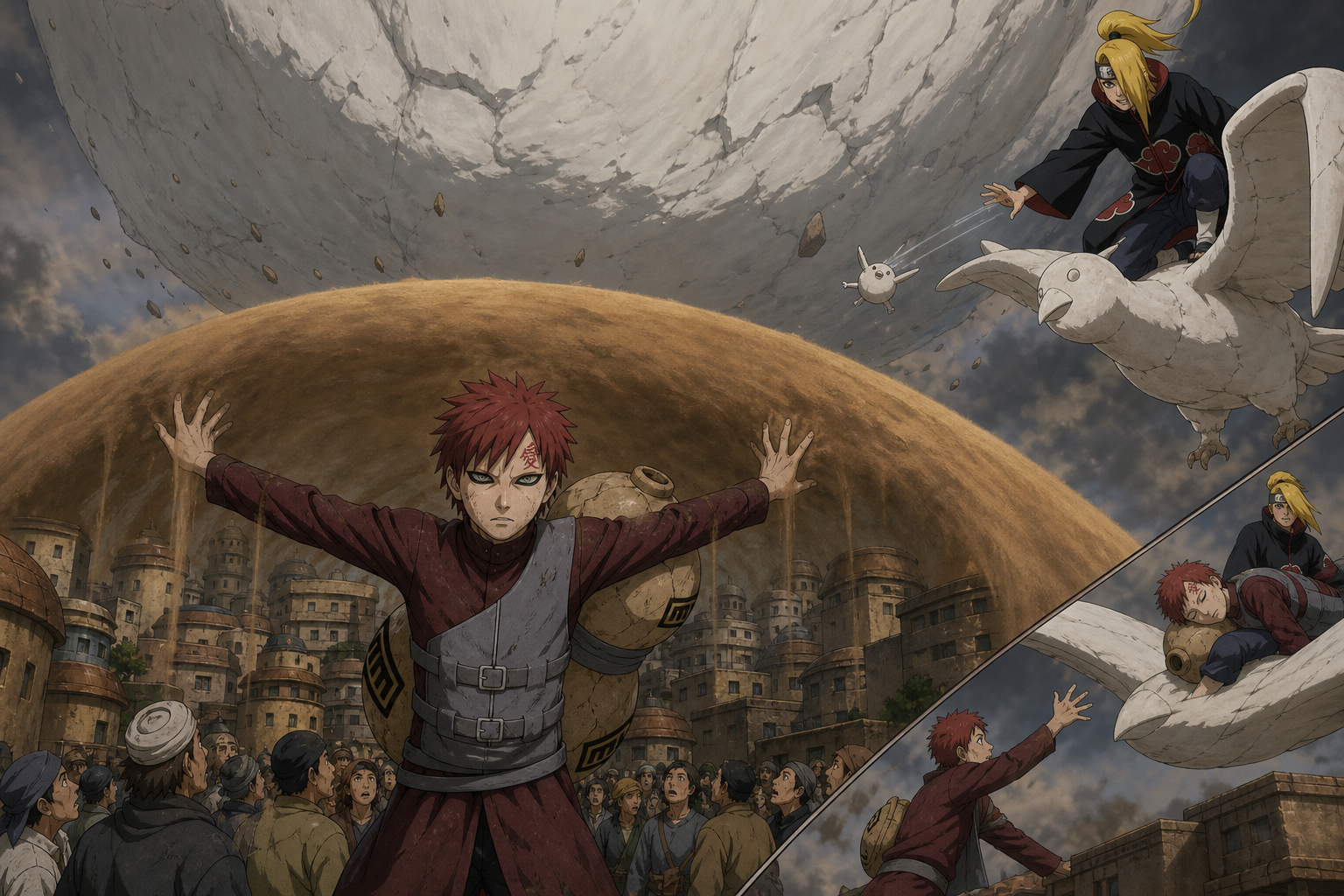
Gaara shields Sunagakure from Deidara’s city-level bomb, opening the concealed trap that lets Akatsuki capture him.
Bottom line
Naruto Shippuden Episode 6 turns Gaara's moral growth into Deidara's opening. A massive clay explosive falls toward Sunagakure, and Gaara spends the chakra needed to protect himself on a village-wide sand shield. Deidara exploits that divided attention, defeats him, and leaves with the Kazekage unconscious. Akatsuki clears the mission because Gaara refuses to clear the city from his list of responsibilities.
That is the episode's cruelty. Gaara does the right thing and loses. The story does not confuse goodness with tactical immunity. His willingness to protect people proves he has changed, while Deidara's plan proves an enemy can weaponize exactly that change.
The bomb is aimed at Gaara's job
Deidara's giant explosive is not simply an attack with a larger blast radius. It targets the office Gaara holds. A private fighter could flee the blast, redirect the confrontation, or prioritize personal survival. The Kazekage cannot treat the village beneath him as disposable terrain.
The bomb therefore attacks two things at once: Gaara's body and his obligation. Deidara does not need the explosion to hit Gaara directly if forcing him to shield thousands of people consumes the attention and chakra that keep him safe. This is hostage-taking performed through geometry.
The tactic is effective because Deidara has watched Gaara. He learns that the young leader will spend himself before allowing the village to absorb the cost. The information is moral, not merely technical. Deidara reads compassion and converts it into a vulnerability.
Calling compassion a weakness would accept the villain's framework. The weakness is not caring about civilians. The weakness is a defense system that leaves one exhausted young man responsible for stopping a city-level attack after an infiltrator bypasses every earlier layer.
Sunagakure's people survive because Gaara refuses to abandon them. The institution fails because it allows that refusal to become the last available barrier.
Gaara builds a roof from the desert
The scale of Gaara's shield matters. His sand is not only blocking a projectile near his body. It spreads across Sunagakure, rising over buildings and people as a second sky. The visual completes the transformation begun when he became Kazekage.
Part I Gaara's automatic sand defense existed to keep other people away from him. Episode 6 turns sand into collective shelter. The same power once associated with isolation now creates a shared protected space.
That does not mean the past was secretly beneficial. Gaara's abuse did not gift him moral clarity. He developed compassion by rejecting the conclusions his abuse taught, helped by people who treated connection as possible. The shield is evidence of his choice, not a thank-you note to trauma.
Akira Ishida's performance keeps the effort focused rather than theatrical. Gaara's strain is visible and audible, but he does not deliver a speech about sacrifice. He sees the threat and acts. The lack of self-congratulation is part of what makes the scene land.
The villagers looking upward also change the meaning of his power. They once looked at Gaara as danger. Now they watch his sand prevent annihilation. Public trust is not complete repair, but shared survival creates evidence the village cannot honestly ignore.
Deidara hides the real attack
The giant bomb demands attention because that is its function. Spectacle becomes camouflage. While Gaara commits his sand to the obvious threat, Deidara uses smaller clay hidden inside the material protecting Gaara's body.
This is the most important correction to the idea that Deidara wins through raw explosive power. He wins through layered tactics. The city-level blast forces a predictable defense. The concealed clay exploits the defense from within. One attack shapes attention; the other produces the actual opening.
Deidara's art language fits this method. He wants viewers to stare at the dramatic object and the instant of detonation. The trick happens in the space spectacle makes people neglect. His philosophy is not separate from his combat style. It teaches opponents to look where he wants them to look.
The plan also answers Gaara's superior command of the environment. Deidara cannot simply overpower all that sand from the outside. He contaminates the defense and makes Gaara's own protective system carry the threat close.
This is why tactical intelligence matters more than a simple power chart. Gaara has more control over the battlefield and can seriously injure Deidara. Deidara still finds a sequence that makes the defender's strength participate in his defeat.
The cost of one-person security
Sunagakure has guards, barriers, intelligence networks, and command structures. Yet the decisive defense becomes Gaara alone holding a shield over the city. The image is heroic and institutionally damning.
Hero stories often celebrate the individual who saves everyone without asking why everyone needed one person to absorb the entire emergency. Episode 6 gives us both sides. Gaara's action deserves admiration. The system's dependence on him deserves scrutiny.
This dependence is especially ugly because the village created his jinchuriki condition. Sunagakure placed Shukaku inside a child for military power, feared the result, attempted to eliminate him, and now survives because that same person uses the imposed power more responsibly than the institution used him.
The village did change enough to make him Kazekage. That matters. It still owes more than applause. Repair requires structures that do not keep demanding Gaara prove his worth through self-destruction.
The attack exposes how fragile symbolic progress can be when operational support lags behind it. Gaara holds the highest title, but the village's defenses still leave him alone at the point of catastrophic failure.
“Mission cleared” belongs to Akatsuki
The title is deliberately cold. For Gaara, the episode is a defense, sacrifice, and capture. For Sunagakure, it is a security disaster. For Deidara, it is a completed assignment.
That language shows how organizations flatten human consequence. A mission report can record target acquired, route exited, and objective met without containing the terror below the bomb or the meaning of the person carried away.
Akatsuki treats jinchuriki as a collection problem. Gaara's office, relationships, and choices do not alter the box beside his name. Completion means possession of the body needed for extraction.
The phrase also refuses to romanticize Deidara's risk. He loses an arm and nearly loses the fight, but the organization evaluates the outcome. Individual damage becomes acceptable operating cost when the target is secured.
That calculation is why Akatsuki feels more dangerous than a collection of dramatic personalities. The members can dislike one another, lose body parts, and still serve a process that keeps moving toward extraction.
This is the institutional mirror opposite Gaara. Gaara spends personal power to preserve people. Akatsuki spends people to acquire power.
Gaara's loss does not erase his victory
Deidara captures Gaara, so the combat result is clear. That result does not cancel what the shield accomplished. Sunagakure remains standing because Gaara made a choice the attacker expected but could not prevent from saving lives.
Stories sometimes frame sacrifice as valuable only if the sacrificing character also wins the larger contest. Episode 6 is more honest. Protection can succeed locally while the protector loses strategically. Civilians survive. The Kazekage is taken. Both outcomes are true.
That split matters for judging leadership. Gaara's responsibility is not disproved by his defeat. If anything, the defeat reveals the cost he accepted. The problem is that the village must now respond to the loss of the person who carried too much of its defense.
Kankuro's emotional response begins to move toward action, but the full pursuit belongs to Episode 7. Keeping that boundary clear matters. Episode 6 ends with the wound: Gaara is gone, and the village has to understand what his absence means.
The brothers' next crisis begins here
Kankuro trusted that Gaara would retain control in Episode 5. Episode 6 proves that trust correct and makes the consequence unbearable. Gaara does not release Shukaku over the city. He protects the village and is captured.
For Kankuro, the old fear has reversed. He once feared what Gaara might do to everyone around him. Now he fears what other people will do to Gaara because Gaara chose to care about everyone around him.
That reversal gives the coming pursuit its emotional logic without moving the fight with Sasori into this episode. Kankuro is not chasing only because a Kazekage was taken. He is chasing his brother, the person he finally learned to trust before time could make that trust comfortable.
The village also loses more than a military asset. It loses the visible proof that its relationship with Gaara could change. Akatsuki's extraction threatens to convert that person back into the resource category Sunagakure once imposed on him.
Performance and staging
Akira Ishida gives Gaara controlled urgency. The voice does not collapse into panic even when the bomb threatens the village. That control supports the character's role as leader while allowing exhaustion to accumulate.
Katsuhiko Kawamoto's Deidara remains lighter and more performative. The contrast is moral as well as tonal. Gaara carries the weight of everyone below. Deidara treats the operation as an opportunity to demonstrate his method.
The staging makes the village visible enough that Gaara's constraint never becomes abstract. Rooftops, streets, and small human figures remain under the action. The battle is not happening in an empty arena with decorative architecture.
Yasuharu Takanashi's score supports the scale without turning the shield into uncomplicated triumph. The scene needs awe and dread at once: awe at what Gaara can protect, dread at what the expenditure leaves exposed.
The episode's pacing deliberately prolongs the defense. That can feel slow if viewed only as waiting for the plot result. Viewed as consequence, the duration forces us to sit with the size of Gaara's task and the time Deidara gains to execute the hidden layer.
Fandom arguments worth sorting out
One argument asks why Gaara did not ignore the village and attack Deidara directly. Because he is the Kazekage and thousands of lives are not scenery. A tactic that wins the duel while allowing the city to be destroyed is not a leadership victory.
Another claims Deidara won only through a cheap trick. Tricks are part of combat, especially for a character whose technique is built on shaped explosives and misdirection. Gaara's power forced Deidara to use layered planning. That does not make the result fair in a sports sense. It makes it tactically coherent.
A third argument treats Gaara's capture as proof he was weaker. Strength is not one number. Gaara controlled the environment, damaged Deidara, and protected a village. Deidara achieved the mission through information, mobility, deception, and willingness to exploit civilians. The outcome answers who completed the objective, not every hypothetical matchup.
The worst reading calls Gaara foolish for caring. That is villain logic wearing a fan-analysis hat. The episode's tragedy depends on recognizing the choice as morally right and tactically costly.
RaeRae's verdict
“Mission Cleared” is the first early Shippuden episode that makes Akatsuki's threat feel fully systemic. Deidara does not merely arrive with a bigger explosion. He studies the target's responsibilities, creates a public emergency, contaminates the defense, and leaves with the body his organization wants.
Gaara loses the mission and wins the episode's moral argument. His sand covers Sunagakure because he no longer defines existence through isolation. The village survives under the power it once feared.
That is not a comforting victory. Gaara is unconscious, Deidara escapes, and the people he protected must now act without him. The title belongs to the villain's report. The meaning belongs to the shield still standing over the village after the Kazekage is gone.
The giant bomb attacks a public promise
Gaara’s office promises that his power will stand between Sunagakure and catastrophe. Deidara does not throw the explosive only at a body. He throws it at that promise, knowing the Kazekage must answer in front of the people who trusted him.
A private fighter might flee and preserve enough chakra for the duel. Gaara cannot call survival a victory if the city disappears beneath him. Deidara turns responsibility into the mechanism that determines Gaara’s next move.
The shield completes a reversal without forgiving Sand
Automatic sand once kept every person away from Gaara. The citywide shield uses the same power to create shelter large enough for strangers who once feared him. That change belongs to Gaara’s choices and the relationships that helped him reject isolation.
It does not transform childhood abuse into useful preparation. Sunagakure does not receive moral credit for creating the condition it now depends on him to manage. The shield is an achievement against the village’s failures, not because of them.
Public awe should become institutional responsibility
Residents watching the second sky of sand receive undeniable evidence of who their Kazekage has become. Admiration after survival is only the beginning of what the village owes him.
Repair means building intelligence, defense, evacuation, and command systems that do not require Gaara to spend his entire body every time the city faces an attack. A society cannot call someone beloved while preserving the machinery that makes self-destruction his job description.
Deidara uses spectacle to hide sequence
The enormous clay figure demands every eye and every available grain of defensive sand. That attention is part of the weapon. Smaller clay already concealed within Gaara’s protection produces the opening after the visible emergency shapes his response.
Deidara does not win by placing one larger number against Gaara’s. He makes the obvious attack control attention while the quieter attack exploits the defense from inside. Spectacle becomes camouflage.
Contaminating the defense is more dangerous than breaking it
Gaara’s sand is too abundant and responsive for Deidara to overpower cleanly from outside. Hiding clay within it lets the attacker travel through the system Gaara trusts to keep threats away from his body.
The tactic resembles the Yura breach at village scale. Akatsuki repeatedly enters through recognized protection: a trusted officer at the gate, then trusted sand around the target. The attack studies what the institution or person automatically allows close.
Mission language strips consequence from the report
“Cleared” can mean the target is secured and the extraction route remains available. It does not record the city beneath the bomb, the chakra Gaara spent saving it, or the relationships inside the unconscious body Deidara carries away.
Akatsuki’s language is efficient because it excludes every fact that might interrupt efficiency. A person becomes an objective, bodily damage becomes operational cost, and capture becomes completion before anyone asks what was destroyed to obtain it.
Gaara succeeds as protector and loses as target
The village survives. Deidara escapes with Gaara. Those outcomes do not cancel each other or combine into one vague result. Protection succeeds locally while defense fails strategically.
That separation matters because defeat does not prove Gaara made the wrong moral choice. It proves the correct choice carried a cost the wider system failed to help him absorb.
The fight exposes one-person security
Sunagakure has gates, guards, sensors, advisers, and shinobi forces. The decisive layer still becomes one exhausted young man holding a roof over everyone. Heroic imagery can hide an institution arranged around a single point of failure.
Gaara deserves credit for standing. The village deserves scrutiny for needing him to stand alone. His title should distribute authority and resources, not simply concentrate blame and sacrifice.
Kankuro’s trust becomes grief with a direction
He correctly believed Gaara would suppress Shukaku and protect the village. That confidence now makes the capture more painful, because control did not save his brother from an enemy prepared to exploit it.
The old fear has reversed. Kankuro once worried about what Gaara might do to people nearby. Now he must face what outsiders will do to Gaara precisely because Gaara chose to care about those people.
Deidara’s injury proves cost without providing deterrence
Gaara crushed his arm and forced him to revise the approach. An ordinary attacker might retreat after that damage. Deidara continues because Akatsuki’s mission tolerates bodily sacrifice when the organization secures a jinchuriki.
This makes the group harder to defend against. Visible pain cannot be assumed to change behavior. Members treat parts of themselves as resources in the same extraction logic they apply to targets.
RaeRae’s full take
I am not calling Gaara foolish for saving the village. That is Deidara’s moral framework wearing analysis clothes. A Kazekage who wins the duel while allowing thousands of people to die has not defended anything worth the title.
I am also not letting Sunagakure disappear beneath the beauty of the shield. The image is magnificent and damning. One person the village once tried to kill becomes the final infrastructure keeping every roof intact. Applause is not repair.
“Mission Cleared” belongs to Akatsuki’s paperwork. The episode’s meaning belongs to the sand still suspended above the city after Gaara loses consciousness. Deidara leaves with the target. Gaara leaves proof that the person inside that category chose everyone beneath him first.
RaeRae checkpoint: Gaara loses because he protects Sunagakure. That does not make protection a mistake. It makes the village’s dependence on one sacrificial defender impossible to ignore.
The shield redistributes danger instead of erasing it
Gaara prevents the explosive from reaching the village, but the required chakra and divided attention move the danger onto his own body. Protection is not magic that removes cost. It decides who will carry the cost when harm cannot be prevented everywhere at once.
Deidara predicts that distribution and plans around it. The strategy remains cruel because it depends on Gaara valuing civilian life more than personal safety. The answer is not teaching Gaara to care less. It is building enough collective defense that one leader is not forced to absorb every impossible choice alone.
The surviving city becomes evidence for the pursuit
Kankuro and the Sand shinobi do not chase only an officeholder or military asset. They move through streets and beneath rooftops that remain intact because Gaara spent himself protecting them.
Every survivor carries part of the reason the village must respond. Rescue is not repayment for a symbolic sacrifice. It is the institution finally acting for the person who acted for all of them before anyone could ask.
Receipts and official routes
- Episode number, Japanese title, Gaara’s village-scale shield, Deidara exploiting the absolute defense, and Gaara’s capture: Naruto Official Site episode guide.
- Licensed English episode route: Crunchyroll.