
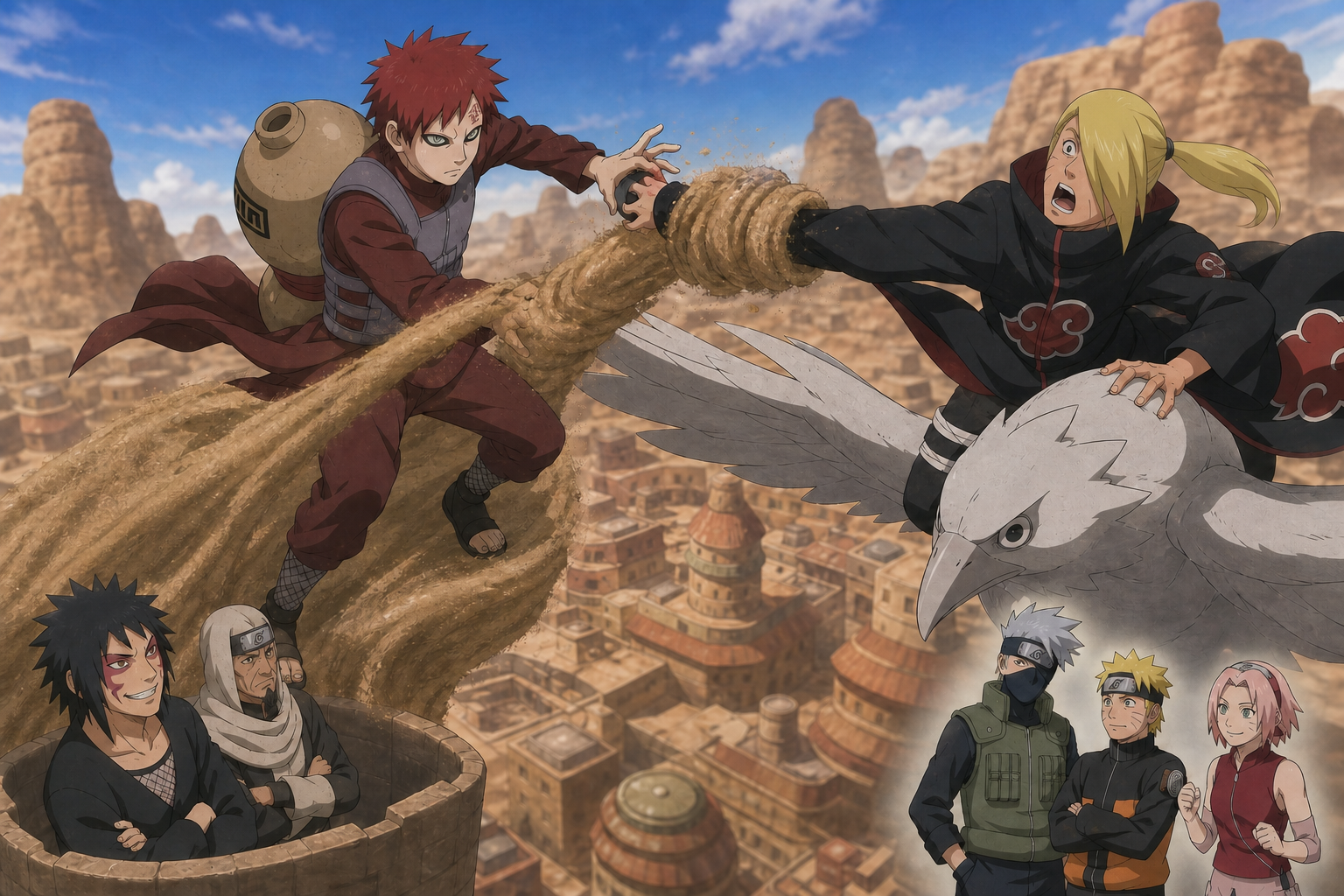
The Kazekage Stands Tall
Kakashi recognizes Naruto and Sakura as peers while Gaara crushes Deidara’s arm and Kankuro trusts his resolve.
Bottom line
Naruto Shippuden Episode 5 gives Team Kakashi a promotion without changing anyone's official rank and gives Gaara a vote of confidence from the brother who once feared him. Naruto and Sakura complete the bell test, and Kakashi tells them they now stand beside him as fellow shinobi. Over Sunagakure, Gaara pressures Deidara hard enough to crush his arm while Kankuro rejects the idea that his brother will lose control and release Shukaku.
The episode is about earned trust. Kakashi updates his judgment because Naruto and Sakura produced evidence. Kankuro trusts Gaara because he knows the person Gaara chose to become. Deidara trusts his information and explosives, but he misjudges the Kazekage as a container whose power will eventually control him. Those are not equal forms of confidence. Two recognize growth. One reduces a person to a category.
Kakashi calls them equals
Kakashi's statement that Naruto and Sakura are now his equals does not mean their skills are identical or that either could replace him on every mission. It means the teacher-student relationship has crossed an operational boundary. They are no longer children he must trick into understanding teamwork. They are shinobi whose decisions can shape a mission alongside his.
That distinction matters more than a sudden rank change would. Naruto is still officially a Genin. Sakura is a Chunin. Kakashi is a Jonin with years of command and ANBU experience behind him. The village's hierarchy remains real, but Kakashi refuses to let paperwork stop him from recognizing current ability.
The bell-test result supports the judgment. Naruto and Sakura did not overpower Kakashi in a clean contest. They changed the terrain, forced the Sharingan into play, coordinated their pressure, identified an established vulnerability, and achieved the assigned condition. Mission work rewards results produced through accurate reading, not only dramatic finishing moves.
Kakashi also demonstrates good teaching by allowing his assessment to change. Adults in Naruto often cling to an old file because admitting a child has grown would require the adult to revise their authority. Kakashi does not pretend the old hierarchy is permanent. He sees evidence and names it.
Kazuhiko Inoue keeps the recognition understated. Kakashi does not deliver a grand graduation speech. The calm tone makes the judgment feel professional rather than sentimental. Junko Takeuchi lets Naruto enjoy the acknowledgment without suddenly becoming modest, while Chie Nakamura gives Sakura the satisfaction of someone who has worked for the result instead of waiting to be included.
Team Kakashi is not restored
Naruto, Sakura, and Kakashi can operate as a three-person squad, but the episode does not magically restore Team 7. Sasuke's absence remains built into the formation. The new team is both functional and incomplete.
That honesty protects the reunion from cheap comfort. Naruto and Sakura have grown partly because the failed retrieval and separation forced them to confront their limitations. Their progress cannot reverse Sasuke's choice or erase the danger surrounding him. It can make them better prepared for whatever comes next.
Calling them Kakashi's equals also changes the emotional burden of future decisions. Children can blame a teacher for failing to solve the mission. Peers have to own their share of the plan. Kakashi is giving respect, and respect carries accountability.
Sakura's place matters especially. The original triangle often treated her as the person reacting to Naruto and Sasuke's rivalry. The new three-person structure gives her no missing teammate to hide behind and no romantic fantasy capable of completing the formation. Her medical training, strength, judgment, and willingness to work with Naruto are now mission assets.
Baki fears the old Gaara
In Sunagakure, Baki watches the aerial battle and considers the possibility that Shukaku could emerge. His concern is understandable. The village remembers what Gaara's loss of control once meant. A tailed beast appearing above populated streets would turn the defense into a disaster.
The concern also shows how institutions remember dangerous behavior more easily than they update the person attached to it. Gaara's history is relevant. It should influence contingency planning. The problem would be treating that history as destiny after his choices have repeatedly contradicted it.
Kankuro rejects the assumption because he knows his brother's determination. This is not blind optimism. Kankuro once feared Gaara, resented the danger around him, and participated in a family structure built on distance. His confidence now carries the weight of that earlier fear. He has watched Gaara choose connection, service, and control.
The brothers' relationship has changed without a public apology scene solving everything. Kankuro's trust is one of the receipts. He no longer describes Gaara only as a weapon the village hopes to manage. He speaks as someone who knows the man inside the title and the beast category.
Gaara controls the battlefield
Gaara spends much of the episode setting the terms of the aerial fight. His sand pursues Deidara, closes angles, and turns the entire environment into reachable material. Deidara has mobility, but flight does not grant safety when the defender can lift and shape the desert itself.
The sand capture around Deidara's arm is important because it proves Gaara can pressure the attacker rather than merely absorb attacks. He identifies a vulnerability and commits enough force to damage Deidara seriously. The Kazekage is not surviving until help arrives. He is close to ending the incursion.
That effectiveness corrects any reading of Gaara's compassion as softness. He is more controlled than the boy from the Chunin Exams, not less dangerous. The difference is purpose. Earlier Gaara used killing to affirm that he existed. Now he applies force to stop a threat over people he has chosen to protect.
Akira Ishida keeps Gaara's Japanese performance level and economical. The restraint makes each decision feel deliberate. He is not intoxicated by the advantage or performing anger for the village below. He is working.
The visual scale reinforces his authority. Deidara entered from above because he expected altitude to bypass the village's defenses. Gaara turns the sky into Sand territory. The battlefield belongs to the person who understands its materials, constraints, and consequences.
Deidara pays for arrogance
Deidara's confidence is not baseless. He breached the village, carries varied explosives, and can fight from a clay bird. The mistake is assuming Gaara's jinchuriki status makes his behavior predictable. Deidara expects power linked to instability. He meets power disciplined by responsibility.
The crushed arm is a physical correction to that assumption. Deidara cannot keep treating the fight as a safe demonstration of artistic superiority. Gaara reaches him, contains him, and inflicts damage before the attacker secures the outcome he expected.
Deidara's response also tells us something important about Akatsuki. Losing an arm does not immediately end his commitment to the operation. The group selects people whose techniques, bodies, and tolerances make ordinary deterrence unreliable. A village defense cannot assume that serious injury produces retreat.
His art philosophy remains part of the tactical problem. Clay animals disguise delivery systems as crafted objects. Flight becomes sculpture. Explosions become a claimed aesthetic event. The language lets Deidara focus on the beauty of the mechanism while avoiding the lives beneath it.
Gaara's sand is visually impressive too, but he does not need to call protection art to make it meaningful. The shield, pursuit, and capture are judged by what they prevent and preserve. That is a more demanding standard than applause for the instant something breaks.
Trust is not the same as ignoring risk
Kankuro's confidence in Gaara does not require Baki to abandon contingency planning. Healthy trust is not pretending risk disappeared. It is updating the probability and the person based on evidence.
This distinction matters beyond the fight. People recovering from violence, instability, or institutional abuse are often trapped between two unfair demands. Some observers treat the past as permanent identity. Others insist that belief means never acknowledging the past again. Gaara deserves neither permanent suspicion nor irresponsible denial.
Kankuro's response works because it is personal and specific. He knows Gaara's resolve. He is not claiming jinchuriki mechanics changed or that Shukaku became harmless. He is saying Gaara's will belongs in the risk calculation.
The village's acceptance of Gaara as Kazekage should operate the same way. The office is not proof that every citizen forgot or repaired the past. It is public evidence that enough people recognized his current conduct to entrust him with authority. The battle tests whether that recognition holds when old fear becomes tactically convenient.
The episode title earns its posture
“The Kazekage Stands Tall” is not only about altitude. Gaara stands as Kazekage by refusing both versions of the role others prepared for him. He does not become the uncontrolled monster Baki fears, and he does not remain the passive target Deidara expects.
His height above the village creates a clean visual statement: the person once isolated from Sunagakure now places himself between it and an invader. The village is not behind him as property. It is beneath him as a responsibility.
The title also applies quietly to Kakashi's team. Naruto and Sakura stand taller because Kakashi recognizes them without pretending their education is finished. Kakashi stands taller as a teacher because he can surrender an old hierarchy without feeling diminished.
These two plots therefore share more than screen time. Both show authority responding to growth. Kakashi recognizes students as peers. Kankuro recognizes a feared brother as a reliable leader. Deidara alone refuses recognition and pays for it physically.
Fandom arguments worth sorting out
The first argument is whether Kakashi calling Naruto and Sakura equals exaggerates their ability. It would be an exaggeration if read as a complete power ranking. The scene is about professional standing and demonstrated teamwork. Kakashi can respect them as fellow shinobi while retaining advantages in experience, technique, and judgment.
The second argument asks why Baki still worries about Shukaku after Gaara became Kazekage. Institutional memory does not vanish because a title changes. His concern is reasonable as contingency planning. Kankuro's correction is necessary because risk assessment becomes prejudice when it refuses new evidence.
The third argument treats Deidara's injured arm as proof he is already outmatched. Damage matters, but Akatsuki members are not ordinary combatants and the operation is not over. Gaara's advantage is real. So are Deidara's preparation, remaining clay, mobility, and willingness to sacrifice his own body.
The fourth argument praises Gaara only because he is “calm now.” Calm is not automatically virtue. Gaara's moral development appears in what the calm serves: protection, control, and responsibility. A calm person using power selfishly would not represent the same change.
RaeRae's verdict
“The Kazekage Stands Tall” is strongest when it lets other people's judgments reveal Gaara's progress. Kankuro's trust matters because he once knew exactly how terrifying Gaara could be. Baki's caution matters because the past is not imaginary. Gaara's conduct matters most because it gives Kankuro evidence and forces Baki's model to update.
The Team Kakashi material provides a lighter version of the same idea. Naruto and Sakura do not need new titles for Kakashi to recognize a new relationship. They earned the bells, forced him to work, and operated together. He names what the evidence means.
Deidara is the person who fails to update. He enters expecting a jinchuriki target and encounters a Kazekage who can crush his arm while protecting the airspace. That mistake does not end the danger, but it clarifies the episode's judgment: categories may guide a mission, yet people decide what they become inside them.
Kakashi’s recognition changes responsibility before rank
Calling Naruto and Sakura fellow shinobi does not promote Naruto or erase Kakashi’s greater experience. It changes the working relationship. Their decisions can now shape the mission beside his rather than functioning only as student attempts he expects to override.
Respect brings weight with it. Peers receive more voice, but they also own more of the plan’s consequences. Kakashi offers acknowledgment without pretending either person has finished learning.
The bells prove mission competence, not universal superiority
The pair changes terrain, forces the Sharingan into use, reads a personal vulnerability, and fulfills the stated condition before dawn. That is enough to pass without becoming evidence that either student could defeat Kakashi under every set of rules.
The distinction protects all three characters. Kakashi remains formidable. Naruto and Sakura still earn the result because mission work values observation, timing, cooperation, and completion instead of demanding a clean tournament victory.
Team Kakashi can be functional and incomplete
Sasuke’s absence is not repaired by arranging the remaining three people into a mission-ready formation. The team can work while grief and unfinished loyalty remain present.
That is healthier than freezing everyone until the old structure returns. Naruto and Sakura become more capable of pursuing Sasuke precisely because they refuse to let missing him prevent all present cooperation.
Sakura’s peer status changes the triangle most
The original formation repeatedly placed her in reaction to Naruto and Sasuke’s rivalry. This version requires her strength, medical knowledge, judgment, and willingness to coordinate with Naruto as operating assets.
Kakashi naming professional equality confirms that she is not occupying a courtesy position left open by Sasuke. The mission would function differently without her, which is the meaningful measure of belonging.
Baki’s concern is memory before it becomes prejudice
Shukaku emerging above Sunagakure would be catastrophic, and Gaara’s history gives Baki a legitimate reason to maintain contingency plans. Responsible leadership does not erase known risk because acknowledging improvement feels kinder.
The danger comes when the old record becomes the only evidence allowed. Gaara’s repeated choices, control, and service must enter the calculation too. Memory becomes prejudice when it refuses every update.
Kankuro trusts the person inside the risk assessment
His confidence carries weight because he once feared Gaara and lived beside the consequences of instability. He is not a stranger offering cheerful denial. He has watched his brother choose protection when violence would have been easier.
Kankuro does not claim Shukaku is harmless. He claims Gaara’s determination matters. The person managing dangerous power belongs inside any honest evaluation of what that power will do.
Gaara turns the sky into accountable territory
Deidara uses altitude to bypass ordinary defenses and make the village beneath him vulnerable. Gaara answers by lifting the desert into pursuit, platforms, capture, and pressure.
The scale is spectacular, but his authority comes from control. Every grain moved above homes carries potential consequence. Gaara does not merely occupy the airspace; he accepts responsibility for what falls from it.
Crushing Deidara’s arm rejects passive-defense readings
Gaara is not waiting behind automatic sand until an ally solves the intrusion. He studies the clay bird’s movement, closes space, traps the limb, and inflicts damage serious enough to change Deidara’s options.
Compassion has not made him less dangerous. It has made the danger selective. Force now serves a community instead of proving that nobody can approach him safely.
Deidara’s injury corrects one assumption, not the whole operation
Losing an arm proves Gaara can reach him and punishes the belief that flight guarantees distance. It does not remove remaining clay, preparation, intelligence about the One-Tail, or willingness to absorb bodily cost.
Akatsuki recruits people for whom ordinary deterrence may fail. Declaring the fight decided after visible damage would repeat the same arrogance Deidara brought into Gaara’s territory.
The episode distinguishes confidence from evidence
Kakashi updates his view after Naruto and Sakura produce a result. Kankuro trusts Gaara through years of observed change. Deidara trusts a category and a plan built around what jinchuriki are supposed to do.
All three positions can sound confident. Only two remain answerable to the person in front of them. Deidara’s certainty fails because he treats classification as destiny.
RaeRae’s full take
Kakashi calling them equals works for me because the scene never asks us to forget who has the larger technique library or longer command history. He is naming a professional threshold. Naruto and Sakura can stand inside the decision-making now, and that is a bigger change than handing Naruto a new vest.
Kankuro gives Gaara the more intimate version of the same recognition. He knows why Baki is afraid. He also knows his brother is not frozen at the worst moment in his file. Trust means allowing present conduct to become evidence.
Deidara is the holdout. He sees a jinchuriki and assumes instability will eventually do the work for him. Gaara answers by controlling the battlefield and crushing his arm above the village. The Kazekage stands tall because enormous power no longer decides who he is. It answers to the leader he chose to become.
RaeRae checkpoint: Kakashi and Kankuro recognize growth because they are willing to revise old knowledge. Deidara recognizes only a category, and Gaara makes that mistake cost him an arm.
Trust changes planning only when people let it
Kankuro’s confidence should not remain a comforting statement spoken beside the battlefield. If Sand truly trusts Gaara’s control, that belief must shape evacuation, reinforcement, communication, and the amount of autonomy he receives as Kazekage.
Institutional trust becomes real when procedures update around evidence. Otherwise, the village can praise Gaara publicly while continuing to plan as though the old catastrophe is inevitable. Kankuro supplies the personal correction; Sunagakure still has to turn that correction into practice.
Recognition does not settle what happens next
Kakashi calling Naruto and Sakura peers opens a new stage rather than completing their development. Gaara crushing Deidara’s arm proves the attacker misjudged him without ending Akatsuki’s operation.
Both victories are provisional in the best way. They establish that old assumptions no longer work, then require every person involved to respond to the new evidence. Growth is not a trophy placed on the shelf. It changes the next decision and raises the standard for what everyone is responsible for seeing.
Receipts and official routes
- Episode number, titles, bell-test result, Kakashi’s new assessment, Gaara’s continuing battle, Baki’s concern, and Kankuro’s confidence: Naruto Official Site episode guide.
- Licensed Naruto Shippuden series route: Crunchyroll.