
Toki Legend OVA React: Healing Was the Strongest Fist and It Still Could Not Save Him
Immediate reaction: Toki Legend follows illness, imprisonment, medicine, and brotherhood without pretending sacrifice makes a dying healer less entitled to care.
Spoilers: This React discusses the complete OVA and its ending.
A healer receives the camera in a franchise that usually waits for violence to define importance
Toki’s story has always challenged the assumption that mastery reaches completion through domination. The OVA centers a man capable of extraordinary violence who chooses to restore bodies instead. That choice does not make him passive. It places power inside relationships where the other person’s recovery, not the practitioner’s prestige, determines success.
A perspective film can romanticize sacrifice until illness becomes proof of purity. Toki deserves more. His radiation exposure, captivity, medical labor, and brotherly conflict should be read as histories imposed on a body with needs of its own. A healer remains entitled to care even when narrative grandeur prefers his martyrdom.
Toki’s radiation exposure is an act of protection and an indictment of the conditions that made one body absorb everyone’s future
Holding the shelter door preserves lives and redirects catastrophe into Toki’s body. The act is courageous because he chooses risk under impossible pressure. It should not teach that the most caring person naturally belongs outside safety. Heroism records a failure of available capacity as well as an extraordinary decision.
The aftermath matters more than the pose. Illness narrows time, changes succession, and reorganizes how others see him. A responsible reading refuses to treat disease as a moral transformation that made Toki gentle. His care preceded injury. Radiation steals possibilities; it does not grant virtue.
Pressure-point mastery reaches its ethical height when knowledge returns a patient to agency
Toki’s treatments show intimate anatomical power organized around relief. The same tradition capable of destroying bodies becomes a form of medicine because purpose, precision, and relationship change. The patient is not an object demonstrating technique; recovery belongs to the person receiving it.
Expertise creates authority, so gentleness alone is not enough. Consent, honest limits, shared learning, and the right to refuse remain essential, especially where alternatives are scarce. Toki’s practice invites the franchise to imagine a medical tradition rather than one miraculous man. Knowledge becomes socially durable when care can continue after the healer is gone.
Imprisoning a healer lets empire control both opposition and the possibility of life outside its permission
Raoh’s prison holds people whose knowledge threatens monopoly. Toki is dangerous not only because he can fight but because healing creates loyalty unrelated to conquest. Patients have evidence that power can touch them without ownership. Such evidence undermines an empire built on fear.
Cassandra turns captivity into information policy. Teachers, techniques, witnesses, and alternatives are physically contained so Raoh’s order can appear inevitable. Liberation must therefore release bodies and restore circulation. Opening a cell matters because knowledge can move again, not merely because one famous brother returns to the plot.
Brotherly love does not erase the structure in which one brother imprisons another for refusing his future
Raoh and Toki share origin, training, grief, respect, and an intimacy capable of surviving ideological separation. That complexity makes their relationship powerful and dangerous to sentimentalize. Imprisonment remains domination even when the captor believes the prisoner is precious.
Raoh’s recognition of Toki’s greatness can coexist with refusal to let Toki define his own life. Love becomes ownership when admiration demands alignment. The OVA succeeds when brotherhood intensifies accountability rather than replacing it. Knowing someone deeply gives more evidence about the harm coercion will cause.
The successor honors Toki best by learning from care rather than inheriting only technique
Kenshiro’s relationship with Toki offers a model of masculinity built through trust, gentleness, and disciplined sorrow. Toki does not need to be defeated for Kenshiro to grow beyond him. Knowledge passes through observation and love, not only succession ritual.
The danger is making Toki’s death another resource for the protagonist. Grief may shape Kenshiro, but Toki’s life cannot be reduced to what it teaches the survivor. The OVA earns its perspective by allowing healing, patients, desire, fear, and brotherhood to matter before they become inheritance.
A damaged body is not a narrative argument that the person has finished living
Toki’s condition is often framed through the dignity with which he accepts death. Acceptance can be moving and can conceal the social expectation that sick people make their needs easy for everyone else. Courage does not cancel pain, anger, dependency, or the desire for more time.
The OVA should let him receive care without making reception a failure of identity. A healer becoming patient exposes whether relationships were reciprocal or organized around usefulness. Toki’s worth is not measured by how long he can keep treating others while dying beautifully. It exists before every service.
Patients give the story a social scale that brotherly mythology alone cannot provide
Ordinary bodies reveal what Toki’s choice means. A healed child, relieved elder, or stabilized survivor shows power changing daily life without producing obedience. These encounters should retain individuality rather than become a montage proving saintliness.
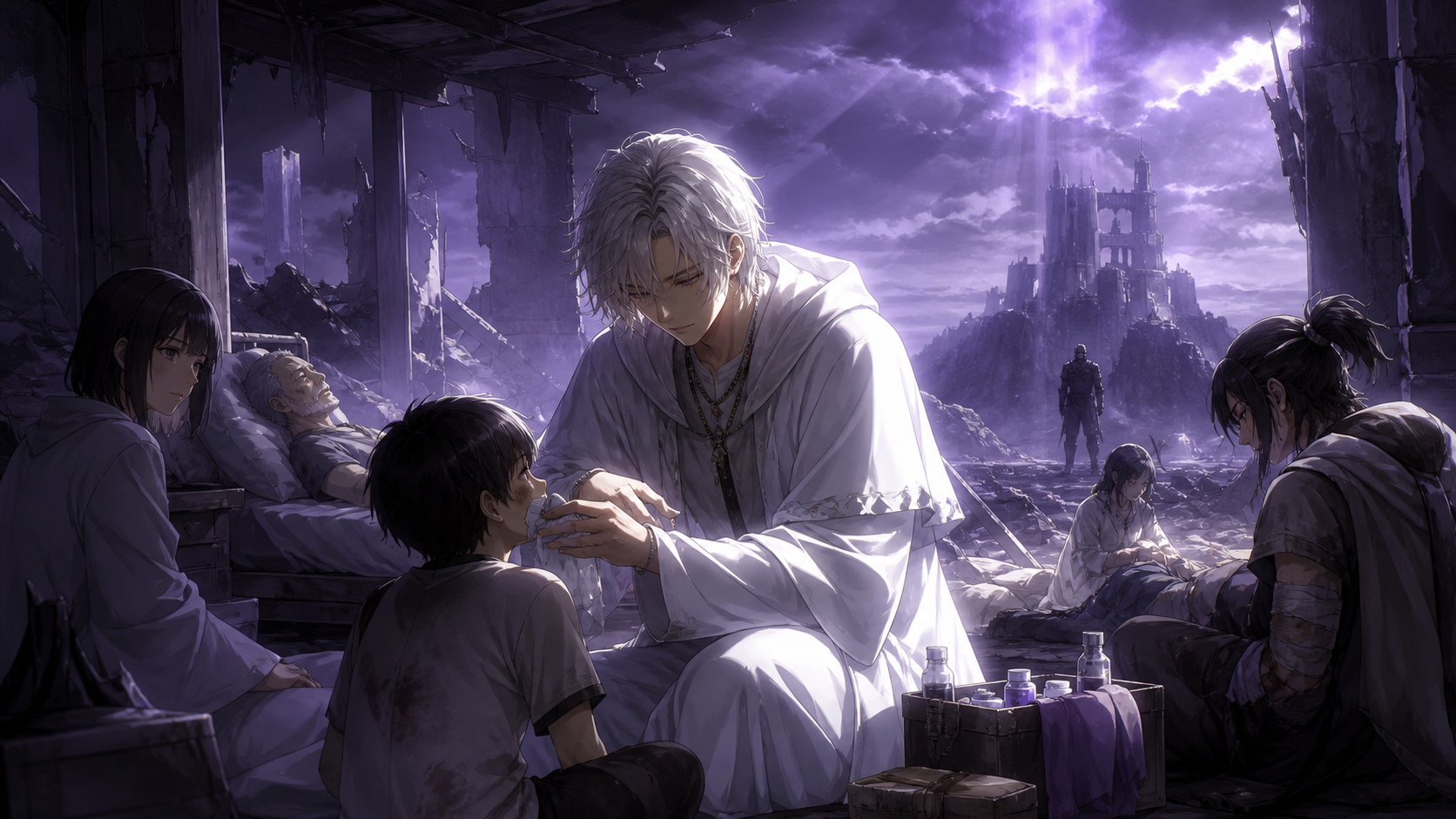
Our canonical image places Toki among patients because the OVA’s ethical center is the clinic, not the duel. Raoh’s silhouette remains distant. The card tells viewers that this React opens care, radiation, disability, and medical authority before it opens another ranking of brothers.
9.0 out of 10 — devastating, humane, and strongest when it refuses to make illness the price of gentleness
Toki Legend gives the five-part project its clearest moral alternative to conquest. Radiation, medicine, Cassandra, brotherhood, and mortality converge around a man whose strength restores choices rather than gathering subjects.
The OVA still risks sanctifying self-erasure and using beautiful death as complete interiority. Its emotional achievement survives that critique. Toki matters because care is rigorous, skilled, and politically threatening—not because the wasteland had to punish him before viewers would recognize tenderness as power.
Toki’s perspective changes famous tragedy only when patients and private fear remain visible beside brotherhood
The OVA returns to radiation, healing, Cassandra, and conflict with Raoh through a man whose death the audience already anticipates. Familiarity can turn each scene into preparation for martyrdom. Perspective resists that fate by showing daily care, bodily limits, and desires that exist before the final lesson.
The material is strongest when Toki is not merely the gentler brother explaining why Kenshiro and Raoh matter. Patients, choices, and illness give him a life with its own center. Adaptation should expand that center rather than make sacrifice more elegantly inevitable.
Would we still call Toki worthy if illness prevented every final fight and every useful service
The franchise honors Toki through extraordinary competence maintained under disease. Admiration can hide a cruel condition: the sick person becomes lovable because he continues giving. Worth should not depend on performing usefulness until death.
Humanity means allowing pain, dependency, unfinished work, and care received without moral penalty. Toki’s gentleness was never a bargain in which the world owed respect only while he healed others. The OVA becomes most humane when the healer may also be patient.
A cinematic recast must carry remembered tenderness without turning Toki into an imitation of the television performance
The Legends project gives every central figure a renewed Japanese voice, changing the emotional texture of scenes viewers may know by heart. Toki requires calm that does not sound detached and frailty that does not erase authority. Breath, pacing, and softened address can make illness present without defining every line.
The performance succeeds when medicine sounds attentive and brotherhood sounds historically complicated. Toki should not become a saintly register floating above the body. Anger, humor, fatigue, and desire for life keep composure human. A new actor honors the role by interpreting those tensions rather than reproducing a vocal silhouette.
The OVA changes when viewers count moments of care received instead of sacrifices offered
First viewing naturally follows the known tragedy toward its emotional peak. Rewatching can ask who checks Toki’s condition, who listens when he names a limit, and whether patients recognize the healer as a person with needs. These moments reveal whether the community around care is reciprocal.
The imbalance is instructive. Toki gives more often than he receives because the franchise uses him as its moral ideal. The React keeps that beauty and refuses the expectation underneath it. Care becomes a social ethic when even the strongest healer is allowed to need someone.
The production record and editorial judgment remain separate
The Fist of the North Star official movie and OVA archive establishes the five-part order, release format, perspective, and official story summary used here. All analysis of coercion, gender, care, disability, performance, and political meaning is CVM Sekai editorial criticism.