
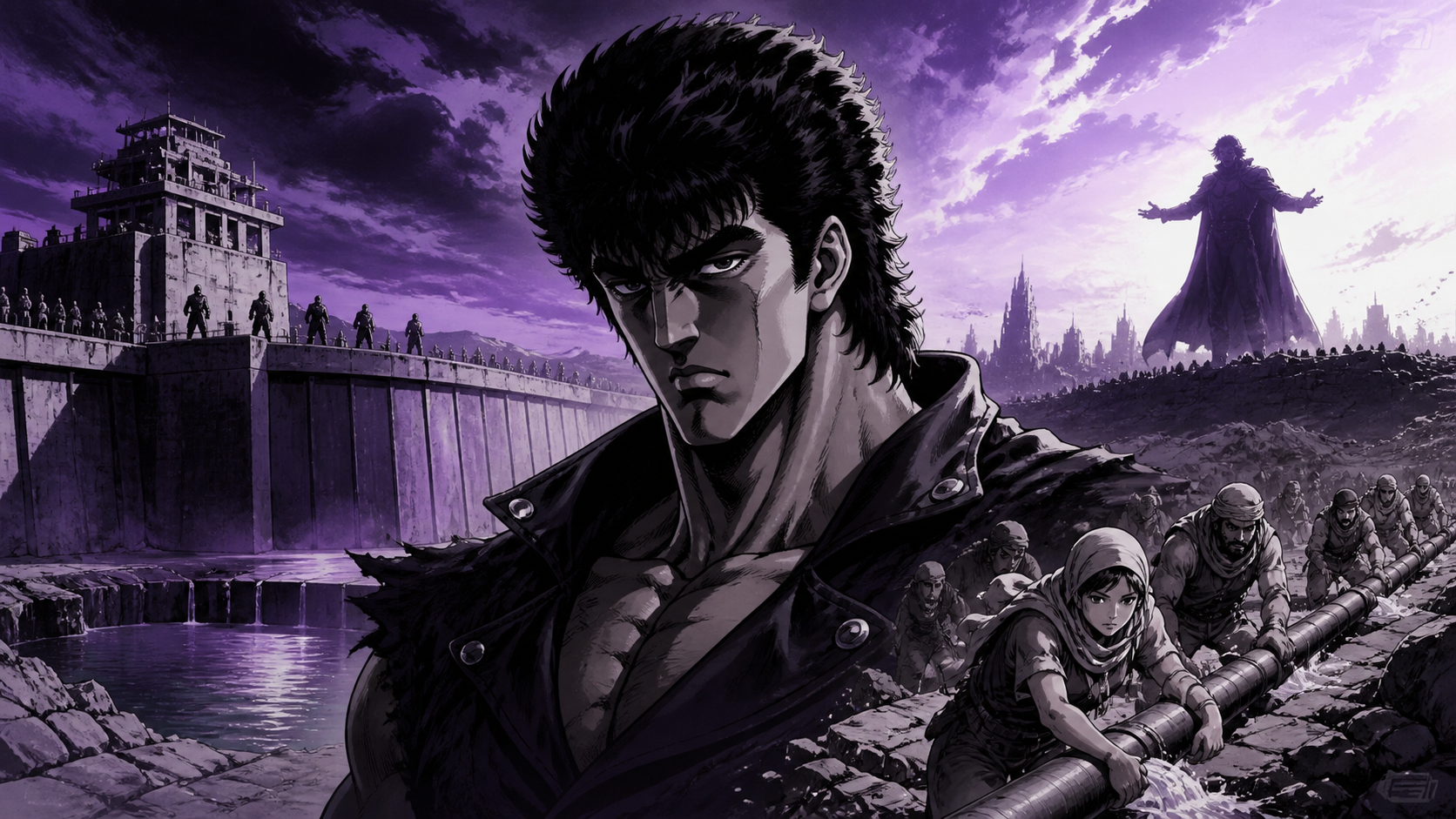
New Fist of the North Star Review: A Savior Cannot Own the Water
New century, same political wound. New Fist of the North Star gives Kenshiro heavier digital shadows, explicit bodily horror, and a city where water monopoly makes every miracle suspect. Its three OVAs ask whether salvation frees people or merely teaches them to depend on a more beautiful fist.
Spoilers: This Review discusses all three OVAs and the complete Lastland conflict.
A fifteen-year return chooses an official novel sequel instead of rebuilding the famous beginning
The 2003–2004 OVA project did not animate the manga from its opening again. It adapted Buronson’s 1996 novel Jubaku no Machi, imagining a later Kenshiro after the completed manga journey. That decision matters because the production could assume legendary competence and ask what remains when the traveler enters a new community without Bat, Lin, Raoh, Toki, or the relationships that once translated his silence.
Takashi Watanabe’s direction and the OVA release format permit a concentrated three-part route with different visual and sonic expectations from weekly television. The project arrives as both continuation and reinvention. It wants the franchise’s moral authority while changing cast, design, music, compositing, and the explicitness of violence. Every change becomes an argument about what adulthood and modernity should look like.
Lastland turns thirst into obedience before Kenshiro turns obedience back into a choice
The trilogy follows a familiar traveler into a conflict whose material basis is unusually clear. Sanga monopolizes water and builds rule around controlled access. Sara’s healing knowledge offers relief outside that monopoly. Tobi circulates information, and Seiji brings a rival martial inheritance capable of becoming a new object of public faith.
This structure allows the OVAs to move from resource dictatorship to charismatic salvation without changing the underlying problem. People remain vulnerable whenever survival depends on access mediated by one powerful figure. Kenshiro can expose both claims because he refuses permanent ownership. The story’s political success depends on whether Lastland becomes more than the audience watching him refuse.
The lonely successor looks complete and must prove completeness has not become emotional closure
This Kenshiro arrives after the foundational relationships that taught viewers how to read him. The OVA does not have Lin’s trust, Bat’s banter, Toki’s gentleness, Rei’s elegance, or Raoh’s rivalry available as immediate context. New design and voice therefore risk turning restraint into blank monumentality.
The character survives because his moral habits remain legible. He observes before judging, distinguishes healing from control, and refuses to transform public gratitude into rule. His tenderness appears through decisions more than facial softness. That makes him recognizably Kenshiro even while the surface insists on a new era. The loneliness is productive when it feels like accumulated history rather than franchise coolness.
The trilogy’s strongest idea is not metaphorical: whoever controls the reservoir controls the length of every life
Water determines settlement, travel, illness, agriculture, labor, and the physical capacity to resist. Sanga’s power is therefore administrative before it is theatrical. Guards and ritual extend a monopoly whose basic claim remains simple: people may live only through access he controls. Scarcity converts a natural need into political permission.
The OVAs understand this sharply and do not remain long enough with the distribution problem after victory. Releasing water is cathartic. Justice requires maintenance, contamination planning, allocation during future drought, and public decisions about the infrastructure. A reservoir becomes free when people can question its governance without risking thirst. Kenshiro opens the gate; Lastland must invent the institution.
Healing knowledge challenges monopoly and deserves a future beyond validating the correct man
Sara’s pressure-point medicine makes her a direct counterargument to rulers who hoard relief. She knows bodies intimately without treating knowledge as permission to dominate them. Care becomes subversive because each recovery proves suffering was politically maintained rather than inevitable.
The narrative sometimes positions her between Kenshiro and Seiji, allowing her response to certify male character. Her deeper function is institutional. How can knowledge circulate, how can patients consent under scarcity, and how can a community avoid replacing water dependency with healer dependency? Sara becomes most important when imagined as an author of reconstruction, not as the moral light cast across somebody else’s fist.
Information brokers flourish where truth is dangerous, then face the question of what usefulness becomes after liberation
Tobi’s practical knowledge compensates for Kenshiro’s outsider status. He understands routes, rumors, risks, and the informal economy created by surveillance. That expertise keeps the story socially grounded. Strength cannot interpret a city automatically, and a legend still needs someone who knows which door opens.
Brokerage also relies on asymmetry. Tobi remains valuable because others know less, creating incentives to preserve uncertainty. Under tyranny, selective disclosure may save lives. After tyranny, public knowledge becomes part of freedom. His arc represents the difficult transition from survival intelligence to civic intelligence: can the map be shared without erasing the person who learned it?
The obvious tyrant is useful because he makes infrastructure visible
Sanga is less psychologically magnetic than Seiji and more politically direct. His authority rests on withholding, enforcement, and the ability to make controlled distribution resemble mercy. He demonstrates that charisma is optional when a ruler controls the chokepoint through which every body must pass.
Defeating him risks making domination look personal. The reservoir, guards, habits of obedience, and frightened calculations survive his certainty. The trilogy partially recognizes this by moving immediately into a new salvation conflict. Lastland’s susceptibility to Seiji is not proof that citizens learned nothing. It is proof that dismantling a person did not yet give them practice governing the resource together.
The false savior is compelling because he offers coherence after coercion
Seiji’s Northern Gate Fist, visual polish, controlled voice, and musical aura make him the trilogy’s most deliberate reinvention. He understands how a person can become a symbol before people have time to evaluate the life organized beneath it. His appeal is not incidental decoration around villainy. It is how the next dependency forms.
His wounds matter because they explain the hunger beneath performance. They do not make followers responsible for healing him through obedience. The story becomes psychologically serious when it lets sorrow and domination coexist without collapsing either. Seiji can be injured, charismatic, loving, dangerous, and accountable at once. Complexity should make judgment more exact, not impossible.
Takehito Koyasu and Gackt define two forms of restraint that the trilogy gradually separates
Koyasu’s Kenshiro sounds hardened, watchful, and deliberately distant from Akira Kamiya’s television-era performance. Gackt’s Seiji uses cool precision that can feel constructed by design. Their contrast initially appears subtle because both men avoid emotional spillage. The trilogy gains force as the reason for each control becomes clearer.
Kenshiro’s restraint protects other people from his grief and power. Seiji’s restraint protects an image from evidence that might limit entitlement. Vocal performance carries that distinction when animation holds hard faces in hard light. The casting reset is not automatically superior or inferior. It gives this project a sonic identity appropriate to its argument about image, authority, and the person underneath.
Modernity arrives as texture, CG, explicit gore, and anatomy that sometimes mistakes hardness for maturity
The production embraces digital compositing, 3DCG, metallic surfaces, severe musculature, and direct bodily rupture. Compared with the television series’ broadcast strategies, the OVA can show consequence with fewer filters. This creates visceral force and makes the franchise feel newly dangerous.
Explicitness is an available tool, not an ethical achievement. Gore has weight when it answers a specific abuse and leaves harmed people visible afterward. It becomes adolescent when detail exists mainly to announce adult classification. The most mature images concern control: a guarded channel, a healer’s hand, citizens approaching released water, or Kenshiro refusing the posture of a ruler.
The trilogy is concentrated enough to preserve pressure and too concentrated to inhabit the society it wants to liberate
The first OVA establishes Lastland, water control, Sara, Tobi, and Kenshiro’s arrival. The second makes Seiji the charismatic alternative and shifts conflict from obvious dictatorship toward belief. The third resolves rival fists, sorrow, and access. The progression is coherent and gives each chapter a distinct political burden.
Compression limits community. Citizens frequently function as the field across which Sanga and Seiji demonstrate control, while reconstruction remains a closing implication. Another chapter could have shown Sara organizing care, Tobi sharing knowledge, and residents deciding how the reservoir should operate. The story understands that salvation can become dependency and leaves its most important alternative underdeveloped.
Adaptation turns narrated interiority into bodies, voices, architecture, and time someone else controls
Jubaku no Machi offers the OVA a continuation already separated from the manga’s panel rhythm. Adapting prose requires deciding which thoughts become dialogue, which histories become flashback, and which social conditions must be visible in streets rather than explained. A water monopoly can be stated in one sentence; animation must make thirst inhabit posture, containers, guards, and the distance between a person and the reservoir.
The three-part structure rewards decisive compression and punishes missing interior bridges. Seiji’s psychology, Sara’s expertise, Tobi’s calculations, and Lastland’s collective fear compete with combat for limited duration. Adaptation succeeds when image and sound externalize those tensions. It weakens when mystery replaces a thought the audience needed in order to distinguish withheld information from absent development.
The city is a machine for converting a shared necessity into private legitimacy
Lastland’s walls, reservoir, guarded channels, medical scarcity, and controlled routes form a political system before Sanga speaks. Architecture organizes proximity to survival. Those nearest authority can receive access, while those outside the protected circuit must bargain, obey, or risk someone else’s ration. The city does not merely contain oppression. Its physical design repeats the ruler’s claim every day.
This setting gives the OVAs unusual specificity within the franchise. A desert village threatened by raiders may be liberated when the raiders leave. Lastland requires decisions about infrastructure. Gates can be opened, but water still needs maintenance and allocation. The story’s greatest uncompleted promise is to imagine the city after monopoly without assuming access becomes just because the villain is gone.
A cursed city is one whose people have been taught that dependency is natural
The title frames Lastland through supernatural language even though the central mechanism is material. That tension matters. Calling a condition cursed can express how inescapable it feels and can hide the people who designed it. Drought is environmental; monopoly is political. Thirst becomes destiny only after power prevents alternatives.
Kenshiro breaks the curse by exposing human authorship. Sanga’s order is neither divine nor inevitable, and Seiji’s charisma is not a cosmic answer. Once residents can see construction, they can imagine reconstruction. The trilogy approaches this insight more clearly than many grander arcs: liberation begins when a system stops looking like weather.
Sara’s practice makes bodily knowledge answer to care rather than succession
Hokuto traditions often guard knowledge through lineage and worthiness. Sara uses pressure-point expertise as medicine inside a community. The contrast reveals that secrecy is not the only way to treat powerful knowledge responsibly. Consent, observation, and the aim of restoring another person’s capacity can provide ethical boundaries more meaningful than bloodline alone.
Medical authority still creates asymmetry. Patients in pain cannot easily judge expertise, especially when alternatives are scarce. Sara’s gentleness matters because it refuses to exploit that imbalance, but durable care requires more than one virtuous practitioner. Training, records, shared standards, and the patient’s right to refuse would turn personal goodness into a social system capable of surviving her absence.
The trilogy understands bodily violation clearly and applies the lesson unevenly to emotional protection
Sanga’s monopoly removes meaningful choice by making refusal physically unsustainable. Martial techniques can seize a body from inside, turning intimate knowledge into domination. Sara’s healing offers the opposite relation: touch and expertise are directed toward restoring agency. These contrasts give the work a strong foundation for thinking about consent.
Emotional arrangements are less consistently examined. People conceal information, make sacrificial plans, and position Sara inside rival masculine stories under the language of protection. Good intention changes motive without automatically returning choice. If the franchise claims love opposes domination, the beloved person’s answer must remain authoritative even when heroes believe they know what safety requires.
A branch of inheritance becomes dangerous when secrecy protects prestige more reliably than people
Seiji’s Northern Gate lineage extends the franchise’s martial cosmology while giving the OVA a rival technique connected to recognizable history. The forbidden label creates immediate gravity. It also invites institutional questions: who drew the boundary, what harm were they preventing, and why did knowledge survive in a form capable of being weaponized by charisma?
Tradition often treats secrecy as responsibility because access is restricted to selected bodies. Restriction can reduce harm and can conceal unaccountable power. A school earns legitimacy through how it teaches restraint, responds to misuse, and treats people outside its succession. Technique is never merely a tool. It carries the social structure through which someone learned they were permitted to use it.
People leaving one false god are vulnerable to the next person who makes uncertainty look shameful
Sanga’s rule trains residents to experience access as favor. When his legitimacy cracks, the emotional habit remains. Seiji supplies coherence at precisely the moment collective decision would feel slow, risky, and unfamiliar. Followers are not foolish; they are responding to a system that punished them for practicing political agency.
The trilogy’s critique of false salvation becomes strongest here. Exposing the new figure cannot be the whole cure because dependency can attach to Kenshiro next. A free community must tolerate uncertainty long enough to deliberate, distribute knowledge, and revise mistakes. Faith becomes less dangerous when nobody’s charisma can close the argument.
Lastland’s citizens are the trilogy’s moral center and receive too little individual duration
The crowd changes posture as water, fear, spectacle, and rumor change. Those responses track the political story more accurately than any villain’s explanation. Citizens know which resistance costs can be survived and which will be transferred to children or sick relatives. Apparent passivity is often collective risk assessment under coercion.
Yet anonymity makes the population easy to use as proof of whichever man currently dominates the frame. More named residents would have turned shifts in belief into relationships rather than mass reaction. The OVAs want to ask whether people can stop waiting for saviors. To answer fully, they would need to let more of those people speak as authors rather than audience.
The healer holds the city’s most constructive power while the plot keeps testing whether men will let that power remain hers
Sara can restore bodies, interpret local need, and imagine care beyond the ruler’s distribution. Those capacities make her central to any future Lastland could build. The narrative recognizes her moral authority and sometimes frames it as a quality rival men can win, protect, or reflect.
That pattern is familiar across the franchise: women occupy the emotional center while men receive narrative sovereignty. A stronger reading resists the reduction. Sara’s choices about medicine, knowledge, community, and love matter apart from what they reveal about Kenshiro or Seiji. Her agency should be the standard by which their protection is judged, not the reward confirming that one protected correctly.
Two controlled men reveal whether strength protects vulnerability or hides from it
Kenshiro and Seiji both present disciplined bodies and contained voices. The visual parallel invites the audience to distinguish ethics through action rather than surface. Kenshiro’s restraint keeps anger from becoming jurisdiction. Seiji’s restraint preserves an image capable of demanding belief. One form of control creates room around other people; the other narrows the room until admiration feels necessary.
The trilogy sometimes romanticizes suffering as the credential that makes a man profound. Its better insight is that sorrow becomes meaningful through what it permits. Pain that increases tenderness may deepen strength. Pain used to invoice strangers remains domination. Masculinity does not mature when the body becomes harder. It matures when vulnerability no longer requires a victim.
Celebrity casting makes performance part of the project’s reinvention before Seiji says a word
Gackt’s involvement in voice and music was presented as a defining feature of the production. That public context enters the viewing experience. Seiji arrives with an aura extending beyond the fictional frame, appropriate for a character whose power depends partly on how completely he can occupy attention.
Celebrity casting can generate fascination and expose differences between vocal acting traditions. The result should be judged through character, not novelty. Gackt’s controlled coolness supports Seiji’s constructed identity, especially when small breaks reveal effort beneath it. Where reserve remains uniform, the image threatens to replace the person the story wants us to understand.
Songs turn the OVA into a mood object and risk smoothing conflict into beautiful inevitability
The musical identity distinguishes this project from the orchestral and theme-song memory surrounding earlier anime. Sound gives Kenshiro’s new era emotional continuity without imitating the old score. It also extends Seiji’s glamour, making attraction part of the trilogy’s form rather than only its dialogue.
Beauty can clarify grief and can overprotect it. When music elevates a sacrifice, viewers may feel resolution before accountability has been examined. The strongest scoring keeps contradiction audible: sorrow and harm, release and unfinished reconstruction, admiration and suspicion. A soundtrack should deepen the argument rather than tell us complexity has already become absolution.
The technology announces a new century most convincingly when it serves geography rather than novelty
Contemporary reports emphasized the project’s substantial use of 3DCG, and the choice is visible in environments, movement, objects, and composited action. Digital tools help establish Lastland’s hard infrastructure and allow camera behavior different from the old television series. The city can feel engineered, which supports the political story.
Integration becomes less persuasive when dimensional elements and drawn bodies appear to obey different visual worlds. The question is not whether CG belongs in Fist of the North Star. It is whether weight, scale, and emotional focus remain coherent. Technology succeeds when viewers understand who controls the space. It fails when the method becomes more noticeable than the decision occurring inside it.
The OVA can show what broadcast television disguised and still has to justify why we are looking
Direct rupture, blood, and internal bodily consequence make violence less abstract. That explicitness can restore horror to techniques remembered through catchphrases and memes. Domination is physical, and the OVA refuses to make every cost playful.
Visibility can become spectacle as easily as stylization. The ethical measure is whether the harmed community remains present after an enemy breaks. Graphic punishment does not automatically constitute seriousness. The trilogy’s most adult moments concern dependency, consent, and reconstruction. Gore supports those concerns when it makes violation harder to ignore and undermines them when it becomes the main attraction.
Pressure-point knowledge makes the body a place where ethics become technique
Kenshiro and Sara demonstrate opposite applications of intimate anatomical knowledge without existing as simple opposites. Kenshiro kills to stop active domination and can also heal. Sara heals within a community and still operates inside dangerous political conditions. Knowledge gains moral meaning through purpose, permission, and consequence.
This is the trilogy’s deepest connection to the franchise. A fist is never only force. It is a relationship to another body that may be treated as enemy, patient, evidence, or citizen. The question is not whether power exists but whom it answers to. Sara’s practice suggests that mastery reaches its most complete form when it returns a body to its owner.
Kenshiro can remove the ruler more easily than he can teach the city not to build another
Hokuto intervention is exceptionally effective against concentrated harm. A dictator, guard, or charismatic challenger occupies a body that can be diagnosed and stopped. Government disperses through habits, scarcity, records, infrastructure, and expectations. Those elements have no single pressure point.
The OVAs recognize this by allowing one authority crisis to produce another. Their ending offers release and leaves civic design mostly implied. That implication should not be dismissed as irrelevant to action. It is the final consequence of the action. A liberated city needs structures capable of receiving dissent without treating it as thirst-worthy betrayal.
The people who survive the climax inherit bodies, grief, and systems that victory did not repair
Lastland’s residents need medicine, water access, burial, testimony, food, and ways to decide what happens to former enforcers. Sara’s care can address some wounds, while no single healer can absorb the city’s entire aftermath. Tobi’s knowledge can help rebuild routes, though knowledge must become shareable rather than private leverage.
Aftercare is not narratively smaller than combat. It proves combat opened possibility. The trilogy gestures toward this truth when citizens move toward water and one another. A longer ending could have made reconstruction part of the climax instead of the space after it. The absence remains an invitation for the Review to keep the people visible.
Kenshiro succeeds when Lastland needs him less after he leaves
The traveler’s legend makes intervention possible and creates a dependency risk. People may exchange Sanga’s enforced divinity or Seiji’s charismatic salvation for gratitude toward a more ethical strong man. Kenshiro refuses this route by declining permanent authority, but departure alone does not guarantee agency.
The true test is what residents can now decide, know, and access. If water remains open, medicine circulates, information becomes public, and disagreement survives, the savior has created room rather than ownership. If the city simply waits for his return during the next crisis, the underlying political structure remains. Salvation should reduce the need for salvation.
The Cursed City establishes the system before it offers the fist that can interrupt it
The opening chapter’s best decision is to make Lastland understandable through need. Water guards, exhausted bodies, Sara’s treatment, Tobi’s navigation, and Sanga’s enforced access explain the political order without requiring a lecture about ideology. Kenshiro enters after the audience has seen what his strength must answer.
This ordering protects civilians from becoming retroactive justification for combat. Their condition has its own duration. The first OVA still accelerates once Kenshiro begins dismantling enforcement, but the resource premise remains stronger than any individual threat. Its cliffhanger works because the city has not been freed by recognizing one powerful man; it has merely learned that the existing monopoly can bleed.
The Forbidden Fist changes the question from who owns water to who owns the meaning of liberation
Once Sanga’s legitimacy is unstable, Seiji offers a more seductive authority. He arrives with inherited technique, aesthetic control, and emotional mystery rather than an obvious ration system. The city’s readiness to believe him exposes the vacuum left when material rule collapses before civic agency has formed.
The middle chapter is less cleanly written because it protects revelation and coolness. That unevenness is thematically revealing. Seiji’s power depends on remaining an image people complete for themselves. The episode succeeds when mystery becomes a method of recruitment and falters when the production treats mystery as a substitute for character. Sara and the citizens need more space to interpret what belief is asking them to surrender.
When a Man Carries Sorrow resolves the rival image and leaves the city’s future deliberately less finished
The finale brings Kenshiro and Seiji toward the emotional truth beneath their controlled surfaces. Sorrow becomes the language through which strength is judged, consistent with the franchise’s longstanding belief that pain can deepen compassion. The ending lands when it distinguishes carrying sorrow from making others carry it.
Lastland’s release has less duration than the men’s recognition. Water returns, citizens move, and the traveler prepares to leave, but governance remains beyond the closing frame. This imbalance does not destroy the finale. It reveals the hierarchy of attention built into heroic narrative. Famous men receive complete emotional arcs; communities receive beginnings and the obligation to continue without music.
Removing Bat and Lin makes his moral legibility depend on strangers willing to risk trusting silence
Classic Kenshiro is interpreted through relationships. Bat responds to practicality, Lin to gentleness, allies to loyalty, and brothers to inherited conflict. New Fist strips away that network. Sara and Tobi encounter the legend without the audience’s familiar translators, requiring each interaction to establish whether this imposing stranger recognizes people beyond the problem they represent.
The austerity suits a post-manga traveler and occasionally makes him feel more brand than person. Koyasu’s performance and small protective choices recover humanity where the design withholds softness. The experiment clarifies how much character exists relationally. Kenshiro remains himself not because the scars and techniques are present, but because new people become safer without becoming his property.
If the trilogy were organized around reconstruction, the healer would carry its central action
Kenshiro drives confrontation, but Sara possesses the knowledge most directly opposed to Lastland’s governing logic. Sanga controls water to maintain dependency. Sara touches bodies to restore capacity. Seiji asks people to invest meaning in his exceptional self. Sara’s care makes knowledge useful without requiring worship.
This is protagonist-level material constrained by the franchise’s preferred camera. Her choices could organize an entire story about medical consent, community training, scarcity, and the emotional cost of being the person everyone needs. The Review restores that possibility by treating healing as action rather than support. Lastland’s future depends more on whether Sara can share care than on whether Kenshiro can repeat victory.
Pragmatism becomes ethical when it stops treating every relationship as an exit strategy
Tobi’s value lies in surviving a system that punishes transparency. He reads power sideways, understands which rumor has teeth, and knows that heroic declarations do not guarantee a safe route. Such intelligence can look cowardly only from the perspective of someone protected by superior force.
His development matters when knowledge begins serving a relationship rather than preserving leverage. Trust does not require him to become naïve. It asks him to risk being useful in a way that cannot be immediately converted into personal safety. That transition mirrors Lastland’s own: survival skills must become civic skills without forgetting why secrecy once mattered.
The first ruler’s banality prevents the franchise from romanticizing every form of evil
Sanga does not need Raoh’s grandeur or Souther’s wounded magnificence. He controls the necessary thing and builds enforcement around it. His relative plainness is politically instructive. Domination often operates through people less fascinating than the systems they command.
The narrative naturally gives him theatrical cruelty because action needs a target. His real danger remains organizational. If every official habit is attributed to one villain, residents may believe the system disappeared when he did. The transition to Seiji proves otherwise. Authority can re-form around new symbols while the population’s learned dependency remains intact.
The rival does not counterfeit Kenshiro’s strength; he counterfeits the social meaning of strength
Seiji can fight, suffer, attract loyalty, and participate in a legitimate martial inheritance. He is not false because every ability is fake. The counterfeit lies in presenting exceptional capacity as authorization over other people’s future. He turns personal coherence into a public claim.
Kenshiro’s answer is ethical before technical. He refuses to make admiration the outcome of rescue. Seiji needs spectators because belief stabilizes the self he performs. Kenshiro needs people to remain alive and capable of choice. Their combat becomes meaningful when this difference enters choreography, voice, and aftermath rather than remaining an abstract moral assigned after the winner is known.
Sara and Kenshiro reveal that intimate knowledge acquires ethics through the freedom it returns
Both can touch a hidden point and alter another body beyond ordinary comprehension. That asymmetry could make either terrifying. Sara uses it to restore function; Kenshiro uses it to stop active harm and sometimes to heal. The technique itself contains no automatic moral certificate.
Purpose is only part of the answer. Consent, necessity, proportionality, and aftermath determine whether expertise serves the person beneath it. The trilogy’s body politics become most interesting when martial knowledge is not separated from medicine. Mastery is mature when the practitioner understands that access to a body creates responsibility rather than ownership.
Anatomical extremity turns Kenshiro into landscape and leaves facial vulnerability fighting for space
The OVA’s Kenshiro is built through thick musculature, severe planes, leather, metal, shadow, and weight. He appears less like a traveler crossing the environment than another geological force inside it. That visual confidence immediately differentiates the project and intensifies the problem of emotional access.
Small expressions must work against an image designed to look unyielding. When they succeed, tenderness feels earned rather than absent. When they fail, the body becomes a logo capable of executing plot. The design’s beauty and limitation are connected: monumentality sells legendary continuation and can obscure the person whose restraint made the legend worth continuing.
The camera must distinguish a healer’s physical presence from the franchise habit of making women visual relief
Sara operates through touch, attention, and proximity to vulnerable bodies. Her design and framing therefore carry ethical weight. The story needs viewers to read competence, fatigue, danger, and judgment rather than treating her body primarily as contrast to enormous men.
The OVA does not escape genre habits, but Sara’s role resists simple objectification because action repeatedly depends on what she knows. A more complete visual language would grant her labor the same compositional seriousness as a technique. Healing has choreography: observation, permission, precision, reaction, and the returned capacity of the patient.
The project’s darkness creates gravity and sometimes mistakes reduced visibility for depth
Hard contrast, purple-black environments, metallic highlights, and night-bound spaces give Lastland a sealed emotional climate. The palette suits a city where access is controlled and people cannot imagine an open horizon. Kenshiro’s face often emerges from shadow as judgment rather than invitation.
Darkness becomes expressive when it changes with political conditions. Water, dawn, skin, and communal movement should introduce softer values after release. If every scene remains equally severe, the production denies viewers a visual destination. Maturity is not the absence of light. It is knowing what light can reveal without pretending the damage is gone.
A powerful body is most readable when the camera understands decision before impact
The OVA format offers more resources per installment than weekly television and creates expectations of sustained motion. Strong sequences preserve geography, let opponents respond, and use timing to reveal diagnosis. Kenshiro’s technique feels intelligent when viewers can understand why a movement ended the conflict rather than merely observe effects.
Digital camera freedom can weaken weight if it detaches the viewer from spatial consequence. The best fights remain grounded in who is being protected and what changes when a guard falls. Action becomes narrative when a decision passes through the body. Without that chain, technical polish turns into a collection of aggressive surfaces.
The body becomes more immediate when impact, breath, water, and silence occupy the surround field
Contemporary promotion emphasized the 5.1-channel release, and the soundscape takes advantage of environmental contrast. Water can be heard as resource before it becomes image; hard footsteps and machinery make Lastland’s administration physical; breath keeps monumental fighters attached to vulnerable bodies.
Impact should not dominate every frequency merely because the format allows it. Silence after violence creates moral space, while small environmental sound can return attention to civilians. The most psychologically effective mix distinguishes spectacle from consequence. A fist may be loud; thirst should remain audible beneath it.
Music carries a celebrity authorial presence that makes the trilogy feel curated rather than inherited
Gackt’s participation in the themes gives New Fist an identity deliberately separated from the famous television songs. The choice announces that this is not nostalgia preservation. It is a product of early-2000s aesthetics, celebrity culture, and a different idea of adult cool.
The songs can make the work feel emotionally unified even where narrative transitions are compressed. That strength becomes a risk when mood supplies cohesion the characters did not earn. On rewatch, the music is most rewarding when it sharpens the split between Seiji’s beautiful self-presentation and the ordinary people whose lives cannot be resolved through atmosphere.
Changing every major surface forces the audience to decide what actually makes Fist of the North Star itself
New voice, new design, new music, digital compositing, CG, OVA pacing, and a post-manga novel story remove many familiar anchors at once. Scars and pressure points alone could produce imitation. Continuity survives through a moral grammar: power encounters vulnerability and must decide whether to protect, possess, or exploit it.
The trilogy is recognizably Fist when Kenshiro’s restraint creates room for Sara, Tobi, and Lastland rather than when an enemy breaks in a familiar way. This distinction matters for every later adaptation. Surface can modernize indefinitely. Identity lives in the relationship strength establishes with people who cannot answer it symmetrically.
A city’s future remains abstract when young people appear mainly as evidence of adult cruelty
Children in Lastland establish urgency because water deprivation and political instability narrow lives before choice can mature. The trilogy uses that vulnerability effectively and gives few young people enough individuality to become more than stakes. Their future is invoked without being allowed much speech.
A reconstruction-centered story would ask what they learn after false salvation collapses. Do they inherit Sara’s care, Tobi’s survival knowledge, or the habit of waiting for another martial figure? Education decides whether liberation becomes cultural memory or temporary relief. The absence of this layer limits the political conclusion.
Kenshiro’s horizon preserves the franchise and transfers the difficult story to people the franchise may never revisit
The wanderer leaves because his narrative identity depends on movement and because remaining could convert gratitude into rule. That departure is ethically preferable to claiming Lastland. It also reveals the asymmetry of heroic storytelling. Kenshiro carries the next adventure; residents carry consequences.
The Review refuses to treat those consequences as empty space. Sara, Tobi, patients, former followers, guards, and families must decide what water and truth become. The hero’s final image is meaningful only if their unwitnessed labor can matter equally. A savior should make stories possible that no longer require him as protagonist.
New Fist trades social accumulation for concentrated atmosphere and loses some of the relationships that made silence warm
The television series built Kenshiro across long repetition. Villages, children, allies, rivals, comic pauses, and weekly aftermath gave his restraint many contexts. New Fist condenses one city into three OVAs and surrounds him with a harder visual language. The result is focused, oppressive, and less socially inhabited.
Concentration sharpens water politics and lets each chapter carry a clear structural role. It also means Sara and Tobi must establish new relational warmth while Seiji absorbs much of the available interior drama. The trilogy is not simply darker because it shows more gore. It is darker because Kenshiro appears farther from the community even while acting for it.
Both sequels ask what happens after a definitive ending, but only one begins with the protected generation organizing itself
Fist 2 moves time forward through adult Bat and Lin, making Kenshiro’s absence generative. New Fist moves beyond the manga through geographical isolation. Lastland’s citizens have no prior relationship to the savior and must interpret him amid competing claims. This makes the later OVA a test of legend without inherited trust.
The tradeoff is agency. Bat and Lin arrive as visible organizers, whereas Lastland’s collective remains comparatively anonymous. Sara and Tobi provide local authorship, but the trilogy’s short form keeps them beside Kenshiro rather than letting them fully reorganize the city. New Fist is more contained and less complete as a generational argument.
The film compresses familiar mythology into spectacle; the OVAs use spectacle to establish unfamiliar political territory
The 1986 movie assumes iconic relationships and rearranges them for concentrated emotional and visual impact. New Fist has no familiar rivalry to borrow until it constructs Seiji. Its task is harder in one sense: create a new society, cast, conflict, and emotional foil while persuading viewers that post-manga Kenshiro still belongs.
Both works risk allowing violent beauty to eclipse ordinary people. The movie turns history into operatic collision. The OVAs turn scarcity into metallic horror. New Fist gains ethical specificity from water and medicine, while the movie gains emotional force from accumulated franchise memory. Neither format can replace the television road.
The OVA calls itself mature through gore and discovers maturity more convincingly through responsibility
Direct blood, ruptured bodies, heavy shadows, celebrity music, and severe character design signal an adult market. Those markers distinguish the release from broadcast television and can make consequence feel less sanitized. They do not automatically create mature thought.
The trilogy becomes adult when it asks what a healer owes a patient, what a survivor owes a community, how dependency outlives dictatorship, and whether sorrow grants authority. Maturity is the refusal of easy emotional reimbursement. A tragic rival remains responsible; a victorious hero remains insufficient; a released resource still requires government. Those ideas last longer than explicit anatomy.
Strength is ethically meaningful only when it changes what less powerful people are allowed to decide
Sanga uses control over water to make other choices impossible. Seiji uses charisma and martial inheritance to make alternative meaning look unnecessary. Kenshiro counters both through superior force, which creates an apparent paradox: domination is defeated by someone even less physically answerable to ordinary people.
The paradox resolves through restraint and departure, but not completely. Kenshiro refuses tribute, permanent office, and possession. Lastland still needs structures that do not rely on his virtue. Ethical power reduces asymmetry where it can, shares knowledge, and leaves people more capable of questioning whoever arrives next. The fist is a beginning, not a constitution.
A person can be grateful for rescue and remain politically free only if gratitude does not become obedience
Lastland has been trained to attach survival to authority. When Kenshiro opens access, gratitude is inevitable and deserved. The danger lies in converting that emotion into legitimacy over unrelated decisions. A rescuer may know how to stop a guard and know little about agriculture, medicine, allocation, or the city’s internal relationships.
Kenshiro’s wandering protects the distinction by refusing to govern. The community must also protect it by honoring help without surrendering authorship. Gratitude becomes healthy when it records relationship rather than debt. Nobody owes lifelong obedience because another person acted courageously on one terrible day.
The trilogy gives wounded men mythic language and gives the city less vocabulary for collective injury
Seiji’s sorrow becomes central, legible through performance, music, technique, and climax. Citizens carry dehydration, fear, captivity, loss, and the instability of shifting rulers, yet their trauma appears mostly through crowd response. The difference reflects heroic narrative’s preference for individualized pain with a face capable of climax.
Collective trauma is less cinematic and more politically important. People may distrust new distribution, hoard resources, repeat rumors, defend former structures, or attach to another savior because familiar dependency feels safer than uncertain freedom. Reconstruction must address those habits without condemning survivors for having learned them. A final burst of water cannot wash away governance written into the nervous system.
Sorrow becomes dangerous when a man treats feeling deeply as evidence that he may decide broadly
The franchise honors men capable of grief because tears disrupt the stereotype of invulnerable strength. New Fist continues that tradition and risks making intense pain a form of moral prestige. Seiji’s injury explains why domination feels emotionally coherent to him. It does not make domination coherent for everyone beneath it.
Kenshiro’s difference is not that he has suffered more accurately. It is that grief rarely becomes an invoice. He can carry loss without demanding Lastland arrange itself around the wound. The most humane masculinity in the trilogy is not the man who feels deepest. It is the man who does not turn feeling into jurisdiction.
Complex rivals receive emotional duration while ordinary enforcers receive graphic certainty
Seiji is granted mystery, sorrow, performance, and a final interpretive frame. Minor enemies often exist to demonstrate brutality and suffer spectacular punishment. Different responsibility justifies different consequence, but narrative attention does not always follow ethical difference. Fame creates mercy.
The pattern matters because low-level participants may be coerced, opportunistic, frightened, or enthusiastic. A mature political story distinguishes them. Kenshiro sometimes does through observation, yet the OVA’s short runtime rewards immediate visual closure. Critical viewing can enjoy the reversal and still ask whose humanity the camera considered worth slowing down for.
A pressure point can stop a tyrant and cannot decide what the community owes former collaborators
The franchise’s violence offers decisive answers inside situations designed to make hesitation dangerous. Killing an active predator may protect people whom no functioning court can reach. The OVA’s world gives Kenshiro little institutional alternative, which explains lethal intervention without transforming it into universal justice.
Lastland will face subtler cases after he leaves. Guards may have enforced rationing under threat, profited eagerly, or shifted loyalty when power changed. Survivors need processes for testimony, accountability, protection, and reintegration. These questions lack the catharsis of a delayed explosion and determine whether fear remains the city’s primary legal language.
Sara’s work demonstrates the social world Kenshiro’s violence is supposed to protect
Healing is slow, relational, repetitive, and dependent on trust. It lacks the clean endpoint of a defeated opponent. A patient may improve incompletely, need continued support, or refuse a treatment. Sara’s practice therefore represents a different narrative rhythm from the fist.
The trilogy’s future belongs to that rhythm. Lastland must maintain bodies and systems after the spectacular crisis. Care becomes political because it decides whose recovery receives resources and whose pain is considered ordinary. Kenshiro protects the possibility of care. Sara reveals what protection is for.
Water does not reach people through moral symbolism; someone repairs, carries, cleans, measures, and shares it
The reservoir’s release creates an iconic image and hides a chain of labor. Channels require clearing, vessels require transport, contamination requires monitoring, and people with limited mobility require assistance. Formerly coerced workers possess essential knowledge even if the old regime devalued them.
A just city would recognize that labor as authority rather than returning decisions to the most impressive fighter. Expertise developed under oppression can help build freedom without making oppression necessary. Reconstruction becomes democratic when the people who maintain survival participate in governing it. The OVAs point toward this truth every time infrastructure occupies the frame.
False divinity works by making controlled access appear morally deserved
Sanga’s rule and Seiji’s charisma use different sacred languages. One treats water as favor distributed through authority; the other presents exceptional presence as the answer to disorder. Both encourage people to interpret survival through the worthiness of a central figure.
The trilogy need not reject spiritual meaning to reject monopoly. Faith can create community, grief rituals, and responsibility beyond the self. It becomes dangerous when questioning the leader threatens material access or social existence. The ethical test is whether belief leaves room for refusal, evidence, and a future not owned by the symbol.
Exposing deception is easier than rebuilding the conditions under which people can verify claims themselves
Kenshiro can reveal a false miracle or defeat the person sustaining it. That event provides truth through spectacle: the stronger body demonstrates that the previous certainty was contingent. The method risks teaching citizens to wait for another exceptional proof.
Durable truth requires access to records, water levels, medical knowledge, routes, and testimony. Tobi’s information and Sara’s expertise need public forms. A community becomes harder to deceive when knowledge no longer travels only through privileged intermediaries. Freedom of information is not abstract in Lastland. It determines who can tell whether thirst was necessary.
The city must remember why each savior felt convincing, not merely that each savior was wrong
A simple history would divide the past into villains and the day Kenshiro arrived. That story honors rescue and teaches little about recurrence. Sanga’s control worked through infrastructure. Seiji’s appeal worked through emotional and symbolic vacancy. Citizens made decisions under constraints that should remain visible.
Precise memory prevents shame from becoming silence. People can acknowledge gratitude, complicity, fear, and error without being reduced to any one of them. Public history should preserve the systems and choices that made domination ordinary. Otherwise the next ruler only needs a new costume and a population convinced the previous failure belonged to uniquely foolish ancestors.
The second viewing improves the political structure and exposes every compressed relationship
Knowing Seiji’s place lets early staging read as recruitment rather than mystery alone. Water imagery becomes administration, Sara’s healing becomes counter-government, and Tobi’s selective knowledge becomes a rehearsal for the city’s information problem. The three chapters form a cleaner argument than their episodic surfaces initially suggest.
Rewatching also makes missing duration obvious. Citizens change allegiance quickly because the structure requires movement; Sara’s interior choices are implied; Seiji’s psychology relies heavily on aura; and aftermath remains abbreviated. The trilogy rewards analysis because its ideas exceed its runtime. That is both a strength and the central limitation of the completed work.
The early-digital aesthetic deserves conservation without being frozen into the definition of modern Fist
New Fist records a particular moment: OVA economics, 5.1 promotion, celebrity integration, visible CG experimentation, and a desire to make an older franchise feel severe enough for a new century. Some surfaces have aged faster than the hand-drawn television series because technological novelty dates itself sharply.
Aging does not make the project disposable. It makes preservation informative. Viewers can see how the franchise negotiated modernity before later remakes and films. Restoration should retain texture rather than smoothing evidence away. Critical appreciation can honor ambition, note uneven integration, and resist treating historical context as a ban on judgment.
New Fist proves Kenshiro can survive outside the famous saga and reveals how much he needs a community written with equal conviction
The trilogy’s post-manga setting gives the franchise a road beyond inherited rivalry. Kenshiro enters a new conflict, recognizes domination, forms temporary relationships, and remains morally coherent. This demonstrates that his character is portable without becoming empty.
Portability becomes formula if every new city exists only to display him. Lastland avoids that fate through water politics, Sara, Tobi, and Seiji, yet its people remain underwritten relative to the hero. The legacy is therefore double: Kenshiro can continue, and continuation must keep finding communities whose lives matter after he leaves.
Lastland is liberated when survival stops requiring permission and becomes governable by the people who depend on it
The trilogy defeats monopoly at the level of bodies and symbols. Its ethical horizon is a city where water, medicine, information, and dissent cannot be withdrawn by one person. That future requires shared authority more than another martial school.
New Fist is at its best when it makes this horizon visible through material stakes. A cup of water, a healed patient, an opened channel, and a disclosed route contain more political meaning than a grand claim about destiny. Kenshiro’s fist matters because those ordinary acts can happen afterward. Their ordinariness is the victory.
New Fist works best for viewers willing to meet a later Kenshiro rather than demand an imitation of the childhood version
The trilogy assumes familiarity with Kenshiro’s moral grammar and does not provide the relational road that made him beloved. A new viewer can understand water monopoly and rival fists, but the weight of his restraint benefits from knowing what he has already lost. This is a continuation, not an efficient franchise introduction.
Longtime viewers should allow the cast and aesthetic reset to establish their own logic. Koyasu is not attempting a disguised Kamiya performance, and the digital severity is not weekly cel animation with more money. Comparison remains useful when it identifies effect rather than demanding duplication. The project becomes interesting at the point where difference reveals what the audience considered essential.
Viewers seeking communal warmth or restrained violence may find the OVA’s hardness emotionally narrow
New Fist foregrounds shadow, muscle, metal, isolation, and explicit bodily damage. The atmosphere is intentional and can make Lastland feel relentlessly sealed. Without Bat, Lin, or an established ensemble, humor and domestic texture rarely interrupt the severity.
This is not a warning that darkness lacks value. It is recognition that tone shapes access. Some viewers will experience the design as mature intensity; others will feel tenderness fighting through too much armor. The Reacts help by isolating each chapter’s human decisions, while the overall Review restores social context the surface can overwhelm.
Episode analysis preserves immediate pressure the completed verdict can no longer honestly recreate
The Cursed City React follows the discovery that water has become law. The Forbidden Fist React stays with the seduction of a new symbol before every motive is known. The final React watches sorrow and release while uncertainty about reconstruction remains fresh. Each format records what the episode asks viewers to believe at that moment.
The overall Review has the advantage and danger of hindsight. It can compare patterns and may make weak transitions look inevitable. Keeping the Reacts separate prevents the completed interpretation from colonizing first experience. A healthy fandom needs both: emotional presence and analytical revision.
Novelty is most meaningful when it changes the questions, not only the surfaces
The project earns “New” through cast, music, technology, release format, setting, and a story beyond the manga. Those changes are substantial. The deeper novelty lies in centering one city’s infrastructure and making salvation itself the recurring danger.
Where the trilogy falls back on lone-man rivalry, graphic punishment, and women positioned as moral evidence, it feels less new than advertised. Reinvention is not betrayal; repetition is not fidelity. The best continuation carries forward the ethical core while allowing social relationships to become more complex than the original format permitted.
Sara’s expertise should change the franchise’s understanding of power even after the branch ends
Sara demonstrates that pressure-point mastery can be organized around consent, recovery, and community without losing dramatic force. Her practice is not a softened imitation of martial knowledge. It is a rigorous alternative account of what intimate bodily power can mean.
Later ecosystem pages should preserve that significance. Character writing, lore, and voice-actor coverage must not reduce her to healer, love interest, or proof of Kenshiro’s kindness. She belongs in conversations about succession, medical ethics, and the political distribution of knowledge. A fandom becomes deeper when categories stop limiting what a woman is allowed to explain.
Tobi makes survival intelligence visible without romanticizing the system that produced it
Tobi’s evasiveness, bargaining, and local knowledge emerge from conditions where transparency can kill. Those habits are not noble because oppression taught them, and they are not moral defects detached from context. They are adaptations carrying both usefulness and harm.
His future matters because liberation requires transforming expertise rather than purging everyone shaped by the old order. Tobi can help make routes and information public while retaining the skepticism that kept people alive. Reconstruction should not demand survivors become innocent. It should create conditions where cunning no longer requires somebody else’s ignorance.
Kenshiro’s refusal of office is ethical and insufficient, which is why the ending remains alive
A grateful city could easily treat the strongest liberator as rightful ruler. Kenshiro declines that conversion. He does not collect tribute, install a dynasty, or make water access dependent on loyalty. Departure protects Lastland from one form of heroic capture.
It also transfers danger to people without his force. This tension prevents the horizon from becoming uncomplicated virtue. The correct departure is the one preceded by enough shared capacity to make retaliation survivable. The trilogy gestures toward that capacity through Sara, Tobi, and collective movement. Its brevity leaves the judgment open.
Seiji’s tragedy is not vanity; it is the decision to make recognition another person’s obligation
Wanting recognition is human. Injury can make invisibility feel like annihilation, and charismatic self-construction may begin as survival. Seiji becomes dangerous when the need crosses into governance. Followers, Sara, and Kenshiro are asked to stabilize an identity whose uncertainty he refuses to bear.
The finale can mourn the person without endorsing the demand. Love cannot be measured by obedience, and understanding cannot require surrender. Seiji’s complexity survives accountability. In fact, accountability makes him more tragic because it confirms that another path remained imaginable.
Lastland’s residents perform the sequel the credits cannot show
After Kenshiro leaves, people must repair channels, distribute water, care for injuries, record what happened, negotiate former loyalties, and decide what role Sara and Tobi will hold. They will make mistakes without a soundtrack declaring which choice belongs to justice.
This unwitnessed labor is the true ending. A heroic narrative can acknowledge it by leaving citizens in motion rather than frozen in gratitude. New Fist offers enough motion for critical imagination to continue. The city should not be remembered as the place Kenshiro saved. It should be remembered as the place people inherited after he broke the lock.
Severity sometimes replaces intimacy, Seiji’s aura outruns his development, and communal agency arrives too late
The project’s hard visual identity can make emotional registers too similar. Kenshiro’s restraint, Seiji’s performance, Sanga’s authority, and the city’s fear all live inside darkness, reducing contrast. Explicit violence receives more time than the systems needed after it.
Sara has protagonist-level material without equal narrative control, while citizens remain a reactive collective. The middle chapter protects cool mystery beyond its useful life, and the conclusion relies on sorrow to compress accountability. These are not cosmetic complaints. They limit the trilogy’s own argument that salvation must become shared agency.
Water, medicine, information, and charisma make a small sequel politically larger than its runtime
Lastland gives Kenshiro a problem with no single pressure point. Sanga embodies resource monopoly, Sara embodies care, Tobi embodies survival knowledge, and Seiji embodies the replacement of government by image. The conflict is readable as action and substantial as social criticism.
The production commits to reinvention rather than tracing old shapes timidly. New cast, music, digital texture, and a post-manga source create a distinct branch worthy of its own Review and Reacts. Even its failures generate serious questions because the premise understands that victory over a ruler does not automatically produce freedom.
The trilogy’s hardest image is not a body breaking; it is a population deciding whether to believe again
Graphic violence made New Fist notorious enough to dominate casual memory. The more unsettling material concerns trust. People need water and medicine now, while every provider may attach a claim. Refusing belief can be as dangerous as giving it to the wrong figure.
Kenshiro offers an unusual relationship to trust because he does not demand continuity. He can be believed for the duration of an act and then leave authority behind. That is emotionally less satisfying than permanent protection and politically healthier. The city’s uncertainty after him is evidence of freedom beginning, not proof rescue failed.
A flawed, fascinating post-manga experiment that understands salvation as a resource-distribution problem
New Fist of the North Star is visually severe, narratively compressed, occasionally more impressed with its own maturity than its social world can support, and genuinely ambitious about what Kenshiro might encounter after the famous saga. Its three OVAs form a coherent movement from monopoly to charismatic replacement to unfinished reconstruction.
Sara and Tobi keep Lastland alive beyond rivalry. Seiji gives the sequel a psychologically useful counterfeit savior, while Koyasu’s Kenshiro remains recognizable through restraint rather than imitation. The trilogy does not fully return agency to its citizens, but it identifies the correct question: who controls the conditions under which people are allowed to live?
8.3 out of 10 — politically rich, aesthetically committed, and emotionally constrained by the hardness it mistakes for adulthood
The score rewards a distinct continuation, a strong resource-politics premise, memorable new characters, thoughtful casting contrast, ambitious OVA production, and a story capable of supporting deep ethical analysis. It also accounts for compressed interiority, uneven CG integration, excessive confidence in gore, restricted female sovereignty, and abbreviated aftermath.
This branch deserves more than being filed as three curiosities between major adaptations. Watched with attention to water, medicine, information, and belief, New Fist becomes a compact study of how dictatorship reproduces itself through dependency. Kenshiro breaks the lock. The people who stay determine whether the door remains open.
Treat New Fist as a post-manga side road with its own continuity label, not as OVA filler hiding inside the movie shelf
The trilogy adapts a later novel conceived after the completed manga, uses a fully renewed Japanese cast, and constructs a conflict outside the classic television route. The branch should therefore remain separate from the 1986 movie, Legends retellings, and Remake. Clear labeling lets viewers enter without mistaking aesthetic reinvention for a replacement of the original canon.
Its four-card ecosystem reflects that distinction. The overall Review judges the completed work, while three Reacts preserve the pressure of each release. Character and voice-actor directories can connect Sara, Tobi, Seiji, Takehito Koyasu, and the era-specific cast without pretending their designs or performances overwrite earlier versions. Continuity becomes welcoming when the page explains difference before asking for commitment.
A branch cannot become part of fandom memory if viewers cannot identify the correct three-part work
New Fist circulates under translated titles, OVA and OAV labels, individual volume listings, and franchise catalogs that can blur it with the 2026 Remake. The directory should preserve the Japanese title Shin Hokuto no Ken, its three episode names, the 2003–2004 release span, and the novel connection without linking viewers to unauthorized copies. Accurate identification is part of access because it prevents the work from disappearing inside search ambiguity.
Preservation also means retaining Japanese performance and the early-digital production as historical evidence. A later adaptation may look smoother or distribute more widely, but it cannot replace the choices made here. The correct fandom posture is neither declaring every old surface sacred nor treating age as obsolescence. We keep the record, name its limitations, and make the branch understandable enough for a new viewer to enter deliberately.
Contemporary production records establish the factual spine; the judgment remains independent
The contemporary AV Watch production report records the project’s 2003 launch, three episode titles, novel source, Takehito Koyasu casting, Gackt’s role as Seiji and music participation, OVA format, 3DCG use, and Lastland’s water-control premise. Japanese release records anchor the 2003–2004 sequence.
All analysis of coercion, gender, medicine, masculinity, resource politics, performance, violence, and reconstruction is CVM Sekai editorial criticism. Production facts explain what the work is; they do not dictate what the Review must conclude.