
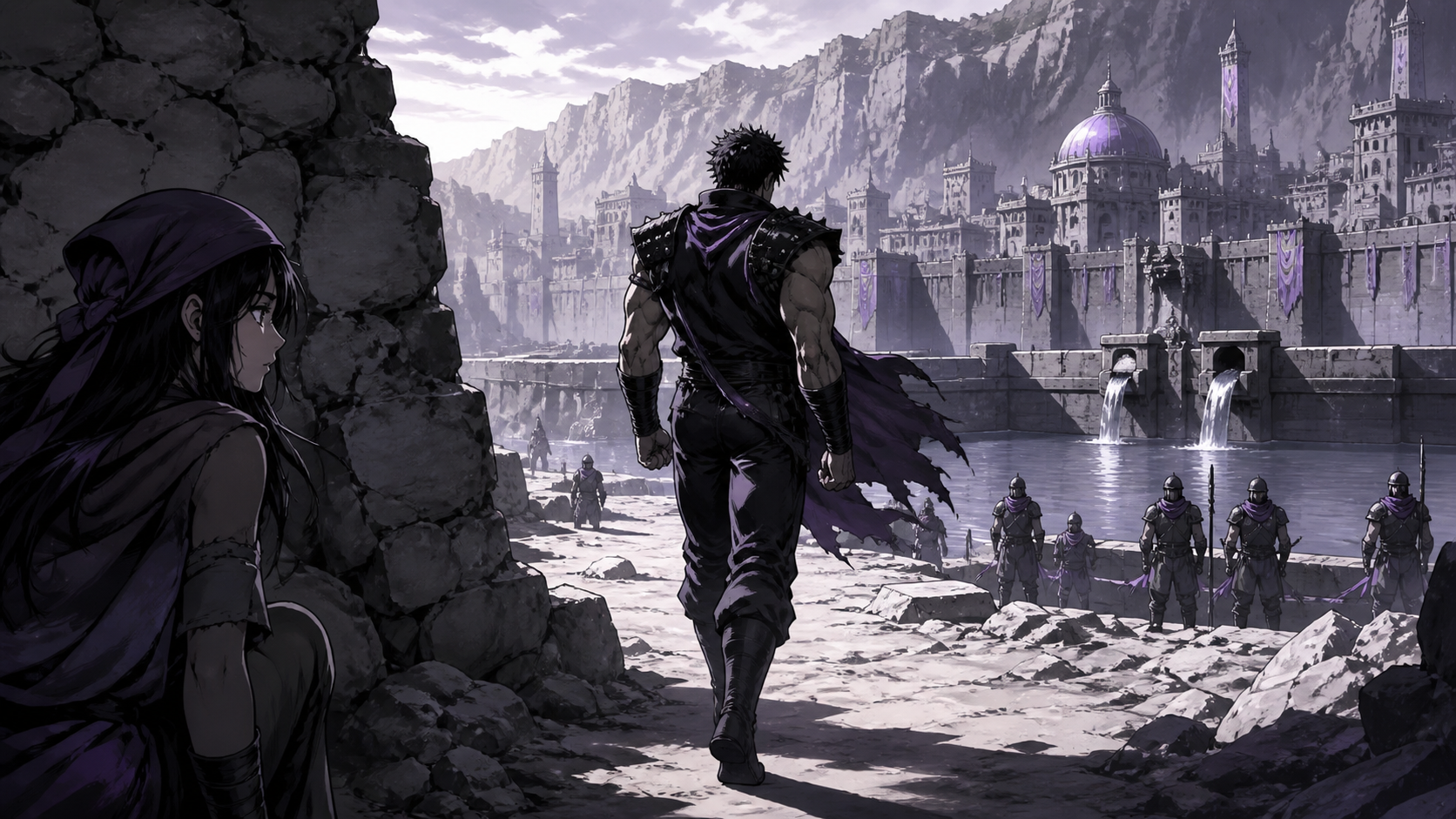
New Fist of the North Star OVA 1 React: The Cursed City Put a Price on Water
Immediate reaction: Kenshiro enters Lastland, where Sanga turns water into government and Sara’s healing becomes a threat to anyone profiting from thirst.
Spoilers: This React discusses the complete OVA episode and its ending.
Kenshiro walks into a city where thirst has already written the law
The first OVA does not need a new apocalypse because scarcity has preserved the old one. Lastland’s rulers understand that controlling water means controlling movement, labor, health, and the length of every argument. Kenshiro enters as an outsider whose strength can interrupt enforcement, but the episode’s real conflict existed before his body crossed the gate.
This makes the setting immediately legible as government rather than generic wasteland cruelty. People do not obey only because guards are violent. They obey because refusal may cost access to the substance keeping their families alive. The city has converted survival into permission, and every cup becomes evidence of who is allowed to possess a future.
A ruler who monopolizes water does not need anyone to believe in him; he needs them to remain thirsty
Sanga’s authority is brutally material. He can surround resource control with ceremony, punishment, and claims about order, yet the reservoir supplies the argument beneath every speech. Scarcity lets him present dependency as gratitude. People receive what was withheld and are expected to experience distribution as generosity rather than jurisdiction.
The episode is strongest when it shows that tyranny does not require theatrical genius. It requires chokepoints, guards, records, and people afraid that resistance will harm someone more vulnerable than themselves. Kenshiro can defeat the man. Liberation will depend on whether the city can make water common without constructing another gate around it.
Healing becomes political because Sara returns private knowledge to suffering bodies
Sara’s ability to heal through pressure points connects her to the franchise’s central idea that intimate bodily knowledge can preserve life or destroy it. Her work threatens the regime because care reduces dependence on institutions controlling relief. A patient who recovers outside official permission becomes proof that the ruler’s monopoly was never natural.
Her importance exceeds being the compassionate woman who confirms Kenshiro’s morality. Sara possesses expertise, judgment, and a relationship to the community that the traveler lacks. Protection should create room for her decisions rather than turning her into another reason for men to fight. The episode opens that possibility even when its action structure recenters Kenshiro.
The guide understands that information is currency and must decide who pays the hidden price
Tobi moves through the city by knowing what can be said, sold, concealed, and survived. That practical intelligence makes him useful and ethically unstable. Information trading can protect people under surveillance, but it can also reproduce the same asymmetry as water control. The person with the map chooses who walks into danger without knowing the whole route.
His relationship to Kenshiro is interesting because raw strength cannot replace local knowledge. The successor needs someone who understands the city’s habits. Tobi needs to decide whether the legend is a tool, ally, or threat. Their tension keeps the OVA from pretending one powerful stranger automatically comprehends the society he intends to disrupt.
The 2003 design makes Kenshiro heavier, colder, and less immediately reachable
The OVA’s digital-era design emphasizes mass, texture, hard shadow, and anatomical severity. Kenshiro looks like a body shaped by decades of legend and by a production environment eager to distinguish itself from weekly television. The result can be imposing and emotionally remote, especially when the face becomes another armored surface.
That distance fits a traveler entering after the original saga and creates a responsibility for performance. Small shifts in gaze and voice must recover the tenderness the geometry suppresses. Modern surface detail is not automatically maturity. The image matters when weight becomes history rather than a demonstration that newer animation can draw more metal and muscle.
Unfiltered bodily horror changes the joke-to-judgment balance of Hokuto consequence
The OVA format permits more direct gore than the old television production often showed through silhouette, light, or stylized delay. Visibility intensifies impact and removes some imaginative distance. An exploding oppressor can feel less like mythic reversal and more like physical punishment presented for inspection.
That shift demands stronger attention to victims and aftermath. Graphic consequence becomes ethically hollow if the city disappears behind the novelty of damage. The episode lands when violence opens access, interrupts coercion, or protects someone specific. It weakens when gore becomes the only evidence that this adaptation is for adults.
People do not follow false salvation because they are foolish; desperation has narrowed the available evidence
A population denied water and medicine is vulnerable to anyone who can stage relief. Faith under those conditions is not simple ignorance. It is a survival calculation made inside controlled information. The ruler’s spectacle works because people have been prevented from testing alternatives safely.
Kenshiro’s task is therefore larger than exposing a fraud through superior force. He must make another reality visible long enough for people to trust their own judgment again. Sara’s healing and communal knowledge matter because they distribute evidence. A savior who merely replaces the miracle at the center would leave the dependency intact.
Opening the conflict is not the same as returning the city to its people
The first OVA ends with power unsettled rather than society repaired. That is appropriate for a trilogy and reveals the story’s central burden. Water, medicine, legitimacy, and fear are connected systems. Removing one guard or humiliating one claim cannot settle who maintains the reservoir, treats the injured, or prevents retaliation.
The cliffhanger works because Kenshiro has entered a problem that cannot be punched into simplicity. The next episode must decide whether Seiji offers a rival ethic or merely a rival body. For now, the strongest image is not Kenshiro standing over an enemy. It is a city beginning to imagine that thirst may not be destiny.
8.6 out of 10 — an oppressive opening that remembers resource control is the real martial art
The Cursed City succeeds through atmosphere, political clarity, Sara’s healing, Tobi’s unstable knowledge, and a Kenshiro whose new design feels genuinely separated from the television era. Its graphic violence occasionally mistakes visibility for weight, while supporting characters still fight for room beside the legend.
The episode earns its score because the central metaphor never becomes merely decorative. Whoever controls water controls time, health, and consent. Kenshiro’s strength matters because it can break that claim. The trilogy will matter only if people receive more than a different powerful man standing near the reservoir.
A new Kenshiro voice makes distance audible before it makes strength audible
Takehito Koyasu inherits a role inseparable from earlier vocal memory and chooses a harder, more isolated register. This Kenshiro sounds like a man encountered after the legend has already traveled ahead of him. The reduced warmth can initially feel severe, but it suits an OVA concerned with a survivor moving beyond the relationships that once made his tenderness immediately visible.
The performance succeeds when restraint contains attention rather than vacancy. Kenshiro listens to Sara, assesses Tobi, and measures Sanga without needing to announce empathy. A lower, controlled delivery makes the rare softening meaningful. The danger is that permanent stoicism can make moral judgment sound identical to emotional absence. Koyasu’s best scenes keep those states separate.
The episode asks whether people become complicit when thirst makes refusal dangerous
Lastland’s citizens may appear passive beside Kenshiro, yet the regime has designed punishment to travel through family and community. Resistance by one person can cost water for many. Under those conditions, obedience does not prove agreement. It proves that domination has learned how to make conscience expensive.
The humanity test belongs as much to the hero as the crowd. Kenshiro must see frightened compliance without despising it, while citizens must decide whether the opening he creates is real enough to risk. Courage is not an unlimited resource. Ethical protection lowers its cost instead of demanding that oppressed people demonstrate worthiness through spectacular defiance.
On a second viewing, every water image becomes an administrative decision
Knowing Sanga’s system makes background details more legible: guarded channels, containers, movement around the city, and the bodily exhaustion of people who cannot plan beyond the next ration. The episode’s atmosphere is not simply desert style. It records how resource policy enters posture and social distance.
Rewatching also exposes where gore competes with the political story. The most memorable violence is not necessarily the most explicit. A guard enforcing access or a healer working outside permission may reveal more about power than an enemy’s destruction. The episode improves when watched for those systems rather than only for Kenshiro’s updated techniques.
Water Lines Are a Census of Power
Every queue, ration mark, guarded well, and private cistern reveals who the city considers fully entitled to survive. Sanga’s control is not merely theft of a resource; it is a system for ranking bodies by obedience, payment, and usefulness.
Resistance needs more than seizing one reservoir. Residents must know the supply, contamination risks, repair needs, and how distribution decisions will be made without recreating another gatekeeper.
The OVA becomes politically sharp when water is understood as infrastructure. A fist can open the gate, but legitimacy begins with transparent access after the lock breaks.
Sara’s Healing Needs Material Support
Sara’s knowledge makes her indispensable, which can quietly turn care into another extraction system. Medicine requires clean water, safe rooms, supplies, assistants, rest, and consent from patients. The city cannot solve institutional collapse by expecting one healer to absorb every untreated wound.
Her expertise should be shared through training and protected records without forcing her to surrender all control over dangerous knowledge.
Healing becomes public power when Sara can set boundaries, receive support, and help build capacity that survives her absence. Otherwise the new order praises care while consuming the caregiver.
Tobi’s Information Network Needs Accountability
Tobi survives by knowing routes, motives, and the price of disclosure. That skill can help resistance and can reproduce hierarchy if information remains private currency. People affected by his choices need to know what risks were concealed and whose safety was traded for access.
A post-Sanga city should establish shared warning systems, protected witnesses, and records available to more than one broker. Secrecy may remain necessary around vulnerable people, but it should not shield decisions from review.
Information becomes common infrastructure when residents can act on it without owing personal loyalty to the person who delivered it.
Kenshiro’s Departure Must Leave More Than an Open Gate
Kenshiro’s arrival interrupts violence that residents cannot stop alone, but heroic intervention can create a vacuum if it leaves before distribution, security, and repair are organized. The city needs local councils, water technicians, medics, and clear procedures for former enforcers.
He should share what he knows, support immediate safety, and avoid selecting a new ruler simply because that person helped him.
The episode’s humanity test continues after combat: can people move from rescue to self-government without making the traveling savior their next source of unquestioned authority?
The city also needs a process for people who enforced Sanga’s water regime. Some designed the monopoly, some profited, and others obeyed under threat or because ration access depended on service. Treating them as identical hides responsibility and makes surrender less likely.
Evidence should be preserved, weapons collected, and residents protected from retaliation while individual roles are examined. Former enforcers who did not organize abuse may contribute knowledge about pipes, stores, and routes under accountable supervision.
Justice becomes part of water restoration when the people who controlled thirst cannot quietly inherit the new distribution system.
Production facts are separated from the editorial judgment
Episode titles, the three-part release structure, novel source, Takashi Watanabe direction, Takehito Koyasu as Kenshiro, Gackt as Seiji, and the 2003–2004 release context are anchored to the contemporary AV Watch production report and Japanese release record. All political, psychological, and ethical analysis is CVM Sekai editorial criticism.