
Toki: Fist of the North Star Character Profile
Profile at a Glance
Toki is Kenshiro and Raoh’s adoptive brother, a master of Hokuto Shinken, a healer, and the clearest proof that lethal knowledge does not have to become government through fear. Radiation sickness limits his body without reducing his authority.
His gentleness is not passivity. It is disciplined attention: the decision to use intimate knowledge of the body to return choice instead of taking it.
The Successor Who Might Have Been
Toki possesses the technical grace and temperament that could have made him Hokuto Shinken’s successor. The nuclear disaster changes that future when he sacrifices his own safety so Kenshiro and Yuria can enter shelter.
The story often frames that decision as noble destiny. It is also a preventable loss produced by scarcity. Admiring sacrifice should never stop us from asking why survival required one person to absorb the cost alone.
Hokuto Shinken as Medicine
Toki reveals that pressure-point knowledge can relieve pain, restore movement, calm a distressed body, and help people survive without humiliation. The same intimacy that makes Hokuto terrifying becomes therapeutic when consent and purpose change.
His clinics rebuild more than health. They restore the expectation that expertise might serve vulnerable people instead of pricing their vulnerability. In the wasteland, that expectation is almost revolutionary.
Radiation and the Body That Keeps Working
Radiation sickness changes Toki’s strength, stamina, and time. The franchise sometimes makes his decline beautiful enough to risk aestheticizing it. His illness must remain material: fatigue, pain, lost possibilities, and the labor of continuing to care while his own body needs care.
He deserves more than the role of serene dying mentor. Anger, grief, urgency, and imperfect decisions keep him human. Holiness would flatten him.
The Shelter Decision Was Not Consent to Disappear
Saving Kenshiro and Yuria does not mean Toki agreed to become disposable forever. Stories often treat one act of sacrifice as permission to demand endless sacrifice from the same person.
Toki continues choosing service, but the people around him still owe him companionship, truth, and practical care. Gratitude is not enough when a community quietly assumes the healer will manage his own suffering.
Raoh and the Authority of Care
Raoh creates obedience through terror. Toki creates trust through relief. Their brotherhood turns political because each embodies a different answer to collapse. One concentrates power; the other distributes survival.
Raoh understands that Toki’s model threatens him even when Toki commands no army. People who have experienced care without ownership learn that domination is not the only possible order.
Kenshiro and the Knowledge He Needs
Toki gives Kenshiro more than techniques. He gives him a language for reading consequence. A body is not merely a target, and victory is not complete when the opponent falls.
Their bond works because Toki does not seek to own Kenshiro’s future. He teaches, corrects, warns, and allows the successor to remain responsible for his own choices.
Rei’s Last Days and the Ethics of Pain
When Rei faces death, Toki offers a terrible choice: a peaceful ending or a counter-pressure point that extends time through extreme pain. The scene matters because neither option is disguised as easy.
Rei chooses the pain for his own purpose. Toki’s role is not to make the decision noble. It is to explain the cost honestly and respect the agency of a dying person.
Masculinity Without Emotional Punishment
Toki refuses the rule that a powerful man must make tenderness look accidental. He touches gently, speaks directly, and recognizes fear without mocking it. The series still surrounds him with violent expectations, but his masculinity does not depend on denying care.
That does not make him emotionally transparent. He can minimize his needs and turn usefulness into a hiding place. Gentleness becomes healthier when it includes the self.
Japanese Voice Performance
Takaya Hashi’s original Japanese performance gives Toki calm authority without erasing physical strain. The voice avoids making kindness sound weak or illness sound decorative. Small changes in breath carry the body’s cost.
Later adaptations use other Japanese performers and require era-specific credits. A complete profile treats performance as interpretation, not a name pasted across every continuity.
Character Design Across Eras
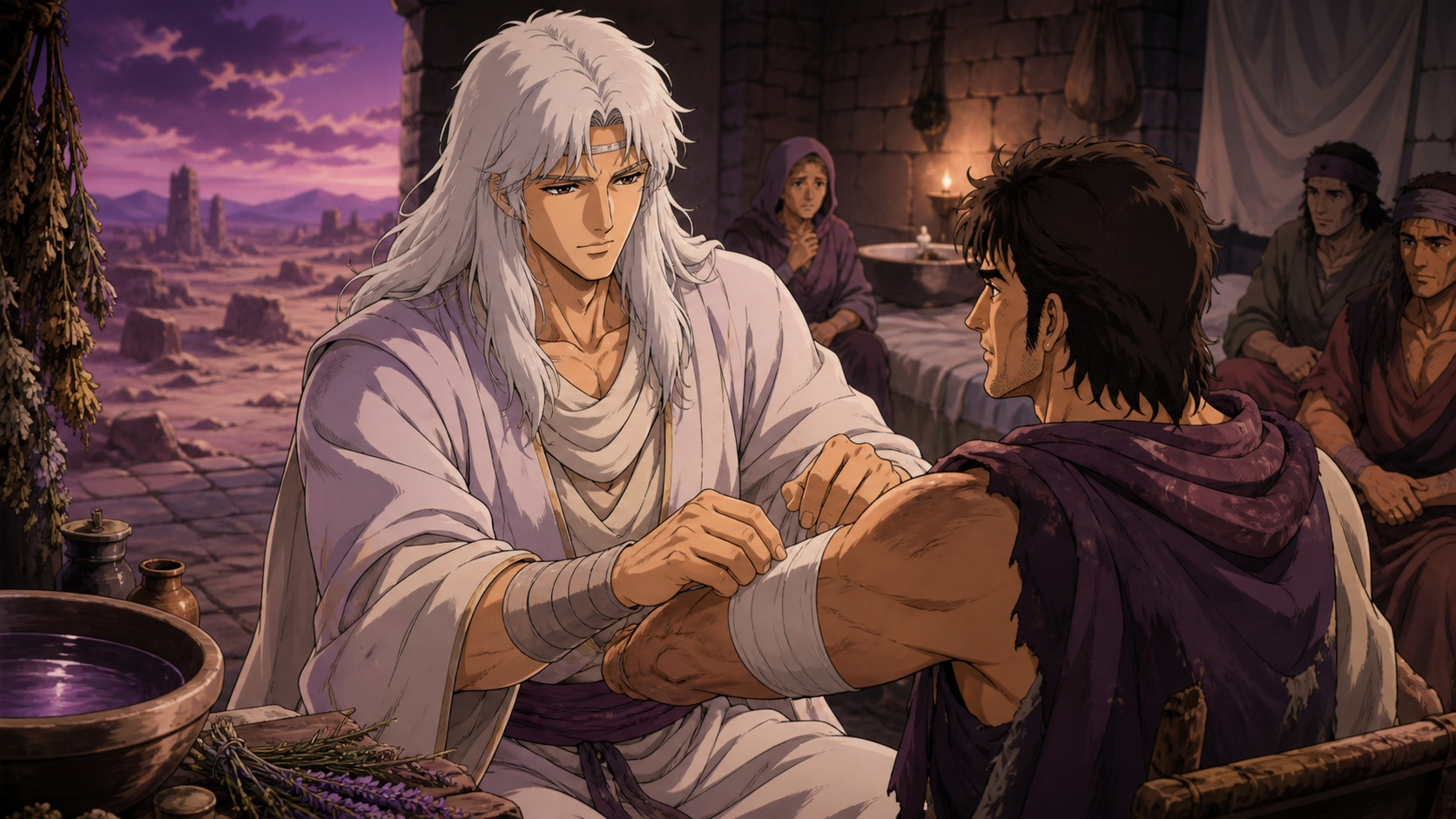
White hair, soft eyes, flowing clothing, and a visibly weathered body distinguish Toki from the franchise’s rulers. Modern fan art can refine anatomy and beauty while keeping the signs of labor and illness that make the design meaningful.
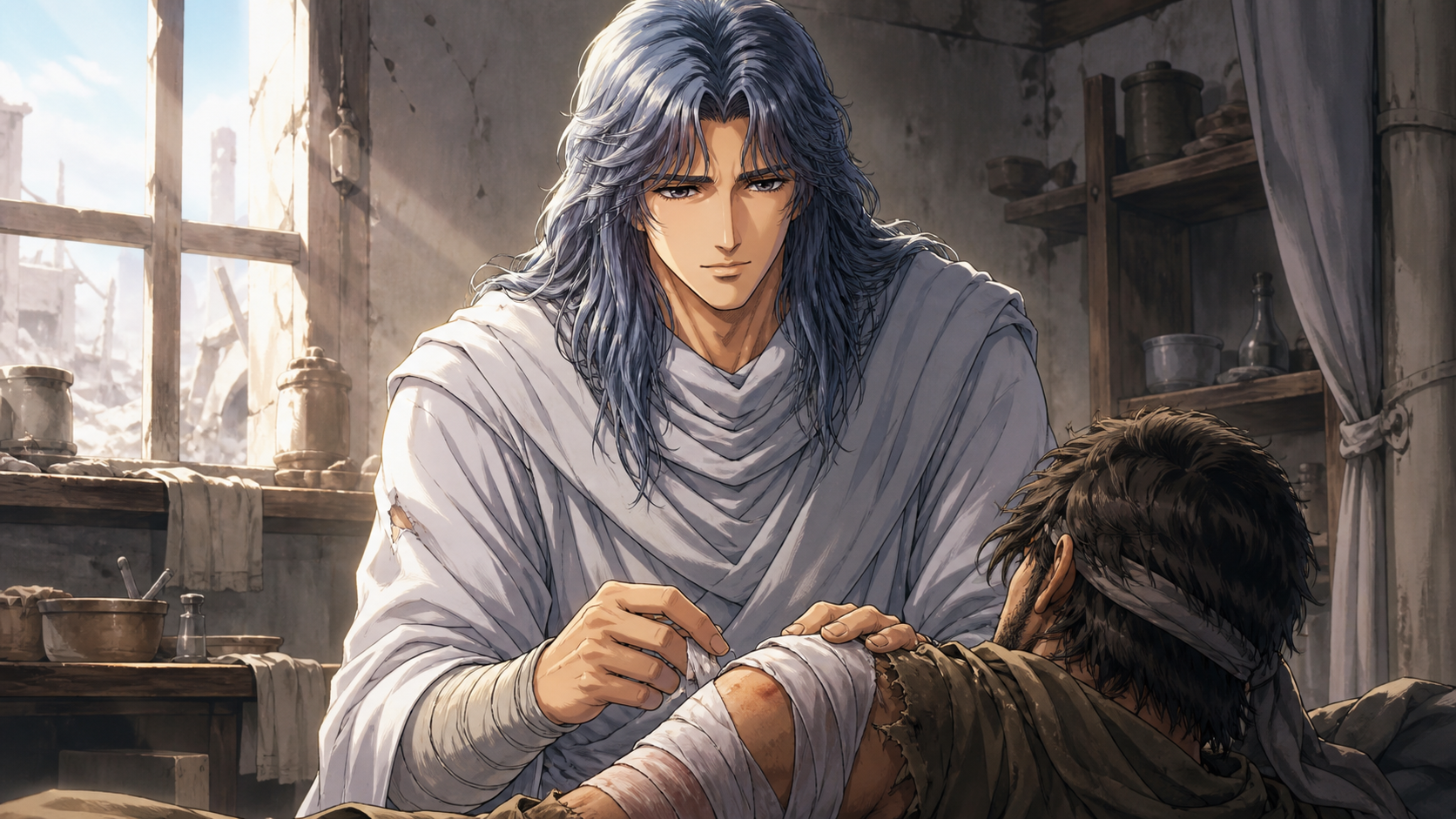
CVM Sekai’s canonical modern portrait shows him treating someone rather than posing as a saint. Care is an action, not an aura.
Care Is Toki’s Theory of Power
Toki does not merely use dangerous knowledge for benevolent outcomes. He changes the relationship between expert and vulnerable person. The patient is not an audience for mastery or a debt waiting to be collected. Care returns capacity without claiming ownership of the life restored.
That makes his clinics politically significant. People experience power that does not arrive as command, learning in their own bodies that authority can be precise, effective, and nonpossessive.
Healing and Killing Share Anatomical Intimacy
Hokuto Shinken depends on detailed knowledge of the body. The same intimacy can destroy from within or relieve pain, restore movement, and interrupt distress. Technique alone therefore carries no moral answer.
Purpose, consent, explanation, and accountability determine what the knowledge becomes. Toki’s gentleness is disciplined because he understands exactly how easily expertise can cross into violation.
The Shelter Was an Infrastructure Failure
Toki’s sacrifice is remembered as proof of character, but the emergency also reveals a system with insufficient protected space and no redundant plan. A door that requires one person to remain outside has converted scarcity into a moral test.
Honoring Toki should include refusing repetition. Better shelters, clear capacity records, distributed routes, and evacuation practice matter more than teaching the next healer to die beautifully.
Radiation Is Not a Spiritual Metaphor
The story often frames Toki’s illness through serenity and destiny. Radiation exposure remains material damage with fatigue, pain, changing capacity, and stolen time. Beauty should not make those consequences abstract.
He deserves medical attention, anger, accommodation, and the right to stop. Continuing to help others may be his choice, but that choice does not erase what others owe his body.
Usefulness Can Become a Hiding Place
Toki’s identity as healer allows him to remain needed while avoiding the vulnerability of receiving care. Competence protects him from questions about fear, grief, and exhaustion because the room always contains someone whose need seems more urgent.
A healthier community interrupts that pattern. Someone else keeps records, prepares medicine, and insists that the healer’s symptoms enter the care plan. Reciprocity is not selfishness forced upon him. It is what prevents devotion from becoming disappearance.
Raoh Understands Why Care Threatens Rule
Raoh organizes safety through obedience and overwhelming force. Toki produces loyalty without coercion because people remember relief, honesty, and the absence of humiliation. That model exposes domination as a choice rather than a law of the wasteland.
Toki needs no army to threaten authoritarian legitimacy. A patient who has experienced nonpossessive power becomes harder to convince that terror is the only source of order.
Kenshiro Inherits a Moral Practice, Not Only Techniques
Toki teaches Kenshiro to read bodies as lives with histories rather than targets arranged around victory. Correction matters because the successor’s precision can either protect agency or erase it.
The inheritance succeeds when Kenshiro carries forward explanation, restraint, and responsibility alongside martial knowledge. A secret art becomes less dangerous when its ethics are taught as rigorously as its pressure points.
Rei’s Choice Requires Honest Information
The counter-pressure point that extends Rei’s remaining time through extreme pain is not compassionate because it creates a dramatic final battle. Its ethical possibility rests on Toki explaining the cost and allowing Rei to decide what purpose the time serves.
Consent under death is complicated, but concealment would be worse. Toki cannot make the choice clean. He can keep it from becoming his own.
Gentleness Does Not Require Perfection
Toki can be compassionate and still minimize himself, make mistakes, feel anger, or choose badly under pressure. Turning him into a saint removes the very interior life that makes care meaningful.
Gentleness is a practice, not an essence. It can be revised when consequences reveal a limit. A perfect healer cannot learn; a human healer can.
Classic-Era Design: The Healer in Motion
The new original CVM fan art places classic-era Toki inside a working clinic, treating an injured adult while other survivors wait. White hair, pale clothing, weathered calm, herbs, water, cloth, and repaired stone keep the image grounded in labor rather than worship.
The CVM plum, lavender, charcoal, ivory, wine, and restrained-gold palette remains consistent with the site. This original-era image now leads the profile because the biography begins with the classic interpretation before moving into later design refinement.
Modern and Remake-Era Design: Beauty Must Keep the Cost
Modern fan art can refine anatomy, lighting, fabric, and facial detail without turning Toki’s illness into decorative fragility. The later portrait should preserve signs of effort, treatment, and physical consequence.
Updating attractiveness does not require erasing age, disability, or care work. Toki becomes more compelling when beauty remains attached to what his body has carried and what his hands choose to do.
What Toki Leaves Behind
Toki’s legacy is not a clinic that collapses when he dies or a collection of techniques only one successor may use. It is the expectation that knowledge should relieve suffering without demanding submission.
That expectation can survive through trained assistants, public health practice, consent, records, and communities willing to care for caregivers. His tragedy is personal. His ethics do not have to remain solitary.
A Clinic Needs More Than One Healer
Toki’s knowledge creates immediate relief, but a clinic that depends entirely on him reproduces the succession problem in medical form. Patients remain vulnerable to his absence, illness, or death because expertise has not become shared capacity.
Training assistants, recording treatments, organizing supplies, and teaching basic wound care would extend his ethic beyond his body. Secrecy may protect dangerous techniques, but ordinary care knowledge should not disappear with the master.
Patients Need Privacy as Well as Treatment
Wasteland care often occurs in crowded spaces where illness and injury become public information. Toki’s gentleness should include control over who watches, what is recorded, and how a diagnosis circulates.
Privacy is not luxury. It protects people from stigma, retaliation, and rulers who might use medical vulnerability as leverage. Returning choice means protecting the story of the body as well as the body itself.
Pain Relief Is Not Moral Weakness
The franchise admires endurance so intensely that relief can appear secondary to proving character. Toki’s practice offers another ethic: pain does not become valuable merely because someone survives it.
Reducing suffering can restore thought, movement, sleep, and the ability to choose. A healer does not diminish courage by making pain smaller. He prevents pain from becoming another ruler.
Toki and the Problem of Hope
Patients may attach enormous hope to a healer whose reputation exceeds what any body can guarantee. Toki must balance reassurance with honesty about limits. False certainty would convert compassion into another form of control.
Hope becomes ethical when it supports action without hiding uncertainty. A patient deserves to know what treatment may do, what it cannot do, and which choices remain theirs.
Brotherhood Should Include Caregiving
Kenshiro and Raoh define brotherhood through training, rivalry, protection, and inheritance. Toki’s illness asks whether brotherhood also includes routine care: preparing food, monitoring symptoms, sharing travel, and listening without turning every need into a duel.
Love expressed only through dramatic sacrifice leaves daily labor to the person already suffering. A family becomes credible when care travels toward the healer too.
Toki’s Anger Deserves a Place
Serenity can become another expectation placed on sick and disabled people. Toki may be angry about exposure, lost time, dependence, institutional failure, or the way others turn his composure into permission to ask more.
Anger would not contaminate his gentleness. It would identify what gentleness refuses to normalize. A complete profile leaves room for both the calm healer and the man whose future was stolen by a preventable shortage.
RaeRae’s Verdict
Toki proves the strongest fist is not automatically the one that destroys most efficiently. Mastery becomes ethical only when knowledge answers to the person receiving it.
His tragedy is not that gentleness failed. Gentleness survives him in the people who learned what non-possessive power feels like. The tragedy is that his world made one healer carry so much proof alone.