
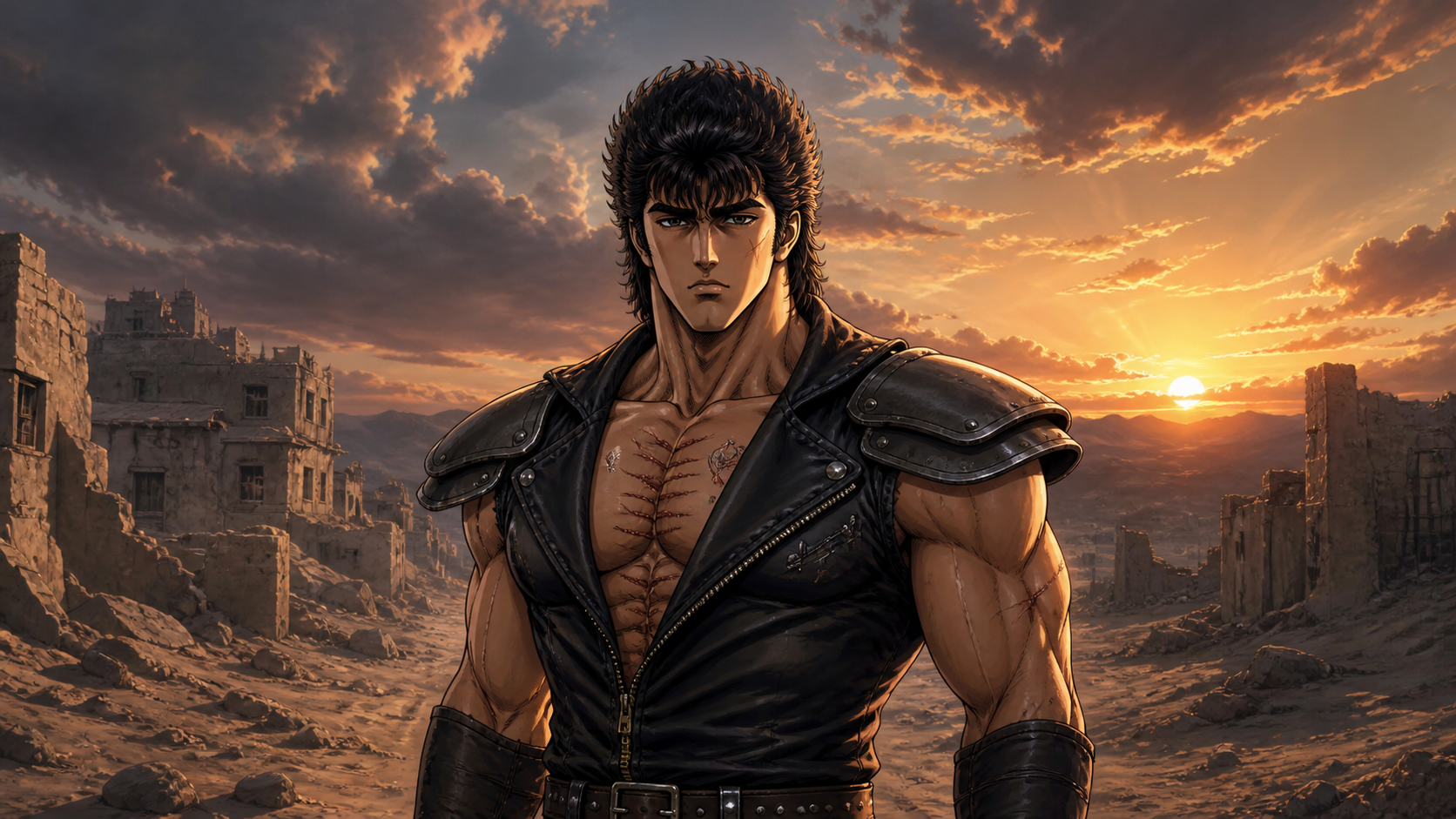
Kenshiro: Fist of the North Star Character Profile
The sixty-fourth successor of Hokuto Shinken is famous for ending fights after they appear finished. His real test is whether unmatched power can protect a world without owning it.
Profile at a Glance
Kenshiro is the sixty-fourth successor of Hokuto Shinken, the man marked by seven scars, and the wandering center of Fist of the North Star. His reputation rests on impossible strength and delayed bodily destruction. His character rests on restraint: what he refuses to take, whom he listens to, and whether lethal knowledge can remain ethical in a world with almost no public law.
He is not emotionless. Kenshiro grieves so deeply that speech often becomes smaller than the feeling. Tears, silence, touch, memory, and decisive action form one emotional vocabulary. The problem is not an empty interior. It is a man trained to carry pain privately while communities increasingly treat his body as their only surviving institution.
Identity, Lineage, and Succession
Hokuto Shinken permits one official successor because its pressure-point knowledge can heal or kill with terrifying precision. Ryuken selects Kenshiro over Raoh, Toki, and Jagi, turning family bonds into a succession crisis with political consequences.
The title does not make Kenshiro morally complete. Succession grants access and responsibility, not permanent righteousness. Every strike requires judgment about intent, proportionality, coercion, and whether death is truly necessary.
The Seven Scars Are Evidence, Not Destiny
Shin defeats Kenshiro, pierces his chest seven times, and takes Yuria. The scars record violence, humiliation, and survival. They do not prove Kenshiro was weak or that Shin owns the meaning of what happened.
Jagi later weaponizes the same pattern by impersonating him. A visible wound becomes false identification, showing how easily communities turn bodies into verdicts when grief demands certainty.
Yuria and the Risk of Making Love a Destination
Kenshiro’s search for Yuria supplies the early journey with direction. Their love matters, but Yuria cannot exist only as the woman whose absence makes him move. Her own choices, leadership, illness, and role within Nanto complicate the fantasy that reunion restores an untouched life.
Kenshiro loves best when he recognizes Yuria as a political and moral actor rather than a stolen possession. He fails whenever rescue logic narrows her to the proof that he defeated another man.
Lin and the First Measure of His Strength
Lin offers water to a dying stranger in a village where water has become survival currency. Kenshiro responds to her silence and fear before displaying power. That sequence matters more than the famous explosion that follows.
He does not demand gratitude after helping her. Lin chooses attachment because he makes response seem possible. Their bond tests whether protection can preserve a child’s agency instead of converting vulnerability into ownership.
Bat and the Labor of Survival
Bat understands routes, barter, vehicles, scams, and danger. Kenshiro supplies overwhelming force; Bat repeatedly supplies the practical intelligence that makes travel possible. Treating him as comic relief would erase the labor beneath the legend.
The relationship also asks Kenshiro to accept help from someone without martial status. A savior who cannot be assisted becomes another hierarchy. Kenshiro’s humanity grows when he recognizes Bat as a partner rather than luggage.
Hokuto Shinken as Medicine and Execution
The same art can restore speech, relieve pain, alter bodily function, or cause delayed death. That dual use makes Hokuto Shinken an ethical system as much as a combat style. Knowledge this intimate should never be reduced to a cool finishing move.
Kenshiro often targets unmistakably violent oppressors, but the technique leaves little room for correction after contact. His moral burden exists before the finger lands. Compassion cannot repair an unjust execution.
Why “You Are Already Dead” Works
The signature line reverses ordinary threat. Kenshiro describes a consequence already set in motion while the opponent’s confidence continues for a few seconds without accurate bodily knowledge.
The phrase becomes iconic because it exposes domination as ignorance. Men who believe size and fear make them invulnerable discover they cannot read the systems inside themselves. The line is not enough on its own; the episode must still justify why Kenshiro chose death.
Restraint Is His Most Attractive Power
Kenshiro can take food, water, territory, attention, and obedience. He usually refuses. Strength becomes morally legible when it does not automatically convert capacity into entitlement.
This distinguishes him from Raoh, Shin, Jagi, and the countless local rulers who treat ability as ownership. Restraint is not softness layered over violence. It is the discipline that prevents mastery from becoming government by one body.
The Savior Problem
Villages need Kenshiro because armies and gangs have captured resources while public institutions collapsed. His arrival can stop immediate predation. It cannot rebuild wells, farming, medicine, schools, courts, and accountable defense by itself.
The franchise is strongest when it admits that heroic rescue and government are different tasks. Communities must retain knowledge and authority after Kenshiro leaves or the next tyrant will inherit the same gap.
Raoh and Competing Models of Order
Raoh believes overwhelming force can impose peace on a fractured world. Kenshiro believes power must protect people without owning them. Both operate through exceptional bodies, which means their difference is ethical rather than simply structural.
Kenshiro’s victory only matters if it opens space for shared institutions. If everyone continues waiting for the strongest man, the political logic of Raoh survives his defeat.
Toki and the Authority of Care
Toki shows Kenshiro a version of Hokuto centered on healing, teaching, and adaptation. Illness changes Toki’s stamina, not his authority. Raoh fears what Toki can transmit because knowledge can outlive physical dominance.
Kenshiro must inherit more than technique. He must inherit the ethic that a body is not valuable only when it wins a fight. Toki’s care work belongs at the center of Hokuto history.
Jagi and the Limits of Mercy
Kenshiro’s earlier mercy toward Jagi does not make him responsible for Jagi’s later cruelty. Jagi chooses impersonation, manipulation, and violence. Mercy offered once is not consent to future harm.
The experience nevertheless complicates Kenshiro’s judgment. Sparing someone can carry risk; killing preemptively can become tyranny. There is no technique that removes the need for moral uncertainty.
Rei and Brotherhood Without Ownership
Rei begins as a misdirected threat and becomes one of Kenshiro’s most meaningful equals. Their trust grows because both revise assumptions and allow care to interrupt revenge.
When Rei stops Kenshiro from fighting Raoh too soon, brotherhood becomes corrective. Loyalty is not cheering another man toward death. It is refusing to let grief make his body disposable.
Masculinity, Tears, and Silence
Kenshiro’s tears are not exceptions that reveal a hidden softer self. They belong to the same masculinity as his fists. He does not become less formidable when grief becomes visible.
His silence can still frustrate relationships. People should not have to infer every need from posture. Emotional restraint becomes harmful when it prevents shared planning or makes others carry uncertainty alone.
Japanese Voice Performance
Akira Kamiya voices Kenshiro in the original television series and 1986 film, balancing controlled quiet with explosive technique calls and grief that never sounds ornamental. The performance gives minimal dialogue weight because breath, timing, and tonal pressure carry what exposition would flatten.
Later adaptations and games use other Japanese performers. Each era should be credited specifically. A character profile can compare interpretations without pretending one actor voiced every continuity.
Character Design Across Eras
The classic design combines impossible upper-body scale, dark clothing, seven scars, heavy brows, and a silhouette built to remain readable against the wasteland. Later art refines anatomy, fabric, facial structure, and lighting while preserving the sense of controlled mass.
CVM Sekai uses modern fan art for the canonical profile identity while labeling period images inside the biography. Updated beauty should not erase scars, restraint, or the visual difference between Kenshiro’s grounded presence and Raoh’s imperial display.
RaeRae’s Verdict
Kenshiro matters because the fantasy is not merely having enough strength to punish every cruel man. The fantasy is possessing catastrophic power and still believing a thirsty child, frightened village, sick brother, or grieving friend has a claim on how that power behaves.
He is not a complete answer to the wasteland. He is a moral interruption. His best legacy would be a world that no longer needs him to arrive—one where water, medicine, safety, and justice belong to communities instead of whichever enormous man controls the road.