
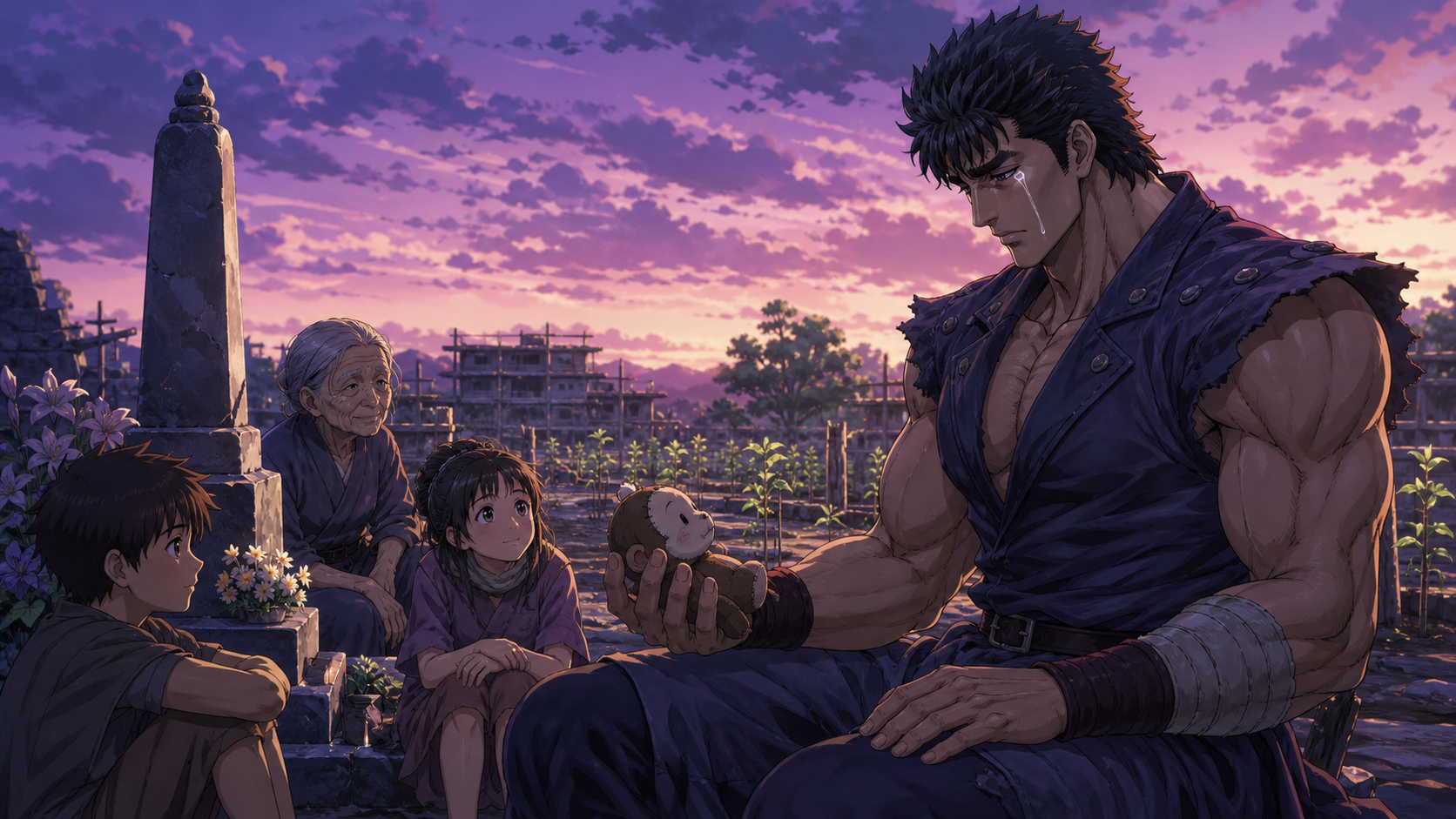
Stop Calling Kenshiro Emotionless Because He Does Not Perform Pain for You
Kenshiro communicates pain through attention, tears, memory, and care. Quiet feeling is real, and it still carries responsibilities to the people who love him.
Silence Is Not an Empty Room
Calling Kenshiro emotionless requires ignoring almost everything he does when nobody is asking for a speech. He remembers the dead, protects children without treating them as props, carries strangers, responds to cruelty as a wound rather than an inconvenience, and lets tears exist without turning them into a referendum on his masculinity.
He is emotionally restrained, sometimes painfully so. Restraint is not absence. The series writes feeling through attention, posture, touch, and the decision to stay near suffering that cannot be punched away. Viewers trained to recognize emotion only when it arrives as confession can mistake quiet literacy for vacancy.
Pain Does Not Owe Us a Performance
There is a cruel demand hidden inside “show me you care.” Sometimes it means communicate honestly with people affected by your choices. Sometimes it means perform pain in a recognizable style so observers can feel generous for believing you. Kenshiro’s grief should not have to become eloquent to count.
Trauma can narrow language. A person may express care through vigilance, repair, routine, or presence before he can name what happened. That does not make every silence healthy, but it does mean volume is a terrible diagnostic tool.
His Body Speaks Before He Does
Kenshiro’s body is designed as overwhelming force, yet the animation repeatedly lets that body soften around people who pose no threat. He lowers himself to a child’s height, carries injured bodies carefully, touches graves, and stands still when another person needs the scene to belong to their grief.
Those choices are not decorative contrast. They tell us strength has become ethical only when it can change scale. A fist capable of destroying stone must also know when not to close.
Lin and Bat Are Not Emotional Accessories
Lin and Bat help make Kenshiro’s care visible, but they are not gauges attached to his conscience. They bring fear, humor, judgment, memory, and practical knowledge. He does not simply save them; they repeatedly call him back into relationship with a future larger than revenge.
The healthiest reading keeps their agency intact. Children should not be required to rehabilitate an adult man through devotion. Kenshiro owes them communication and stability precisely because they love him, not because their love excuses his disappearances.
The Tears Matter Because They Are Not Currency
Kenshiro cries. The famous image matters because the tear is not bargaining for forgiveness or demanding that another person stop being angry. It recognizes loss without converting grief into entitlement. His sadness does not authorize an army.
That difference separates him from men who weaponize feeling. Emotion is not automatically virtuous; what matters is the claim it makes on other people. Kenshiro’s best grief enlarges his obligation to protect life without owning it.
Quiet Men Can Still Cause Harm
Defending Kenshiro from the emotionless label does not require romanticizing every silence. Withholding plans can frighten companions. Leaving without explanation can force children and communities to absorb uncertainty. Competence does not relieve him of the duty to tell people what risks his choices create.
The point is not that quiet men are secretly perfect. It is that communication can be expanded without demanding theatrical vulnerability. A clear warning, an honest limit, a returned promise, or the sentence “this is not your fault” may matter more than a monologue.
Masculinity Beyond Domination
The wasteland offers masculinity as hierarchy: command the room, endure alone, make desire into possession, and prove grief by destroying something. Kenshiro interrupts that script whenever he uses power to create breathing room and then refuses to become the permanent owner of the people he helped.
His wandering can reproduce another masculine fantasy—the man too burdened to remain—but his tenderness complicates it. The possibility of staying, receiving care, and participating in ordinary repair is the growth his archetype still needs.
Memorials Are a Form of Conversation
Kenshiro’s relationship with the dead is active. Graves, tokens, techniques, and remembered words continue shaping his choices. He does not “move on” by making loss irrelevant. He carries memory without insisting that every survivor carry it in the same way.
A memorial is not silence doing nothing. It is an agreement that a life altered the world and that the living will organize attention around that fact. His pauses at those sites are part of the dialogue.
Care Must Become Community
One heroic man cannot be the emotional or physical infrastructure of every settlement. Kenshiro’s compassion becomes sustainable only when it supports healers, growers, teachers, guardians, and children who learn that safety is a shared practice rather than a miracle arriving on foot.
That is also where his own healing becomes possible. Community does not require him to stop being private. It requires him to let other people matter before the emergency and to accept that being cared for is not a defeat.
RaeRae’s Verdict
Stop calling Kenshiro emotionless because he does not audition his pain for you. Watch the hands that repair, the body that kneels, the tear that asks for nothing, and the attention he gives people whose names will never enter a succession legend. That is emotional language.
Then ask more of him without demanding a different personality: clearer goodbyes, shared plans, room for children to be children, and a home that does not collapse whenever the strongest man walks away. Quiet feeling is real. Quiet responsibility must be real, too.