
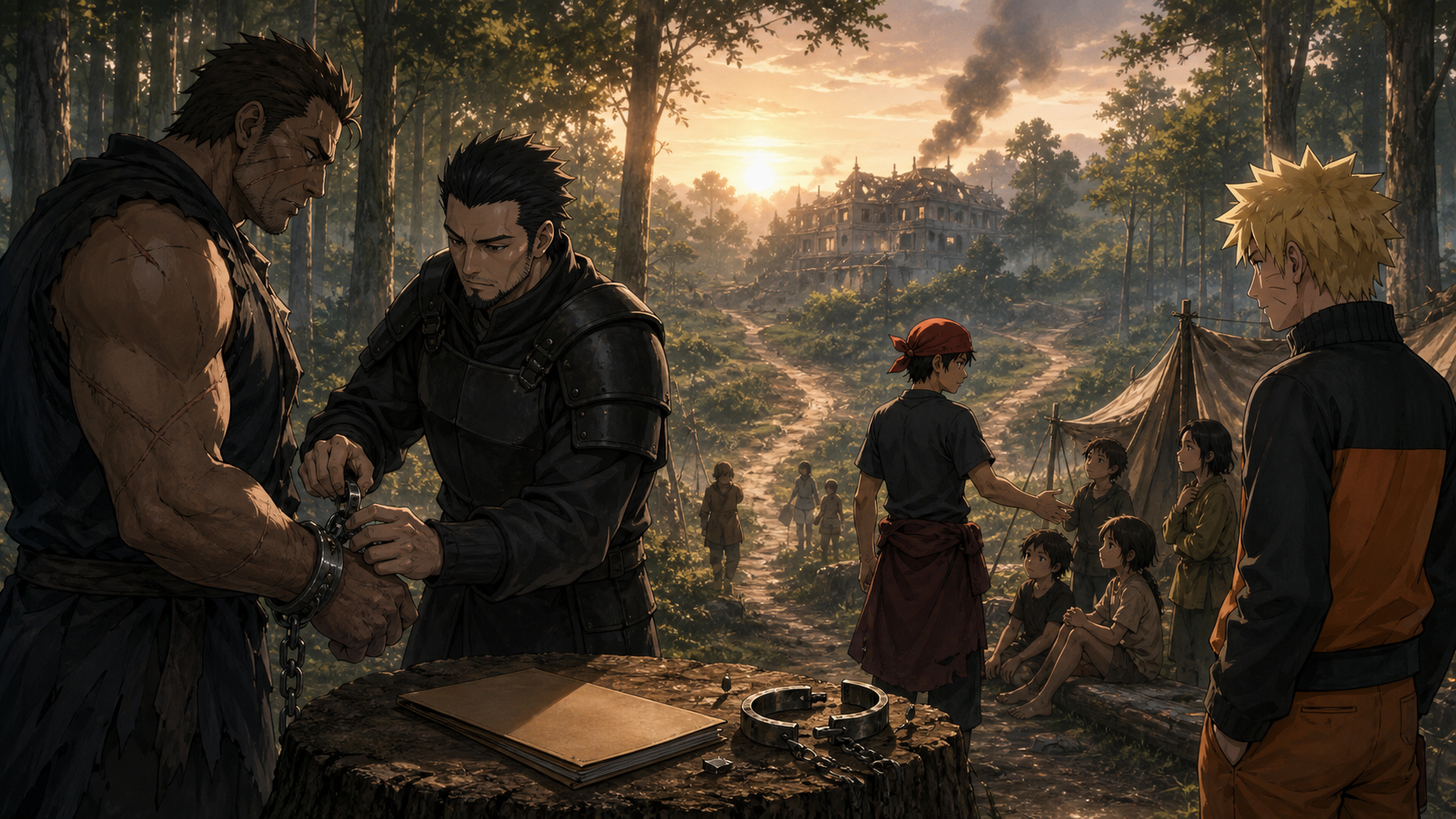
To Each His Own Path
After Gantetsu and Todoroki rescue Akio from another fire, the officer chooses mercy without forgiveness and leaves the former prisoner to continue caring for the forest children.
Gantetsu saved Akio.
Gantetsu also helped the gang that murdered Akio's parents.
Both facts survive the fire.
Naruto Episode 212, `To Each His Own Path`, closes the Gantetsu Escort Mission without pretending one good decision erases years of harm. Todoroki gets his brother back. The Shinobazu fall. Gantetsu remains guilty.
The ending offers mercy anyway.
That is harder than forgiveness and much more interesting.
Shura Takes the One Child Who Knows the Treasure
Akio is valuable to Shura for the same reason Gantetsu kept him close: the boy belongs to the practical life built around the returned property. He knows where resources move, who depends on them, and how the refuge functions. Shura sees that knowledge only as access to money.
The kidnapping also proves that the gang never came to rescue Gantetsu as a comrade. Its members want the cache and will use the child Gantetsu saved to force his cooperation. Loyalty inside the Shinobazu lasts exactly as long as stolen wealth remains available.
For Todoroki, the crisis removes revenge's abstraction. Gantetsu is no longer only the face remembered in flames. He is the person who knows where Akio was taken, why Shura wants him, and how to reach the place before the gang kills another witness.
Naruto continues fighting Monju while Sakura, Lee, and the forest children protect Gantetsu.
Monju trusts his wire cage too much. Naruto uses shadow clones and coordinated pressure to break through the defense, because a villain declaring something impossible is basically an invitation with Naruto's name on it.
Before Naruto can finish the confrontation, Shura arrives.
Monju tells him that the boy in the red bandanna knows where Gantetsu hid the treasure. Shura takes Akio and retreats to the gang's mansion.
The abduction forces every unfinished question into the same rescue. Todoroki must save the brother he believed dead. Gantetsu must protect the first child he carried out of the Shinobazu's violence. Naruto must stop the gang while keeping Todoroki from turning the mission back into revenge.
Nobody gets to avoid the past now.
Gantetsu Finally Explains the Burning House
His plan is morally serious because it includes his own capture. Gantetsu does not steal the valuables and disappear into a comfortable new identity. He creates a trail that forces the Shinobazu into the open and accepts the possibility that lawful custody will end with his punishment.
That does not retroactively make every year inside the gang part of a noble strategy. He says the opposite. Saving Akio did not stop him from helping produce new victims. Change began in the fire, failed to become action quickly enough, and eventually hardened into a plan against the organization.
The delay matters. A person can choose better and still remain responsible for everyone harmed while that choice was postponed. Gantetsu's later courage gains weight because he does not use it to rewrite the years before it.
Gantetsu admits what happened five years earlier.
He had begun to hate the Shinobazu's methods. During the attack on Todoroki's home, he found Akio and carried him away from the fire.
For a moment, Gantetsu believed saving one child might change him.
It did not change enough.
He stayed with the gang and continued helping create more victims like Akio. That admission prevents the episode from handing him a cheap hero label. Gantetsu did something brave inside the burning house, then returned to the people who set it on fire.
Eventually, he understood that secret rescues could not compensate for continued participation.
He stole the gang's treasure, returned property to the families and children they harmed, and allowed himself to be captured. He expected the Shinobazu to pursue him for the location, exposing the group so authorities could destroy it.
The escort was bait.
Gantetsu was the hook.
The Children Became a Family
The refuge is Gantetsu's answer to damage he cannot reverse. He cannot return murdered parents or restore burned homes. He can provide food, shelter, recovered property, and an adult who does not disappear when the consequences of the gang become inconvenient.
Akio's role shows that this is not a collection of dependents waiting for rescue. The children care for one another, with the oldest carrying responsibilities formed through shared survival. Gantetsu anchors the household, but the relationships among the children have their own permanence.
That is why the final choice cannot be reduced to whether Gantetsu deserves freedom. Removing him changes the lives of people who did not participate in his crimes and have already lost adults to Shinobazu violence.
Akio grew into the oldest child in the forest refuge.
He helps care for the younger children, all survivors of homes attacked by the Shinobazu. Gantetsu provides shelter and becomes the central adult in their strange, wounded family.
Todoroki struggles to accept any of it.
The man he spent five years hating saved his brother. That same man belonged to the gang that killed their parents. Todoroki cannot replace one truth with the other, and the episode does not ask him to.
Gantetsu agrees.
His crimes cannot be washed away. After Akio is safe, he tells Todoroki, the officer may do whatever he wants with him.
That is not a demand for forgiveness. It is an acceptance that protecting children does not cancel accountability.
First, they need to bring Akio home.
Everyone Takes a Job
The division reflects what each person can protect best. Sakura stays where injury, fear, and another possible attack could overwhelm the younger children. Lee uses speed and close combat to prevent outside fighters from collapsing onto the entry team. Naruto carries the flexible power needed to answer Shura's techniques inside.
Todoroki and Gantetsu both possess knowledge nobody else has. One knows Akio as family. The other knows the mansion and the gang. Their cooperation should be the strongest part of the rescue, yet Todoroki's urgency almost turns that knowledge into another vulnerability.
Rushing ahead is understandable. It is also exactly what a prepared enemy expects from someone whose missing brother is screaming in the next room.
The rescue team divides responsibilities.
Sakura remains with the younger children, who need protection and medical support. Lee handles the Shinobazu fighters outside the mansion. Naruto enters with Todoroki and Gantetsu.
This is one of those moments when the mission works because nobody argues that the most visible fight is automatically the most important job.
Sakura protecting children is not less valuable than Naruto chasing Shura. Lee keeping reinforcements outside is what lets the others reach the basement. A rescue collapses when everybody wants the dramatic hallway.
Todoroki does want the dramatic hallway.
He rushes ahead despite warnings that Shura has prepared the mansion for intruders.
The man has found his brother after five years. Patience has left the building before he enters it.
Akio Refuses to Betray the Children
Akio's refusal is not a child's attempt to imitate adult bravery. He understands that the treasure already has owners: the people from whom the Shinobazu took it. Giving Shura a location would help the thief steal the same property twice.
It would also expose every younger child depending on the refuge. Akio acts as their older brother before Todoroki ever recognizes him. His silence protects a family Todoroki does not yet know he has.
Shura responds by repeating the gang's standard method. Extract what is useful, remove witnesses, and burn the location. The mansion fire is not merely a dramatic backdrop. It is the same evidence-erasing violence seen at the start of the arc, now turned inward on the gang's own hideout.
Shura tortures Akio for the treasure location.
Akio refuses to answer.
The valuables support the children whose families the Shinobazu destroyed. Giving Shura the location would return stolen property to the people who stole it and expose the refuge to further danger.
Akio understands the stakes better than the adults who once assumed he died without evidence.
When Todoroki charges into the basement, Gantetsu follows to protect him. Shura's trap catches Gantetsu, and the gang leader prepares to kill everyone rather than leave witnesses.
History is repeating itself with irritating precision.
Another Shinobazu hideout burns. Akio is trapped inside. Todoroki sees flames between himself and his little brother.
This time, he is not arriving after the loss.
Todoroki Freezes, Then Moves
The second fire gives Todoroki something the first denied him: a chance to act before the outcome is fixed. That opportunity does not erase the body's panic response. It gives him a direction through it.
Gantetsu's movement supplies the missing memory in physical form. Five years earlier, Todoroki saw the man in flames but could not see what he did next. Now he watches Gantetsu bend iron, place himself between Akio and the fire, and carry the boy toward safety.
Helping them out does not mean Todoroki has forgiven Gantetsu. It means he refuses to let hatred make him sacrifice Akio's rescuer while that rescuer is still holding his brother. Action becomes possible once protecting Akio outranks settling the past.
The fire drags Todoroki back into the worst moment of his life.
For several seconds, he cannot act.
That reaction is not cowardice. Trauma does not care how many years somebody trained or what badge he carries. The same heat, smoke, and desperate calls return his body to the night he failed to find Akio.
Gantetsu moves through the flames.
He breaks through the iron barrier, reaches Akio, and shields him. Todoroki watches the scene his memory never contained. Gantetsu did not carry Akio into the fire. He carried him out.
Then Todoroki moves too.
He helps Gantetsu and Akio escape instead of letting revenge decide who deserves rescue. When Gantetsu emerges carrying the boy, Todoroki takes his brother and keeps going.
The fire cannot have Akio twice.
Naruto Sends Shura Down with a Rasengan
Naruto pursues Shura while Todoroki handles the rescue.
Shura uses his umbrella to glide, fire needles, and launch Blood Rain. He treats murder techniques like a personal product line.
Naruto answers with shadow clones.
Shura attacks the visible targets and discovers too late that Naruto has arranged the battlefield around him. The real Naruto closes the distance and lands a Rasengan, sending the Shinobazu leader down into the forest.
The gang loses its leader, hideout, and control over the stolen treasure.
The long escort mission ends without Gantetsu ever reaching the capital.
That sounds like failure until Todoroki writes the report.
Todoroki Does Not Forgive Gantetsu
Outside the burning mansion, Akio recognizes his older brother.
Todoroki finally gets the reunion he stopped allowing himself to imagine. The souvenir he carried for five years reaches the person who was supposed to receive it.
Then Todoroki turns to Gantetsu.
He says he cannot forgive him.
Good.
Instant forgiveness would insult the dead and flatten Gantetsu's own admission. Gantetsu helped create the conditions that orphaned these children. Saving them afterward matters enormously, but it does not restore their parents.
Todoroki chooses something more precise than forgiveness.
He states that the Shinobazu were annihilated and that Gantetsu died during the fighting while being escorted.
The official record will close the prisoner transfer. Gantetsu can remain in the forest with the children.
A False Report Protects a Real Family
The report carries real risks. It hides a living prisoner from the court, prevents a public accounting of Gantetsu's crimes, and asks every official who reads it to believe a death that did not occur. Todoroki has no clean statutory authority to substitute community service for trial.
His decision still differs from the secret killing he planned. That plan would have used official access to satisfy private revenge and destroy testimony. The false death report gives up revenge, protects survivors, and keeps Gantetsu performing the repair work he chose. Both acts violate procedure, but motive and consequence are not remotely equal.
The unresolved discomfort is deliberate. A functional legal system should not require a fabricated death to preserve a group of orphaned children. The forest refuge exists because official protection never found them in the first place.
Todoroki lies to the state.
I am not going to pretend that is clean law enforcement.
The lie also prevents the system from removing the only stable guardian these children have. Gantetsu has accepted responsibility, destroyed his old gang, returned its stolen property, and built a life centered on the survivors. Sending him to execution may satisfy the original warrant. It would punish the children again.
Todoroki chooses their future over the simplicity of his revenge.
He does not announce Gantetsu's innocence. He does not hug him. He creates room for continued atonement.
Mercy here is not a pardon stamped across the past.
It is work Gantetsu must keep doing.
Akio Chooses Both Families
Todoroki expects Akio to stay with Gantetsu and the children.
Akio is surprised. He has just recovered his biological brother, and leaving together would be the obvious sentimental ending.
It would also abandon the younger children who depend on him.
Todoroki recognizes that Akio has become their irreplaceable older brother. By accepting his choice, Todoroki proves that reunion is not ownership. He loves Akio enough to see the life his brother built while missing.
Akio can belong to Todoroki and remain with his found family.
The title belongs to all of them. Todoroki returns to his path as an officer carrying a merciful secret. Akio stays with the children. Gantetsu continues a life of atonement that may never reach forgiveness. Naruto, Sakura, and Lee head home.
Then they realize Gantetsu is no longer guiding them through the impossible forest.
Justice is complicated.
Getting home is apparently worse.
Gantetsu’s plan includes punishment without pretending it began nobly
He steals the Shinobazu treasure, returns property, supports survivors, and allows himself to be captured so the gang will pursue him into the open. That plan accepts the possibility of trial and death rather than constructing a comfortable escape.
He also admits the change came too late for later victims. Saving Akio did not immediately make him leave. Any account of atonement must preserve the damage committed during that delay instead of recasting every year inside the gang as undercover virtue.
The refuge is repair for harm that cannot be reversed
Gantetsu cannot restore murdered parents or unburn homes. He can provide shelter, food, returned resources, and stable care for children the gang tried to erase from the record.
That work matters because the children are living people, not evidence exhibits supporting his redemption. Their safety has value whether a court forgives him, reduces punishment, or finds that his past still demands a sentence.
Akio protects a family before Todoroki recognizes him
He refuses to reveal the treasure because it belongs to people the Shinobazu robbed and supports younger children in the refuge. The red-bandanna boy is already acting as an older brother inside a found family.
Todoroki’s reunion therefore cannot mean removing Akio from every relationship formed during the missing years. Biological love must encounter the person Akio became, not demand a return to the child frozen in memory.
The second fire gives Todoroki action without erasing trauma
Flames return his body to the night he believed Akio died. Freezing is not proof of cowardice or failed training. It is the nervous system recognizing a scene before conscious judgment can reorganize it.
This time, the outcome is not already fixed. Gantetsu moves toward Akio, and Todoroki eventually joins the rescue. He does not conquer trauma through a speech. He finds a present action more urgent than the memory’s command.
Gantetsu’s movement completes the scene Todoroki never saw
Five years earlier, Todoroki saw his face inside the burning home and attached murder to everything beyond that moment. In the mansion, he watches Gantetsu bend through a barrier, shield Akio, and carry the boy outward.
The repeated fire supplies missing visual evidence. It cannot prove every detail of the earlier rescue by itself, but Akio’s life and Gantetsu’s consistent protection make the new account stronger than the old inference.
Naruto defeats Shura while the rescue remains the real climax
Rasengan ends the gang leader’s attack, but beating Shura would mean little if Akio died in another burning building. The episode correctly divides spectacle from moral resolution.
Lee holds outside fighters, Sakura protects the children, Naruto handles the gang leader, and Todoroki enters the fire with Gantetsu. Everyone performs the job their position makes necessary rather than crowding the most visible fight.
Refusing forgiveness preserves the seriousness of the dead
Todoroki does not declare Gantetsu innocent or say the rescue cancels participation in the Shinobazu. His parents remain dead, other families remain harmed, and Gantetsu has already admitted responsibility.
Mercy does not require rewriting those facts. Todoroki can refuse forgiveness while also refusing revenge, which makes his final decision more morally precise than a sudden embrace.
The false death report solves one injustice by creating another problem
Reporting Gantetsu dead keeps him with the children and prevents an execution from removing their only stable guardian. It also hides a living prisoner, blocks public accounting, and substitutes one officer’s judgment for a legal process.
The lie is not clean. It exposes a system that failed to find these orphans and offers no obvious way to preserve their household while prosecuting its guardian. Todoroki chooses the people in front of him because the formal route has not shown it can protect them.
Continued atonement is more demanding than instant absolution
Gantetsu does not leave with a certificate declaring the debt paid. He remains responsible for children whose losses connect to his former gang, and the work continues without a promised date when everyone must call him good.
That open-ended obligation fits the episode better than punishment or forgiveness treated as one dramatic moment. Atonement is the daily life he must keep choosing after Naruto goes home.
RaeRae’s full take
Episode 212 earns mercy because it refuses to confuse mercy with innocence. Gantetsu saved Akio, stayed too long, helped create more victims, turned against the gang, and built a home for survivors. The entire record survives.
Todoroki’s report makes me uncomfortable, as it should. An officer secretly inventing a prisoner’s death is not a model justice system. It is an emergency answer to a system that apparently never noticed a forest full of orphaned children until this mission crashed into them.
Akio gets the healthiest choice. He can love the brother who searched for him and remain with the siblings who still need him. Reunion does not have to confiscate the life built during absence. Each person takes a path, and none of those paths pretends the fire never happened.
RaeRae checkpoint: Todoroki does not forgive Gantetsu. He decides that continued repair serves the living better than revenge serves the dead.
Receipts and official routes
- Episode number, licensed title, Akio’s rescue, Gantetsu’s history and plan, Shinobazu defeat, and Todoroki’s final choice: Naruto Official Site.
- Japanese title, December 7, 2006 broadcast record, and TV Tokyo episode synopsis: TV Tokyo.