
Memory of Flames
Todoroki’s five-year certainty fractures when he discovers the brother he believed dead alive among the children Gantetsu rescued from Shinobazu attacks.
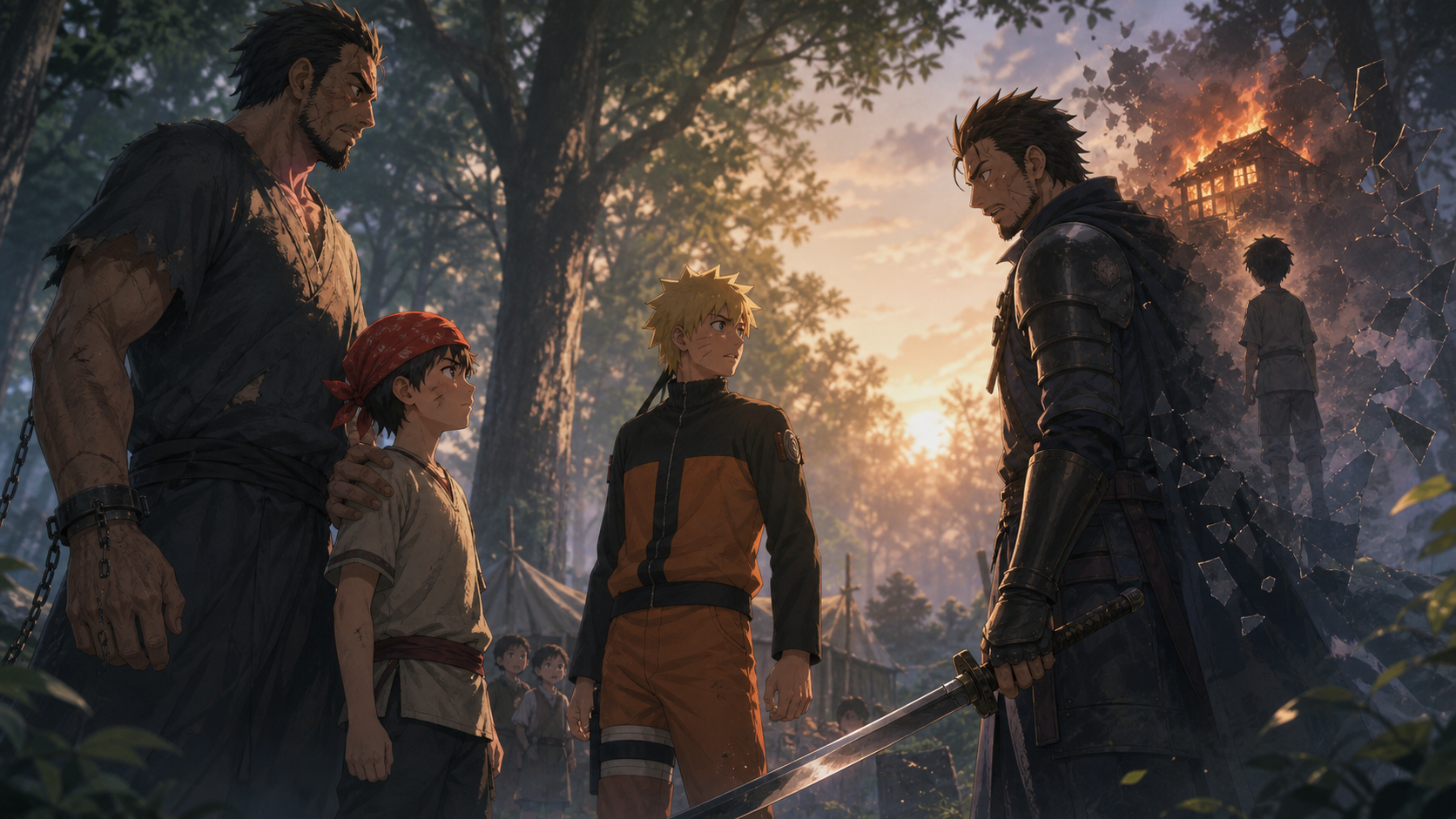
Todoroki remembers Gantetsu's face in a burning house.
He does not remember seeing his brother die.
For five years, he has treated those two facts as the same thing.
Naruto Episode 211, `Memory of Flames`, finally opens Todoroki's past and shows what revenge has done with the missing pieces. Gantetsu was there when the Shinobazu attacked. Todoroki's parents died. His little brother Akio disappeared in the fire.
Todoroki became a police officer so he could find the people responsible.
Now he has found one.
The truth is standing elsewhere in the forest with a red bandanna.
Todoroki Saw Gantetsu in the Fire
The officer's explanation about the missing body becomes foundational because it sounds medically plausible and offers no alternative. Todoroki is a traumatized survivor, not an investigator with a complete scene report. He receives an inference at the moment he is least equipped to question it and carries that inference as fact for five years.
His visual memory is real. Gantetsu was inside the fire. The mistake comes from attaching an unseen action to that presence: if Gantetsu was there and Akio vanished, then Gantetsu must have killed him. The conclusion fits the gang's conduct so well that nobody has reason to keep searching for a different one.
Episode 211 does not mock Todoroki for believing it. It shows how a truthful fragment can support a false complete story when grief supplies the missing sequence.
Naruto blocks Todoroki's attack and demands an explanation.
Todoroki gives him one.
Five years earlier, he returned to find his family home burning. He ran inside, called for his parents, and searched for Akio. Through the fire, he saw Gantetsu's face.
Authorities later recovered the bodies of Todoroki's parents. They found no trace of his little brother. An officer told him that Akio was small and the fire spread quickly, so nothing may have remained.
That is not proof of death.
It is a devastated adult trying to give a survivor an answer when the scene offers none.
Todoroki accepts it because uncertainty hurts in a different way. If Akio died, Todoroki can mourn him. If Gantetsu killed him, Todoroki can hate somebody. The conclusion turns an unbearable blank into a target.
He never stops aiming at it.
Todoroki Built a Career Around Revenge
Law enforcement gives Todoroki a socially useful direction for his pain. He trains, serves, and gains the authority to pursue criminals like the ones who destroyed his home. That career can be honorable even if revenge helped begin it.
The danger appears when institutional power becomes the delivery system for a private sentence. Todoroki does not happen to encounter Gantetsu in a street fight. He receives him through lawful custody, under a duty designed to protect evidence and procedure. His badge places the target exactly where personal vengeance can reach him.
Waiting for a court-imposed death also lets Todoroki tell himself that his desire and justice are identical. The forest removes the court from view, and the distinction immediately collapses.
Todoroki joins law enforcement and trains until he becomes the officer leading Gantetsu's escort.
He insists that he can separate duty from personal anger. During the transport, he tells himself that the capital will sentence Gantetsu to death. Waiting becomes tolerable because the system appears ready to deliver the result he wants.
Then the convoy breaks apart.
There are no other officers nearby. Gantetsu stands in front of him. The face from the fire is no longer behind bars in a guarded ship.
Todoroki decides procedure has become optional.
Naruto reminds him that their mission is still to deliver Gantetsu alive. Todoroki says it does not matter because Gantetsu killed his brother.
Grief explains the rage.
It does not authorize the sword.
Nobody Is Watching Except Naruto
The witness calculation exposes how far Todoroki has moved from avenging victims. Killing Naruto would create another grieving family and another false account of a death. He is prepared to reproduce the very secrecy and violence he believes define Gantetsu.
Naruto does not answer with a lecture about forgiveness. He plants himself between the sword and the prisoner. The immediate moral line is simpler than the whole history: Todoroki cannot kill either of them here.
That refusal matters because Naruto has no proof Gantetsu is innocent. Defending due process only when the accused appears sympathetic would not be due process. He protects the man while remaining uncertain about what the eventual truth will demand.
Todoroki repeats that nobody is watching.
Naruto points out the obvious problem.
He is watching.
That should pull Todoroki back toward reality. Instead, Todoroki begins considering Naruto part of the problem. If the witness remains silent, nobody will know. Better yet, if the witness does not remain at all, the secret becomes easier to keep.
Todoroki is prepared to kill a child assigned to assist his unit.
At this point, we are no longer discussing a good officer having one bad impulse. He is planning two murders and a false report. He says he is calm, which makes the moment worse. Rage can explode. This is calculation built on rage.
Naruto prepares to fight him.
Protecting Gantetsu now means protecting him from his captors as well as his former gang.
Monju Lets the Escort Destroy Itself
Wire Bind turns Todoroki's secret plan into a tactical defeat visible to everyone. Had the captain maintained formation and treated Naruto as an ally, Monju would have faced two alert fighters protecting the cage. Instead, both are committed to each other when the attack begins.
The trap's heat response punishes panic. Struggling raises temperature, temperature tightens the strands, and the tightening causes more desperate movement. Escape requires the same thing the escort has lacked: attention to what is actually happening instead of reacting to the first emotional command.
Monju does not care whether Todoroki's grief is justified. An enemy only needs the division it creates. Personal revenge becomes operational intelligence the moment it makes a team predictable.
Monju has excellent timing.
He waits until Naruto and Todoroki are focused on each other, then traps both in wire stronger than steel. The strands tighten as heat rises and will eventually cut them apart.
Monju takes Gantetsu without needing to defeat a functioning escort team.
The escort defeats itself for him.
This is the practical cost of Todoroki's revenge. He does not merely violate the mission's ethics. He creates the opening that lets the Shinobazu recover the prisoner.
Naruto and Todoroki end up bound together by the same wire, which feels almost too appropriate. One wants to save Gantetsu for trial. The other wants to kill him. Neither can do anything until they cooperate long enough to escape.
Nothing says workplace reconciliation like a shrinking metal net.
Sakura and Lee Meet Gantetsu's Defenders
Sakura's restraint prevents another avoidable disaster. The armed children appear hostile and occupy terrain the Leaf team does not understand. Treating every raised weapon as proof of Shinobazu membership could turn rescuers into attackers before a single question is answered.
The children's testimony adds information no official wanted notice could contain. Criminal records track Gantetsu's association with the gang and the crimes linked to it. They do not record the young survivors hidden in a forest, the shelter he maintains, or property quietly returned outside legal channels.
That does not make the children objective judges of every act Gantetsu committed. It makes them indispensable witnesses to acts Todoroki never knew existed.
Across the forest, Sakura and Lee face a group of armed children.
The children demand Gantetsu's return.
That sentence makes no sense within the story Todoroki has told. If Gantetsu is simply a murderer who burns families and steals their property, why would children living in the same forest risk their lives to defend him?
Sakura and Lee cannot solve the confusion by hitting harder. These are not trained shinobi, and the Leaf pair refuses to use full force against frightened young people.
They try talking.
The children explain that Gantetsu saved them from homes the Shinobazu attacked. He gave them shelter inside the forest and used the gang's stolen valuables to support them.
The money belonged to their families before the Shinobazu took it.
Returning stolen property is not generosity. It is restitution.
Giving orphaned children a home is something more.
Gantetsu Cannot Erase What He Helped Do
Atonement without accountability would let Gantetsu choose his own sentence by pointing to the children. Accountability without room for changed action would tell him that rescuing them never mattered. The episode refuses both shortcuts.
His use of `we` is the beginning of honest responsibility. He does not isolate Shura and Monju as the only real criminals after benefiting from the gang. He places himself inside the history and then describes the choices he made against it.
The children are not moral receipts. They are people alive because Gantetsu stopped obeying the group. Their survival matters independently of whether a court later forgives, reduces, or confirms his punishment.
The revelation does not transform Gantetsu into an innocent man.
He says the children came from homes that we, the Ninja Dropouts, attacked.
That word matters.
Gantetsu does not pretend he arrived after the violence as a spotless rescuer. He belonged to the group. He participated in its crimes. Saving children afterward cannot restore their parents or remove his responsibility.
It does show that he recognized the horror and acted against his own gang.
The moral question is not whether good deeds cancel murder on a neat scoreboard. They do not. The question is whether a guilty person can choose to stop causing harm, protect survivors, and accept that atonement may never become absolution.
Gantetsu appears to understand that difference better than the people trying to label him either monster or hero.
Sweat Beats Monju's Steel
Naruto and Todoroki struggle against Monju's wire as the strands tighten.
Heat makes the trap contract, but sweat gives them an opening. Moisture loosens the binding enough for the pair to work free.
It is not Naruto's most glamorous escape.
Nobody will carve a monument to tactical perspiration.
It works.
During the struggle, Naruto thinks about Gantetsu taking the snake bite for him. That action does not match Todoroki's claim that nothing human remains in the prisoner. Naruto decides he needs to see Gantetsu again and judge the man through what he actually does.
Todoroki also wants to see him again.
His reason remains revenge.
The two men escape the same trap without escaping the argument that put them there.
Monju Uses a Child as Leverage
Gantetsu's reaction to Akio supplies the missing action from Episode 209's burning-house opening without yet explaining every detail. When faced with a child during a Shinobazu crime, he does not behave as Monju expects. He treats the child's safety as more important than gang loyalty, stolen wealth, or his own survival.
Monju calls that behavior betrayal because the Shinobazu define loyalty through shared guilt. Returning property threatens more than their finances. It proves a member can reject the system, assist its victims, and preserve evidence of lives the gang tried to erase.
Akio's name then connects Todoroki's private loss to the community Gantetsu built. The brother remembered as ashes has been living among other children rescued from similar fires.
Sakura, Lee, and the children reach Monju and Gantetsu.
The children say they are avenging their families' deaths. Monju has no interest in their grief. He traps the group in a wire cage and threatens the boy wearing the red bandanna.
Gantetsu calls him Akio.
That name changes the episode before Todoroki even arrives.
Monju demands the treasure location. Gantetsu refuses until Akio is in danger, then agrees to talk. Protecting the boy matters more than protecting the money or his own plan.
He admits sheltering the children and returning the valuables stolen from their families. Monju calls him a traitor.
For once, the Shinobazu label is accurate and complimentary.
Gantetsu betrayed a gang that murdered families. Good.
Naruto Arrives Right on Schedule
Naruto reaches the confrontation with his usual modest announcement that Naruto Uzumaki has arrived.
He promises not to hand Gantetsu over.
That promise now carries more weight than it did on the ship. Naruto has seen Gantetsu save him, return when escape was possible, and surrender information to protect a child. He has also learned that the Shinobazu want the prisoner because Gantetsu turned their stolen wealth against them.
Naruto is still completing an escort mission.
He is also protecting the possibility that a guilty man can do something other than remain guilty in exactly the same way forever.
Then Todoroki arrives.
He sees the boy in the red bandanna.
He recognizes Akio.
Memory Was Not the Whole Truth
Episode 211 ends before Todoroki can process what he sees.
His brother is alive.
Gantetsu, the man Todoroki planned to execute, knew him by name and put himself at Monju's mercy to protect him.
This does not erase the burning house. It does not bring back Todoroki's parents or excuse Gantetsu's part in the Shinobazu.
It proves that Todoroki's memory was incomplete.
He saw Gantetsu in the flames and built five years of certainty around what he could not see afterward. Naruto kept Gantetsu alive long enough for the missing person inside that memory to step back into view.
Sometimes justice begins with refusing to let anger end the story early.
A plausible explanation hardens into an untested fact
Officials recover Todoroki’s parents but find no trace of Akio. An adult explains that a small body may have been completely consumed by the fire. In the immediate aftermath, that answer offers a shape for grief when the scene cannot provide certainty.
Todoroki carries the inference for five years without separating it from observation. He saw Gantetsu in the house. He did not see Gantetsu kill Akio or see Akio’s body. The gang’s known brutality makes the missing step feel unnecessary until the supposedly dead child stands in front of him.
Law enforcement gives grief purpose and dangerous access
Training as an officer lets Todoroki protect other families and pursue the organization that destroyed his own. Revenge can begin a career that still contains honorable service.
The danger appears when lawful custody places the face from the fire within sword range. Institutional authority becomes the delivery system for a private sentence, and Todoroki mistakes the role’s access for permission.
Killing Naruto would reproduce the crime Todoroki claims to avenge
Once the witness becomes disposable, Todoroki is willing to create another grieving community and another false account of a child’s death. The plan stops resembling justice even on his own terms.
Naruto does not need to forgive Gantetsu or disprove every accusation to hold the line. The captain cannot murder a prisoner and then murder the person who saw it. That standard is complete enough for the immediate moment.
Monju converts internal division into tactical capture
Naruto and Todoroki should be two alert fighters protecting Gantetsu. Their confrontation turns both inward, allowing Wire Bind to restrain them while Monju removes the prisoner.
The Shinobazu does not care whether Todoroki’s grief is understandable. An enemy needs only the predictable opening it creates. Personal vengeance becomes operational intelligence when it reliably breaks formation.
The wire trap punishes emotional escalation
Heat tightens the strands, tightening produces panic, and struggling raises the conditions making escape harder. The mechanism physically repeats the pattern controlling Todoroki: reaction strengthens the thing trapping him.
Sweat becomes the escape route because survival requires noticing what the system actually does. It is not glamorous, but it rewards evidence over another forceful response.
The children expand the record beyond the wanted notice
Official files can show Gantetsu’s gang membership and crimes linked to the Shinobazu. They do not contain the young survivors hidden in the forest, the shelter he maintains, or stolen property returned outside formal channels.
The children are not impartial judges of his entire past. They are indispensable witnesses to conduct Todoroki never knew existed. A complete judgment must hold both records instead of selecting the one that produces an easier label.
Restitution and rescue do not purchase innocence
Gantetsu says “we” attacked the families. He does not isolate Shura and Monju as the only criminals after benefiting from the group. Returning stolen valuables restores property to victims rather than functioning as charity.
Sheltering children is a meaningful changed action. Neither deed resurrects parents or cancels participation. Atonement matters because the survivors matter, not because they become receipts Gantetsu can exchange for acquittal.
Monju defines loyalty through shared guilt
Calling Gantetsu a traitor means he stopped protecting the criminal system, returned property, and kept victims alive. The gang needs members to believe departure cannot change anything, because a person who acts against it threatens secrecy and control.
Gantetsu’s betrayal is therefore morally correct and legally incomplete. He can oppose the gang now while still owing accountability for what happened before that opposition began.
Akio is the missing person inside Todoroki’s memory
The red bandanna does not erase the fire. It proves the conclusion attached to the absent body was wrong. Gantetsu knows Akio by name and yields information when Monju threatens him, connecting protection to the child Todoroki believed he murdered.
Naruto’s insistence on keeping Gantetsu alive creates the only condition under which that contradiction can appear. An execution beside the river would have preserved revenge by destroying the evidence capable of changing it.
RaeRae’s full take
Episode 211 does not tell Todoroki that his memory was fake. It tells him the memory was true and the conclusion was larger than what he saw. That is harder, because he cannot dismiss five years as a simple illusion. He has to admit real grief built certainty from an empty space.
Gantetsu also does not get a clean redemption stamp because children love him. He participated in the Shinobazu, then chose to protect survivors and return what the gang stole. Both parts belong in the judgment.
Akio’s appearance is why Naruto’s refusal matters. Due process sounded abstract on the ship. In the forest, it has a face, a red bandanna, and five stolen years. Keeping the prisoner alive did not guarantee innocence. It kept the truth alive long enough to walk into the clearing.
RaeRae checkpoint: Todoroki remembered a real face in a real fire. Justice still required him to leave room for the part of the scene he never saw.
Receipts and official routes
- Episode number, licensed title, Todoroki’s family history, Monju’s capture, the rescued children, and Akio’s reveal: Naruto Official Site.
- Japanese title, November 30, 2006 broadcast record, and TV Tokyo episode synopsis: TV Tokyo.