
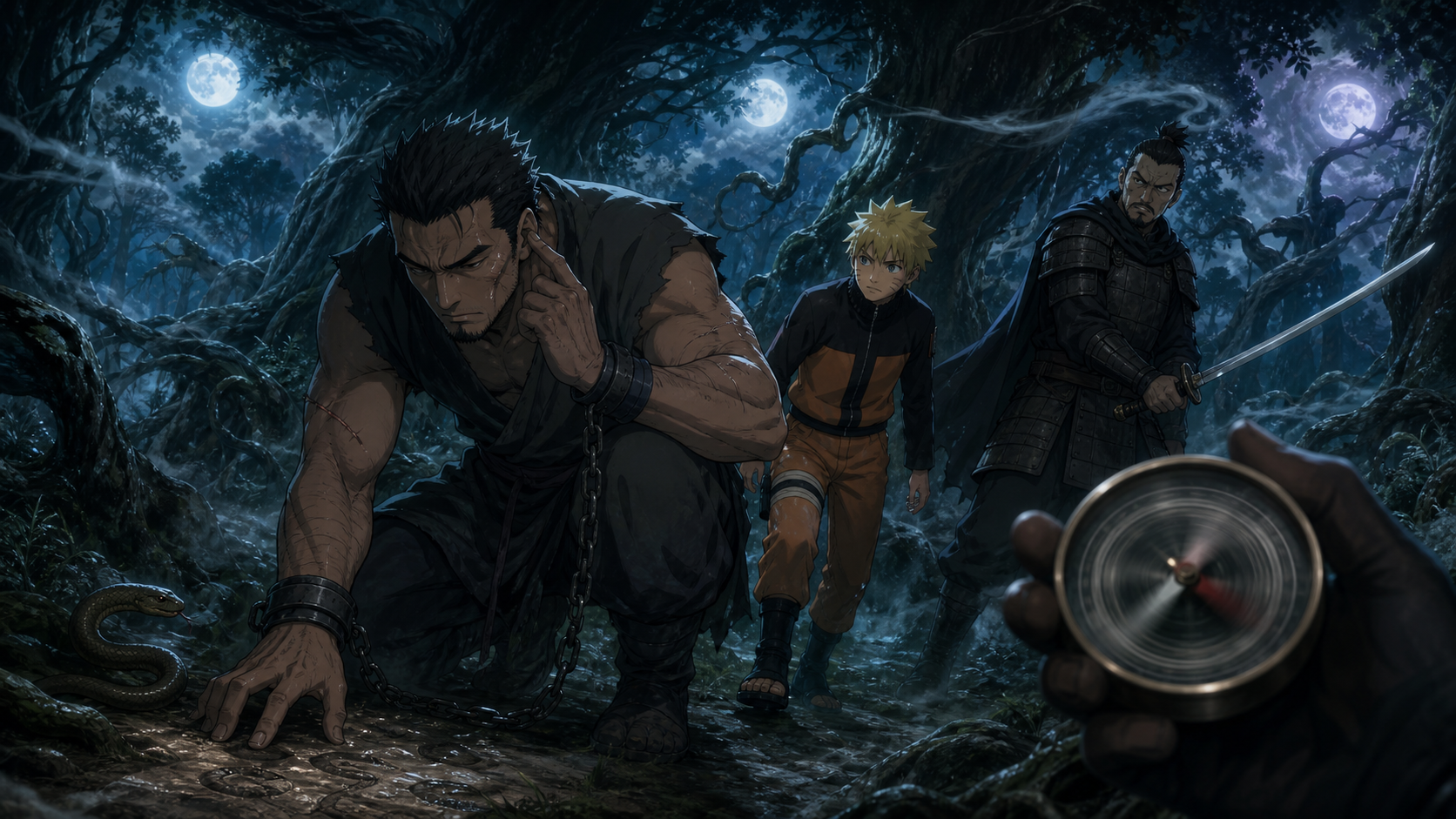
The Bewildering Forest
Lost inside a forest that defeats the moon, wind and compass, Naruto must depend on chained prisoner Gantetsu while Captain Todoroki turns revenge into an ambush.
The forest cannot be trusted.
The prisoner might be lying.
The escort captain is definitely planning a murder.
Naruto Episode 210, `The Bewildering Forest`, takes the broken convoy into woods designed to ruin every normal sense of direction. The moon lies. The wind changes. A compass becomes decoration.
The only man who knows the route is Gantetsu.
Yes, the prisoner.
No, Captain Todoroki is not handling that well.
Shura Brings an Umbrella to a Ninja Fight
Blood Rain is effective because Shura uses the ship's condition against Naruto. Shadow clones normally give Naruto room to absorb an opening attack and discover its pattern. A wide needle storm clears the copies at once, injures Todoroki, and leaves no stable deck on which to regroup.
Shura does not need to defeat the entire detail. He only needs the river and the damaged vessel to finish separating them. The waterfall converts one attack into isolation, loss of transport, and broken communication. By the time the survivors reach land, the Shinobazu have already dictated the shape of the next fight.
That makes Todoroki's fixation even more dangerous. The enemy has divided his force exactly as planned, yet he spends the first quiet moment debating whether to complete their work by killing the person they came to recover.
Episode 209 ended with Shura arriving to reclaim Gantetsu. The fight begins immediately.
Naruto sends shadow clones across the remains of the ship. Shura opens an umbrella and launches Blood Rain, a storm of needles that tears through the clones and wounds Todoroki.
Shura proudly says his technique is not ninjutsu. It is killer jutsu.
That sounds like the sort of branding decision a criminal gang makes after one meeting and several dramatic poses.
The attack still works. The damaged ship section rushes toward a waterfall, and the escort loses any chance of controlling the battlefield. Naruto, Todoroki, and Gantetsu survive the fall. Sakura, Lee, and the other guards remain somewhere behind them.
The prisoner transfer now has no boat, no full team, and no clear route.
It does have two people arguing about whether to kill the prisoner.
Todoroki Calls Murder a Worst-Case Plan
His argument depends on three assumptions presented as certainty: the gang will recapture Gantetsu, the court will impose death, and immediate killing will protect everyone else. None has happened. Todoroki uses a chain of possible outcomes to justify the one outcome he personally wants.
The logic also misunderstands the transfer. Gantetsu is not being moved only so a sentence can be announced. Authorities need information about the Shinobazu, their victims, their hideout, and the stolen property. A dead prisoner cannot answer any of those questions. Todoroki's shortcut would make the remaining gang safer.
Naruto keeps the mission narrow. Protect the prisoner now. Reach the capital. Let evidence and lawful authority decide what follows. He does not need to solve the whole justice system beside a waterfall to know Todoroki's blade is not it.
Todoroki wants to continue delivering Gantetsu to the capital because that is his mission.
Then the Shinobazu pursue them.
Todoroki changes his answer.
If the gang will take Gantetsu anyway, he argues, they should kill him first. The capital will probably sentence him to death, so Todoroki frames immediate execution as a practical adjustment to the schedule.
Naruto refuses.
Gantetsu has not been tried. The Shinobazu have not captured him. A feared outcome does not give Todoroki permission to create it himself.
Naruto also reminds the captain that guarding Gantetsu is his mission. Todoroki cannot quietly redefine the assignment while a Leaf shinobi stands beside him.
The captain calls his suggestion a worst-case measure.
I call it revenge wearing a mission vest.
The Moon Starts Following Naruto
The forest attacks confidence before it attacks the body. Todoroki chooses the moon because celestial direction should sit beyond local manipulation. When that reference appears to move with them, the group loses more than a route. It loses the belief that careful observation can correct the problem.
Fog blocks distance. Conflicting winds defeat environmental reading. Magnetic interference ruins tools. Each fallback fails for a different reason, which prevents the travelers from checking one method against another. The woods produce agreement among bad indicators.
Gantetsu's knowledge becomes valuable because it is procedural rather than sensory. He does not need the forest to behave normally. He knows how its abnormal patterns work and where the Shinobazu built within them.
Returning to the river would lead the pursuers straight to them, so Todoroki chooses a route through the forest toward the capital.
He plans to navigate by the moon.
For a while, that sounds reasonable. Then Naruto notices the moon seems to be following them no matter which direction they walk.
The forest has defeated astronomy.
Gantetsu finally speaks. He identifies the Forest of Bewilderment, a place where dense fog, winds from conflicting directions, and magnetic conditions ruin a person's sense of direction. Once somebody becomes lost, normal navigation will not lead them out.
The Shinobazu built their hideout here for exactly that reason.
Todoroki has unknowingly marched his prisoner through enemy territory.
Gantetsu knows the way.
This is not welcome news.
The Prisoner Becomes the Guide
Naruto's choice is controlled dependence, not blind faith. Gantetsu remains watched, wounded, and outnumbered. Accepting his directions does not require accepting his account of every past crime. It simply assigns weight to the only information capable of moving the group before Shura catches up.
The stolen-loot explanation gives Gantetsu a motive that runs against both sides. The guards want him delivered. The gang wants the cache and then his silence. Gantetsu wants to survive people who know the terrain better than his escorts. Cooperation aligns those immediate interests without resolving whether he deserves punishment later.
Todoroki cannot tolerate that limited arrangement because hatred demands a total category. If Gantetsu can provide useful truth or fear former comrades, then the monster in Todoroki's memory has a present-tense human life. Complexity feels like betrayal when revenge depends on certainty.
Gantetsu offers to lead them through the forest.
Todoroki sees an obvious trap. A former Shinobazu member has every reason to guide the escort toward his comrades, and the captain already believes Gantetsu murdered his family.
The suspicion makes sense.
Gantetsu answers by showing the scars on his body and explaining why the gang attacked the convoy. He hid the money and valuables the Shinobazu had stolen. His former comrades do not want to rescue him. They want the location of the treasure, after which they intend to kill him.
That confession does not make Gantetsu innocent. He admits participating in the thefts before taking the loot from the gang. It does, however, explain why Shura needs him alive and why Gantetsu cannot expect a warm reunion.
Naruto looks at the tactical problem.
The pursuing Shinobazu know the forest. Naruto and Todoroki do not. Refusing Gantetsu's help will not make him less suspicious. It will only leave all three lost until the enemy finds them.
Naruto accepts the guide with his eyes open.
Trust does not always mean believing somebody is good. Sometimes it means recognizing that cooperation is the only plan with a pulse.
Gantetsu Takes the Snake Bite
His claimed venom tolerance is not an invitation to treat the bite as harmless. Gantetsu chooses a known danger for himself rather than letting Naruto meet an unknown one. The scars already covering his body make the choice credible: survival around the Shinobazu and their forest has trained him through repeated injury.
Naruto notices actions because actions are the evidence available now. Gantetsu has not offered a persuasive speech or asked for a reduced sentence. He prevents harm when allowing it would improve his chance of escape. That is not proof of innocence, but it is evidence against Todoroki's belief that cruelty defines every decision the man makes.
The scene also reverses the expected escort relationship. The restrained prisoner protects the armed shinobi. Custody may define their legal roles, but it does not determine who behaves responsibly in a given moment.
Naruto follows Gantetsu but keeps questioning whether the prisoner knows where he is going.
Then Gantetsu stops him from stepping on a snake.
The snake strikes anyway. Gantetsu takes the bite on his own arm and says the venom does not affect him because he is used to it.
Naruto would not have been so comfortable testing his own resistance.
This moment is small, but it changes the evidence. Gantetsu had no reason to absorb the bite if he wanted Naruto weakened or dead. He could have kept walking, allowed the forest to solve his guard problem, and blamed the environment.
Instead, he protects Naruto.
One decent action cannot erase a criminal history. It can force Todoroki to admit that the man in front of him does not perfectly match the monster preserved in his memory.
Todoroki does not admit anything.
He grips the memory harder.
Toki Has a Drill Arm Because Subtlety Left Town
The trio reaches a massive tree and drops into a pit.
Toki, another Shinobazu member, waits above them with a mechanical drilling arm. The gang has trapped the route Gantetsu chose, which seems to confirm Todoroki's suspicion for about five seconds.
Naruto has already replaced the group with a combination of shadow clones and transformation.
Toki falls for the countertrap.
Naruto forms a Rasengan, but Toki escapes into a network of underground passages. His drill lets him attack through earth, retreat into tunnels, and threaten to collapse the ground around Naruto.
This is the correct tool for someone whose entire strategy is becoming an angry mole.
The fight separates Naruto from Todoroki and Gantetsu. Todoroki sees the prisoner run and assumes Gantetsu has taken his chance to escape.
He has not.
Gantetsu Comes Back
Returning is stronger evidence than the snake bite because the exit is already open. Toki's tunnel attack distracts Todoroki and Naruto, and the forest makes pursuit difficult. Gantetsu could disappear with a reasonable chance of success.
Instead, he uses knowledge Todoroki interprets as escape behavior to locate Naruto. Pressing his ear to the earth and moving down the slope look suspicious from a distance because Todoroki has decided every ambiguous action must confirm guilt. The rescue reveals how badly that filter distorts what he sees.
Naruto's Rasengan ends the immediate attack, but Gantetsu creates the opportunity. The prisoner does not become heroic enough to erase his record. He becomes demonstrably unwilling to leave a child buried when freedom is available at the price of doing nothing.
Gantetsu presses an ear to the ground, tracks the movement below, and descends the slope toward Naruto.
Toki corners the genin in a tunnel.
Gantetsu opens a route behind Naruto and throws him clear. Naruto uses a shadow clone to set up another Rasengan. The strike collapses the passage and buries Toki under the rock he intended to use against Naruto.
Naruto thanks Gantetsu.
The prisoner has now done more than provide directions. He returned when escape was available and put himself in danger to save the person guarding him.
That does not answer what happened to Todoroki's family. It does establish that Gantetsu's present actions deserve attention.
Naruto judges the man in motion, not only the file attached to his cage.
Sakura and Lee Find the Forest Residents
Sakura and Lee continue searching from the other side of the split.
A young person attacks them from the trees and draws them deeper into the woods. Soon the pair faces several armed young residents who move like people defending their territory.
Sakura wants answers. Lee recognizes that the group seems ready to fight.
The episode does not explain who they are or why they care about this mission. It simply places another contradiction in front of us. The Shinobazu use the forest as a criminal hideout, but these young residents do not look like members of Shura's gang.
Something else has been living inside the maze.
That answer belongs to the next episode.
Todoroki Becomes the Ambush
After Gantetsu saves Naruto, Todoroki makes his choice.
He charges with his sword.
Naruto pushes him aside, but the blade cuts Gantetsu's arm. Todoroki finally says the truth without disguising it as mission procedure. Gantetsu slaughtered his family, including his younger brother. Todoroki intends to avenge them.
His private thoughts go further. Naruto has seen too much. Todoroki is prepared to kill the genin so no witness can report what happened.
That crosses the final line.
Todoroki's grief deserves compassion. His plan deserves none. He is willing to murder a prisoner in his custody and a child assigned to help him, then hide both deaths behind the chaos of an enemy attack.
The forest does not make Todoroki lose his direction.
He chooses to throw it away.
The Most Reliable Man Is Still in Chains
By the end of Episode 210, every role has flipped.
The captain abandons the law.
The prisoner saves his guard.
Naruto becomes the only person still performing the escort mission as assigned.
Gantetsu has not earned forgiveness. The episode has not even revealed the full accusation against him. What he has earned is the right to reach the next minute alive and answer for himself.
Naruto understands that justice cannot survive if the angriest person at the scene gets to define it.
The Forest of Bewilderment confuses direction through fog, wind, and magnetism.
Todoroki brings his own fog.
Shura lets the river complete the separation
Blood Rain clears Naruto’s clones, wounds Todoroki, and destabilizes a ship already cut apart. Shura does not need to defeat every guard on the deck. The current and waterfall turn one attack into lost transport, broken communication, and a smaller group.
That efficiency exposes Todoroki’s fixation. The enemy has successfully divided the escort, yet he uses the first quiet moment to propose killing the person the gang came to recover. Revenge narrows his attention more effectively than the forest will.
“Worst-case measure” disguises a preferred outcome
Todoroki claims recapture is inevitable, a court will probably impose death, and immediate execution protects the mission. Every link is an assumption. He selects the conclusion he already wants and describes it as planning.
A live transfer exists for more than sentencing. Gantetsu may identify a hideout, stolen property, members, and crimes whose evidence the gang burned. Killing him could make the Shinobazu safer while satisfying the captain for one moment.
The forest defeats cross-checking by breaking every reference differently
Fog removes distance, conflicting winds undermine environmental direction, magnetic interference ruins the compass, and the moon appears to move. Each failed method would normally be checked against another, but the woods make every comparison unreliable.
Gantetsu’s advantage is procedural knowledge. He does not expect the forest to behave normally; he knows how the abnormal pattern is navigated and where the gang built its routes inside it.
Trusting the guide is controlled dependence
Naruto does not remove Gantetsu’s restraints, accept every claim, or declare him innocent. He recognizes that refusing the only usable guide leaves all three men lost until pursuers who know the terrain arrive.
Immediate interests align without settling the moral record. The guards need movement. Gantetsu needs survival from former comrades seeking the stolen loot and his silence. Cooperation can be rational before trust becomes complete.
Todoroki needs guilt to remain a total category
If Gantetsu can fear the gang, provide accurate directions, or protect Naruto, then the man in front of Todoroki contains more than the figure preserved in a burning-home memory. Complexity feels like betrayal because revenge depends on a person remaining nothing but the crime attached to him.
Recognizing decent present behavior does not erase past wrongdoing. It prevents the past accusation from dictating the interpretation of every new action before the evidence arrives.
The snake bite is evidence, not absolution
Gantetsu absorbs a danger he could have allowed Naruto to meet. The choice works against escape and against any plan to weaken his guard. It therefore deserves evidentiary weight.
One protective act cannot answer what happened to Todoroki’s family. It can disprove the claim that cruelty controls every decision Gantetsu makes. Naruto reads the action at its proper size instead of turning it into instant forgiveness.
Returning for Naruto is the stronger test
Toki’s underground attack gives Gantetsu a plausible chance to disappear into terrain that defeats pursuit. Instead, he listens through the earth, locates Naruto, and opens an escape route.
Todoroki sees the first movement and calls it flight because suspicion has already decided the conclusion. The completed act shows how his filter converts ambiguous behavior into guilt even when the prisoner is moving toward rescue.
Toki’s drill turns the ground into an ambush network
The mechanical arm is ridiculous to look at and tactically suited to the forest. Toki can attack through earth, retreat through prepared passages, and threaten collapse without offering a stable target.
Naruto’s Rasengan ends the immediate attack, but Gantetsu creates the opening. The prisoner and guard roles reverse again: the restrained man makes survival possible for the armed shinobi assigned to control him.
Todoroki crosses from unlawful revenge into witness elimination
Attacking Gantetsu after the rescue rejects present evidence. Deciding Naruto must also die so nobody reports the execution abandons every defensible connection between grief and justice.
The captain is no longer losing control for one instant. He is planning a second murder to conceal the first. The forest’s confusion cannot excuse a direction he consciously chooses.
RaeRae’s full take
Episode 210 makes the prisoner the only reliable navigator and the captain the person nobody can safely follow. That reversal works because Gantetsu does not earn sainthood. He earns the next minute through specific actions: guidance, a snake bite, and a return when escape was available.
Naruto keeps the standard beautifully narrow. Gantetsu may still face trial. Todoroki may still deserve compassion for the family he lost. Neither fact authorizes a sword beside a waterfall, and neither permits killing the kid who saw it.
The Forest of Bewilderment lies through moon, wind, fog, and magnetism. Todoroki’s private certainty is worse because it keeps interpreting every correction as betrayal. Gantetsu knows how to leave the woods. Naruto now has to stop the captain from abandoning justice inside them.
RaeRae checkpoint: Trusting Gantetsu as a guide does not acquit him. It means evidence from what he does now is allowed to exist beside the accusation Todoroki refuses to examine.
Receipts and official routes
- Episode number, licensed title, separated escort, Forest of Bewilderment, Gantetsu’s guidance, and Todoroki’s attack: Naruto Official Site.
- Japanese title, November 16, 2006 broadcast record, and TV Tokyo episode synopsis: TV Tokyo.