
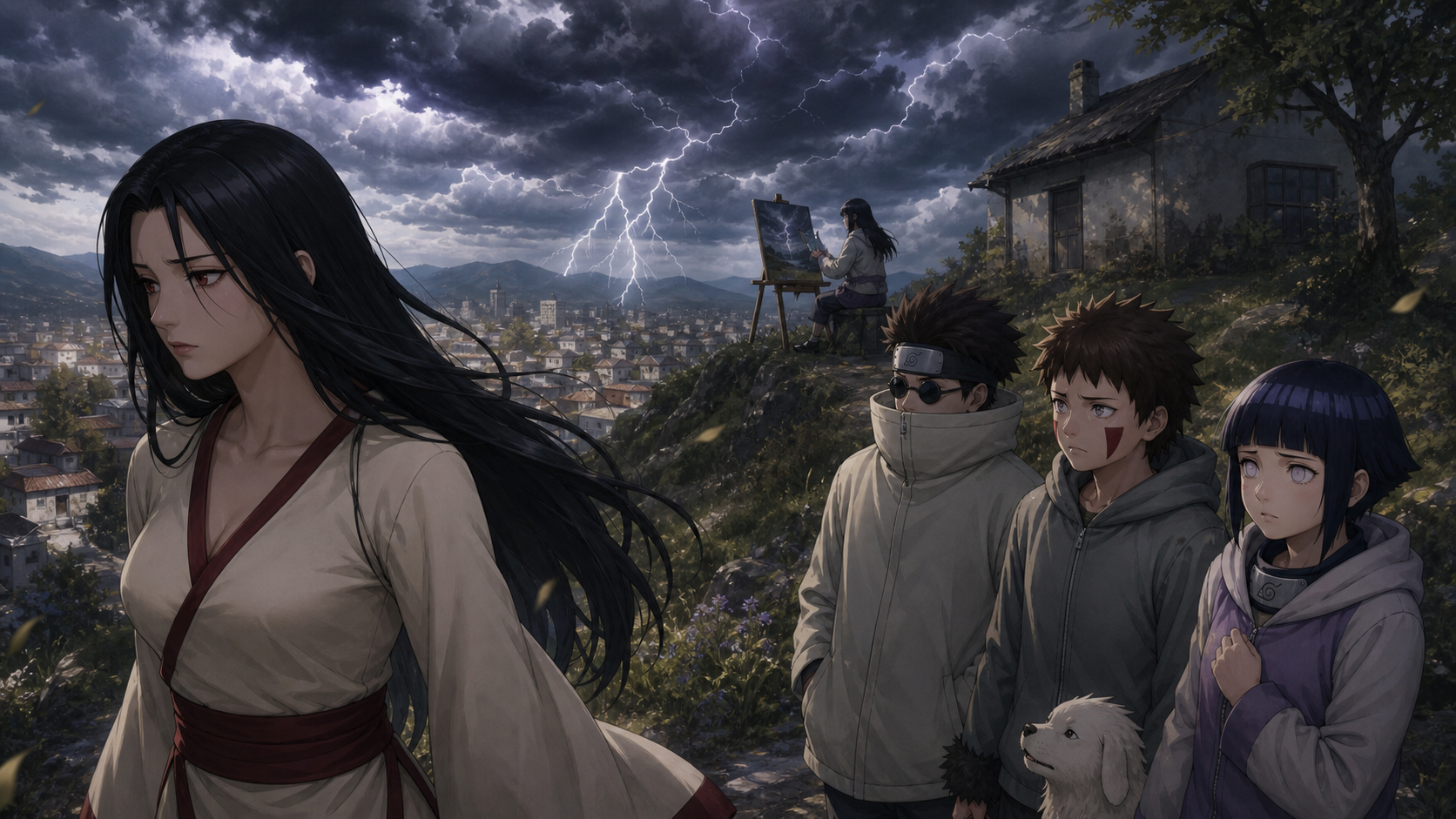
Kurenai’s Decision: Squad 8 Left Behind
Kurenai resigns from Team 8 while a confined young artist named Yakumo paints a storm into reality, linking the teacher’s guilt to a classified genjutsu case.
Kurenai tells Team 8 that they were only coworkers.
Nobody believes her.
Kiba gets angry. Hinata searches for the reason behind the words. Shino recognizes that storming Tsunade's office will not reverse a choice Kurenai made herself. Naruto, who is not even on this team, promises to fix it anyway.
That is the emotional setup for Naruto Episode 203, `Kurenai's Decision: Squad 8 Left Behind`.
The actual danger begins with a paintbrush.
Episode 203 Facts
Episode: 203 of the original Naruto anime
Licensed title: Kurenai's Decision: Squad 8 Left Behind
Japanese title: 紅の決断 とり残された第8班 (Kurenai no Ketsudan, Torinokosareta Daihappan)
Japanese broadcast: October 5, 2006
Arc: Yakumo Kurama Rescue Mission
Classification: Anime-original filler
“Squad 8” and “Team 8” refer to Kurenai's team with Kiba, Shino, and Hinata. Kurenai requests withdrawal; Tsunade does not order her resignation. Episode 203 deliberately withholds the complete nature of the Third Hokage's assignment, Yakumo's sealed power, and the truth surrounding her parents' deaths.
The episode ends with Naruto leaving to confront Kurenai after experiencing pain from a painted wound. Episode 204 supplies the next layer of Yakumo's history and should not be pulled backward.
Yakumo Paints a Storm Into a Clear Sky
Naruto is attempting to train alone while complaining about Jiraiya's latest disappearance when he notices a girl painting near a mountain cottage.
Her canvas shows Konoha beneath dark clouds.
The real sky is clear.
Then the clouds arrive.
Lightning strikes the Hokage's building and starts a fire. Konoha shinobi attack it with Water Style, miss the roof badly enough to soak Tsunade, apologize, and finally point the water where it belongs.
The comedy does not soften Tsunade's reaction. She recognizes the strike as the event she feared.
ANBU and medical personnel collect the girl before Naruto can learn anything. They order him away and tell him not to repeat what he saw. Her name is Yakumo Kurama, and Konoha has placed her under round-the-clock watch at the Satomi Hill cottage.
The security detail consists of two medical ninja and one ANBU member. That combination reveals the village's uncertainty. Yakumo is treated as a patient who needs monitoring and a threat who needs containment. Neither role gives her meaningful control over her own confinement.
Silence protects classified information, but it also ensures that Naruto interprets every restriction as proof adults are hiding an injustice. The guards know what the paintings can do and still offer him no safe explanation. He responds exactly as anyone familiar with Naruto should predict.
Naruto has now seen a girl paint impossible weather moments before the weather becomes real.
Naturally, the adults decide the best explanation is none.
Kurenai Resigns Without Telling the Truth
At the same time, Kurenai asks Tsunade to remove her as Team 8's jonin leader.
Tsunade pushes back. Kurenai chose Kiba, Shino, and Hinata for the Chunin Exams when they were still inexperienced. She watched them become capable shinobi. Walking away now is not a minor staffing adjustment.
Kurenai says an old problem remains unresolved. She considers it her responsibility.
Tsunade tells her directly that the earlier incident was not her fault.
Kurenai does not accept that mercy.
She tells Team 8 that her duty is complete and that another jonin will eventually replace her. Their relationship, she claims, was only commander and subordinate. Circumstances change, team formations change, and that is all.
It is a brutal speech because every person hearing it knows better.
Kiba reacts with fury and wants to march into the Hokage's office. Shino calls that futile, correctly reasoning that Kurenai may have chosen to leave. Hinata wants her teacher to remain but understands that a decision this sudden must have a hidden cause.
None of them shrugs and moves on.
Kurenai's attempt to erase the relationship proves how real it became.
Her wording also abuses the authority she claims is ending. Kiba, Shino, and Hinata cannot argue as equals because Kurenai delivers the rejection as their commander. She uses professional hierarchy to declare that the emotional history they experienced was merely a job.
Each student answers according to established character. Kiba externalizes the injury and wants confrontation. Shino analyzes whether protest can change a voluntary decision. Hinata looks for the pain behind the statement. Their different responses show the team Kurenai helped form, even while she denies forming it.
Naruto Volunteers for Someone Else's Family Problem
Naruto finds the team fighting and immediately appoints himself chief resignation preventer.
Kiba points out the obvious problem.
Naruto is not a member of Team 8.
That has never stopped him from entering a personal crisis at full speed.
He confronts Kurenai and tells her that her students revere her. Kurenai refuses to return. She says she does not deserve to lead them and asks Naruto to deliver a final message: she is never coming back.
Naruto considers going over her head to Tsunade. His negotiation strategy involves threatening to reveal the Hokage's hidden alcohol supply to Shizune. It is blackmail built from household gossip, which sounds ridiculous until you remember how seriously Tsunade guards both the bottle and her authority.
Sakura stops him from assuming that Tsunade is the problem. She has overheard enough of the private conversation to know Kurenai has a reason.
Naruto's urge to fix the resignation is generous and invasive at once. Team 8 wants Kurenai back, but none of them appoints him to reveal her classified history. He converts their hurt into permission because unexplained separation resembles every bond he is already desperate to prevent.
Sakura provides the first restraint by separating “Kurenai is wrong” from “Kurenai has no reason.” Knowing a reason exists does not make the speech to Team 8 fair. It does mean Naruto cannot solve the problem by winning an argument with Tsunade.
That reason has a name.
Yakumo.
The Kurama Clan Put Its Future on One Sick Child
A flashback reveals how Kurenai became involved.
The Third Hokage selected her because she was Konoha's finest genjutsu practitioner. He introduced Yakumo as the only daughter of Murakumo Kurama, head of the Kurama clan's main family.
The Kurama clan once stood beside the Uchiha in genjutsu reputation. Recent generations had not produced jonin-class talent, and the clan's power had faded.
Then Yakumo was born with exceptional latent ability.
Her relatives placed their dream of restoring the family on her shoulders.
The clan treats extraordinary talent as communal property before Yakumo can decide what she wants from it. Her illness makes that pressure sharper, not smaller. Every limitation threatens the family's hoped-for revival, so health becomes evidence that she is failing a role assigned at birth.
Yakumo's Rock Lee comparison is emotionally sound but medically incomplete. Lee proves that a closed route does not erase the entire dream. He does not prove every body can tolerate every training method. A responsible teacher would need to distinguish adaptation from denial rather than answer with a flat yes or no.
Her body could not carry the same weight. Yakumo suffered serious health problems and could not attend the Academy. Her parents had died, leaving a physically fragile child to inherit a clan's disappointment and ambition at once.
Yakumo still wanted to become a ninja.
She pointed to Rock Lee. If he could pursue shinobi life without ninjutsu or genjutsu, she reasoned, then weak stamina should not erase the path open through her talent. She wanted to become a genjutsu specialist like Kurenai.
Kurenai told her she could not train her.
That refusal lands as rejection because the true assignment remains classified. Yakumo sees Konoha's best genjutsu teacher, the one adult chosen specifically for her, deny the only path she believes can make her life her own. Kurenai knows more than she can say and mistakes silence for protection.
Episode 203 stops before explaining the full order from the Third Hokage. That missing instruction matters. Kurenai was chosen for Yakumo, but not simply to turn a gifted child into a stronger weapon.
Guy Refuses Kurenai's Self-Punishment
Guy finds Kurenai after training Lee.
He confirms that Team 8 has grown, though he cannot resist adding that they still do not match his own pupils. Kurenai dismisses the compliment. Their progress, she says, came from their effort rather than her help.
Guy agrees with half of that.
Lee earned his improvement. Guy cannot perform a pupil's work for him. What a teacher can do is believe, embrace, and remain present with everything they have.
Kurenai says she could not manage something so simple.
Guy tells her to believe in herself.
It is one of his quieter appearances, and one of his better ones. The speech contains no miracle cure and no claim that encouragement fixes every body or every trauma. It only rejects Kurenai's convenient conclusion that a student's effort leaves the teacher irrelevant.
Kurenai is not resigning because Team 8 failed.
She is resigning because she has made Yakumo's pain the final verdict on herself.
Guy's distinction between labor and belief prevents teachers from claiming ownership of student achievement. Lee performs the push-ups, takes the risks, and builds the technique. Guy's contribution is not the result itself. It is the sustained relationship that lets Lee imagine effort has somewhere to go.
Kurenai uses the same truth to erase herself. If Team 8 did the work, she concludes she provided nothing. Guy refuses that false humility because belief, advocacy, correction, and presence are still actions even when the student retains full credit.
Naruto Borrows Kurenai's Face and Misses the Point
Sakura's information gives Naruto a location.
He reaches the Satomi Hill cottage, triggers its eastern security trap, and uses Transformation Jutsu to impersonate Kurenai. The guards accept the disguise and give the apparent jonin ten minutes alone with Yakumo.
Naruto searches instead of speaking to her.
The cottage is filled with disturbing paintings. One shows Kurenai pierced through the chest.
Naruto suddenly feels the same wound.
His chest burns with pain. He panics, checks his body, and finds no injury. The painting has made an imagined event register as physical reality.
That is the first clear demonstration of what makes Yakumo dangerous.
Her art does not predict trouble in the vague way adults use when they want to sound mysterious. The storm on her canvas arrives over Konoha. The wound she paints reaches Naruto's nervous system. Genjutsu is normally an attack on perception, but Yakumo's perception can push back against the world with frightening force.
The security team catches Naruto, exposes the transformation, tranquilizes him, and sends him home alive. Their irritation is justified. He entered a protected site, impersonated the person connected to Yakumo's trauma, and wandered through material he did not understand.
The breach is also a security failure. A transformation and one triggered perimeter trap allow a genin to enter the room of a person guarded around the clock. The staff recognizes Kurenai's appearance but does not verify identity despite Yakumo's case depending on genjutsu and altered perception.
Naruto's intentions do not excuse impersonating Kurenai before Yakumo. If Yakumo had entered expecting her former teacher, the reveal could have deepened the exact abandonment injury driving the paintings. He gets useful evidence through a method that could easily worsen the patient.
Naruto wakes beside Sakura and immediately runs off to confront Kurenai.
Subtlety remains unavailable.
Kurenai Is Trying to Disappear Before She Hurts Anyone Else
Episode 203 builds its mystery from two forms of concealment.
Konoha hides Yakumo behind ANBU guards and classified silence. Kurenai hides her love for Team 8 behind a cold description of rank and duty.
Both choices come from fear.
Containment and resignation share the same logic: remove relationships until danger becomes manageable. Yakumo loses ordinary contact because her power frightens the village. Team 8 loses Kurenai because her guilt frightens Kurenai. Neither policy asks the people being “protected” what isolation costs them.
The village fears what Yakumo can do. Kurenai fears that staying close to students will repeat whatever happened under the Third Hokage's assignment.
Her resignation looks responsible from inside that fear. If she is the common element, remove her. If attachment creates another chance to fail, deny the attachment. If Team 8 hates her, perhaps they will accept the replacement and remain safe.
The plan fails before she leaves the room.
Kiba's anger, Hinata's concern, and Shino's careful reading all expose the same truth. Team 8 does not need Kurenai to pretend the bond never existed. They need her to trust them with an honest explanation.
Naruto Episode 203 does not give them that explanation yet.
It gives us a painted storm, a wound without a wound, and a teacher trying to punish herself out of three students' lives.
Kurenai turns professional language into an emotional weapon
Calling Team 8 “commander and subordinates” sounds formally correct and personally false. Kurenai uses rank to announce that the shared history her students experienced never exceeded an assignment. They cannot debate her as equals because she delivers the erasure from the same position of authority she claims to be surrendering.
The speech is meant to make separation easier. It does the opposite. Kiba, Shino, and Hinata know enough about their teacher to recognize that cruelty this sudden is manufactured. Denying the bond becomes evidence that Kurenai is frightened by how much it matters.
Each Team 8 response reflects the team Kurenai built
Kiba externalizes the injury and wants confrontation. Shino separates Tsunade’s authority from Kurenai’s voluntary decision and asks whether protest can change the source. Hinata searches for the pain behind words she does not believe.
Those are not interchangeable reactions added to fill a scene. They show three observation styles Kurenai helped develop. Even while she claims she contributed nothing, her students respond as a coordinated set of distinct thinkers rather than one wounded chorus.
Self-blame gives Kurenai the illusion of control
Tsunade tells her the earlier incident was not her fault. Guy tells her that student effort does not make a teacher’s belief irrelevant. Kurenai rejects both because guilt offers a simple rule: if she is the dangerous constant, removing herself prevents repetition.
That rule avoids the harder work of distinguishing responsibility from omnipotence. A teacher can make mistakes, obey harmful orders, fail to prevent tragedy, and still not control every force surrounding a student. Resignation punishes Kurenai while transferring the cost to Team 8, which never agreed that losing her would repair Yakumo.
Yakumo is treated as patient and threat but rarely as participant
Medical ninja monitor her body. ANBU guards contain her ability. The cottage isolates her from ordinary contact. Those roles tell us what Konoha fears and what it wants to preserve, but neither gives Yakumo meaningful control over the decisions structuring her life.
Secrecy may prevent public panic and hostile exploitation. It also ensures every restriction arrives without an explanation she can test. A talented, grieving child experiences protection as imprisonment because adults keep the purpose classified and expect trust to survive on command.
The Kurama clan makes one child carry institutional decline
Yakumo’s rare power becomes family property before she can define what being a ninja means to her. The clan’s fading reputation turns her talent into a restoration project. Her illness then reads as an obstacle to communal ambition instead of a medical reality requiring adaptation.
Comparing herself with Lee gives Yakumo hope, but the comparison cannot answer what training her body can survive. Lee proves that conventional limits do not settle every future. He does not prove that determination makes every harmful regimen responsible.
Guy rejects Kurenai’s false humility
He agrees that students perform their own labor. Lee completes the repetitions, faces pain, and builds skill. That truth does not make belief, correction, advocacy, or presence meaningless. A teacher can respect student ownership without pretending the relationship contributed nothing.
Kurenai uses humility as self-erasure because acknowledging her importance would make departure harder. Guy refuses to let her hide inside praise for Team 8’s effort. Their growth belongs to them, and her care remains part of the environment that let growth happen.
Naruto’s intervention is generous and invasive
He sees abandoned teammates and immediately recognizes a bond in danger. That empathy is real. He also assumes their pain authorizes him to uncover a classified case, impersonate Kurenai, and enter Yakumo’s protected room without understanding what the disguise could do to her.
Intent does not remove impact. If Yakumo believed Kurenai returned and then saw Naruto’s transformation fail, the intrusion could deepen the exact rejection driving her distress. Naruto obtains useful evidence through a method that treats Yakumo as a clue rather than a person entitled to control contact.
The cottage security fails the threat model it exists to manage
A perimeter trap and visual recognition allow a transformed genin to reach Yakumo alone. This is a case defined by genjutsu, perception, and images capable of altering experienced reality. Accepting Kurenai’s face without a second verification method is astonishing.
Good containment should verify identity through something the protected person’s power cannot easily fabricate, define access logs, and require paired supervision. The guards are right to remove Naruto. They also need to explain how he reached the room they were assigned to secure.
Yakumo’s paintings collapse the boundary between perception and harm
The storm canvas precedes real weather over Konoha. The painted chest wound causes Naruto genuine pain without physical penetration. Her ability makes “only an illusion” useless as reassurance because a body responds to what the mind experiences.
That power explains the village’s fear while making careless isolation more dangerous. A person whose perception can push against reality needs stable communication, consent-aware care, and adults who do not turn every silence into proof she is too frightening for honesty.
RaeRae’s full take
Episode 203 is about adults trying to protect people through disappearance. Konoha hides Yakumo in a cottage. Kurenai hides love behind job language and tries to remove herself from Team 8. Naruto barges into both silences because he has never trusted abandonment dressed as responsibility.
He is right that something is wrong and wrong about the access that insight grants him. Impersonating Kurenai in front of her former student could have caused serious damage. The fact that his break-in reveals the painted wound does not retroactively make the method respectful.
Kurenai’s students deserve more than a lie designed to make them detach cleanly. Yakumo deserves more than guards and classified decisions. Protection without truthful participation keeps turning relationships into containment, and everybody in this episode is already paying for it.
RaeRae checkpoint: Kurenai cannot protect Team 8 by declaring their bond imaginary, and Konoha cannot protect Yakumo by treating her voice as the least important part of her own case.
Receipts and official routes
- Episode number, licensed title, Kurenai’s resignation, Yakumo’s confinement, and the painted storm and wound: Naruto Official Site.
- Japanese title, October 5, 2006 broadcast record, and TV Tokyo episode synopsis: TV Tokyo.